

Yes, gold trading is legal in India, but the rules depend on which gold product you trade and where you trade it.

Indian investors and traders can access SEBI-regulated gold products such as MCX gold futures and options, Gold ETFs and Electronic Gold Receipts (EGRs) through registered intermediaries. Gold mutual funds, existing Sovereign Gold Bonds (SGBs) and physical gold are other ways to gain exposure to gold.
XAUUSD is different. Indian residents should not treat an offshore XAUUSD or gold-CFD platform as equivalent to a regulated Indian gold exchange. RBI rules require permitted forex transactions to be undertaken with authorised persons and, when executed electronically, through RBI-authorised electronic trading platforms or recognised Indian stock exchanges. RBI also does not permit remittances under the Liberalised Remittance Scheme for margin or margin calls to overseas exchanges or counterparties.
Gold is one of the most closely followed assets in India, but trading gold legally does not mean that every app, website or product using the word “gold” is regulated in the same way.
This guide explains where you can legally trade gold in India, whether XAUUSD trading is permitted, how MCX gold differs from XAUUSD, and the regulatory status of Gold ETFs, EGRs, digital gold and tokenised gold.
Yes. However, the regulatory position depends on what you are buying or trading.
Broadly, gold products available to Indian users fall into three categories:
| Category | Examples | Regulatory position |
|---|---|---|
| SEBI-regulated gold products | MCX gold futures/options, Gold ETFs, Electronic Gold Receipts | Regulated under India’s securities/commodity-market framework |
| Gold ownership/investment outside the above exchange-traded framework | Physical gold, some digital-gold products, tokenised gold | Regulatory treatment and investor protections differ by product |
| Overseas forex/CFD routes | Leveraged XAUUSD or gold CFDs offered through unauthorised offshore forex platforms | Should not be treated as a permitted Indian exchange-traded gold route |
SEBI specifically identifies exchange-traded commodity derivative contracts, Gold ETFs and EGRs as SEBI-regulated gold products. In November 2025, SEBI separately cautioned that online “digital gold” or “e-gold” products are neither notified securities nor regulated commodity derivatives and therefore operate outside SEBI’s securities-market framework.
That distinction matters because:
Legal to purchase does not automatically mean SEBI-regulated, and regulation does not mean risk-free.
Even regulated gold products can lose value. Futures and options can also involve leverage, margin calls and potentially significant losses.
Visit Commodity Trading Detail Page
This is one of the most common questions among Indian gold traders because XAUUSD is widely available on global trading platforms.
XAUUSD represents the price of gold quoted in US dollars.
The quote therefore tells you approximately how many US dollars one troy ounce of gold is worth.
International trading platforms commonly offer XAUUSD through spot-style contracts, leveraged derivatives or Contracts for Difference (CFDs). These products are structurally different from gold futures traded on India’s MCX.
Under FEMA, Indian residents may undertake forex transactions only with authorised persons and for permitted purposes.
RBI further states that permitted forex transactions executed electronically should take place only on:
RBI warns that residents undertaking forex transactions through unauthorised ETPs may be liable for action under FEMA.
Indian exchanges currently provide exchange-traded currency derivatives for currency pairs such as:
XAUUSD is not an exchange-traded currency pair on these recognised Indian exchanges.
Therefore, Indian residents should not assume that an overseas broker offering leveraged XAUUSD or gold CFDs is an RBI-authorised or SEBI-regulated route merely because the platform accepts Indian customers.
Also Read: Best Time to trade Gold in India
No, not for overseas margin payments.
The Liberalised Remittance Scheme allows resident individuals to remit money abroad for permitted current- and capital-account transactions, subject to applicable rules and limits.
However, RBI specifically states that remittances in the nature of margins or margin calls to overseas exchanges or overseas counterparties are not allowed under LRS.
Therefore, LRS should not be viewed as a route to fund an offshore leveraged forex or XAUUSD margin account.
Do not judge a platform solely by whether its website or app is accessible in India.
RBI maintains:
Importantly, RBI says its Alert List is not exhaustive. If a platform is missing from the Alert List, that does not automatically mean the platform is authorised.
Always verify the entity against RBI’s authorised lists rather than relying only on advertisements, app-store availability or the broker’s own claims.
If your objective is to gain exposure to the price of gold, regulated Indian-market alternatives include:
MCX Gold Futures and Options:
Suitable for traders looking for exchange-traded derivatives, including the ability to take long or short positions. Futures involve margins and leverage.
Gold ETFs:
Exchange-traded funds designed to track domestic gold prices without requiring physical storage.
Electronic Gold Receipts:
SEBI-regulated securities representing physical gold held through the EGR ecosystem.
The right choice depends on whether your objective is short-term trading, leveraged exposure, portfolio diversification or longer-term ownership.
ALSO READ: 5 Powerful XAUUSD Trading Strategies You Can Start Using Today — [EXISTING LINK, KEEP]
There is no single “gold market” in India. Different products are designed for different goals.
Here are the main ways to access gold.
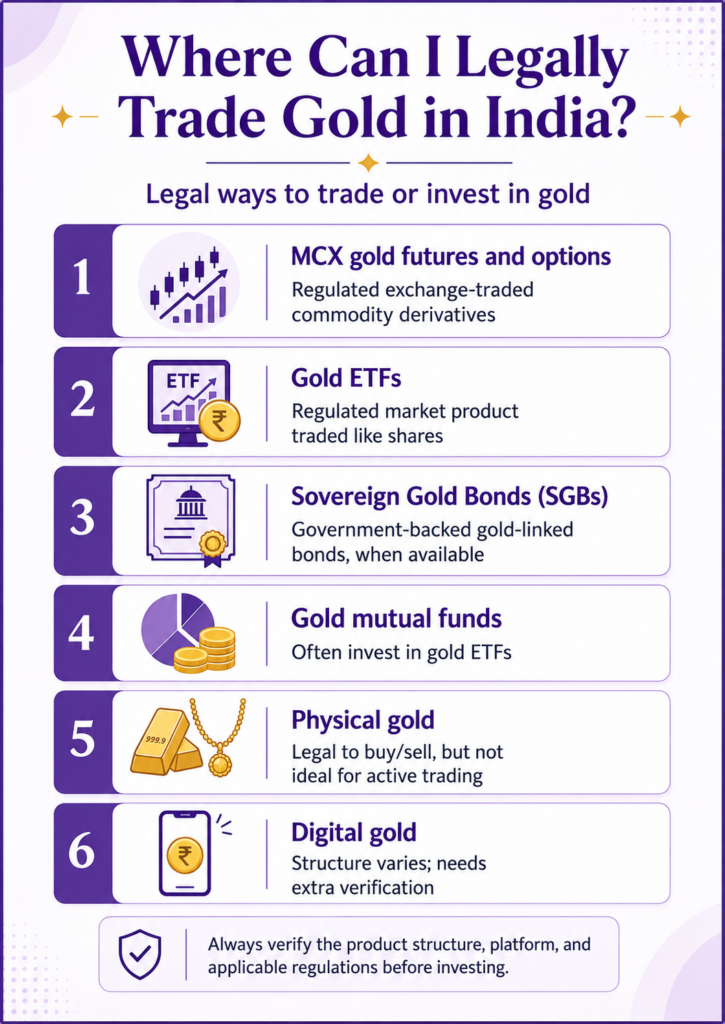
If you want to actively trade the price of gold, the Multi Commodity Exchange of India (MCX) is one of the primary regulated venues for gold derivatives in India.
MCX operates under the securities and commodity-derivatives regulatory framework overseen by SEBI.
Gold futures are exchange-traded contracts linked to the future price of gold.
A futures position can be:
Futures involve margin and are marked to market. Traders therefore need to manage leverage and sufficient margin carefully.
Gold options give the buyer the right, but not the obligation, to buy or sell the underlying contract at a predetermined strike price, subject to the contract terms.
An option buyer pays a premium. The risks and payoff structure differ from futures.
MCX offers gold contracts with different contract sizes, including:
| Contract | Contract size |
|---|---|
| Gold | 1 kg |
| Gold Mini | 100 g |
| Gold Ten | 10 g |
| Gold Guinea | 8 g |
| Gold Petal | 1 g |
The availability and liquidity of individual contracts may vary. Traders should always check the latest MCX contract specifications before placing a trade.
Gold falls under MCX’s internationally referenceable non-agricultural commodities.
Normal trading generally starts at 9:00 AM, Monday to Friday.
The evening closing time changes with the US daylight-saving schedule:
MCX’s published 2026 market schedule follows this framework.
Gold futures are leveraged. A relatively small movement in the underlying price can produce a larger percentage gain or loss on the margin deployed.
Positions held close to expiry can also have different settlement or delivery obligations depending on the contract.
Always check the specific MCX contract specification and your broker’s expiry policy.
ALSO READ: What Is Commodity Trading?
If you want gold exposure without storing physical gold or taking futures leverage, Gold Exchange-Traded Funds (ETFs) are one of the simplest regulated options.
A Gold ETF is a SEBI-regulated mutual-fund product that seeks to track the price of gold and trades on a stock exchange like a share.
A demat account and a trading account with a broker.
Gold ETFs normally trade during the equity-market session, generally 9:15 AM to 3:30 PM on trading days.
Costs can include:
Electronic Gold Receipts are SEBI-regulated securities representing physical gold held within an exchange-linked vaulting ecosystem.
They combine exchange trading and demat ownership with underlying physical gold.
SEBI identifies EGRs as one of the regulated ways investors can access gold through the securities market.
BSE introduced EGR trading in 2022, while NSE commenced live EGR trading on May 18, 2026.
Physical gold deposited with the designated vault ecosystem can be converted into an Electronic Gold Receipt.
That EGR can then:
NSE currently offers multiple EGR denominations and both 995 and 999 purity product structures.
NSE states that its EGR market operates Monday to Friday from approximately:
Settlement is T+1.
A demat and trading account with a broker offering access to the EGR segment.
Investors or market participants who want:
Sovereign Gold Bonds are government securities issued by the Reserve Bank of India on behalf of the Government of India.
Each unit is denominated in grams of gold. Existing SGB series generally pay 2.5% annual interest on the nominal value, subject to the terms of the relevant issuance.
As of September 2026, RBI’s SGB portal does not show a fresh subscription tranche after Sovereign Gold Bond Scheme 2023-24 Series IV, for which the issue price was announced in February 2024.
Investors may still find already-issued SGBs trading on stock exchanges, although liquidity and market prices can vary by series.
Under the 2026 tax change, the capital-gains exemption on redemption is restricted to an individual who has held the Sovereign Gold Bond continuously from the date of original issue until maturity.
This means a secondary-market buyer should not assume the same maturity-redemption exemption available to an original subscriber who satisfies the holding condition.
Gold mutual funds usually invest in Gold ETFs, offering gold exposure in a familiar mutual-fund format.
Pros: lump-sum or SIP investing, no demat account needed, and easy access through common investment platforms.
Cons: fund expenses, sometimes in addition to the underlying ETF’s costs, and they aren’t suited to intraday-style activity.
Buying physical gold in the form of jewellery, coins or bars is legal in India, but it is generally less suitable for active trading.
Costs and risks may include:
For gold jewellery and artefacts, check the BIS hallmark and verify the Hallmark Unique Identification or HUID through the BIS Care app.
Mandatory hallmarking rules for jewellery and artefacts should not be confused with bullion and coins. BIS states that the mandatory hallmarking order applies to gold jewellery and artefacts; bullion and coins have a separate framework, with 995/999 bullion and coins permitted to be hallmarked by BIS-approved refineries or mints.
Always retain a proper invoice.
Many people searching for the “best gold trading app in India” encounter products called digital gold, tokenised gold, gold-backed crypto or gold futures.
These products are not interchangeable.
Digital-gold platforms typically allow users to purchase small quantities of gold while a service provider or partner claims to store corresponding physical gold on the user’s behalf.
However, SEBI issued a specific caution on November 8, 2025.
SEBI stated that online digital-gold or e-gold products:
Therefore, do not assume that a digital-gold product is SEBI-regulated simply because it can be purchased through a well-known app.
Evaluate the provider, custody structure, ownership terms, redemption rules and counterparty risk before buying.
Tokenised gold refers to crypto assets designed to represent exposure to physical gold or its price.
Examples include Tether Gold (XAUT) and PAX Gold (PAXG).
These products should not be confused with SEBI-regulated Gold ETFs or EGRs.
On Mudrex, users can access:
Gold futures on Mudrex offer a more flexible way to trade gold price movements than traditional options such as physical gold, Gold ETFs, EGRs or SGBs. Traders can access the market 24/7, use INR as margin, start with as little as ₹100 and take leveraged positions of up to 50x. Unlike physical gold, there are no storage, purity or making-charge concerns, while futures are better suited to active trading than ETFs or long-term products such as SGBs. Traders can also take positions based on both rising and falling gold prices. However, leverage can amplify losses and requires careful risk management.
Virtual Digital Asset Service Providers carrying out specified activities in India fall within the PMLA reporting framework and are required to register with FIU-IND as reporting entities. FIU-IND’s guidance focuses on AML/CFT obligations such as KYC, transaction monitoring and reporting.
Important: FIU-IND registration should not be interpreted as SEBI or RBI approval of an individual crypto asset or investment product.
Check:
ALSO READ: XAUT vs PAXG: Tether Gold or PAX Gold? — [NEW INTERNAL LINK]
Before choosing a platform, understand what you are actually trading.
| Feature | MCX Gold | Gold ETF | EGR | XAUT / PAXG | Offshore XAUUSD / CFD |
|---|---|---|---|---|---|
| Product type | Futures/options | Exchange-traded fund | Security representing vaulted gold | Crypto/tokenised gold | Leveraged forex/CFD-style gold product |
| Where it trades | MCX | NSE/BSE | EGR exchange segment | Crypto platforms | Offshore trading platforms |
| Indian regulatory position | SEBI-regulated commodity derivative | SEBI-regulated | SEBI-regulated security | Not a SEBI-regulated gold product | Not equivalent to a regulated Indian gold exchange product |
| Trading currency | INR | INR | INR | Crypto/fiat depending on venue | Usually USD-based quote |
| Leverage | Yes, through exchange margin | No conventional trading leverage in the ETF itself | No conventional futures leverage | Depends on platform/product | Commonly high |
| Expiry | Futures have expiry | No | No conventional futures expiry | Token does not normally expire | Depends on broker/product |
| Physical gold relationship | Derivative contract | Fund assets linked to gold | Represents vaulted physical gold | Issuer claims token backing | Usually no ownership of physical gold |
| Typical use | Active trading/hedging | Investment | Exchange-traded gold ownership | Crypto-native gold exposure | Offshore leveraged trading |
MCX Gold and XAUUSD often react to the same global gold-price drivers, but they are not the same instrument.
MCX Gold is an exchange-traded commodity derivative in India. It is denominated in INR, has defined contract specifications and expiries, and operates through India’s regulated commodity-market infrastructure.
XAUUSD is an international gold-versus-US-dollar quote. Retail platforms outside India commonly provide access through leveraged CFD or forex-style products.
Their prices are connected because both ultimately respond to global gold prices, but they can differ because of:
Therefore, an Indian trader should not treat MCX Gold and an offshore XAUUSD CFD as legally or structurally interchangeable.
Before depositing money into any platform, first identify what product the platform is actually offering.
Verify:
Check:
Remember: absence from RBI’s Alert List does not mean the platform is authorised.
Where applicable, verify whether the Virtual Digital Asset Service Provider is registered with FIU-IND as a reporting entity.
But remember:
FIU-IND registration relates to PMLA/AML compliance. It is not the same as SEBI regulation of an investment product.
Review:
Be cautious if a platform:
If something sounds too good to be true, verify it independently before transferring money.
There is no single gold product that suits every investor or trader.
| Your objective | Product commonly used |
|---|---|
| Active, regulated gold trading | MCX Gold Futures/Options |
| Simple exchange-traded gold exposure | Gold ETF |
| Demat ownership linked to vaulted physical gold | EGR |
| Long-term holding through existing government-issued securities | Existing SGBs |
| SIP-style indirect gold exposure | Gold Mutual Fund |
| Physical ownership | Jewellery, coins or bullion |
| Crypto-native gold exposure | Gold-backed tokens such as XAUT/PAXG |
The choice should depend on your risk tolerance, investment horizon, need for liquidity and whether you understand leverage.
Gold trading is legal in India, but the product and platform matter.
For regulated Indian-market access:
XAUUSD offered by offshore forex or CFD platforms should not be treated as equivalent to MCX Gold or another regulated Indian-market gold product. Indian residents undertaking forex transactions must follow RBI and FEMA requirements, and RBI specifically prohibits LRS remittances for overseas margin or margin calls.
Digital gold and tokenised gold also require a separate assessment. SEBI-regulated Gold ETFs, EGRs and exchange-traded commodity derivatives come within its investor-protection framework, while digital gold does not.
Whichever route you choose, understand the product before putting money into it. Regulation can provide a framework and investor protections, but it does not eliminate gold-price risk, leverage risk or the possibility of losses.
To make better crypto and commodity decisions, focus on learning the fundamentals, managing risk and staying informed.
Start with Mudrex Learn or the Mudrex YouTube channel.
Yes. Gold trading is legal in India through regulated products such as MCX gold futures and options, Gold ETFs and Electronic Gold Receipts. Gold mutual funds, physical gold and already-issued Sovereign Gold Bonds are other ways to gain gold exposure. However, the regulatory status differs across products, so you should check the product and platform before investing or trading.
Indian residents should not assume that XAUUSD offered through an offshore forex or CFD broker is a permitted Indian trading route. RBI says resident persons may undertake forex transactions only with authorised persons and for permitted purposes, and electronic forex transactions must use RBI-authorised ETPs or recognised Indian exchanges. XAUUSD is not among the exchange-traded currency pairs available on recognised Indian exchanges.
Depending on your objective, you can access gold online through MCX gold futures and options, Gold ETFs, EGRs, gold mutual funds and already-issued SGBs. The first step is to identify the product you want and then use the appropriate registered intermediary or exchange-linked platform.
For MCX Gold, use a SEBI-registered intermediary offering access to the commodity segment. Gold ETFs and EGRs can be accessed through eligible brokers offering the relevant exchange segment. For forex-related products, verify the entity and platform against RBI’s authorised-person and authorised-ETP lists rather than relying on the platform’s own advertising.
You can gain exposure to gold prices in India through regulated products such as MCX Gold Futures and Options, Gold ETFs and EGRs. Using an unauthorised offshore ETP to trade leveraged XAUUSD is different. RBI states that residents are not permitted to undertake forex transactions on unauthorised ETPs, and LRS cannot be used for margin payments to overseas exchanges or counterparties.
Not through India’s traditional regulated exchanges. MCX bullion products generally trade from 9:00 AM until 11:30 PM or 11:55 PM depending on the US daylight-saving schedule. NSE EGRs have similar extended timings, while Gold ETFs trade during regular equity-market hours. Some crypto-based gold products trade around the clock, but they are not SEBI-regulated gold securities.
Yes. Gold ETFs are SEBI-regulated mutual-fund products traded on recognised stock exchanges. They provide exposure to gold prices without requiring investors to store physical gold.
No, not by SEBI. In November 2025, SEBI clarified that online digital gold or e-gold products are neither notified securities nor regulated commodity derivatives and therefore operate outside SEBI’s regulatory framework. Securities-market investor-protection mechanisms do not apply to these products.
No. The term “gold trading app” can refer to very different products. One app may provide access to SEBI-regulated Gold ETFs or MCX derivatives, another may sell digital gold outside SEBI’s framework, while another may offer offshore forex or CFD products. Always identify the exact product and independently verify the platform’s regulatory status.
RBI states that remittances under the Liberalised Remittance Scheme cannot be made for margins or margin calls to overseas exchanges or overseas counterparties. Therefore, LRS should not be treated as a way to fund an offshore leveraged XAUUSD margin account.
There is no risk-free way to trade gold. If regulatory oversight is the priority, SEBI-regulated routes include MCX commodity derivatives, Gold ETFs and Electronic Gold Receipts. The appropriate option depends on whether you want active trading, leverage, longer-term investment or ownership linked to physical gold.
Gold-backed crypto tokens such as XAUT or PAXG should not be treated as SEBI-regulated Gold ETFs or EGRs. If a platform providing VDA services is registered with FIU-IND, that registration relates to its obligations as a reporting entity under India’s AML/PMLA framework; it does not mean SEBI or RBI has approved the underlying crypto token.
Electronic Gold Receipts are SEBI-regulated securities representing physical gold held within an approved vaulting ecosystem. They can be held in a demat account and traded on an exchange. NSE commenced live EGR trading in May 2026 and currently follows a T+1 settlement cycle.
No. MCX Gold is an INR-denominated exchange-traded commodity derivative regulated within India’s securities and commodity-market framework. XAUUSD is the international price of gold quoted in US dollars and is commonly offered by global brokers through leveraged forex or CFD-style products. Although their prices are influenced by global gold movements, the instruments, currency, contract structure and regulatory framework are different.