As of Jan 29, 2026, XRP is priced at $1.8864, approximately ₹176.91 in INR. Backed by strong fundamentals and an expanding global user base, XRP remains one of the most recognized cryptocurrencies in the payments sector.

XRP is the native digital asset of the XRP Ledger (XRPL), an open-source, decentralized, and permissionless blockchain launched in 2012. XRPL was purpose-built for fast, low-cost, and energy-efficient cross-border payments, enabling settlement in 3–5 seconds with transaction fees typically around $0.0002 and minimal energy consumption compared to traditional blockchains.
Based on the current market price of XRP, the price is expected to remain range-bound over the next week with limited movement. However, over the next 30 days, a gradual upside is possible if market sentiment improves.
| Date | Forecasted Price |
| Jan 29, 2026 | $1.87 |
| Jan 30, 2026 | $1.88 |
| Feb 05, 2026 | $1.88–$1.90 |
| Feb 28, 2026 | Around $2.00 |
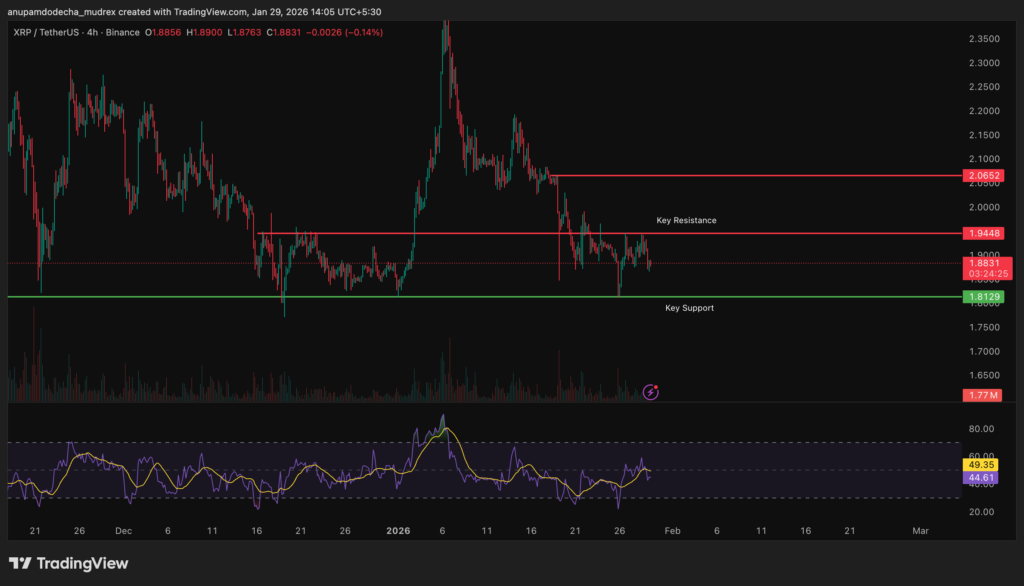
XRP is holding above major support at $1.8129, while facing key resistance near $1.9448. Price action suggests consolidation within this range.
Momentum indicators, including RSI and other oscillators, remain neutral, indicating no strong bullish or bearish bias at the moment.
Overall, the chart below points to range-bound movement until a clear breakout or breakdown occurs.
| Year | Low Estimate (USD) | High Estimate (USD) | Low Estimate (INR) | High Estimate (INR) |
| 2026 | $3.0 | $3.5 | ₹276 | ₹322 |
| 2027 | $2.4 | $3.0 | ₹221 | ₹276 |
| 2028 | $3.2 | $4.5 | ₹294 | ₹414 |
| 2029 | $4.8 | $6.5 | ₹442 | ₹598 |
| 2030 | $6.0 | $8.0 | ₹552 | ₹736 |
2026
XRP could reach $3–$3.5 by year end as markets stabilize and sentiment improves.
2027
A broader market slowdown may push XRP into a $2.4–$3 range, with limited upside.
2028
Recovery and improving liquidity could lift XRP back toward $3.2–$4.5.
2029
Continued expansion may support a move into the $4.8–$6.5 zone.
2030
In a realistic best-case scenario, XRP could reach up to $8, reflecting long-term utility growth rather than hype.
XRP’s long-term price will depend on actual payment flows on XRPL rather than speculation. Growth in cross-border payments, tokenized assets, and stablecoins issued on XRPL will be key. Recent WEF 2026 remarks highlighted stablecoins and institutional blockchains as critical payment infrastructure, reinforcing the relevance of efficient settlement networks like XRPL.
XRP’s large circulating supply and scheduled escrow releases act as a natural cap on aggressive price expansion. Sustained price growth requires demand to consistently absorb new supply, making adoption more important than scarcity narratives.
Deep liquidity and broad exchange access remain essential for XRP’s price stability and growth. Expanding institutional corridors, improved global access, and continued interest from regions such as India, where cross-border payments are a practical use case, could support steady demand.
XRP operates in an increasingly competitive environment that includes regulated stablecoins and traditional payment networks. As emphasized at WEF 2026, institutions are prioritizing compliant and efficient settlement options. XRP’s success depends on maintaining its role as a cost-effective bridge asset alongside these alternatives.
This framing keeps expectations grounded and tied to real market structure rather than hype-driven assumptions.
Unfavorable regulatory outcomes or changing crypto policies in major jurisdictions could limit XRP adoption, exchange listings, or institutional usage.
Ongoing concerns around token supply concentration and Ripple’s influence over the ecosystem may continue to weigh on investor perception, even if network operations remain decentralized.
XRP remains exposed to broader crypto market cycles, meaning prolonged bear markets or risk-off sentiment can suppress price and activity regardless of network fundamentals.
Tight global liquidity, higher interest rates, or reduced capital flows into risk assets could limit speculative and institutional demand for XRP.
No, $100, $200, $500, or $1000 for XRP is not realistic.
At $100, XRP’s market cap would already be multiple trillions, larger than most global payment networks.
Prices like $200, $500, or $1000 would require absurd levels of capital and adoption that are not achievable.
A more realistic outcome over the next 5–10 years would be XRP trading in the $5–$15 range under strong adoption and favorable market conditions.
Disclaimer: Crypto products and NFTs are unregulated and can be highly risky. There may be no regulatory recourse from any loss from such transactions.
It is possible over the long term, but only with sustained adoption, supportive market cycles, and sufficient liquidity. It is not guaranteed.
If adoption continues steadily and market conditions are favorable, XRP could trade in the $8–$10 range, driven by utility rather than speculation.
They serve different purposes. Bitcoin acts as a store of value, while XRP is built for fast, low-cost payments. “Better” depends on the use case, not price alone.
That depends on your capital, entry price, time horizon, and overall market conditions. For most investors, it would require either very large holdings or exceptional price appreciation.