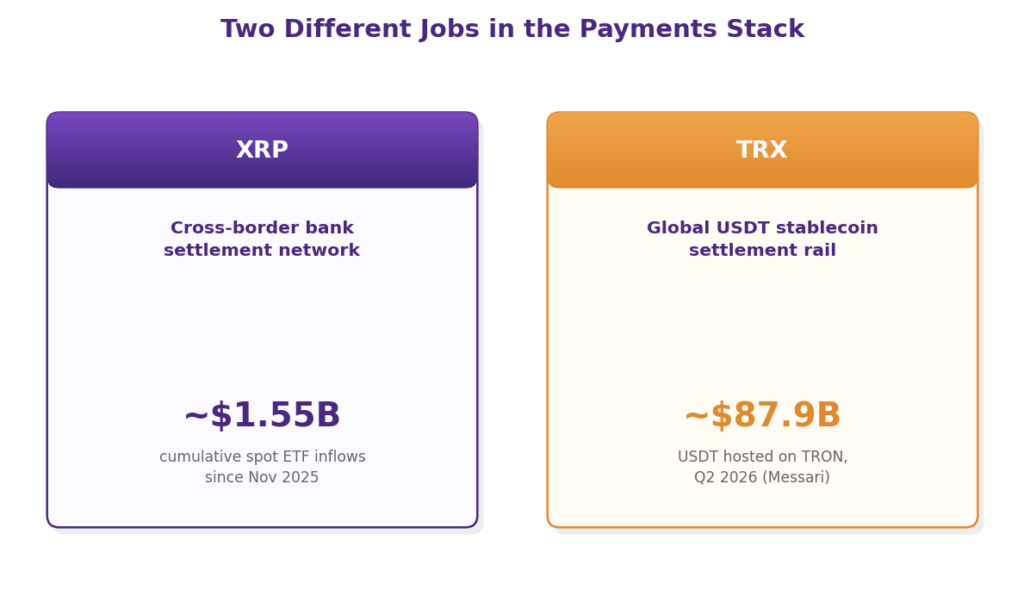
XRP vs TRX is a comparison that TRON’s own founder helped put on the map: Justin Sun has publicly called TRX “the next XRP,” pointing to both tokens’ shared focus on fast, low-cost payments. But XRP and TRON solve genuinely different problems in practice. XRP is built around cross-border bank settlement and now carries $1.55 billion in cumulative spot ETF inflows. TRX has quietly become the backbone of global USDT movement, hosting nearly $88 billion in stablecoin value and processing $2.1 trillion in USDT transfers last quarter alone.
This XRP vs TRX guide walks through exactly how the two actually compare on price, fees, speed, security, and where each one fits in a portfolio.
Key Takeaways
Before diving into the full XRP vs TRX breakdown, here’s the comparison at a glance:
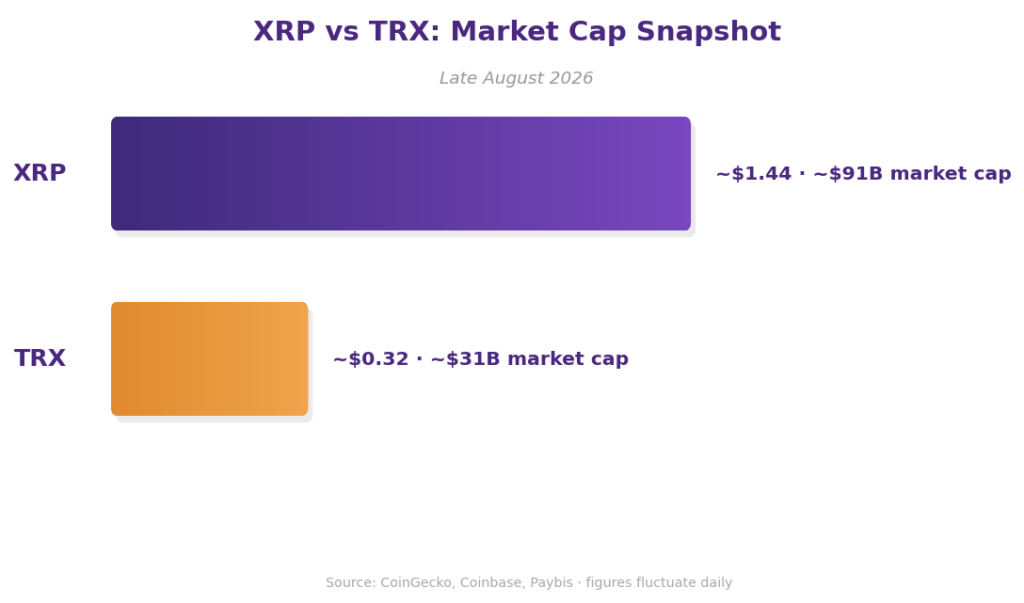
XRP trades around $1.44 with a market cap near $91 billion, while TRX trades around $0.32 with a market cap near $31 billion, making XRP roughly three times larger by market cap.
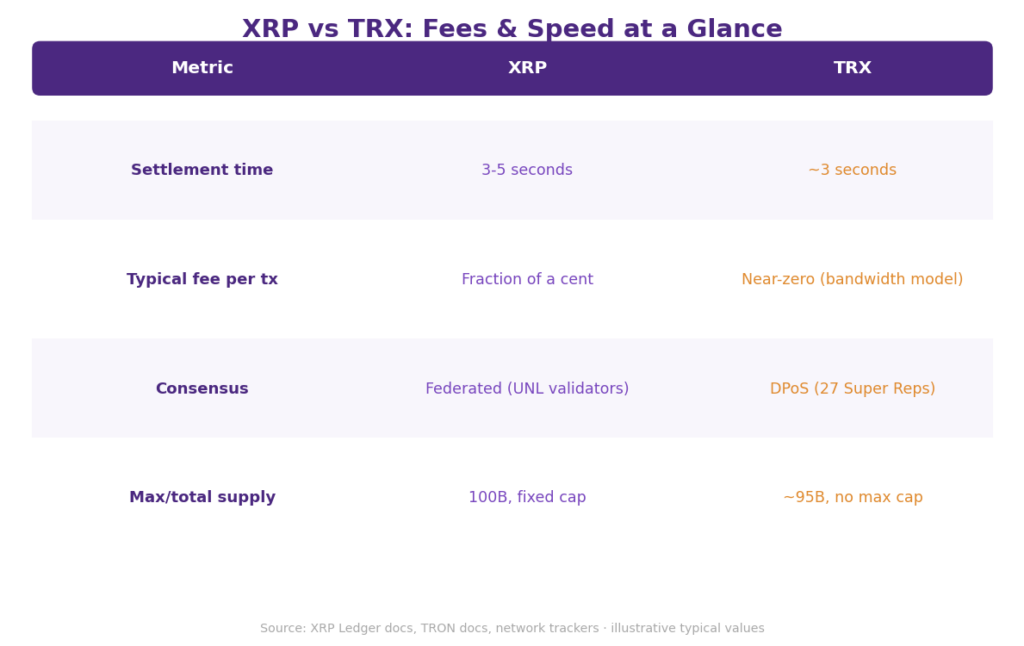
XRP has a fixed maximum supply of 100 billion tokens, while TRX has no maximum supply, currently sitting at roughly 95 billion in circulation.
XRP’s core use case is cross-border bank settlement, backed by $1.55 billion in cumulative spot ETF inflows since November 2025.
TRX’s core use case is stablecoin settlement, hosting roughly $87.9 billion in USDT, more than any other blockchain, including Ethereum.
Both networks settle transactions in roughly 3-5 seconds for a fraction of a cent, making fees and speed a near-tie between XRP and TRX.
What Is XRP?
XRP is the native digital asset of the XRP Ledger, a blockchain designed specifically for fast, low-cost cross-border payments and originally associated with the fintech company Ripple.
XRP has a fixed maximum supply of 100 billion tokens, with the remainder held in escrow and released on a schedule. Its investment case has strengthened through 2025-2026 via spot ETF approval, a 2026 classification as a digital commodity by US regulators, and a growing base of institutional partners using RippleNet for settlement. Keep this fixed-supply, institution-first model in mind as the XRP vs TRX comparison unfolds, since it shapes nearly every other difference between the two. Our deeper analysis of whether XRP will bounce back in 2026 covers XRP’s recent price history and ETF flow data in more depth.
What Is TRON (TRX)?
TRON is a blockchain founded by Justin Sun in 2017, and TRX is its native token, now best known as the leading network for hosting and transferring Tether’s USDT stablecoin.
TRON uses a Delegated Proof of Stake (DPoS) consensus mechanism with 27 elected Super Representatives validating transactions. Unlike XRP, TRX has no fixed maximum supply, with roughly 95 billion tokens currently in circulation. TRON’s core strength is stablecoin infrastructure: it hosted $87.9 billion in USDT during the second quarter of 2026, more than any other blockchain, and processed a record $2.1 trillion in USDT transfers during the same period. That volume advantage is the single biggest fact to hold onto anywhere XRP vs TRON comes up.
XRP vs TRX: Quick Comparison
XRP vs TRX comes down to two different specializations: XRP focuses on cross-border bank payments with institutional and regulatory backing, while TRX focuses on being the world’s dominant settlement rail for USDT stablecoin transfers.
Metric
XRP
TRX
Price (late Aug 2026)
~$1.44
~$0.32
Market cap
~$91B
~$31B
Max supply
100B (fixed)
No maximum
All-time high
$3.84 (Jan 2018)
$0.4313 (Dec 2024)
Core use case
Cross-border payments
USDT stablecoin settlement
Consensus
Federated (UNL validators)
DPoS (27 Super Representatives)
Definition: Market Capitalization The total value of a cryptocurrency’s circulating supply, calculated by multiplying current price by the number of coins in circulation, used to compare the relative size of XRP against TRX and other crypto assets.
XRP vs TRON: Key Differences
The core difference between XRP and TRON is what each network was actually built to do: XRP targets bank-grade cross-border settlement with a fixed token supply, while TRON targets high-volume, low-cost stablecoin transfers with an uncapped, continuously issued token.
This distinction matters more than it might first appear. XRP’s value proposition depends heavily on financial institutions and regulators formally adopting it for settlement, a slower but potentially more durable path. TRX’s value proposition depends on continued dominance of stablecoin transfer volume, a faster-growing but more competitive space, since other blockchains actively court the same USDT and USDC transfer volume TRON currently leads.
XRP vs TRX: Fees, Speed, and Security Compared
XRP and TRX are remarkably close on raw fees and speed, both settling transactions in roughly 3-5 seconds for a fraction of a cent, with the more meaningful difference showing up in how each network is secured and governed.
Definition: Delegated Proof of Stake (DPoS) A consensus mechanism where token holders vote to elect a limited number of validators (called Super Representatives on TRON) who are responsible for confirming transactions and securing the network.
XRP’s federated consensus relies on a Unique Node List (UNL) of validators, a list historically influenced by Ripple itself, though increasingly diversified over time. TRON’s DPoS model concentrates validation among just 27 Super Representatives, a smaller validator set that critics point to as a decentralization tradeoff in exchange for TRON’s high throughput. Neither model is inherently more secure than the other, but both carry a similar critique: a relatively small number of parties have outsized influence over network operation compared to more broadly distributed consensus models.
XRP vs TRX: Price Performance Compared
XRP has delivered stronger absolute price performance historically, with an all-time high of $3.84 set in January 2018, while TRX’s all-time high of $0.4313 came far more recently, in December 2024.
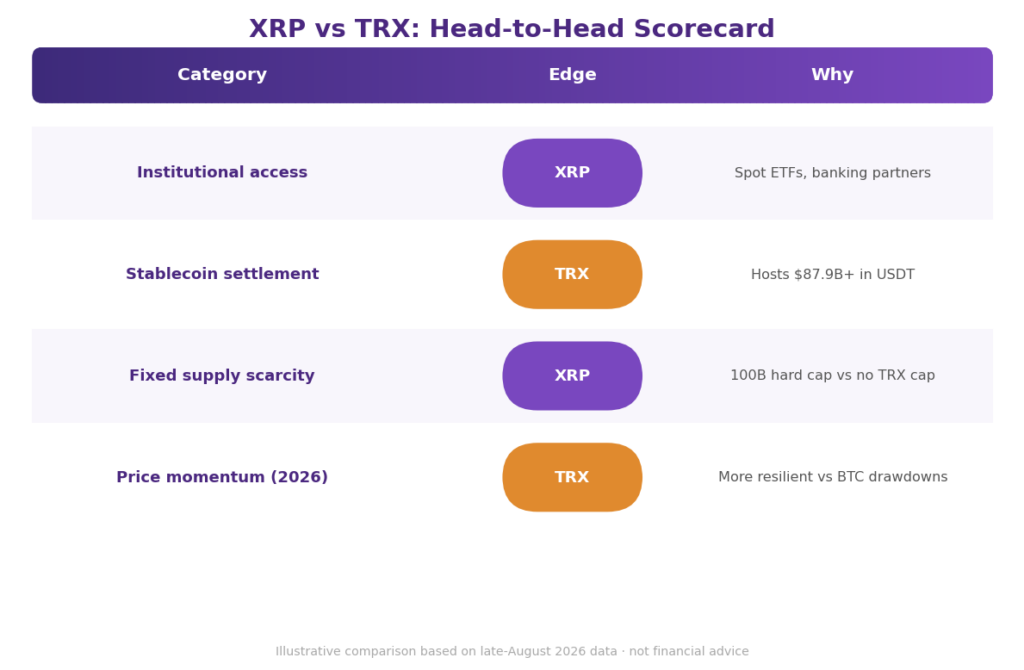
Both tokens sit well below their respective all-time highs: XRP trades roughly 62% below its 2018 peak, while TRX trades roughly 26% below its more recent 2024 high. On pure price performance, XRP vs TRX is a mixed picture rather than a clean win for either side. In relative terms, TRX has shown notable resilience during 2026’s broader market stress, rising even as Bitcoin fell sharply during parts of the year, a divergence tied to TRON’s stablecoin-driven fee revenue holding up better than pure speculative demand.
XRP vs TRX: Use Cases Compared
XRP’s primary use case is enabling banks and payment providers to settle cross-border transactions without pre-funded accounts in destination currencies, while TRX’s primary use case is providing cheap, fast rails for transferring USDT and other stablecoins globally.
XRP use cases center on RippleNet partnerships with financial institutions, on-demand liquidity for remittance corridors, and increasingly, ETF-based institutional exposure. TRX use cases center overwhelmingly on stablecoin transfer, particularly in emerging markets, where TRON captures a majority of global USDT transfers under $1,000, making it a de facto retail payment rail in regions with less developed banking infrastructure. Comparing XRP and TRX use cases side by side, the two barely overlap in practice despite both being labeled “payment coins.”
Which Has Stronger Utility, XRP or TRX?
TRX currently shows stronger measurable network utility, given its dominant, growing share of global USDT transfer volume, while XRP’s utility case rests more on institutional adoption that is real but smaller in daily transaction terms.
That said, “stronger utility” depends on the metric: XRP’s institutional and regulatory positioning, including spot ETFs and bank partnerships, represents a different, arguably higher-value-per-transaction form of utility than TRON’s high-volume, low-value retail stablecoin transfers. Both are legitimate, verifiable forms of network usage rather than purely speculative activity.
Which Is Safer for Investors, XRP or TRX?
Neither XRP nor TRX is free of concentration risk: XRP has historically faced scrutiny over Ripple’s own token holdings and validator influence, while TRX carries well-documented concerns about Justin Sun’s outsized influence and TRON’s small, 27-member validator set.
XRP has gained regulatory clarity through its 2026 digital commodity classification and years of resolved legal uncertainty, which reduces one category of risk. TRX carries less regulatory ambiguity in that specific sense but faces ongoing questions about founder-level control and validator concentration. On balance, XRP vs TRX safety comes down to which category of risk concerns you more: regulatory history for XRP, or founder and validator concentration for TRX. Our guide on utility tokens vs security tokens covers how both XRP and TRX are typically classified and why that classification matters for investors.
XRP vs TRX: Which Has Better Long-Term Potential?
XRP’s long-term case depends on continued institutional and regulatory adoption translating into durable settlement volume, while TRX’s long-term case depends on maintaining its lead in an increasingly competitive stablecoin settlement market. Both are plausible paths, and neither is guaranteed: XRP could see slower institutional adoption than hoped, while TRX faces direct competition from other low-fee chains actively targeting the same stablecoin transfer volume.
Should You Buy XRP or TRX?
Whether to buy XRP or TRX depends on which specific thesis you find more convincing: XRP suits investors betting on institutional cross-border payment adoption, while TRX suits investors betting on continued or growing dominance in stablecoin settlement. Framed as XRP vs TRX for a single portfolio slot, the honest answer is that they hedge different outcomes rather than compete for the exact same one.
Some investors choose to hold both, treating them as complementary rather than competing bets, since XRP and TRX are exposed to meaningfully different adoption drivers despite superficial similarities in speed and fees. As with any crypto allocation, position sizing relative to your own risk tolerance matters more than picking a single “winner” between the two.
Both XRP and TRX are available on regulated Indian crypto exchanges that support INR deposits, including Mudrex, where you can buy TRX or XRP starting from as little as ₹100 via UPI or bank transfer.
Conclusion
XRP vs TRX isn’t really a question of which token is objectively better, it’s a question of which specialization you believe in more. XRP is the more institutionally-backed bet on cross-border bank settlement, carrying a fixed supply and years of regulatory progress behind it. TRX is the more operationally dominant bet on global stablecoin infrastructure, already moving trillions of dollars in USDT every quarter, but with less fixed scarcity and real questions about validator concentration. Both are legitimate, working payment-focused networks rather than purely speculative tokens, which is more than can be said for most of the market.
This article is for informational and educational purposes. It is not financial advice, and you should do your own research and consult a qualified financial advisor before making investment decisions.
In the XRP vs TRX comparison, XRP focuses on cross-border bank settlement with a fixed 100 billion token supply, while TRON focuses on global USDT stablecoin settlement with no maximum token supply.
Which is better, XRP or TRX?
Neither wins the full XRP vs TRX comparison outright; XRP suits investors favoring institutional payment adoption, while TRX suits investors favoring stablecoin infrastructure dominance.
Which has lower fees?
XRP and TRX both charge a fraction of a cent per transaction, making fees roughly comparable between the two networks.
Which is faster?
Both XRP and TRX settle transactions in approximately 3-5 seconds, making speed close to a tie between the two.
Which has stronger utility?
TRX currently shows higher measurable transaction volume through USDT settlement, while XRP’s utility leans toward institutional and regulatory adoption rather than raw transaction count.
Which is safer for investors?
Both carry concentration risk: XRP through Ripple’s historical influence, and TRX through Justin Sun’s influence and TRON’s 27-validator consensus model.
Can I buy XRP and TRX in India?
Yes, both are available on regulated Indian platforms like Mudrex, supporting INR deposits starting from as little as ₹100.
Which has better long-term potential?
XRP’s potential depends on institutional cross-border adoption; TRX’s potential depends on defending its stablecoin settlement lead against growing competition.
Risk Disclaimer
Cryptocurrency investments carry a high risk of loss and are highly volatile. Any use of leverage or futures magnifies both potential gains and potential losses. The figures, comparisons, and scenarios in this article are illustrative and for educational purposes only; they are not financial advice or a guarantee of future performance. Please consult a qualified financial advisor before making any investment decisions.
Siri is a writer venturing into the exciting realms of blockchain technology, cryptocurrency, and decentralized finance (DeFi), eager to explore the transformative potential of these innovations. She brings a unique perspective that bridges traditional industries and cutting-edge technology, often infused with a touch of humor through memes. She has a rich background in real estate and interior design, having previously contributed to NoBroker, where she crafted blogs and assets on these topics.