
XRP vs XLM are both often competing for the best cross-border payment provider position – but who is the clear winner here?
A quick background on both: XRP is the native token of the XRP Ledger, launched in 2012 by Ripple to help banks and payment providers move money across borders faster and cheaper than traditional rails. XLM is the native token of Stellar, launched two years later in 2014 by Jed McCaleb, one of the original XRP Ledger’s creators, this time built as a non-profit network aimed at individuals and financial access rather than enterprise clients.
Both trace back to overlapping founders, yet they have grown into very different networks with different audiences and different regulatory stories. This cryptocurrency comparison matters more now than it did a year ago, since XRP’s legal status has changed dramatically.
XRP leans institutional, with a major 2025 US regulatory resolution behind it, while XLM leans individual, non-profit-run, and focused on financial access. This guide compares their differences, use cases, fees, and long-term potential.
XRP vs XLM starts with their founding teams and mission. XRP is the native token of the XRP Ledger, built by Ripple to move value between banks and financial institutions.
Definition: XRP Ledger An open-source blockchain launched in 2012 that settles transactions in seconds, originally designed to support institutional cross-border payments.
Stellar, and its native token XLM, was co-founded in 2014 by Jed McCaleb, who also helped build the original XRP Ledger. Stellar and Ripple share technical roots but diverged in focus: Ripple stayed centralized and enterprise-facing, while the non-profit Stellar Development Foundation steered Stellar toward individuals, remittances, and financial access for the underbanked. This is the core of the XRP vs Stellar differences that shape everything else in this comparison, from tokenomics to target users.
XRP vs XLM for fees and speed is close to a tie on paper. Both settle transactions in three to five seconds at a cost of a fraction of a cent, far cheaper than most traditional cross-border transfers. Transaction fees and settlement speed rarely decide this comparison on their own, since both networks were built from the ground up to solve the same slow, costly problem.
| Factor | XRP | XLM |
| Consensus mechanism | Ripple Protocol Consensus Algorithm (RPCA) | Stellar Consensus Protocol (SCP) |
| Validator model | Ripple-influenced trusted validator list | Federated, more open validator model |
| Typical settlement time | 3-5 seconds | 3-5 seconds |
| Typical transaction fee | Fraction of a cent | Fraction of a cent |
Security-wise, both networks rely on validator consensus rather than energy-intensive mining, and neither has suffered a major protocol-level security breach. Decentralization differs though: XRP’s validator list has historically leaned more toward Ripple’s influence, while Stellar’s federated model is generally considered more open. The bigger security-adjacent difference is regulatory: XRP now operates under a settled US legal framework, while Stellar has largely avoided the same regulatory scrutiny by design.
XRP wins clearly on market liquidity. Its market capitalization sits in the tens of billions of dollars, several times larger than XLM’s, with correspondingly deeper order books and daily volume.
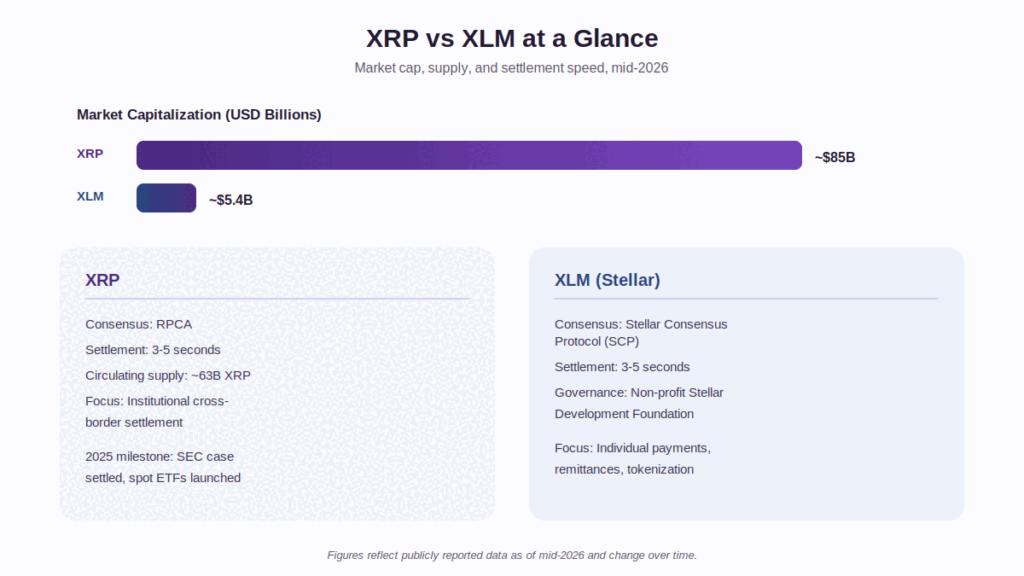
XRP and Stellar use cases diverge sharply despite similar underlying technology, which is exactly why XRP compared with XLM often confuses newcomers who assume near-identical coins serve the same purpose. XRP is primarily a bridge asset for institutional cross-border settlement, used by banks and payment providers through Ripple’s network, showing strong network adoption among financial institutions specifically.
XLM focuses on individual and small-business payments, remittances, and tokenizing real-world assets on an open network anyone can build on. Developers and fintechs building consumer-facing payment tools tend to gravitate toward Stellar’s more permissionless design and broader coin utility for retail use, while large financial institutions gravitate toward Ripple’s enterprise relationships.
Neither coin is a guaranteed long-term winner, and XRP vs XLM investment decisions should weigh very different catalysts for each. Which is better XRP or XLM often depends less on technology and more on your own risk-return profile and time horizon. XRP’s five-year SEC lawsuit ended in August 2025, and spot XRP ETFs launched in the US later that year, both genuine regulatory tailwinds.
This is a genuine fundamental analysis tradeoff, not a case where one coin is objectively the safer long-term hold. Holding both is a common way to add portfolio diversification within the payments-coin category itself, rather than betting everything on a single XRP and Stellar comparison outcome. Price correlation between the two tends to rise during broad market moves and diverge during coin-specific news, like the SEC settlement or Stellar’s own product launches.
You can buy XRP in India or buy XLM in India on Mudrex in a few steps.
If you want exposure to both, you can also trade XRP and XLM directly against each other on Mudrex’s spot market. Comparing XRP vs XLM side by side before buying, rather than picking on hype alone, is the more disciplined approach.
XRP vs XLM ultimately comes down to what each network is built for. XRP offers deeper liquidity, a settled US regulatory status, and institutional momentum, while XLM offers a more open, non-profit-run network focused on individual financial access. Many investors hold both for different reasons rather than treating this as a strict either-or choice.
Ready to compare live prices yourself? Download the Mudrex app, or visit the Mudrex YouTube channel for more coin comparisons.
XRP targets banks and institutional cross-border payments, while Stellar targets individuals, remittances, and financial access for the underbanked.
Neither is universally better. XRP suits investors wanting institutional exposure and regulatory clarity, while XLM suits those interested in a more open, non-profit-governed network.
Both charge a fraction of a cent per transaction, so fees are effectively comparable between the two.
Both settle transactions in roughly three to five seconds, making speed a near-tie between XRP and Stellar.
XRP has stronger utility as an institutional bridge asset, while XLM has stronger utility for individual payments and asset tokenization.
Both carry typical crypto volatility and market risk. XRP now has a settled US regulatory status, which reduces one specific type of risk that XLM hasn’t faced in the same way.
Yes, both are available on Mudrex, starting from ₹100 with UPI or bank transfer.
XRP has more institutional momentum and regulatory clarity right now, while XLM’s potential depends more on niche remittance and tokenization adoption growing over time.
Cryptocurrency investments, including XRP and XLM, are subject to high market volatility and risk of loss. Regulatory outcomes, including the resolved Ripple-SEC case, do not guarantee future price performance for either coin. This article is for educational purposes only and is not financial advice. Please consult a qualified financial advisor before making investment decisions.