Trend Following Strategy Crypto: How to Ride Trends in Futures Trading
Vikram spent a year trying to call tops and bottoms. He shorted every rally and bought every dip, certain he knew where price would turn. He was wrong more often than not. Then he tried the opposite: instead of predicting, he simply followed. When Bitcoin trended up, he stayed long. When it turned down, he flipped. His account stopped bleeding almost overnight.
That switch is the essence of a trend following strategy crypto traders rely on. A trend following strategy crypto approach means trading in the direction the market is already moving, riding the trend until it clearly ends, rather than guessing reversals. Stop fighting the market and start flowing with it, and trading gets a lot simpler.
Here is how to do it properly. You get the strategies, the indicators that confirm a trend, and the risk rules that let your winners run.
What Trend Following in Crypto Trading Means
Imagine paddling a canoe. Fighting upstream is exhausting and slow. Turn around and paddle with the current, and suddenly you fly. Trend following is paddling with the current.
Trend following in crypto trading is a method where you identify the market’s dominant direction and trade with it, buying in uptrends and shorting in downtrends. You do not try to catch the exact turn. You wait for a trend to establish, join it, and hold until the trend shows real signs of ending. In crypto futures, this works in both directions, so a good trend following strategy crypto plan profits whether the market is rising or falling.
The core belief is simple: trends tend to persist longer than people expect. Your job is to capture the middle of the move, not the very top or bottom.
Why Trend Following Beats Predicting
You’re here because calling reversals is exhausting and, for most people, a losing game. Trend following flips the burden. You react to what the market is doing instead of betting on what it might do.
The math is friendly too. A trend follower can be wrong often, taking many small losses in choppy patches, yet still come out ahead because a few big trends more than pay for them. One strong move can cover a dozen small stop-outs. That asymmetry is the entire edge of a trend following strategy crypto traders use.
The trade-off is patience. Trends do not appear on demand, and sideways markets will chop you up. Knowing when not to trade is part of the skill.
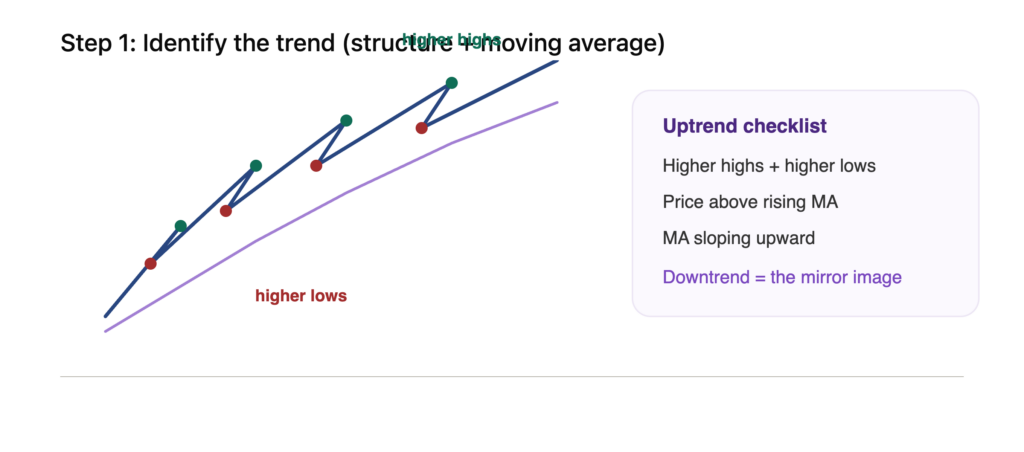
Before any entry, you need to confirm a trend actually exists. The diagram above shows the structure to look for.
An uptrend makes higher highs and higher lows, with price riding above a rising moving average. A downtrend makes lower highs and lower lows, with price below a falling moving average. If highs and lows are flat and overlapping, there is no trend, and a trend following strategy crypto setup simply does not apply there.
Trend Following Strategy Crypto: Ride Futures Trends
A fast visual check: is your moving average clearly sloping, and is price respecting it? A rising 50 EMA with price above it is one of the cleanest trend signals a beginner can use.
The Core Trend Following Strategies
Each method below is a different way to join and ride a trend. Learn the first one properly before layering on the rest.
Strategy 1: Moving Average Trend Following
This is the backbone of nearly every trend following strategy crypto traders deploy. You add a moving average, often the 50 EMA or 200 EMA, to your chart. When price is above a rising EMA, you only look for longs. When price is below a falling EMA, you only look for shorts.
Some traders use two moving averages and trade the cross: when a faster EMA crosses above a slower one, the trend is turning up. The moving average keeps you on the right side of the market and filters out counter-trend temptation.
Trend Following Strategy Crypto: Ride Futures Trends
Strategy 2: Buy the Pullback
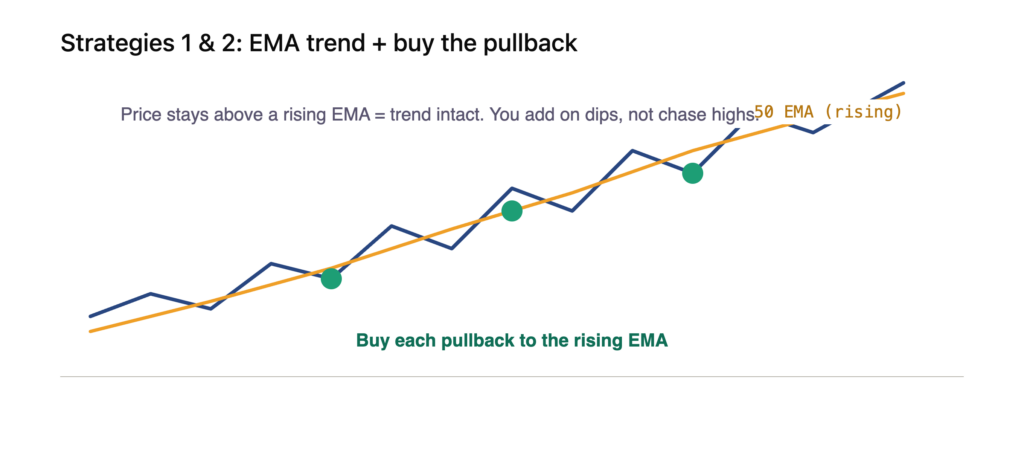
Chasing a candle that has already run is how beginners get poor entries. The fix is to buy pullbacks. In an uptrend, price does not go straight up; it climbs, dips, and climbs again.
You wait for one of those dips back toward the rising moving average or a prior support level, then enter in the trend’s direction. The diagram above shows repeated pullback buys into a rising EMA. Your risk is small because your stop sits just below the pullback low, while your target rides the larger trend.
Trend Following Strategy Crypto: Ride Futures Trends
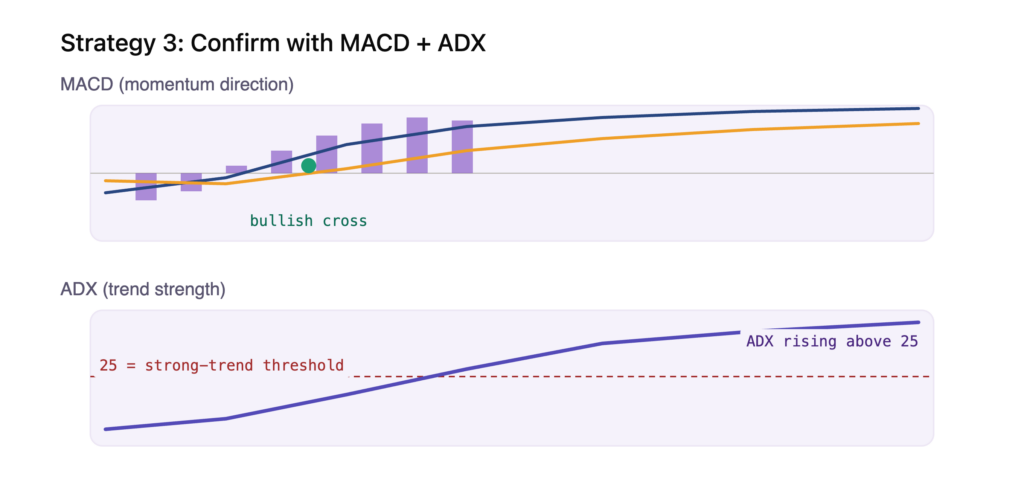
Direction is not enough; you also want strength. Two indicators help. MACD shows momentum: a bullish MACD cross with a rising histogram supports an uptrend. ADX (Average Directional Index) measures trend strength, and a reading rising above 25 suggests a trend worth following, while a low ADX warns of a range.
The two-panel diagram above shows MACD crossing up and ADX pushing above 25 together. Pairing them filters out weak, choppy moves and keeps you in the strong, tradeable trends.
Strategy 4: Ride It with a Trailing Stop
Trend Following Strategy Crypto: Ride Futures Trends
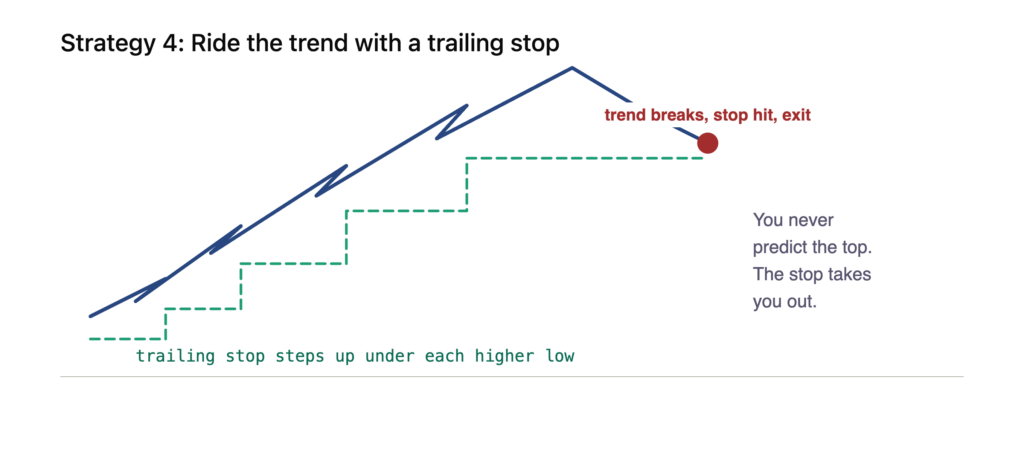
The hardest part of trend following is not entering; it is holding. A trailing stop solves this. Instead of a fixed exit, your stop follows price higher, stepping up beneath each new higher low in an uptrend.
This lets profits run while protecting them. You never try to guess the exact top. When the trend finally breaks and price takes out your trailing stop, you are out with most of the move banked. The diagram above shows the stop laddering up until the trend ends.
Comparing the Trend Following Strategies
Strategy
What it does
Role in the plan
Moving average
Defines trend direction
Filter: trade one way only
Buy the pullback
Times the entry
Entry: better price, tighter stop
MACD + ADX
Confirms momentum and strength
Filter: avoid weak, choppy moves
Trailing stop
Manages the exit
Exit: lets winners run
Strategies Comparison
Notice they work together, not in competition. Moving averages define direction, pullbacks give entries, MACD and ADX confirm strength, and the trailing stop manages the exit. A complete trend following strategy crypto plan usually blends all four.
The Risk Rules That Protect Trend Traders
Trends are generous until they reverse. These rules keep a reversal from wrecking you:
Trade with the trend, never against it. Counter-trend trades are a different, harder game.
Always use a stop loss. Even a strong trend has sharp pullbacks that can hit an oversized position.
Let winners run, cut losers fast. This asymmetry is the whole point; do not cap a big trend early.
Keep leverage modest. Trends have violent shakeouts; heavy leverage gets flushed on the noise.
Avoid choppy markets. If ADX is low and the moving average is flat, stand aside. A trend following strategy crypto approach needs an actual trend.
The biggest mistake trend traders make is exiting winners too early out of fear. Trust the trailing stop.
How a Beginner Should Start
Keep it boring. Add a 50 EMA to the 4-hour chart. Trade only in the EMA’s direction, enter on pullbacks to it, and manage the trade with a trailing stop. Take one position at a time and log every result. After thirty trades, review whether your winners were bigger than your losers. That single ratio tells you if your trend following strategy crypto process is working.
Direction first, patience always. The trend is your partner, not your enemy.
Conclusion: Follow, Don’t Forecast
A trend following strategy crypto traders can rely on comes down to four moves: identify the trend with a moving average, enter on pullbacks, confirm strength with MACD and ADX, and ride it with a trailing stop. Stop trying to predict tops and bottoms. Follow the direction the market gives you, protect every trade with a stop, and let the occasional big trend do the heavy lifting.
Vikram still trades this way. He stopped forecasting and started following. Fewer opinions, better results.
Ready to trade with the trend instead of against it? Pick one moving average, wait for a clean pullback, and place your next trade with a trailing stop in place.
Disclaimer: This content is for educational purposes only and is not financial advice. Crypto futures trading involves significant risk, and leverage can amplify losses beyond your initial capital. Do your own research and never trade more than you can afford to lose.
FAQs
What is trend following in crypto trading?
Trend following in crypto trading is a strategy where you trade in the direction the market is already moving, buying in uptrends and shorting in downtrends. Instead of predicting reversals, you join an established trend and hold until it shows clear signs of ending.
What is the best trend following strategy?
The most reliable approach combines a moving average to define direction, pullback entries for better prices, MACD and ADX to confirm momentum and strength, and a trailing stop to ride winners. No single tool is best; they work together as a complete system.
Which indicators are best for trend trading?
The most useful are moving averages (EMA or SMA) for direction, MACD for momentum, and ADX (Average Directional Index) for trend strength. Many traders add RSI for pullback timing and ATR to set sensible trailing stops.
How do you identify a trend in crypto?
An uptrend shows higher highs and higher lows with price above a rising moving average, while a downtrend shows lower highs and lower lows with price below a falling moving average. If the moving average is flat and highs and lows overlap, there is no clear trend.
Is trend following profitable?
Trend following can be profitable because a few large trends can more than cover many small losses taken in choppy conditions. Success depends on cutting losers quickly, letting winners run with a trailing stop, and avoiding sideways markets where trends do not exist.
What timeframe is best for trend trading?
Higher timeframes like the 4-hour and daily charts produce cleaner, longer trends with less noise, which suits most traders and beginners. Lower timeframes offer more signals but also more false moves, so they require faster decisions and tighter risk control.
How do professional traders follow trends?
Professionals typically trade only in the direction of a defined trend, enter on pullbacks rather than chasing, confirm strength with tools like ADX, and manage exits with trailing stops. They accept frequent small losses and focus on capturing the occasional large trend.
Anupam has over 3 years of experience in the crypto industry, having worked with top indian crypto exchanges. He writes about Bitcoin, altcoins, AI, and emerging tech, helping readers understand what’s driving markets and where the digital asset ecosystem is headed.