
If you have explored crypto futures, you have probably seen two common contract types: perpetual futures and delivery futures. Both let you trade a cryptocurrency’s price movement without owning the underlying asset. However, they manage time, pricing and holding costs differently.
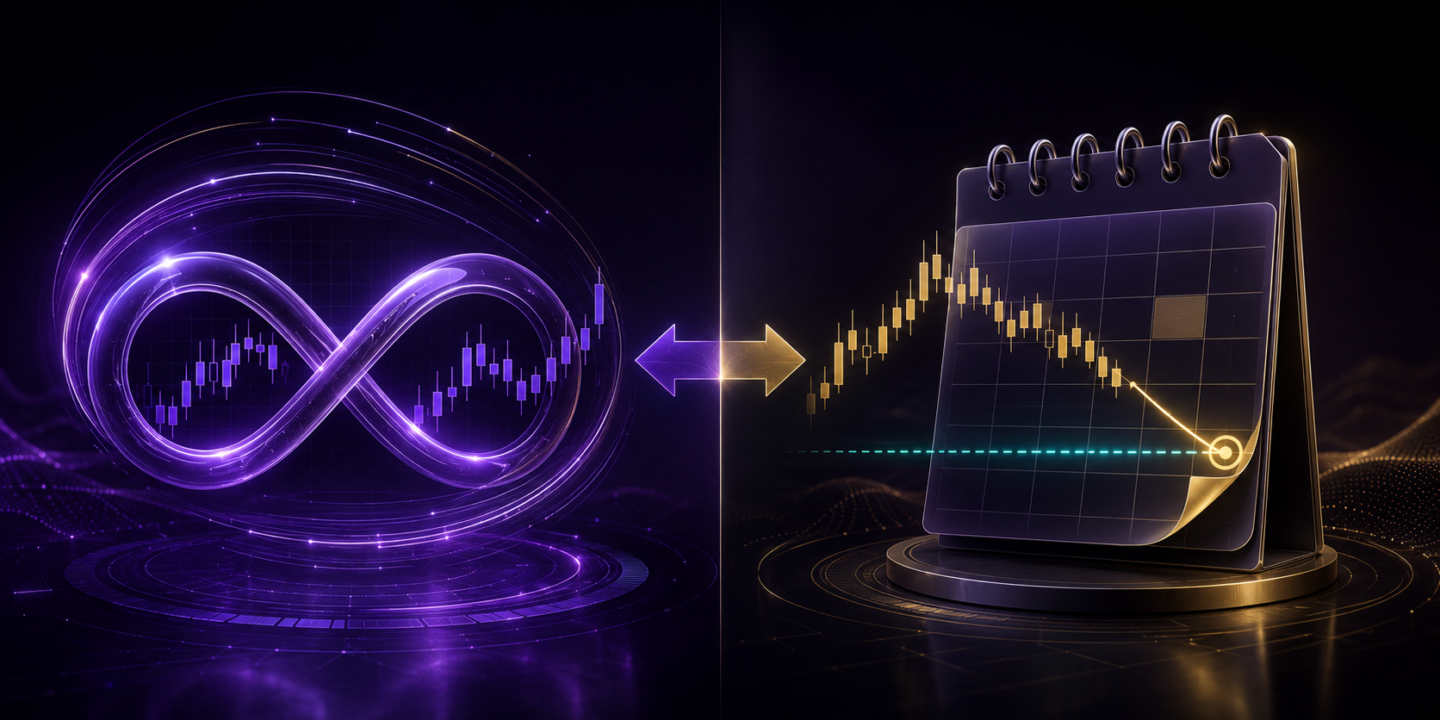
The central distinction is simple. Perpetual futures have no fixed expiry date, while delivery futures expire and settle on a specified date. That difference affects funding payments, futures expiry planning, price behaviour and position management.
This guide compares perpetual futures vs delivery futures across seven practical factors. It also explains the risks to check before selecting a contract. The aim is not to name one universal winner, but to help you match the contract to your trading horizon and risk tolerance.
Perpetual contracts may suit active traders who value flexible entry and exit. Delivery contracts may suit traders who have a defined time horizon or want to plan around a known settlement date. Both can involve leverage and significant loss
Crypto futures are derivative contracts whose value tracks an underlying cryptocurrency. Instead of buying the asset directly, a trader opens a long position when expecting the price to rise or a short position when expecting it to fall.
Traders may use futures to speculate, hedge an existing holding or manage portfolio exposure. Many venues also offer leverage, which lets a trader control a position larger than the margin posted. Leverage can magnify gains, but it can magnify losses just as quickly.
Before placing a trade, understand margin, mark price, liquidation and position size. The Mudrex beginner checklist for crypto futures explains these terms in plain language.
Different traders need different time structures. Some want continuous exposure without managing an expiry calendar. Others want a contract that ends on a known date and can align with an event, hedge or planned holding period.
Perpetual futures solve the first need by removing fixed expiry. Delivery futures solve the second by using a predetermined maturity and settlement process. Their common purpose is price exposure, but their mechanics produce different costs and risks.
A perpetual futures contract has no scheduled expiry date. A position can remain open until the trader closes it, the venue liquidates it or another contract rule ends it. The trader must continue to meet margin requirements throughout the holding period.
Because the contract does not naturally converge at expiry, the market uses a funding mechanism to help keep its price close to the spot price. Funding payments pass between long and short position holders; the exchange’s published formula and schedule determine the amount and timing.
When the contract trades above spot, the funding rate is commonly positive, so longs pay shorts. When it trades below spot, the rate may turn negative, so shorts pay longs.
Perpetual futures often attract active traders because they remove the need to roll a position into a later-dated contract. However, holding one for a long period can create recurring funding costs. High leverage also places the liquidation price closer to the entry price.

A delivery futures contract has a fixed expiry or maturity date. Traders may close a position before that date or keep it open until the contract’s settlement process applies.
Despite the name, a crypto delivery contract does not always involve physical delivery of cryptocurrency. Depending on the venue and contract specification, settlement may occur in cash, stablecoins or the underlying asset. Traders should check the exact contract terms before opening a position.
Delivery futures do not normally use the recurring funding mechanism associated with perpetual contracts. Instead, the difference between the futures price and spot price—known as the basis—tends to narrow as expiry approaches. At settlement, the venue applies its stated reference price and settlement rules.
The fixed date can help traders align a hedge or directional view with a known period. However, it also adds expiry risk. A trader who wants to maintain exposure beyond maturity may need to close the current contract and open a later one, a process called rolling.
The following table summarises perpetual futures vs delivery futures and explains why each distinction matters.
| Factor | Perpetual futures | Delivery futures | Why it matters |
| Expiry | No fixed expiry date | Fixed expiry and settlement date | Determines whether you must plan around maturity or roll the position |
| Funding | Periodic payments may pass between longs and shorts | Usually no perpetual-style funding payment | Changes the cost or credit associated with holding a position |
| Price alignment | Funding helps keep the contract near spot | Basis generally narrows as expiry approaches | Explains why the two contracts track spot through different mechanisms |
| Settlement | No scheduled maturity settlement | Settles under the venue’s contract rules | Determines how and when an open position ends |
| Holding period | Flexible, provided margin is maintained | Limited by the selected contract’s lifecycle | Helps match the instrument to the trader’s time horizon |
| Position management | No contract roll solely because of expiry | May require a roll to extend exposure | Rolling can introduce fees, slippage and basis risk |
| Typical use | Active trading and continuous exposure | Time-bound views and defined-period hedging | Connects contract structure to strategy rather than popularity |

Costs can determine whether perpetual futures vs delivery futures remain suitable after a position stays open for several days or weeks. Compare the entire holding cost, not only the entry fee.
The funding fee generally depends on the position’s notional value and the current funding rate:
Funding payment = position notional value × funding rate
The payment direction can change with market conditions. A trader may pay funding during one interval and receive it during another. Schedules also vary by venue, so check the live rate, countdown and contract specification before trading.
Funding can look small as a percentage but still affect a large leveraged position. If you expect to hold a perpetual contract for an extended period, estimate several scenarios instead of assuming today’s rate will remain unchanged. For a deeper explanation, read how crypto funding rates work.
Also read: Why Funding rates spike During Market Stress
Delivery futures avoid recurring perpetual funding, but they are not cost-free. Their price may trade above or below spot, creating basis risk. The basis can change before expiry and affect the trade even when the spot price moves as expected.
If you want to keep the exposure after expiry, you may need to roll the position. That means closing the near-dated contract and opening a later one. Trading fees, spreads, slippage and the price difference between contracts can all influence the roll.
Therefore, compare expected funding on the perpetual contract with the basis and potential roll cost on the delivery contract. The cheaper choice can change with market conditions and holding period.
Choosing perpetual futures vs delivery futures starts with one question: how long and why do you plan to hold the position?
If you plan to use leverage, read how much leverage may be too much before choosing a multiplier.
Availability, specifications and liquidity vary by venue. Confirm whether the chosen platform lists delivery contracts for the asset and expiry you need.
Ask these questions before you select either contract:

Both sides of the perpetual futures vs delivery futures comparison involve material risk. A suitable contract structure does not make a poor position safe.
Leverage increases exposure relative to margin. A smaller adverse price move can therefore create a larger percentage loss and trigger liquidation sooner. The Mudrex guide to crypto futures liquidation explains how margin and liquidation interact.
Liquidity can differ across assets, venues and expiry months. Thin order books may produce wider spreads or slippage, especially during fast markets. Review volume, open interest and order-book depth for the exact contract rather than assuming every futures market is equally liquid.
Read the contract specification. Check the settlement asset, price index, funding schedule, maintenance margin, expiry time, position limits and liquidation process. These details can vary even when two products share a similar name.
For a broader framework covering position sizing and protective orders, use these crypto futures risk-management strategies.
The choice between perpetual futures vs delivery futures depends on your trading objective, holding period and ability to manage the contract’s specific costs.
Perpetual futures provide flexible, no-expiry exposure, but funding can affect a position over time. Delivery futures provide a known maturity and no perpetual-style funding mechanism, but they introduce expiry, settlement and possible rolling considerations.
Before choosing either contract, compare liquidity, leverage, margin, funding or basis, settlement rules and your planned exit. The right contract is not the one with the most features; it is the one whose mechanics fit your strategy and risk limit.
Explore Mudrex Learn or the Mudrex YouTube channel for more guides on Bitcoin market cycles, risk management, and execution basics.
Perpetual futures have no fixed expiry date and use funding to help keep the contract near spot. Delivery futures expire on a specified date and rely on settlement and price convergence as maturity approaches.
No scheduled expiry applies to standard perpetual contracts. A position may remain open while margin requirements are met, unless the trader closes it, the venue liquidates it or another contract rule applies.
Delivery futures generally do not use the recurring funding mechanism found in perpetual contracts. Traders can still face trading fees, spreads, slippage, basis risk and roll costs.
Usually, yes, provided the market is open and there is sufficient liquidity. Check the venue’s last trading time and contract rules because settlement procedures vary.
Neither contract is automatically beginner-friendly. New traders should first understand leverage, margin, funding, basis, settlement and liquidation. Starting with small position sizes and a written risk plan can reduce avoidable errors.
Perpetual futures often attract substantial activity, but liquidity is not guaranteed. It varies by asset, venue and market conditions. Delivery contract liquidity can also differ sharply between expiry months.
Yes you can Trade Perpetual Futures on Mudrex.
Disclaimer: This content is for educational purposes only and is not financial advice. Crypto futures trading involves significant risk, including the loss of your entire margin. Do your own research and never trade more than you can afford to lose.