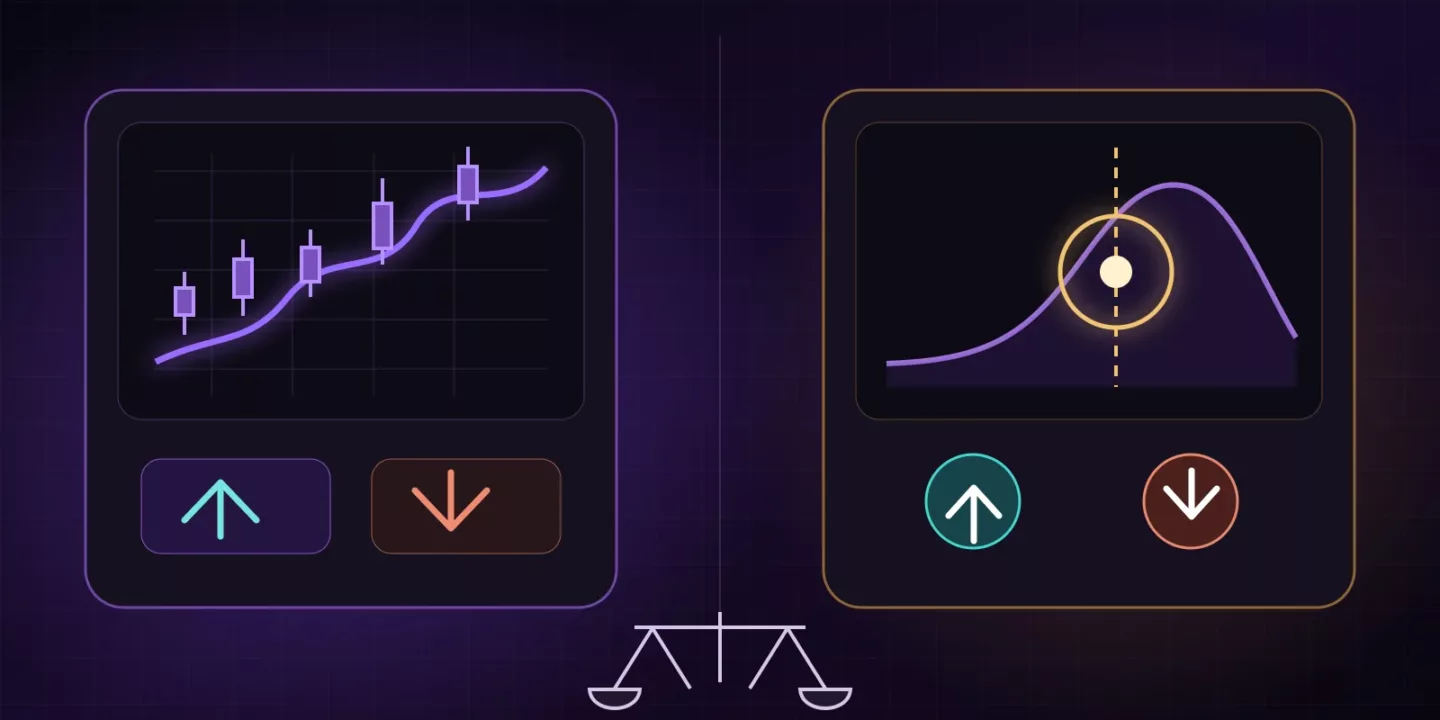

Bitcoin is rallying, and you expect the momentum to continue. Instead of buying BTC directly, you explore crypto derivatives. That is when two popular products appear: crypto futures and crypto options.
Both products offer exposure to cryptocurrency price movements without requiring direct ownership of the asset. However, they create very different rights, obligations, costs and risk profiles. A futures position gains or loses value with the contract price and must meet margin requirements. An option gives its buyer a contractual right, while the seller accepts the corresponding obligation.
Understanding crypto futures vs options helps you compare margin, premiums, liquidation and time-sensitive pricing. Neither product is universally better. The suitable choice depends on your objective and ability to manage loss.
The central difference in crypto futures vs options is the structure of the contract.
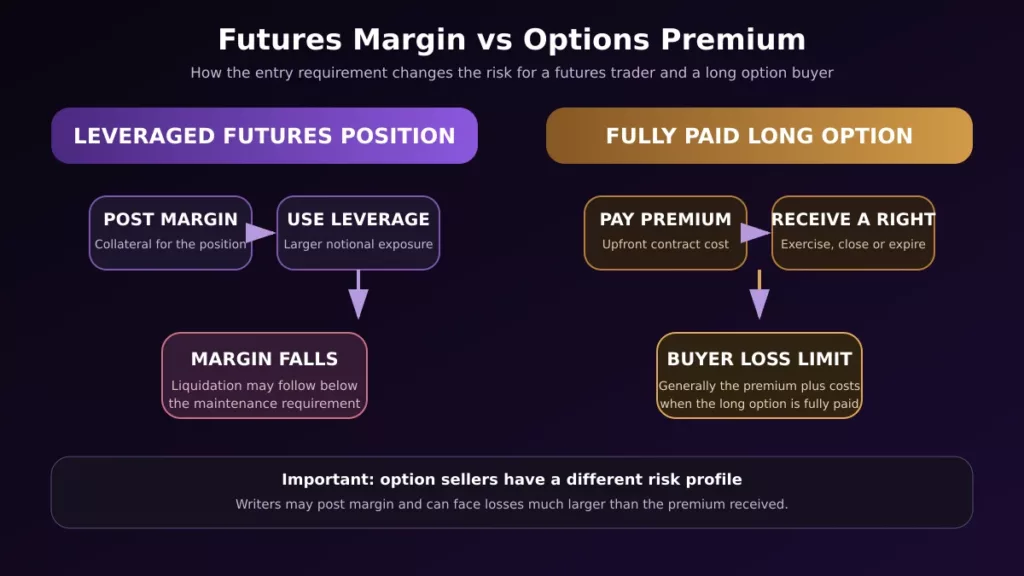
A futures position creates a binding exposure under the contract terms. Traders usually post margin, and the position’s profit or loss changes as the market moves. If account equity falls below the maintenance requirement, the venue may liquidate the position.
An option gives the buyer the right—but not the obligation—to buy or sell the underlying asset or settle the contract under specified terms. The buyer usually pays a premium for this right. For a fully paid long option, the buyer’s maximum loss is generally the premium and transaction costs. The seller or writer faces a different risk profile and may need margin.
“Options have limited risk” is not a rule for every options position. It applies most clearly to purchased calls and puts. Short options can create much larger obligations.
Crypto derivatives are contracts whose value is linked to an underlying cryptocurrency, index or reference price. A trader gains exposure to price changes without necessarily owning Bitcoin, Ether or another referenced asset.
Market participants may use crypto derivatives to:
These uses come with additional risks. Derivative values can change quickly, leverage can magnify losses, and each venue sets its own margin, settlement and liquidation rules.
Before trading futures, read the Mudrex beginner checklist for crypto futures. It explains margin, funding, leverage and liquidation in plain language.
Crypto futures trading involves taking a long or short position in a contract linked to a cryptocurrency’s price. The position generally moves more directly with the underlying market than an option does.
Traders post margin as collateral. Leverage allows the margin to control a larger notional position, which can magnify both gains and losses. A highly leveraged position leaves less room between the entry price and liquidation.
Two common futures structures are:
Futures can support directional trading and hedging. However, traders must monitor margin, leverage, funding or expiry, and the venue’s liquidation process. The Mudrex guide to crypto futures liquidation explains how maintenance margin affects an open position.
Also read : Perpetual Futures Vs Delivery Futures
Crypto options give the buyer a right under defined contract terms. A call option gives its buyer the right to buy or receive positive exposure at a strike price. A put option gives its buyer the right to sell or receive negative exposure at a strike price. Exact exercise and settlement mechanics vary by contract.
The buyer pays a premium. For a fully paid long call or put, that premium is generally the maximum loss if the option expires without value. The option seller receives the premium but accepts an obligation if the contract is exercised or settled in the buyer’s favour.
Options prices depend on more than the underlying cryptocurrency’s direction. Important factors include:
Time decay can reduce an option’s value as expiry approaches. Implied volatility can also change the premium without a comparable move in the underlying price.
Read the Detailed Guide : Crypto Options Trading
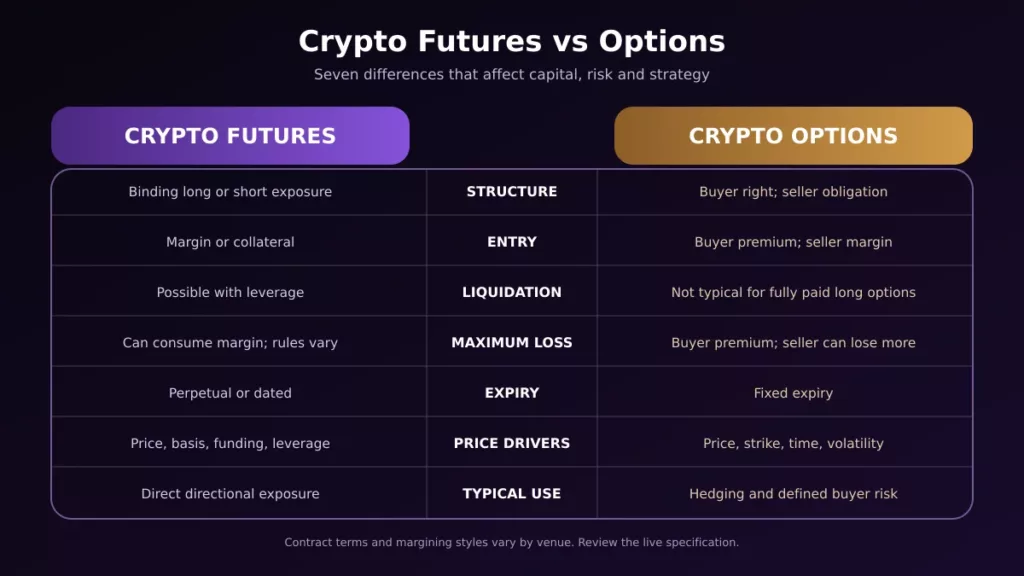
The following crypto futures vs options table summarises how the products differ. A futures trading vs options trading decision must also account for venue-specific settlement, margin and exercise rules.
| Feature | Crypto futures | Crypto options | Why it matters |
| Contract structure | Binding long or short exposure under the futures terms | Buyer has a right; seller accepts the corresponding obligation | Determines whether the position creates direct exposure or optionality |
| Entry requirement | Margin or collateral | Buyer generally pays a premium; seller may post margin | Changes the upfront capital and ongoing account requirements |
| Liquidation | Leveraged positions can be liquidated | Fully paid long options generally avoid liquidation; short options may not | Separates buyer-defined risk from margined seller risk |
| Maximum loss | Can consume the margin and may exceed it depending on venue rules | Long buyer generally risks premium and costs; seller risk can be much larger | Defines the downside that must be planned before entry |
| Expiry | Perpetual or dated | Fixed expiry | Time affects options more directly and can make them expire worthless |
| Price drivers | Underlying price, basis, funding, leverage and liquidity | Underlying price, strike, time, implied volatility and other pricing inputs | Options can lose value even when direction is broadly correct |
| Typical use | Direct directional exposure and futures hedging | Defined-risk buyer strategies, volatility views and portfolio hedging | Helps match the instrument to the strategy |
Also Read : Comparison between Crypto Spot, Futures and Options
A futures trader holds a long or short exposure until the position is closed, expires, settles or is liquidated. Profit and loss continue to change with the contract price.
An option buyer may exercise, close or allow the option to expire according to the contract rules. The buyer is not required to exercise an unfavourable option. However, an option seller can be assigned or required to settle when the contract terms apply.
This buyer–seller distinction is central to crypto futures vs options. Comparing futures only with purchased options can hide the risks carried by option writers.
Futures traders post initial margin and must maintain sufficient equity. Margin is collateral, not the full value of the position. Higher leverage means a smaller adverse move can consume that collateral.
A long option buyer typically pays the premium. The market must move enough to overcome that premium and other costs before the position becomes profitable. A short option seller receives the premium but may need substantial margin.
Review how leverage works in futures before comparing the apparent capital efficiency of the two products.
Futures profit and loss usually respond more directly to movements in the contract price. Funding, basis and leverage still affect the outcome.
Option values also respond to time and expected volatility. A call buyer can correctly predict that Bitcoin will rise yet still lose money if the move is too small, arrives too late or fails to exceed the premium-adjusted breakeven.
This makes options flexible, but not automatically safer or easier.
Assume Bitcoin trades at ₹90 lakh, and you expect it to rise to ₹95 lakh. The following example is illustrative and excludes fees, funding, slippage, taxes and contract-specific multipliers.
A long BTC futures position gains if the contract price rises and loses if it falls. Leverage changes the percentage effect on your margin. If the market moves sharply against the position, falling equity can trigger liquidation.
The futures trader does not pay an option premium. However, perpetual funding or dated-futures basis can affect the total result.
A BTC call buyer pays a premium for upside exposure above a strike price. If Bitcoin rises sufficiently before expiry, the option may gain value. If the move is too small or arrives after expiry, the option can lose part or all of its premium.
The long call does not usually face futures-style liquidation when the premium is fully paid. Nevertheless, a 100% loss of the premium is possible.
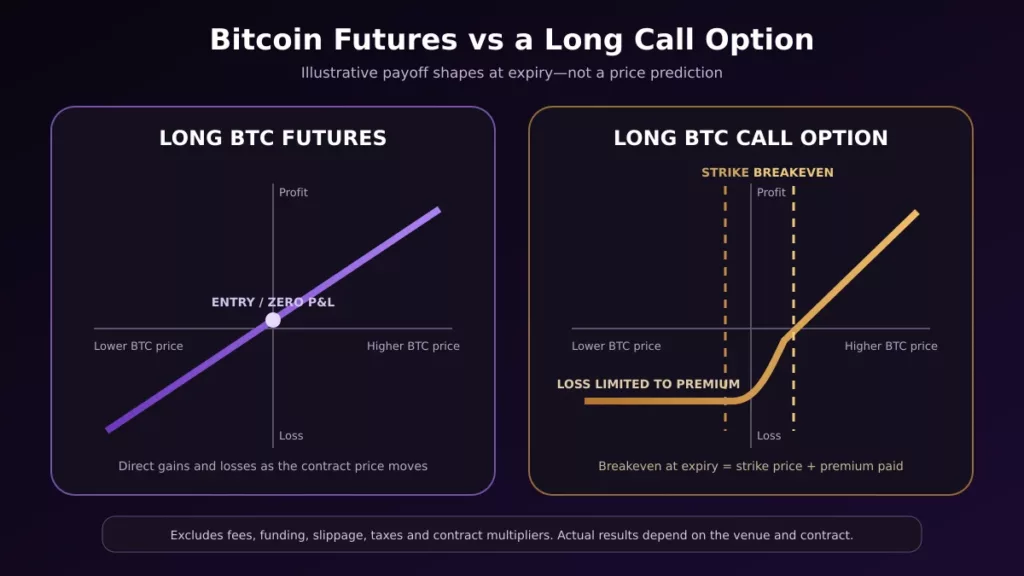
The comparison between crypto futures vs options becomes more useful when these answers are written before the trade.
Both products can hedge an existing portfolio, but they create different trade-offs.
A short futures position can offset some losses on a spot holding when the market falls. However, the hedge introduces margin and liquidation risk. If the market rises, losses on the short futures position can offset gains in the spot asset.
A purchased put option can create downside protection while preserving some upside in the spot holding. The premium is the cost of that protection. Strike and expiry selection determine how much protection the option provides and how long it lasts.
Neither hedge is automatic. Position size, contract multiplier, basis, liquidity, fees and tax treatment can change the result. Review crypto futures risk-management strategies before using leverage as a hedge.
Choosing between crypto futures vs options requires more than deciding which product appears simpler or cheaper.
Futures can suit direct, actively managed exposure when the trader understands leverage, margin, funding and liquidation. Purchased options can provide defined buyer risk and flexible hedging, but strike selection, premiums, implied volatility and time decay affect the result. Option sellers face a separate and potentially much larger risk profile.
Before trading either product, review the contract specification, liquidity, total costs, maximum loss and exit plan. Start with education and conservative position sizing. The right instrument is the one whose mechanics fit your strategy—not the one with the most leverage or the lowest apparent entry cost.
Explore Mudrex Learn or the Mudrex YouTube channel for more guides on Bitcoin market cycles, risk management, and execution basics.
Disclaimer: This content is for educational purposes only and is not financial advice. Crypto futures trading involves significant risk, including the loss of your entire margin. Do your own research and never trade more than you can afford to lose.
Futures create direct long or short exposure under the contract terms. An option gives the buyer a right, while the seller accepts the corresponding obligation. Futures generally use margin; a long option buyer generally pays a premium.
Crypto futures trading involves taking a position in a contract linked to a cryptocurrency’s price. Leverage can increase exposure, but it also increases the speed and size of potential losses.
Crypto options trading involves calls and puts with a strike price and expiry. Buyers pay for a contractual right. Sellers receive the premium and accept an obligation under the contract terms.
A fully paid long call or put generally does not face futures-style liquidation because the buyer pays the premium. However, some venues use different margining styles. Option sellers and complex strategies may have margin and liquidation risk.
Yes. A leveraged futures position may be liquidated when account equity falls below the venue’s maintenance-margin requirement. Review the live liquidation price and margin ratio before entering.
Perpetual futures have no fixed expiry, while dated futures do. Options have an expiry date. Exercise and settlement can differ between American-style, European-style and venue-specific contracts.
No. Long options define the buyer’s maximum loss, but the entire premium can be lost. Option sellers can face much larger losses, and complex strategies create additional risks.
Yes. A short futures position or purchased put option can reduce some downside exposure. Each approach introduces costs and risks, so the hedge ratio and contract terms matter.
Yes, Mudrex supports Crypto Futures trading.
Availability depends on the platform, product structure, user eligibility and applicable rules. Confirm current access and compliance requirements with the chosen venue rather than relying on a general article.