
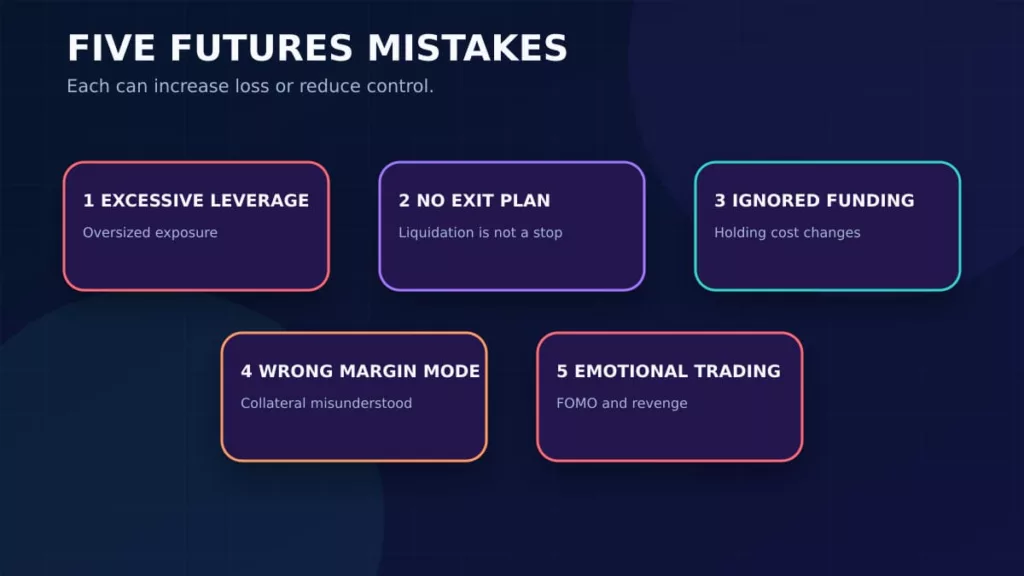
Crypto futures trading mistakes often begin with a reasonable idea—such as using leverage for capital efficiency—but become dangerous when a trader ignores position size, margin or the exit plan.
Futures let traders take long or short exposure without directly owning the referenced cryptocurrency. They also introduce leverage, funding, maintenance margin and liquidation. A small operational error can therefore affect capital more quickly than it would in standard, unleveraged spot trading.

This guide explains five common mistakes, why they matter and what a beginner should check before opening a position.
A futures position uses margin to control notional exposure. This means the profit or loss is calculated on a position that may be much larger than the collateral posted.
For example, ₹10,000 of margin at 10× leverage controls ₹1,00,000 of exposure. A 2% contract-price move changes the position by about ₹2,000 before fees and funding. That equals approximately 20% of the initial margin.
The same mechanics apply in both directions. Leverage does not make a forecast more accurate; it only increases the effect of the outcome.
Liquidation adds another constraint. If account equity falls below the venue’s maintenance-margin requirement, the platform may reduce or close the position. This can happen before a trader’s long-term market view has time to play out.
The platform may offer a high maximum leverage ratio, but that does not make the maximum appropriate for every trade.
Higher leverage usually means:
There is no universally safe leverage level. Two positions using the same leverage can carry different risks because their size, stop distance, volatility, maintenance margin and available collateral differ.
Also Read : How much leverage should I use
Define the trade’s invalidation level first. Then calculate the position size that keeps the loss at that exit within the amount you can afford to lose.
Leverage can change how much margin is required, but it should not decide the rupee amount at risk.
Entering without a stop or invalidation level leaves the trader with no predefined point at which the original idea is considered wrong.
A stop-loss order can support discipline, but it is not a guarantee. During a rapid move or in a thin order book, the order may fill away from the trigger price. Incorrect trigger settings can also cause the stop to behave differently from the trader’s expectation.
The liquidation price should not be treated as the exit plan. Liquidation is a venue risk process, not a controlled trading decision, and may involve less favourable pricing or additional fees.
Also Read : How to avoid liquidation
Before entering, record:
The planned stop should remain meaningfully separated from liquidation, with enough room for execution risk.
Perpetual futures have no fixed expiry. Funding payments between long and short holders help keep the contract close to its spot index.
When the rate is positive, longs generally pay shorts. When it is negative, shorts generally pay longs. The platform determines the interval, formula and settlement method.
Funding applies to notional exposure, not simply the margin deposited. A small rate can therefore become material on a large or long-held position. The sign and size can also change while the trade remains open.
Check the current and projected funding rate, funding interval and notional position value before entering. Recalculate the expected holding cost if the trade remains open longer than planned.
Funding should be treated as one input alongside price, open interest, liquidity and the trade thesis—not as a standalone directional signal.
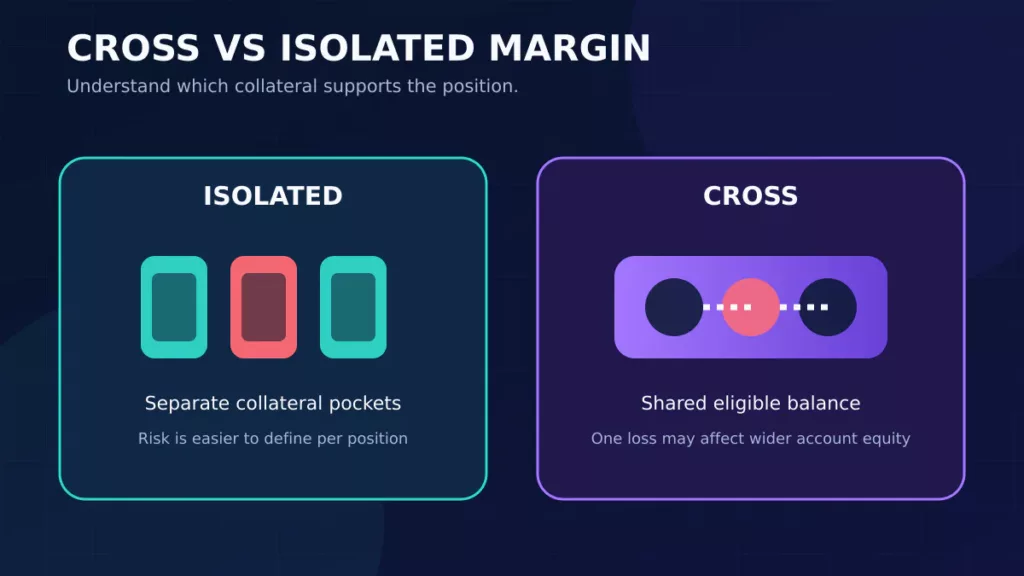
Margin mode determines which collateral can support a losing position.
| Feature | Isolated margin | Cross margin |
|---|---|---|
| Collateral | Assigned to one position | Eligible balance shared across positions |
| Risk boundary | Generally easier to define per trade | May extend across the futures account |
| Liquidation buffer | Based mainly on assigned margin | Influenced by account equity and other positions |
| Monitoring | Position-level | Account-level and position-level |
Isolated margin can make per-trade risk easier to understand. Cross margin may give a position a wider buffer, but it can also allow one loss to draw on funds supporting other positions.
Exact behaviour varies by venue. Some platforms apply different collateral, offset, liquidation and negative-balance rules.
Before selecting a margin mode, confirm:
FOMO often appears after a sharp market move. The trader enters because the price is moving, not because the setup satisfies a written plan.
Revenge trading often appears after a loss. The trader increases size or leverage to recover quickly, even though the next setup may be weaker.
Both behaviours shift attention from risk quality to emotional relief. One controlled loss can then become a larger drawdown.
Use a cooling-off rule after a predefined loss or rule violation. Record the reason for the trade, planned risk and whether execution followed the strategy.
Judge the process separately from the result. A profitable rule-breaking trade can reinforce a harmful habit, while a disciplined losing trade can still represent correct execution.
Averaging into a losing futures position increases exposure while available margin is already under pressure. It may also move the effective entry price without solving the original invalidation.
Adding collateral can move the estimated liquidation threshold, but it also places more capital at risk. It should not be used automatically to delay a necessary exit.
Any scaling plan should specify the maximum total position, additional entry levels, combined stop and total rupee loss before the first order is placed.
Also Read :
Risk controls cannot prevent every loss, but they can reduce avoidable mistakes.
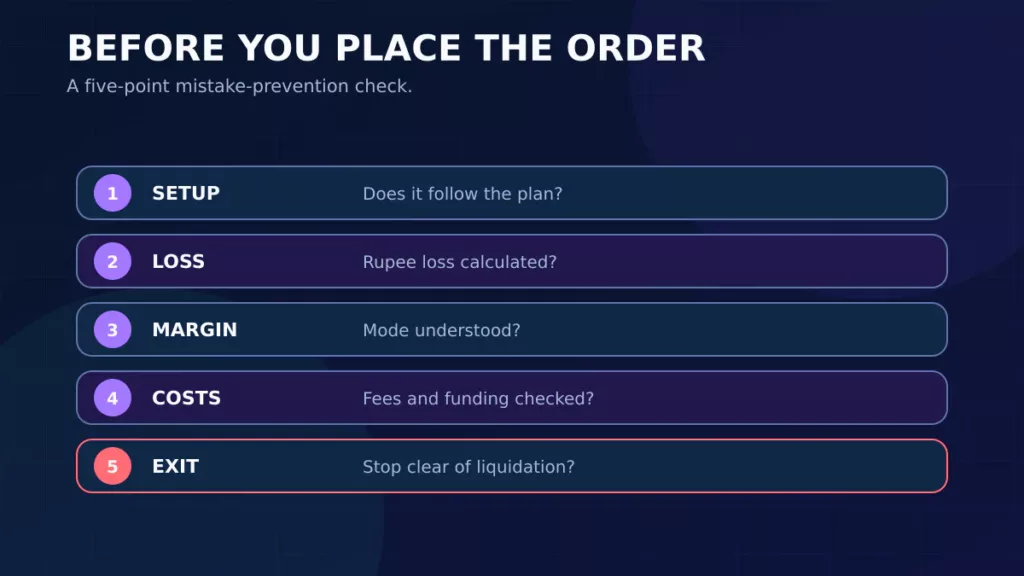
Before clicking Long or Short, confirm:
If several answers are “no”, do not place the order.
Crypto futures trading mistakes are rarely limited to choosing the wrong entry. Excessive leverage, undefined exits, ignored funding, misunderstood collateral and emotional decisions can have a larger effect on the final result.
Before opening a position, calculate the loss at the planned stop, verify the liquidation distance and confirm which collateral the margin mode can use. Protecting capital begins with a repeatable process, not a higher leverage setting.
Explore Mudrex Learn, visit the Mudrex YouTube channel or download the Mudrex app to continue learning about crypto futures and risk management.
Disclaimer: Crypto futures involve substantial risk. A trader can lose all margin allocated to a position and, depending on the margin mode, platform rules and market conditions, may expose additional collateral. This article is educational and not financial advice.
Common errors include excessive leverage, trading without an exit plan, ignoring funding, misunderstanding cross margin and allowing FOMO or revenge trading to control decisions.
Losses can result from incorrect market views, but leverage, oversized positions, poor exits, costs and emotional decisions can make the financial impact much larger.
There is no universally safe ratio. Beginners should size the position from a predefined loss and stop distance, then use only the leverage needed to support that plan.
No. It can help limit loss, but gaps, slippage, low liquidity, technical issues or incorrect trigger settings can produce a different fill or no fill.
Repeated funding debits can reduce profit or increase loss on a perpetual position. Funding credits can add to the result, but the rate may change over time.
No. Isolated margin often makes per-position risk easier to define, while cross margin can support portfolio-level strategies. The suitable mode depends on the account structure, strategy and platform rules.