

If you have traded Nifty Futures, Bank Nifty, or options in the Indian stock market, you’ve probably come across crypto futures as another way to trade market movements. At first glance, both markets appear similar. They allow traders to speculate on price movements without owning the underlying asset, support both long and short positions, and use leverage to amplify potential returns.
However, once you look beneath the surface, the differences become much clearer.

Crypto futures trade around the clock, many contracts never expire, and positions can be liquidated automatically if margin requirements aren’t met. Indian Futures and Options (F&O), on the other hand, operate during fixed exchange hours, follow predefined expiry cycles, and function within a structured regulatory framework overseen by SEBI.
Understanding these differences is essential, especially if you’re an Indian trader exploring crypto derivatives for the first time. Strategies that work well in the NSE’s derivatives market don’t always translate directly to crypto futures, where markets never close, leverage works differently, and risk management requires a more active approach.
In this guide, we’ll compare crypto futures vs Indian F&O, explain how each market works, and help you decide which may be better suited to your trading style and risk tolerance.
Indian Futures and Options (F&O) are derivative contracts traded on regulated exchanges such as the National Stock Exchange (NSE) and the Bombay Stock Exchange (BSE). Instead of buying an asset outright, traders speculate on its future price through contracts linked to stocks, indices like Nifty 50 and Bank Nifty, currencies, or commodities.
Indian F&O contracts follow defined expiry cycles. Equity futures are generally monthly, while selected index options may also have weekly expiries. Traders can close positions before expiry, roll eligible contracts or allow settlement under the exchange’s rules. The market also follows established margin frameworks, including SPAN Margin and Exposure Margin, helping maintain stability in the derivatives ecosystem.
Crypto futures are derivative contracts that let traders speculate on the future price of cryptocurrencies such as Bitcoin (BTC) and Ethereum (ETH) without owning the underlying assets.
Like Indian F&O, traders can profit from both rising and falling markets. The key difference is that most crypto exchanges primarily offer perpetual futures, which don’t have an expiry date. Instead, they use Funding Rates to keep futures prices closely aligned with the underlying Spot Price and Index Price. Crypto futures markets also operate 24/7, allowing traders to react instantly to global market events.
Trader’s Note: Understanding how a market is structured is just as important as predicting where prices will move. Many costly mistakes happen when traders approach crypto futures with the same strategies they use in traditional F&O markets.
In the next section, we’ll compare crypto futures and Indian F&O side by side to understand how they differ in contract structure, trading hours, leverage, settlement, and risk management.
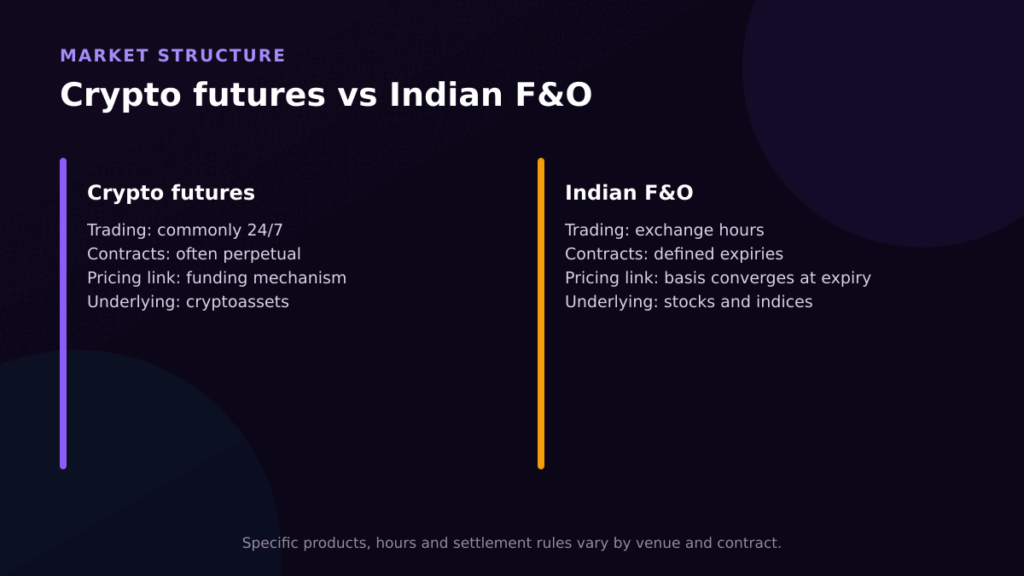
Now that we’ve covered how both markets work, let’s compare how they perform in real trading conditions. While crypto futures and Indian F&O are both derivative markets, they differ significantly in contract structure, trading hours, leverage, settlement, and risk management. Understanding these differences is essential because they directly influence how traders manage positions and respond to market volatility.
| Feature | Crypto Futures | Indian F&O |
|---|---|---|
| Underlying Assets | Bitcoin, Ethereum and other digital assets | Stocks, indices, currencies and commodities |
| Trading Hours | 24/7, including weekends | NSE/BSE trading hours on business days |
| Contract Expiry | Mostly perpetual contracts with no expiry | Monthly futures; selected options may also have weekly expiries |
| Price Alignment | Maintained through Funding Rates | Converges naturally as expiry approaches |
| Margin System | Initial Margin and Maintenance Margin | SPAN Margin and Exposure Margin |
| Settlement | USDT, coin or cash settled, depending on the contract | Primarily cash settlement |
| Risk Management | Automatic liquidation | Exchange and broker margin controls, including possible position square-off |
| Regulation | Varies by exchange and jurisdiction | Regulated by SEBI |
One of the biggest structural differences lies in how contracts remain active.
Indian F&O contracts have predefined expiries. Equity futures are generally monthly, while selected options may have weekly expiries. As a futures contract approaches expiry, its price generally converges with the underlying reference before settlement or a trader-initiated roll.
Most crypto exchanges, however, primarily offer perpetual futures, which don’t expire. Instead, they use periodic Funding Rate payments between long and short traders to keep futures prices closely aligned with the underlying Index Price and Spot Price. This allows traders to hold positions indefinitely, provided they continue meeting the exchange’s margin requirements.
Market Observation: Traders moving from Indian F&O to crypto futures often expect contracts to behave similarly. Perpetual futures require a different approach because positions can remain open indefinitely while Funding Rates continue to apply.
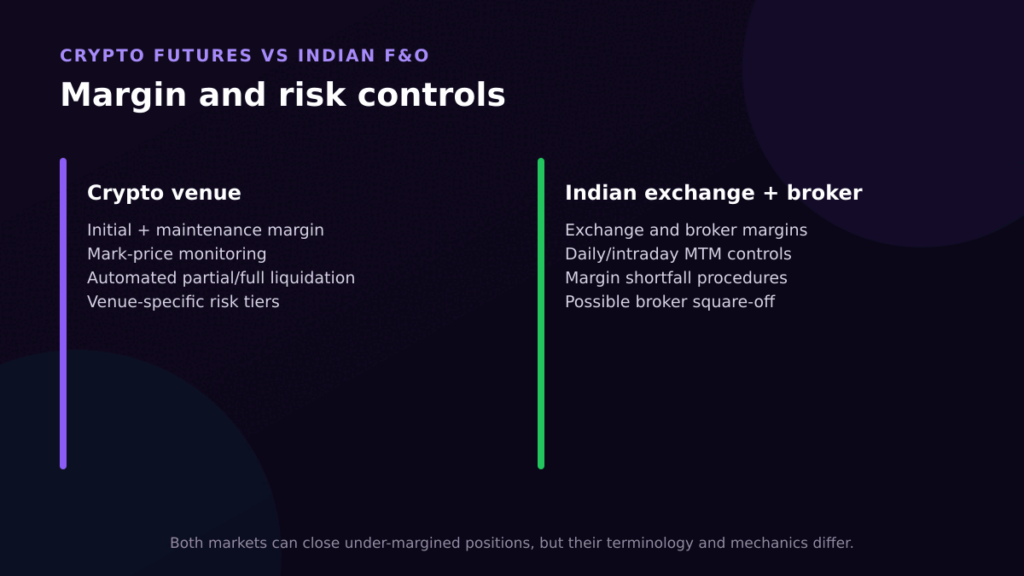
Risk management also works differently across the two markets.
Indian F&O uses SPAN Margin and Exposure Margin to determine the capital required before a trade is executed. Crypto futures require an Initial Margin to open a position and a Maintenance Margin to keep it active. If the account balance falls below the required threshold, the exchange can automatically liquidate the position based on the Mark Price.
Unlike a stop-loss, which is placed voluntarily by the trader, liquidation is enforced automatically by the exchange to limit further losses. This makes disciplined position sizing and margin management especially important when trading crypto futures.
Trader’s Note: Higher leverage increases both opportunity and risk. Experienced traders prioritise capital preservation and disciplined risk management over using the maximum leverage available.
In the next section, we’ll compare crypto futures and Indian F&O from a trader’s perspective, covering regulation, taxation, key risks, and which market may be better suited to your trading style.
After comparing how crypto futures and Indian F&O work, one question remains: which market is the better choice?
The answer depends less on the market itself and more on how you trade, your experience with derivatives, and your ability to manage risk.
Both markets allow traders to speculate on price movements using leverage and both can be used for short-term trading or hedging. However, they operate in very different environments. Indian F&O follows fixed trading hours, expiry-based contracts, and a structured regulatory framework, while crypto futures are built for a global market that trades 24/7 and relies heavily on perpetual contracts and continuous margin management.
Rather than asking which market is better, it’s more useful to ask which market is better suited to you.
If you primarily follow Indian equities and indices such as Nifty 50 or Bank Nifty, Indian F&O offers a familiar and predictable trading environment.
Trading takes place during fixed exchange hours, contracts follow weekly or monthly expiry cycles, and the market operates under SEBI’s regulatory framework. This structure allows traders to plan their positions around defined trading sessions while using established margin frameworks such as SPAN Margin and Exposure Margin.
For investors who prefer regulated markets and already understand the Indian equity ecosystem, Indian F&O often provides a natural starting point for derivatives trading.
Crypto futures are designed for traders who value flexibility and global market access.
Unlike Indian F&O, most crypto futures are perpetual contracts, allowing positions to remain open without worrying about weekly or monthly expiries. Since the market operates 24 hours a day, seven days a week, traders can respond immediately to global news, macroeconomic events, or sudden changes in market sentiment.
If you’re already experienced in Indian F&O, many concepts such as leverage, long and short positions, and margin trading will feel familiar. The biggest adjustment is learning how Funding Rates, Mark Prices, and Maintenance Margin influence open positions in a market that never closes.
Market Observation: Many experienced Indian F&O traders transition to crypto futures successfully because the principles of derivatives remain the same. The challenge isn’t learning a new product. It’s adapting to a market that requires continuous risk management.
Both markets carry significant risk, but the risks aren’t identical.
In Indian F&O, traders typically manage downside risk using stop-loss orders and predefined position sizes within fixed trading sessions. Crypto futures introduce an additional layer of complexity because positions remain exposed to overnight and weekend price movements, and exchanges can trigger automatic liquidation if the required Maintenance Margin is no longer available.
Another important consideration is regulation.
Indian F&O is traded on recognised exchanges operating under SEBI’s regulatory framework. Crypto futures, however, are offered by exchanges across different jurisdictions, making it important to evaluate an exchange’s security practices, liquidity, and risk management systems before opening an account.
Tax treatment can also differ. Since regulations evolve over time, traders should always refer to the latest government guidance or consult a qualified tax professional before making decisions based on tax considerations.
Trader’s Note: Leverage is a tool, not a strategy. Long-term success comes from disciplined position sizing, consistent risk management, and protecting your trading capital during volatile market conditions.
The comparison between crypto futures and Indian F&O isn’t about deciding which market is superior. Both are powerful derivative markets designed for different trading environments.
If you prefer a structured, regulated ecosystem with fixed trading hours and expiry-based contracts, Indian F&O may be the better fit. If you’re comfortable trading in a 24/7 market, actively managing leverage, and understanding concepts such as Funding Rates and liquidation, crypto futures offer greater flexibility and access to global digital asset markets.
Whichever market you choose, the fundamentals of successful trading remain the same. Markets reward preparation, discipline, and sound risk management far more consistently than they reward aggressive leverage or short-term speculation.
Continue learning: explore Mudrex Learn, watch the official Mudrex YouTube channel, or download the app and start trading.
Both are derivative markets, but they differ in contract design, trading hours, settlement, regulation, and risk management. Indian F&O uses fixed-expiry contracts traded during exchange hours, while crypto futures commonly use perpetual contracts that trade 24/7.
Most crypto futures offered by crypto venues are perpetual contracts and do not expire. Indian F&O follows defined expiries: equity futures are generally monthly, while selected index options may also have weekly expiries.
A Funding Rate is a periodic payment exchanged between long and short traders in perpetual futures markets. It helps keep futures prices aligned with the underlying Index Price and Spot Price.
No. Exchange-traded Indian F&O does not use the perpetual-style funding mechanism. For Indian futures, the basis generally narrows as expiry approaches.
Crypto futures often offer higher leverage, depending on the exchange and jurisdiction. Indian F&O leverage is determined by exchange rules and regulatory margin requirements.
Rules can depend on the instrument, venue, user eligibility and changing Indian law. Verify current legal, tax and platform requirements before trading instead of relying on a general article.
Both markets can produce substantial losses. Crypto futures add 24/7 exposure, often higher volatility and venue-driven liquidation mechanics; Indian F&O carries expiry, gap, option-premium and margin shortfall risks. The practical risk depends on the instrument, leverage, position size and trader’s controls.
Disclaimer: This content is for educational purposes only and is not financial advice. Crypto futures trading involves significant risk, including the loss of your entire margin. Do your own research and never trade more than you can afford to lose.