What happens when Bitcoin dominance rises is easy to answer in one line: altcoins tend to underperform. But the past few weeks of crypto trading show why the full picture matters more than a simple one-liner.
Bitcoin just rallied from the high-$50,000s to nearly $79,000, and altcoins rallied right alongside it. Yet Bitcoin dominance barely moved, sitting around 57-60% through the entire move, and the Altcoin Season Index has actually kept falling through the rally, from 33 to 28 to 27 over the past week. Prices went up across the board, and Bitcoin still tightened its grip.
Find out what rising dominance actually signals, why it doesn’t always mean what people assume, and how to read it alongside the indicators that matter more on their own.
Key Takeaways
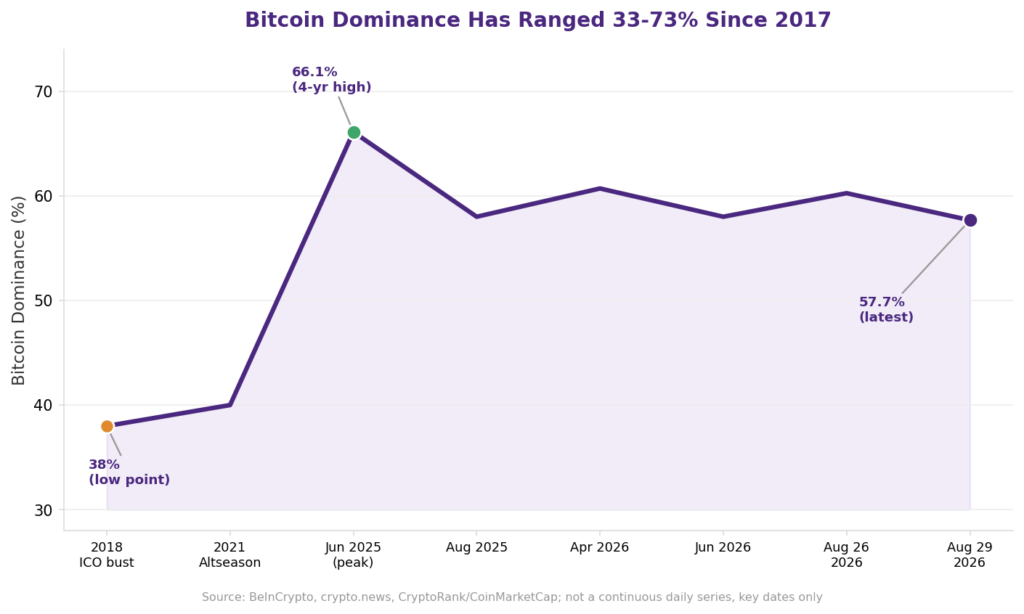
Bitcoin dominance is Bitcoin’s share of the total crypto market cap, currently sitting around 57-60% as of late August 2026, well within its historical 33-73% range since 2017.
When dominance rises, altcoins typically underperform Bitcoin in relative terms, even if their prices are rising in absolute dollar terms, as the past few weeks have shown directly.
Rising dominance doesn’t mean Bitcoin’s price is rising, and falling dominance doesn’t always mean altcoins are winning; both can happen for reasons unrelated to the other.
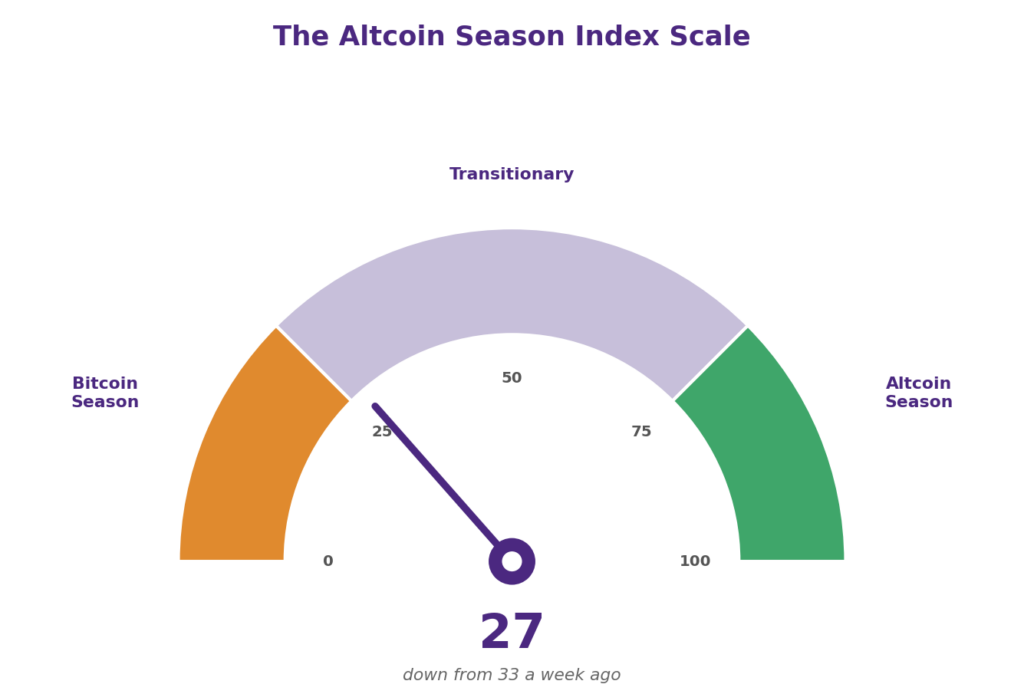
The Altcoin Season Index has fallen to 27 as of today, continuing a decline from 33 just a week earlier, firmly in “Bitcoin Season” territory (0-25 Bitcoin season, 26-74 transitionary, 75+ altcoin season).
Ethereum’s ETH/BTC ratio is one of the clearest ways to see this play out: it hit a 10-month low near 0.024-0.027 in May 2026 before a partial recovery, tracking Bitcoin’s dominant grip on capital almost directly.
What Is Bitcoin Dominance?
Bitcoin dominance measures what share of the entire crypto market’s total value belongs to Bitcoin specifically, and it has ranged between roughly 33% and 73% since 2017.
What Happens When Bitcoin Dominance Rises?
Dominance fell as low as 38% during the 2018 ICO bust, when thousands of new altcoin projects launched and briefly pulled significant capital away from Bitcoin. It climbed back above 60% for extended stretches since, including a four-year high of 66.06% in June 2025, before settling into the upper-50s to low-60s range that has largely held through 2026. As of late August 2026, dominance sits around 57.7%, with Ethereum’s own dominance at roughly 10.9% and stablecoins accounting for a further meaningful share of the total.
Definition: Bitcoin Dominance The percentage of the total cryptocurrency market capitalization represented by Bitcoin alone, calculated by dividing Bitcoin’s market cap by the market cap of the entire crypto market, including all altcoins and stablecoins.
Why Does Bitcoin Dominance Rise?
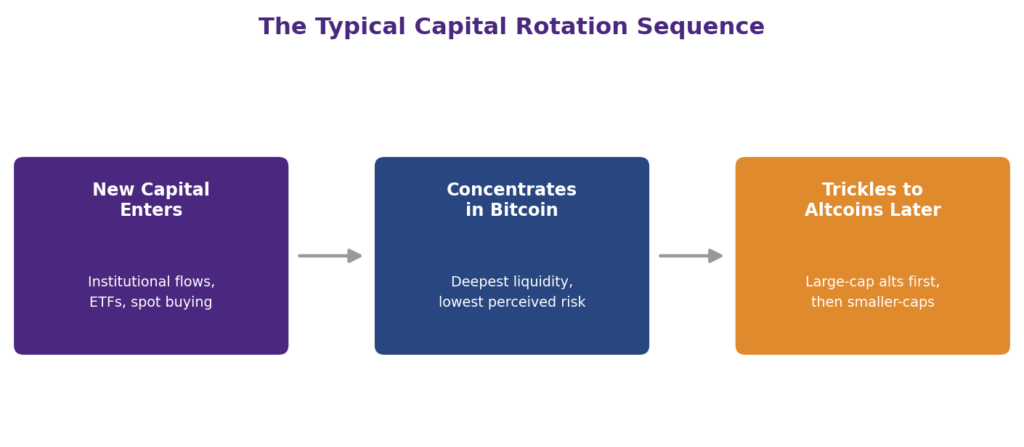
Bitcoin dominance rises primarily because new capital, especially institutional capital, tends to flow into Bitcoin first, given its deeper liquidity, longer track record, and lower perceived risk relative to altcoins.
What Happens When Bitcoin Dominance Rises?
This pattern is sometimes called the capital rotation model: money typically enters the crypto market through Bitcoin first, particularly via spot ETFs and institutional allocation, and only trickles outward into large-cap altcoins and eventually smaller-cap names later in a cycle, if at all. Our recent breakdown of Bitcoin’s 2026 macro and ETF risks covers how these institutional flows have behaved through the year in more detail.
Dominance can also rise during risk-off periods that have nothing to do with fresh capital: when the broader market sells off, altcoins often fall faster and further than Bitcoin, which mechanically pushes Bitcoin’s share of the shrinking total higher even as Bitcoin’s own price also declines.
What Happens When Bitcoin Dominance Rises?
When Bitcoin dominance rises, capital concentrates in Bitcoin relative to the rest of the crypto market, which typically means altcoins underperform Bitcoin on a relative basis, even when altcoin prices are technically rising.
Bitcoin’s share of total crypto market cap increases, whether or not Bitcoin’s own price is rising.
Altcoins tend to lag Bitcoin in percentage terms, a dynamic distinct from whether altcoin prices rise or fall in dollar terms.
The Altcoin Season Index typically stays low (below 25-40) during periods of rising or elevated dominance.
It often signals a risk-off or Bitcoin-led market regime, where investors favor crypto’s most liquid, most established asset.
What Happens to Altcoins When Bitcoin Dominance Increases?
When Bitcoin dominance increases, altcoins as a group tend to underperform Bitcoin on a relative basis, a pattern confirmed directly by the current market: despite a sharp, broad rally in late August 2026, the Altcoin Season Index has kept falling, from 33 to 28 to 27 over the past week, while dominance held around 57-60%.
What Happens When Bitcoin Dominance Rises?
Definition: Altcoin Season Index A metric that tracks what percentage of the top 100 altcoins have outperformed Bitcoin over a trailing 90-day period; a reading above 75 confirms a broad altcoin season, while readings below 25 confirm Bitcoin season.
This is the counterintuitive part worth sitting with: altcoins can rally in dollar terms while still “losing” to Bitcoin dominance, because dominance measures relative market share, not absolute price direction. TOTAL2 (total crypto market cap excluding Bitcoin) crossed $1 trillion in late August 2026 even as dominance stayed elevated, meaning altcoins gained real value in aggregate while still failing to outpace Bitcoin’s own gains proportionally. Our deeper guide on the Altcoin Season Index covers how to read this signal in more detail.
What Happens to Ethereum When BTC Dominance Rises?
Ethereum tends to underperform Bitcoin when BTC dominance rises, a relationship best measured through the ETH/BTC ratio rather than ETH’s dollar price alone, since the ratio isolates Ethereum’s relative strength from broader market-wide moves.
The ETH/BTC ratio fell to a 10-month low near 0.024-0.027 in May 2026, down from levels above 0.035 earlier in the cycle, as institutional capital concentrated heavily in Bitcoin through spot ETF flows that consistently outpaced Ethereum’s own ETF inflows for most of the year. The ratio began recovering to around 0.030 by July 2026, aided by Ethereum ETFs briefly outdrawing Bitcoin ETFs for the first time, and during the sharp rally in mid-to-late August 2026, Ethereum genuinely outperformed Bitcoin rather than merely riding along with it. Our analysis of why Ethereum has underperformed in 2026 breaks down the structural reasons behind this relationship in more depth.
Does Bitcoin Dominance Rise During a Bull Market?
Yes, and this is one of the more commonly misunderstood dynamics in crypto: dominance can rise throughout a bull market, not just during corrections, if capital keeps favoring Bitcoin over altcoins even as prices climb broadly.
2026 has demonstrated this directly. Bitcoin dominance held in the upper-50s to low-60s range through a year that included a sharp correction and an equally sharp recovery, without ever meaningfully breaking down toward levels associated with genuine altcoin outperformance. This contradicts a common assumption that rising prices automatically mean “altseason is coming.” A bull market led by institutional Bitcoin adoption, ETF flows, and corporate treasury buying can push dominance higher even as the entire market, Bitcoin included, moves up together.
Can Bitcoin Price Fall While Dominance Rises?
Yes. Bitcoin dominance can rise even while Bitcoin’s own price is falling, as long as altcoins are falling faster, which is a common pattern during risk-off periods and market-wide corrections.
In June 2026, for example, Bitcoin traded around $60,141, well below its later August highs, while dominance was still climbing toward 58%. This happens because dominance is a relative measure: if altcoins lose value faster than Bitcoin during a selloff, Bitcoin’s share of the shrinking total market cap goes up even though Bitcoin itself is also losing value in absolute terms. This is sometimes described as Bitcoin being the “least risky” asset in a risk-off crypto market, not a genuinely strong one.
Bitcoin Dominance vs Altcoin Season: How Are They Related?
Bitcoin dominance and altcoin season are closely related but not identical signals: falling dominance is generally necessary for a genuine altcoin season, but it isn’t sufficient on its own, since dominance can drop for reasons unrelated to real altcoin strength.
Signal
What It Measures
Current Reading (Late Aug 2026)
Bitcoin Dominance
BTC’s share of total market cap
~57.7%
Altcoin Season Index
% of top 100 altcoins beating BTC over 90 days
27, falling from 33 (Bitcoin Season)
ETH/BTC Ratio
Ethereum’s relative strength vs. Bitcoin
Recovering from a 10-month low
TOTAL2
Total market cap excluding Bitcoin
Crossed $1 trillion in Aug 2026
A genuine, broad-based altcoin season typically shows multiple signals aligning together: dominance trending down, the Altcoin Season Index climbing and staying above 75, the ETH/BTC ratio in a sustained uptrend, and altcoin trading volume expanding on spot markets rather than just leveraged futures. Watching only one signal in isolation, especially dominance alone, can be misleading, since a single altcoin spike or a broad but shallow rally can move one indicator without confirming the others.
Best Indicators to Track With Bitcoin Dominance
Bitcoin dominance is most useful when read alongside several complementary indicators, since dominance alone can be misleading about what’s actually happening beneath the surface.
ETH/BTC ratio: isolates Ethereum’s relative strength from Bitcoin’s own price moves.
TOTAL2 and TOTAL3: track total altcoin market cap with and without Ethereum included, showing whether altcoins are gaining real value.
Altcoin Season Index: measures how many of the top 100 altcoins are actually beating Bitcoin over a rolling period.
Stablecoin dominance: rising stablecoin share can signal capital sitting on the sidelines rather than flowing into either Bitcoin or altcoins.
Funding rates and open interest: help distinguish spot-driven altcoin strength from leverage-driven spikes that tend to reverse quickly.
When Bitcoin dominance is increasing, a common approach is to weight portfolios more heavily toward Bitcoin and away from smaller, higher-beta altcoins until dominance shows clear signs of rolling over.
This doesn’t mean avoiding altcoins entirely, but it does mean sizing altcoin positions with the understanding that they’re more likely to underperform Bitcoin on a relative basis during this phase, even if their dollar prices rise. Some traders use rising dominance as a signal to rotate profits from altcoin positions into Bitcoin, while others simply reduce overall altcoin exposure and wait for confirmation, a sustained dominance rollover alongside a rising ETH/BTC ratio, before rotating back out into altcoins. Our guide to altcoin season strategy for 2026 covers the specific multi-signal confirmation framework in more detail.
Want to know where Bitcoin could be heading this year? Take a look at our expert’s breakdown-
Conclusion
What happens when Bitcoin dominance rises isn’t just “altcoins go down.” It’s more precise than that: capital concentrates in Bitcoin relative to the rest of the market, which can happen whether Bitcoin’s own price is rising, falling, or moving sideways, and whether altcoins are gaining or losing value in absolute terms. The past few weeks made this unusually clear: a sharp, broad market rally that still left dominance elevated and the Altcoin Season Index in Bitcoin Season territory. Reading dominance alongside the ETH/BTC ratio, the Altcoin Season Index, and TOTAL2 gives a far more complete picture than watching any single number in isolation.
This article is for informational and educational purposes. It is not financial advice, and you should do your own research and consult a qualified financial advisor before making investment decisions.
Ready to track Bitcoin dominance and altcoins yourself? Download the Mudrex app for Android or iOS, or subscribe to the Mudrex YouTube channel for market updates.
FAQs
What is Bitcoin dominance?
Bitcoin dominance is the percentage of the total crypto market capitalization represented by Bitcoin alone, currently around 57-60% as of late August 2026.
Why does BTC dominance rise?
Bitcoin dominance rises when capital concentrates in Bitcoin relative to altcoins, either through fresh institutional inflows favoring Bitcoin first, or because altcoins are falling faster than Bitcoin during a selloff.
What happens to altcoins when Bitcoin dominance increases?
When Bitcoin dominance rises, altcoins typically underperform Bitcoin in relative terms, even if their dollar prices are rising, which is exactly what happened during the broad rally in late August 2026.
Does high Bitcoin dominance mean a bull market?
Not necessarily. High or rising Bitcoin dominance can occur during both bull and bear phases; it reflects Bitcoin’s relative strength versus altcoins, not market direction on its own.
Can BTC dominance rise when Bitcoin falls?
Yes, if altcoins are falling even faster than Bitcoin, dominance rises even though Bitcoin’s own price is also declining, since dominance measures relative market share.
What level signals an altcoin season?
An Altcoin Season Index reading above 75 is the conventional threshold, alongside falling Bitcoin dominance and a sustained uptrend in the ETH/BTC ratio.
How does Ethereum affect Bitcoin dominance?
Ethereum is the second-largest crypto asset, so its relative strength or weakness against Bitcoin, tracked via the ETH/BTC ratio, is one of the clearest signals of whether capital is rotating beyond Bitcoin.
How can traders use the dominance chart?
Traders typically watch for dominance rolling over from a high alongside a rising ETH/BTC ratio and improving altcoin breadth as multi-signal confirmation before rotating into altcoins.
Risk Disclaimer
Cryptocurrency investments carry a high risk of loss and are highly volatile. Any use of leverage or futures magnifies both potential gains and potential losses. The figures, indicators, and trading approaches described in this article are illustrative and for educational purposes only; they are not financial advice or a guarantee of future performance. Please consult a qualified financial advisor before making any investment decisions.
Siri is a writer venturing into the exciting realms of blockchain technology, cryptocurrency, and decentralized finance (DeFi), eager to explore the transformative potential of these innovations. She brings a unique perspective that bridges traditional industries and cutting-edge technology, often infused with a touch of humor through memes. She has a rich background in real estate and interior design, having previously contributed to NoBroker, where she crafted blogs and assets on these topics.