Searching for the “next Bitcoin” often starts with the feeling that Bitcoin’s biggest gains have already passed. That can make any fast-rising token look like a second chance. The comparison is more complicated.
Bitcoin’s path combined first-mover advantage, a fixed issuance schedule, proof-of-work security, deep liquidity and years of network growth. Another project cannot recreate those starting conditions simply by offering faster transactions or a lower token price.

People also use “next Bitcoin” to mean different things: a new store-of-value asset, the next large crypto network, or a small token with high return potential. This guide separates those questions and compares eight candidates by what they do, why they may deserve attention and what could invalidate their investment thesis.
There is no single “next Bitcoin.” The phrase usually describes one of three different goals, and each requires a different comparison.
This version looks for scarcity, security, liquidity and a credible monetary role. It is the hardest Bitcoin thesis to copy because confidence and network effects develop over many years.
This version looks for infrastructure that users and developers rely on. Ethereum, Solana, XRP, BNB Chain and Chainlink serve different application, payment and data functions, so they should not be treated as interchangeable.
This version looks for an asset that can rise rapidly from a smaller market value. The possible upside can be larger, but so is the risk of failure, illiquidity, dilution or permanent loss. A useful network also does not automatically create value for its token.
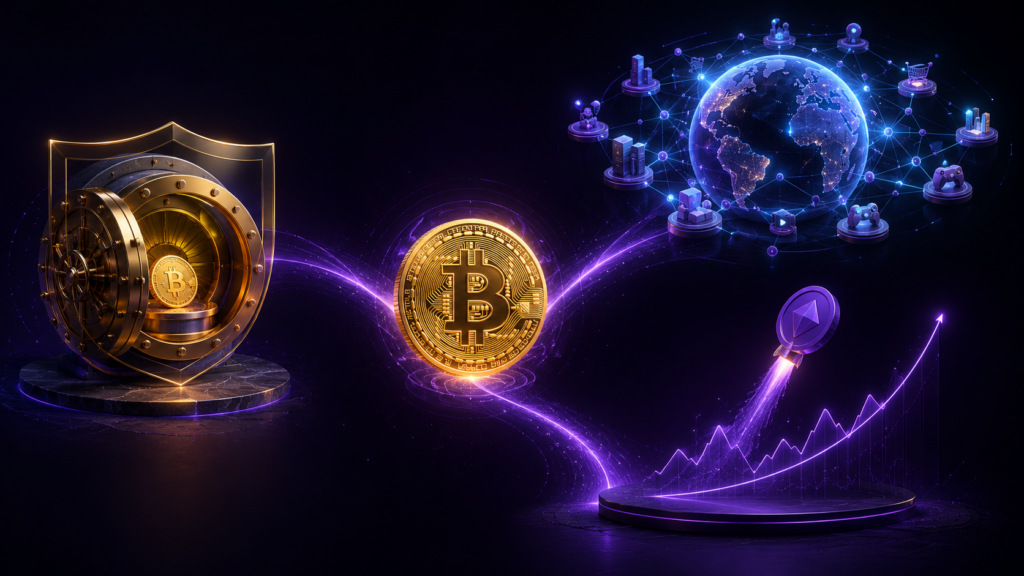
Bitcoin introduced a peer-to-peer network that uses proof of work to order transactions without a trusted intermediary. Its issuance follows a predictable schedule until the supply reaches 21 million BTC. Those rules, combined with its long operating history and broad liquidity, make Bitcoin’s position historically distinct.
Other networks can optimise for programmability, payments, transaction throughput, external data or privacy. Each choice creates different benefits and trade-offs. A proof-of-stake application network, an oracle token and a privacy-focused currency should not be evaluated as if they perform the same job as Bitcoin.
Bitcoin’s specific advantages today:
The more useful question is: Which network has a credible route to durable demand, and does its token capture value from that demand?
Also Read: Is Bitcoin a good investment
Sources: Bitcoin white paper and Bitcoin issuance FAQ.
Bitcoin remains far larger than every candidate by market capitalisation. The snapshot below illustrates the scale; it is not a price target or prediction.
| Asset | Approximate market capitalisation | Approximate share of Bitcoin’s market cap | Main comparison thesis |
|---|---|---|---|
| Bitcoin (BTC) | $1.55 trillion | 100% | Monetary network and store-of-value thesis |
| Ethereum (ETH) | $291 billion | 18.8% | Programmable settlement and applications |
| BNB | $92 billion | 5.9% | Ecosystem utility |
| XRP | $85 billion | 5.5% | Payments and tokenised-value settlement |
| Solana (SOL) | $58 billion | 3.8% | High-throughput applications |
| Hyperliquid (HYPE) | $18.5 billion | 1.2% | On-chain trading infrastructure |
| Zcash (ZEC) | $14.1 billion | 0.9% | Privacy-focused digital currency |
| Chainlink (LINK) | $8.4 billion | 0.5% | Data and cross-chain infrastructure |
| Bittensor (TAO) | $2.1 billion | 0.1% | Decentralised AI services |
Approximate CoinGecko market-cap snapshot checked on 2 September 2026. Values and rankings change continuously; update this table on the publication date.
Ethereum was less than one-fifth of Bitcoin’s market value in this snapshot. Smaller assets need less new capital to move sharply, but that does not make them more likely to succeed. It usually means their range of possible outcomes is wider.
The eight candidates were assessed using the same framework. A compelling story or recent price rise was not enough for inclusion.
What problem does the network solve, who uses it and who pays for the service? Activity created mainly by temporary rewards is weaker than demand that continues without subsidies.
Look for sustained users, applications, integrations and developer work. One viral application or a short burst of transactions does not establish a durable network effect.
Review outages, exploits, validator incidents, audits and how the network responded. No blockchain or smart-contract ecosystem is risk-free.
Check who validates transactions, changes network parameters, controls treasuries or can pause contracts. Decentralisation is a spectrum rather than a yes-or-no label.
Healthy liquidity makes it easier to enter or exit without extreme slippage. Thin or concentrated markets can make a token’s displayed value difficult to realise.
Review circulating supply, fully diluted valuation, emissions, unlocks, insider allocation and the token’s actual role. A successful product does not automatically make its token valuable.
Prefer shipped products, measurable integrations and transparent roadmaps over rumours, influencer posts or unspecified announcements.
Write down what would make you change your view before investing. Examples include shrinking usage, security failures, concentrated governance, large unlocks or a stronger competitor.
For a deeper process, read Mudrex’s guides to analysing a cryptocurrency before investing and doing your own research in crypto.
The watchlist is not a return ranking. It combines established networks with smaller, higher-risk themes so that different meanings of “next Bitcoin” can be compared honestly.
| Crypto | Core thesis | Why it enters the conversation | Main risk to the thesis |
|---|---|---|---|
| Ethereum (ETH) | Smart-contract settlement and applications | Largest established application-network comparison | Scaling complexity, fee variability and competition |
| Solana (SOL) | High-throughput application platform | Strong fit for transaction-heavy consumer and financial applications | Reliability, validator/infrastructure concentration and cyclical activity |
| XRP | Payments and tokenised-value settlement | Native payment and exchange functions | Usage may not translate directly into XRP demand; regulatory conditions vary |
| BNB | Utility across BNB Chain | Repeated gas and staking utility inside a broad ecosystem | Ecosystem and governance concentration; regulatory exposure |
| Chainlink (LINK) | Data and cross-chain infrastructure | Connects smart contracts with external data and other networks | Service adoption and LINK value capture are not identical |
| Hyperliquid (HYPE) | On-chain trading infrastructure | Product-led adoption around on-chain financial markets | Trading cyclicality, token supply, concentration and technical risk |
| Bittensor (TAO) | Incentives for decentralised AI services | Connects crypto-economic incentives with specialised AI services | Complex incentives, quality measurement and narrative risk |
| Zcash (ZEC) | Privacy-focused digital currency | Bitcoin-related design with optional shielded transactions and scarce supply | Regulatory/listing restrictions, adoption and liquidity risk |
Ethereum is a proof-of-stake blockchain designed for smart contracts and decentralised applications. ETH is used to pay network fees and can be staked by validators who help secure the chain.
Why it qualifies: Ethereum’s strongest argument is not that it copies Bitcoin. Its application and developer ecosystem can make ETH important for settlement, security and on-chain economic activity.
Why it is different from Bitcoin: Bitcoin primarily focuses on a proof-of-work monetary network. Ethereum prioritises programmability, which creates more use cases but also more technical and application-layer complexity.
What could invalidate the thesis: Persistent fee friction, fragmented user experience across scaling networks, serious security failures or sustained migration of developers and users to competitors.
Check live Ethereum chart and market data.
Solana runs on-chain programs that process instructions and update network accounts. Its design is intended to support applications that require frequent, low-friction transactions.
Why it qualifies: Solana offers a different application thesis from Ethereum: many activities can run on a high-performance base layer. That can suit trading, payments, consumer applications and other transaction-heavy products.
Why it is different from Bitcoin: SOL is used within a programmable proof-of-stake ecosystem. Its value depends more heavily on application demand and continued network execution than on a Bitcoin-style monetary thesis.
What could invalidate the thesis: Reliability problems, excessive validator or infrastructure concentration, declining developer activity, or applications failing to retain users after incentives fade.
Check live Solana price and market data.
XRP is the native asset of the XRP Ledger, a public blockchain with built-in payment, tokenisation and decentralised-exchange functions. The ledger can support direct and cross-currency payments involving XRP and issued assets.
Why it qualifies: XRP’s case is based on payment and settlement utility. If the XRP Ledger becomes more widely used for moving and exchanging value, XRP may benefit from its role in the network.
Why it is different from Bitcoin: XRP does not use Bitcoin’s proof-of-work design and is not positioned primarily as a scarcity-based monetary asset. Its thesis is tied more closely to payment flows, tokenised assets and ledger adoption.
What could invalidate the thesis: Payment adoption that bypasses XRP, limited developer growth, governance or decentralisation concerns, or adverse regulatory developments in key markets.
Check live XRP price and market data.
BNB is used for transaction fees and staking on BNB Smart Chain and has additional utility across the wider BNB Chain ecosystem.
Why it qualifies: BNB’s investment case comes from repeated utility inside a large application and trading ecosystem. Demand for blockspace, applications and related services can support token use.
Why it is different from Bitcoin: BNB is an ecosystem utility asset, not a Bitcoin-style neutral monetary network. Its success is more closely connected to BNB Chain activity and the surrounding commercial ecosystem.
What could invalidate the thesis: Regulatory pressure, ecosystem concentration, declining chain usage, security incidents or migration to competing networks.
Check live BNB price and market data.
Chainlink provides decentralised oracle networks that can deliver external data to smart contracts. Its infrastructure also supports communication and token transfers between blockchain networks.
Why it qualifies: Blockchains cannot natively know external prices, reserve balances or real-world events. If financial and real-world applications continue moving on-chain, reliable data and interoperability can become critical infrastructure.
Why it is different from Bitcoin: LINK is an infrastructure token. Its thesis depends on the use of Chainlink services and how that activity creates demand for LINK, not on becoming a standalone monetary network.
What could invalidate the thesis: Competing oracle systems, applications internalising data services, weak token value capture or security failures in high-value integrations.
Check live LINK price and market data.
Hyperliquid is a blockchain ecosystem built around on-chain financial markets. Its core trading infrastructure includes an on-chain order book, with HYPE tied to the ecosystem.
Why it qualifies: Hyperliquid represents a product-led route to crypto adoption. If users prefer transparent, on-chain markets with fast execution and deep liquidity, the network could retain meaningful financial activity.
Why it is different from Bitcoin: HYPE is tied to an application-focused financial ecosystem. Its value depends more on trading usage, ecosystem design and token economics than on Bitcoin-like monetary neutrality.
What could invalidate the thesis: Lower trading activity, stronger competitors, validator or governance concentration, smart-contract or bridge failures, token-supply pressure and regulatory risk around perpetual markets.
Check live HYPE price and market data.
Bittensor is an open network in which specialised subnets can provide digital services such as inference, compute, storage or prediction. Participants are rewarded through the network’s incentive mechanisms.
Why it qualifies: TAO connects crypto-economic coordination with artificial intelligence. If decentralised markets can reliably reward useful AI services, the network may develop a distinct form of demand.
Why it is different from Bitcoin: Bittensor is attempting to measure and reward useful outputs across specialised subnets. That creates more complex execution, incentive and governance risks than Bitcoin’s monetary design.
What could invalidate the thesis: Poor-quality subnet outputs, gaming of incentives, centralised AI services remaining superior, confusing token economics or demand driven mainly by speculation.
Check live TAO price and market data.
Zcash is a privacy-focused cryptocurrency originally derived from Bitcoin’s codebase. It uses zero-knowledge proofs to support shielded transactions that can conceal transaction details while allowing the network to verify validity.
Why it qualifies: Zcash is closer than many application tokens to the digital-currency version of the “next Bitcoin” question. It combines a limited maximum supply with a privacy function that Bitcoin does not provide natively.
Why it is different from Bitcoin: Zcash has a much smaller network, liquidity base and adoption footprint. Privacy is optional rather than universal, and its role depends on users choosing shielded transactions.
What could invalidate the thesis: Exchange or regulatory restrictions, low shielded usage, weaker liquidity, security concerns or a failure to turn privacy demand into sustained network adoption.
There is no investment with Bitcoin’s original conditions. Bitcoin began before crypto had a mature market, institutional products or millions of competing tokens. Later projects face a very different environment.
Instead of looking for an identical outcome, compare the characteristics that made Bitcoin durable:
A lower unit price does not make a token early. A smaller market capitalisation may provide more room to move, but it also reflects greater uncertainty and usually higher failure risk.
Ethereum is the only cryptocurrency with a credible path to the number one spot, because it is the only one within striking distance by market value. It powers the largest developer ecosystem in crypto, from DeFi to Layer-2 rollups to tokenised assets.
What works in its favour:
What works against it:
You can buy Ethereum in India directly in INR.
BNB is a strong contender on liquidity and usage, but a weak one on decentralisation. It is the fourth-largest cryptocurrency at $91.6 billion, powering BNB Chain and the Binance ecosystem.
Strengths: a very large global user base, consistent token burns that reduce supply, and deep liquidity across exchanges.
Risks: ongoing regulatory scrutiny of its parent exchange, and a governance structure far more centralised than Bitcoin’s. If your definition of the next Bitcoin includes Bitcoin’s decentralisation, BNB does not qualify.
XRP is a payments bet, not a store-of-value bet. At $86.9 billion it is the fifth-largest crypto, built for fast, low-cost cross-border settlement rather than for holding.
That distinction matters. Bitcoin’s investment case is scarcity. XRP’s case is throughput and institutional adoption in remittances. They can both do well, but they are not competing for the same job.
Main risk: its value depends heavily on institutional partnerships that are difficult for retail investors to verify independently.
Solana remains a top-tier Layer-1 but is trading well below its previous cycle highs, which cuts both ways. At $59.9 billion it is the seventh-largest crypto, known for very high throughput and near-zero fees.
Strengths: genuine consumer application usage, a deep memecoin and DeFi ecosystem, and one of the most active developer communities outside Ethereum.
Risks: a history of network outages, and heavy dependence on speculative on-chain activity that can dry up quickly. You can track Solana live before deciding.
Hyperliquid is the newest name here and the one most competitor articles have missed entirely. It has climbed to ninth by market cap at $18.7 billion on the back of on-chain perpetual futures trading.
Why it matters: it is one of the few crypto projects generating meaningful, visible revenue from actual usage rather than from token emissions.
Why it is risky: its circulating supply is only about 23% of its fully diluted supply, which means significant token unlock pressure ahead. This is a genuine next crypto to explode candidate, and genuinely high risk.
Privacy coins have become one of the loudest narratives of 2026, and Zcash has climbed into the top 10 by market cap at $14.6 billion. Monero, the original privacy coin, sits at $9.9 billion.
The argument is straightforward. As governments tighten crypto reporting rules, some users will pay a premium for transaction privacy. Bitcoin is pseudonymous, not private, and every transaction is permanently public.
Important for Indian readers: privacy coins face significant listing and compliance restrictions in many jurisdictions. Availability on any regulated Indian platform is not guaranteed, and that is a real liquidity risk you should check before you buy.
The two phrases describe different goals.
| “Next Bitcoin” | “Next crypto to explode” |
|---|---|
| Looks for durable adoption, security and network effects | Looks for rapid price momentum or a near-term catalyst |
| Often favours established networks or critical infrastructure | Often favours smaller and less liquid tokens |
| Should be evaluated over years | Is frequently driven by weeks or months of sentiment |
| Still carries substantial risk | Usually carries even higher failure and liquidity risk |
A token can rise rapidly without building durable utility. A network can also grow steadily without producing dramatic short-term returns. For a separate catalyst-led watchlist, read Next Big Cryptocurrency 2026: Top Coins to Watch.
No coin can be identified reliably as a future 100x or 1000x winner. Returns of that size generally require a very small starting valuation, which usually comes with thin liquidity, limited operating history, concentrated ownership and a high probability of failure.
CoinGecko’s April 2026 study found that 13.4 million of 25.2 million cryptocurrencies once listed on GeckoTerminal had stopped trading. That 53.2% figure describes GeckoTerminal-listed projects under the study’s methodology, not every established cryptocurrency, but it shows how frequently small tokens disappear.
If you research this category, focus on controls rather than a promised multiple:
For More information on 1000x crypto Read the detailed guide.
No. Token price does not show whether an asset is cheap. Market capitalisation—price multiplied by circulating supply—is the more useful starting point.
A token priced at $0.20 with 50 billion tokens in circulation has a $10 billion market capitalisation. A token priced at $500 with 10 million tokens in circulation has a $5 billion market capitalisation. The second asset is smaller despite its higher unit price.
Fully diluted valuation and future unlocks also matter. A low-priced token can still be expensive if a large share of its supply has not entered circulation. For more examples, read Mudrex’s guide to cryptos priced under $1.
Also Read: Top coins under $1
Indian tax rules can materially change the net outcome of a speculative crypto trade. Under current Income Tax Department guidance, gains from Virtual Digital Assets are subject to a 30% tax, along with applicable surcharge and 4% cess. A 1% TDS can apply to consideration paid on VDA transfers under the relevant provisions.
| Rule | What it means at a high level |
|---|---|
| 30% tax plus applicable surcharge and cess | Applies to taxable VDA gains under the special tax framework |
| 1% TDS on qualifying transfers | TDS may be deducted when the transfer meets the applicable conditions |
| Loss set-off restriction | A loss from transferring one VDA cannot be used to offset income from another VDA |
| No carry-forward of such loss | The restricted VDA loss cannot be carried forward for later set-off |
| Schedule VDA reporting | VDA income is reported transaction by transaction in the relevant tax-return schedule |
This makes recordkeeping important. A portfolio can contain both winners and losers, but the losing trades may not reduce the taxable VDA income from profitable ones. TDS is also not the final tax liability; it is a tax credit that must be reconciled when filing the return.
Tax treatment depends on the transaction and the investor’s circumstances, and rules can change. Verify the latest Income Tax Department VDA guidance, use Mudrex’s crypto tax calculator and consult a qualified chartered accountant for personal advice.
Start with official documentation, the white paper, governance proposals, token contracts and release notes. Then cross-check claims using block explorers, independent analytics and published security reports.
Circulating market capitalisation reflects the tokens currently in the market. Fully diluted valuation estimates the value if the defined total or maximum supply were already circulating. A large gap can indicate future dilution risk, although the release schedule and future demand also matter.
Check how much supply is held by insiders, foundations, treasuries and early investors. Large unlocks do not guarantee a price decline, but they can change available supply and incentives.
Before buying, understand where the asset trades, withdrawal support, network fees, wallet compatibility and realistic slippage. A displayed gain is less useful if liquidity is thin or withdrawals are restricted.
Use only money you can afford to lose. Staggered purchases can spread entry-price risk, but they cannot prevent losses. Avoid leverage unless you fully understand liquidation, funding and the possibility of rapid loss. Review the thesis instead of assuming that a falling price automatically creates value.
One concern may require more research. Several together can invalidate the investment thesis.
There is no cryptocurrency that can be identified as the next Bitcoin in advance. Bitcoin’s first-mover history, monetary design and liquidity make its path unique.
Ethereum and Solana are the clearest established comparisons for application adoption. XRP, BNB and Chainlink represent different payment and infrastructure theses. Hyperliquid, Bittensor and Zcash provide higher-risk exposure to on-chain trading, decentralised AI and privacy.
The useful question is not “Which coin will definitely repeat Bitcoin’s returns?” It is: Which network has durable demand, credible security, transparent tokenomics and a token that captures value from real usage?
Apply the same framework to every coin, write down what would invalidate the thesis and verify live market and product data before making a decision. Indian investors should also estimate tax and TDS effects rather than evaluating returns only before tax.
For more guides and information, check out Mudrex Learn or the Mudrex YouTube Channel.
Download the app to trade in Next Bitcoin.
There is no confirmed next Bitcoin. Ethereum and Solana are the strongest established comparisons for application-network adoption, while XRP, BNB, Chainlink, Hyperliquid, Bittensor and Zcash represent different payment, infrastructure, trading, AI and privacy theses.
No coin can be identified with certainty. Ethereum is the closest candidate by market capitalisation, but it is designed for programmable applications rather than to copy Bitcoin’s monetary role.
Ethereum is the closest large-network comparison, but it is not a Bitcoin replica. Ethereum prioritises programmable applications and proof-of-stake security, while Bitcoin prioritises a proof-of-work monetary network with a fixed issuance schedule.
XRP is not a Bitcoin replica. Its thesis is based on payment, exchange and tokenisation use cases on the XRP Ledger. Whether that usage creates durable demand for XRP is a central question for investors.
No asset offers Bitcoin’s original market conditions. Investors can compare traits such as scarcity, network effects, liquidity, security and credible utility, but the risks and possible outcomes will be different.
A single replacement is unlikely because crypto networks serve different purposes. Bitcoin can remain a monetary asset while other networks specialise in applications, payments, data, trading, AI or privacy.
It cannot be known reliably. Rapid price momentum often depends on short-term liquidity and sentiment, whereas a “next Bitcoin” thesis requires durable usage, security and network effects.
Only very small assets can mathematically rise 1000 times from a low valuation, and most fail or never develop enough liquidity for investors to realise the displayed return. Treat any specific 1000x prediction as speculation rather than analysis.Read the detailed guide.
No. Unit price does not show valuation. Market capitalisation, fully diluted value, circulating supply, ownership and future unlocks are more informative than whether one token costs less than $1.
No special tax category applies because an asset is described as a “next Bitcoin.” It is generally treated under India’s VDA tax framework. Tax outcomes depend on the transaction and current rules, so investors should verify official guidance and obtain personal tax advice.
Risk: Cryptocurrency investments are subject to market risk and can lose value rapidly. Prices, market caps and rankings in this article reflect data as of 1 September 2026 and will change. Leveraged products magnify both gains and losses, and can result in losses exceeding your initial capital. All examples in this article, including the tax calculation, are illustrative and do not represent expected returns.Nothing here is financial, legal or tax advice. Tax treatment depends on your individual circumstances and may change. Consult a qualified financial advisor and a chartered accountant before making any investment or filing decision.