

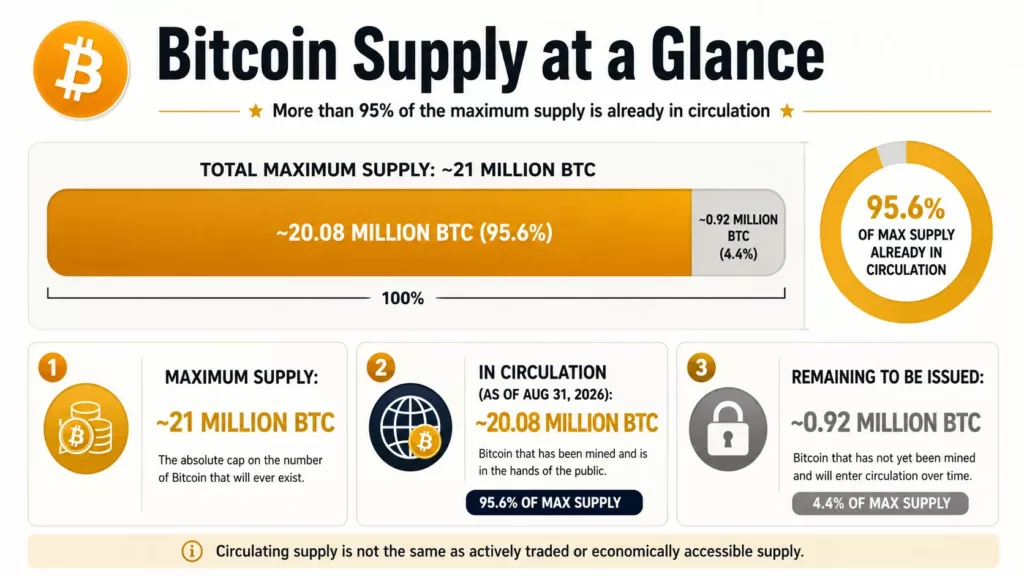
If you’re wondering how many Bitcoins are there in the world, the headline answer is approximately 21 million BTC. But that number doesn’t tell the whole story. As of August 31, 2026, approximately 20.08 million BTC were in circulation, leaving roughly 0.92 million BTC still to be issued under Bitcoin’s current consensus rules.
More than 95% of Bitcoin’s eventual supply has already entered circulation, yet the remaining supply will take more than a century to release because the block subsidy is repeatedly cut in half.

The current Bitcoin block subsidy is 3.125 BTC per block. At an average of about 144 blocks per day, that represents roughly 450 newly issued BTC per day. The subsidy is expected to fall to 1.5625 BTC at the next halving and continue declining through subsequent halvings. New issuance is expected to reach zero around 2140.
That is why answering how many Bitcoins are there currently requires more than quoting the 21 million maximum. Maximum supply, circulating supply, newly issued BTC and the amount of Bitcoin that is actually accessible to holders are different concepts.
Bitcoin’s supply increases when miners add valid blocks to the blockchain and claim the block subsidy permitted by the protocol. The subsidy represents newly created BTC. Transaction fees are different: they are existing bitcoins paid by users to miners and therefore do not increase Bitcoin’s total supply.
As of August 31, 2026, approximately 20.08 million BTC were in circulation, representing roughly 95.6% of Bitcoin’s approximately 21 million maximum supply. That leaves about 0.92 million BTC still to be issued through future block subsidies.
Because new BTC are created as blocks are mined, the exact figure changes continuously.
Bitcoin supply metric | Meaning |
| Maximum supply | Approximately 21 million BTC under Bitcoin’s current consensus rules |
| Circulating supply | A market-data measure of BTC considered to be in circulation |
| Remaining supply | BTC that can still be created through future block subsidies |
| Dormant BTC | Coins that have not moved for an extended period |
| Potentially lost BTC | Coins that may be inaccessible because their private keys are unavailable |
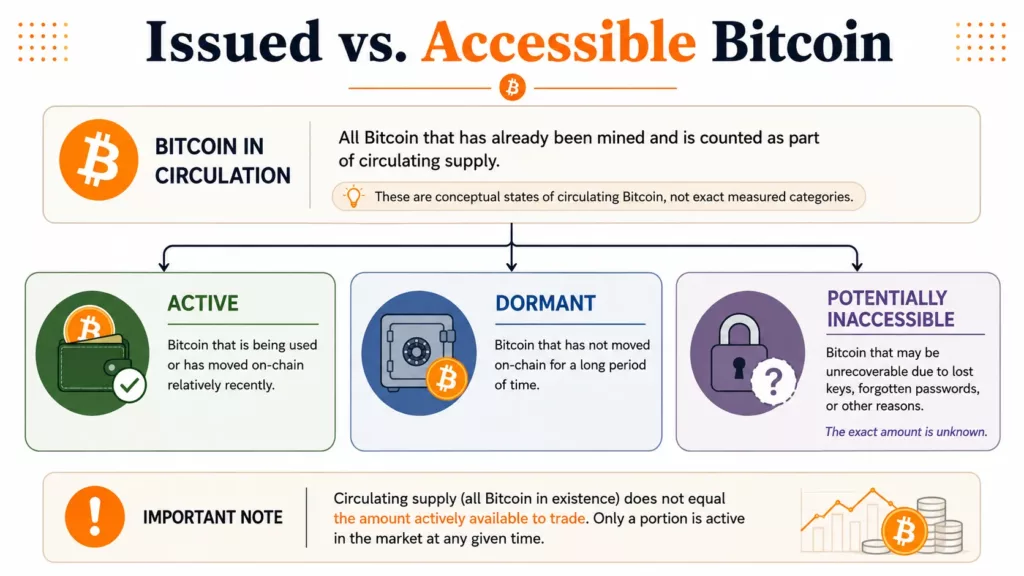
One important distinction is that circulating does not mean actively traded. The blockchain can show that bitcoins exist and whether they have moved, but it cannot reliably determine whether an inactive wallet belongs to a long-term holder or someone who has permanently lost access.
Also Read: What is Bitcoin Wallet Address?
Bitcoin has a maximum supply of approximately 21 million BTC under its current consensus rules. The limit is enforced through Bitcoin’s monetary rules rather than by a central bank, company or government. New BTC are issued through mining according to a predetermined block-subsidy schedule, and that subsidy becomes smaller over time.
The commonly cited maximum is 21 million BTC. The actual issuance schedule results in a total slightly below exactly 21 million BTC because Bitcoin records amounts in satoshis, its smallest unit.
The important point is that Bitcoin does not create new coins at a constant rate. Its supply schedule is front-loaded: large amounts were issued during Bitcoin’s early years, while future issuance becomes progressively smaller.
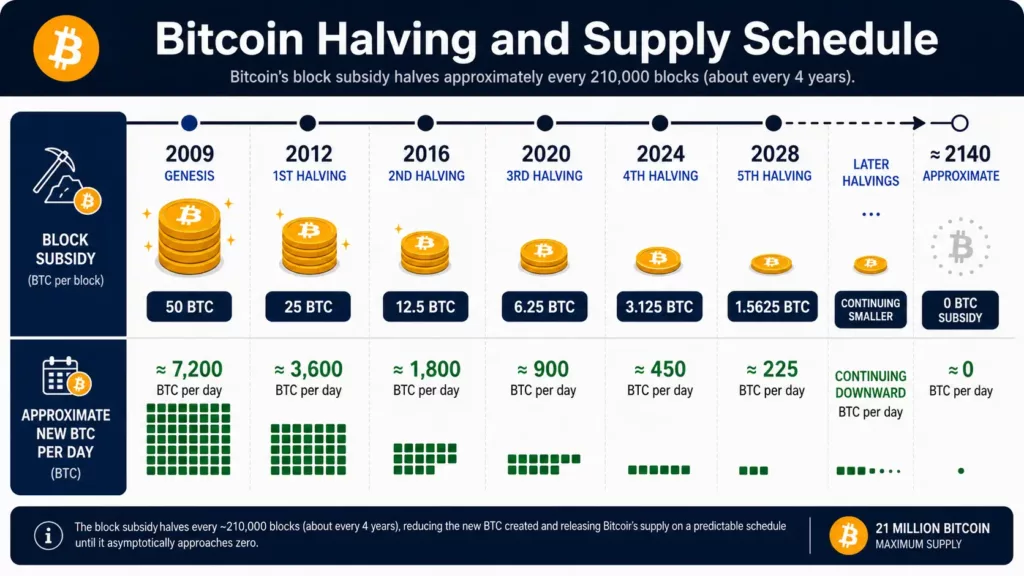
Bitcoin’s monetary design began with a 50 BTC block subsidy in 2009. Every 210,000 blocks, the subsidy is cut in half. The sequence has moved through 25 BTC, 12.5 BTC, 6.25 BTC and the current 3.125 BTC subsidy. The next scheduled subsidy is 1.5625 BTC.
This creates a predictable supply curve. Instead of a central authority deciding how many new coins should be created each year, Bitcoin’s issuance follows rules that network participants can independently verify.
The result is a monetary system in which the rate of new Bitcoin creation is known in advance and decreases over time.
New Bitcoin enters the supply through mining. Bitcoin miners use specialized computing equipment to compete to add valid blocks to the blockchain. When a miner produces a valid block accepted by the network, the miner can claim the block subsidy and collect transaction fees from the transactions included in the block.
Only the block subsidy creates new BTC. Transaction fees are payments made from existing BTC.
For example, if a block contains 0.5 BTC in transaction fees and the current block subsidy is 3.125 BTC, the miner’s total reward would be 3.625 BTC. However, only 3.125 BTC would represent newly created Bitcoin. The 0.5 BTC in fees already existed elsewhere in the Bitcoin supply.
In everyday language, people often say “Bitcoin left to be mined.” Technically, these are BTC that remain to be issued through future block subsidies.
The April 2024 halving reduced Bitcoin’s block subsidy from 6.25 BTC to 3.125 BTC per block. The next halving is expected in 2028, when the subsidy will fall to 1.5625 BTC.
Bitcoin targets an average of roughly one block every 10 minutes. Using an average of 144 blocks per day:
3.125 BTC × 144 blocks = 450 BTC per day
That works out to approximately:
450 BTC × 365 days = 164,250 BTC per year
These are averages rather than fixed daily allowances. Blocks are not mined at exactly 10-minute intervals, so actual daily issuance varies. Bitcoin adjusts mining difficulty to keep the long-term block interval close to its target.
A Bitcoin halving cuts the block subsidy by 50%. It occurs every 210,000 blocks, which is roughly four years at Bitcoin’s target average block interval.
| Halving era | Block subsidy | Approx. new BTC per day* |
| 2009 launch | 50 BTC | ~7,200 BTC |
| 2012 | 25 BTC | ~3,600 BTC |
| 2016 | 12.5 BTC | ~1,800 BTC |
| 2020 | 6.25 BTC | ~900 BTC |
| 2024 | 3.125 BTC | ~450 BTC |
| 2028 expected | 1.5625 BTC | ~225 BTC |
| Later eras | Continues decreasing | Continues decreasing |
*Approximate figures based on 144 blocks per day. Actual block production varies.
The halving does not remove existing Bitcoin. It reduces the amount of new BTC entering the supply.
This explains one of Bitcoin’s most important supply characteristics. More than 95% of its eventual supply has already entered circulation, but the remaining portion takes far longer to issue because each halving reduces the amount created with every block.
Want to know the price of Bitcoin in future? Read the detailed guide
The amount of Bitcoin left to be issued can be expressed simply:
Bitcoin remaining = maximum supply − circulating supply
Using approximately 20.08 million BTC in circulation as of August 31, 2026:
21 million − 20.08 million ≈ 0.92 million BTC
That means roughly 0.92 million BTC remain to be issued under Bitcoin’s current subsidy schedule. The figure is rounded and changes as new blocks are mined.
The important point is that 0.92 million BTC remaining does not mean Bitcoin will run out soon.
The remaining coins will be released increasingly slowly. The current 3.125 BTC subsidy will eventually fall to 1.5625 BTC, then 0.78125 BTC, then 0.390625 BTC and continue decreasing through successive halvings.
This declining issuance rate is why Bitcoin’s final coins will take more than a century to issue.
The most striking feature of Bitcoin’s supply schedule is how differently its first 20 million BTC compare with its final roughly 1 million.
| Supply milestone | Approximate timeframe |
| First ~20 million BTC | About 17 years |
| Remaining ~1 million BTC | More than 100 years |
| Expected end of new issuance | Around 2140 |
Bitcoin issued its first approximately 20 million BTC during the network’s early years, when the block subsidy was much larger. The final roughly 1 million BTC will be released much more slowly because successive halvings keep reducing the subsidy.
In 2009, miners could receive 50 BTC per block. Today, the subsidy is 3.125 BTC. After the next halving, it will fall to 1.5625 BTC.
The supply curve is therefore heavily front-loaded. Bitcoin issued large quantities of new coins in its early years, while the remaining supply is distributed across progressively smaller block subsidies.
That is why the statement “only around 1 million Bitcoin remain” should always be paired with the explanation that those coins will be issued very slowly.
Also Read: Is bitcoin a good investment
Bitcoin’s block subsidy is expected to reach zero around 2140. The halving schedule shows the reward declining from 50 BTC in 2009 toward zero as successive halvings continue.
2140 is an estimate, not a fixed appointment on the calendar.
Bitcoin’s issuance schedule is based on block height rather than a specific date, and blocks are discovered probabilistically. Bitcoin targets one block every 10 minutes on average, but individual blocks can arrive sooner or later.
The precise calendar date of the final subsidy therefore cannot be known today.
Also Read: Why BTC down today?
The amount of Bitcoin in circulation is not necessarily the amount actively available in the market.
Some BTC are held and moved regularly. Some have remained untouched for years. Others may be inaccessible because their owners have lost private keys, wallet backups or recovery information.
The blockchain can show that coins exist and whether they have moved, but it generally cannot determine why an address has remained inactive. A wallet that has not moved BTC for 15 years could belong to a long-term holder or someone who has permanently lost access.
That is why dormant Bitcoin should not automatically be classified as lost Bitcoin.
Circulating-supply figures published by market-data providers are useful market metrics, but they should not be interpreted as a precise count of every bitcoin that is immediately available to buy or sell.
There is no single number that perfectly represents how many bitcoins are economically available to buy or sell at any given moment.
There is no definitive number for how many bitcoins are permanently lost.
When a user loses access to a wallet, the associated bitcoins remain recorded on the blockchain but cannot be spent without the required private keys.
Bitcoin can become inaccessible through lost private keys, destroyed wallet backups, forgotten recovery information, death without successful transfer of wallet access, or coins sent to unspendable conditions.
The important distinction is that lost Bitcoin does not disappear from the blockchain. The coins remain part of the recorded supply, but they may no longer be economically accessible.
For example, if someone permanently loses the private key controlling 1 BTC, the Bitcoin network does not create a replacement BTC and does not reduce the 21 million supply limit. That 1 BTC remains recorded on the blockchain even if it can never be spent again.
Because dormant coins cannot reliably be distinguished from permanently lost coins, estimates of total lost Bitcoin should be treated as estimates rather than established supply figures.
Also Read : Best bitcoin wallets
No single person, company or government controls Bitcoin’s supply. The issuance schedule is enforced through Bitcoin’s consensus rules.
Miners produce blocks. Nodes enforce the rules.
Miners cannot simply decide how many new BTC to create. Nodes independently validate blocks and transactions according to the consensus rules they enforce.
Bitcoin Core’s validation system allows full nodes to independently verify blocks and reject those that violate Bitcoin’s consensus rules.
For example, if a miner attempted to claim 10 BTC in newly created subsidy when the permitted subsidy was 3.125 BTC, nodes enforcing the current rules could reject that block.
This means miners do not get to rewrite Bitcoin’s monetary policy simply because they operate mining hardware.
Bitcoin is open-source software, so different code can be written and proposed. But changing the software does not automatically change the rules followed by the entire Bitcoin network.
Increasing Bitcoin’s supply limit would require changing its consensus rules and gaining adoption for those new rules. Users who continued enforcing the existing rules could reject blocks that created unauthorized BTC.
A developer, miner or company therefore cannot simply announce that Bitcoin now has a 25 million BTC supply and make that change apply to everyone.
A different supply rule could be proposed, but it would only become part of the Bitcoin network if participants adopted and enforced the new consensus rules.
When the block subsidy eventually reaches zero, miners will no longer receive newly created BTC. Mining can continue, with transaction fees becoming the primary economic incentive for miners to process transactions and secure the network.
Today, miner revenue can be simplified as:
Block subsidy + transaction fees = miner revenue
After new issuance ends:
Transaction fees = miner revenue
Transaction fees are already part of miner revenue, but their importance will increase as the block subsidy becomes smaller.
The exact economics of mining around 2140 cannot be predicted today. Future miner revenue will depend on Bitcoin usage, demand for block space, transaction-fee levels, mining technology, electricity costs and the value of BTC.
What is predictable is the transition itself: the subsidy declines according to Bitcoin’s schedule until it reaches zero.
Bitcoin’s limited supply is one part of its monetary design, but scarcity alone does not determine its price.
The protocol controls how quickly new BTC are created. It does not control demand.
If demand increases while new issuance remains low, buyers may compete for existing BTC. If demand decreases, a fixed supply does not guarantee that Bitcoin’s price will rise.
Bitcoin’s supply cap should therefore be understood as a supply characteristic, not a promise of investment returns.
This distinction also explains why Bitcoin supply and Bitcoin available for sale are different concepts. The blockchain can establish how many BTC have been issued, while market availability depends on holder behavior, liquidity and the willingness of owners to sell.
Curious to know whether Bitcoin can reach $1 million in 2026? Read the detailed guide
A maximum supply of approximately 21 million BTC does not mean Bitcoin can support only 21 million individual units or payments.
Each bitcoin is divisible into 100 million satoshis.
1 BTC = 100,000,000 satoshis
For example:
This divisibility means the 21 million BTC limit is not a practical limit on the number of users or transactions Bitcoin can support.
| Metric | Figure |
| Maximum supply | Approximately 21 million BTC |
| Circulating supply, August 31, 2026 | Approximately 20.08 million BTC |
| Percentage of maximum supply in circulation | Approximately 95.6% |
| Remaining supply | Approximately 0.92 million BTC |
| Current block subsidy | 3.125 BTC |
| Approx. new BTC per day | ~450 BTC |
| Approx. annual issuance at current average | ~164,250 BTC |
| Next scheduled subsidy | 1.5625 BTC |
| Halving interval | 210,000 blocks |
| Average block target | 10 minutes |
| Smallest standard unit | 1 satoshi |
| Satoshis per BTC | 100 million |
| Expected end of new issuance | Around 2140 |
The circulating-supply figure is an August 31, 2026 snapshot and changes as new blocks are mined. Daily and annual issuance figures are approximate calculations based on an average of 144 blocks per day.
So, how many Bitcoins are there in the world? The simplest answer is approximately 21 million BTC maximum, with about 20.08 million BTC in circulation as of August 31, 2026. That means roughly 95.6% of Bitcoin’s maximum supply is already in circulation, leaving approximately 0.92 million BTC to be released through future block subsidies.
The important part is what happens next. Bitcoin currently has a 3.125 BTC block subsidy, equivalent to roughly 450 newly issued BTC per day when using an average of 144 blocks. The subsidy will be cut in half again in 2028 and continue declining every 210,000 blocks. That is why the remaining supply will take more than a century to issue even though more than 95% is already in circulation.
Not every bitcoin in circulation is necessarily active or accessible. Some BTC are held for years without moving, while others may be permanently inaccessible because their private keys have been lost. The blockchain records those coins, but it cannot reliably determine whether an inactive wallet belongs to a long-term holder or someone who has lost access.
Bitcoin’s supply is also not controlled by a central issuer. Miners produce blocks, while validating nodes enforce the consensus rules that determine how much new BTC can be created. Once the block subsidy eventually reaches zero around 2140, miners are expected to rely primarily on transaction fees.
The three numbers worth remembering are approximately 21 million BTC maximum, about 20.08 million BTC in circulation as of August 31, 2026, and roughly 0.92 million BTC remaining to be issued. The live supply figure will continue to change, but the underlying principle remains the same: Bitcoin’s issuance is predictable, its block subsidy declines over time, and its monetary rules are enforced by the network rather than a central issuer.
To keep learning, explore Mudrex Learn and follow the Mudrex YouTube channel for practical crypto education. Always assess product, custody, market and protocol risks before committing funds.If you are ready to trade Bitcoin then Download the app.
Bitcoin has a maximum supply of approximately 21 million BTC. As of August 31, 2026, about 20.08 million BTC were in circulation, leaving roughly 0.92 million BTC to be issued through future block subsidies.
As of August 31, 2026, approximately 20.08 million BTC were in circulation. However, circulating supply is not the same as actively traded or immediately accessible supply because some BTC are dormant and some may be permanently inaccessible.
Bitcoin’s maximum supply is approximately 21 million BTC under its current consensus rules. New BTC are issued through mining according to a decreasing block-subsidy schedule.
BTC’s maximum supply is approximately 21 million BTC under its current consensus rules. The block subsidy progressively decreases until new issuance reaches zero.
Bitcoin uses a predetermined issuance schedule in which the block subsidy is cut in half every 210,000 blocks. The declining subsidy gradually reduces new BTC creation until issuance stops.
As of August 31, 2026, roughly 0.92 million BTC remain to be issued under Bitcoin’s current subsidy schedule. The exact number changes as new blocks are mined.
New Bitcoin issuance is expected to reach zero around 2140. The exact calendar date is an estimate because Bitcoin’s issuance schedule is based on block height and actual block production varies over time.
No single person or organization controls Bitcoin’s supply. The issuance rules are part of Bitcoin’s consensus rules, which validating nodes enforce when checking blocks and transactions.
Changing the maximum supply would require changing Bitcoin’s consensus rules and gaining adoption for those new rules. A miner, developer or company cannot unilaterally increase Bitcoin’s supply for everyone.
New BTC issuance will stop when the block subsidy reaches zero. Mining can continue, with transaction fees becoming the primary source of miner revenue.