
A Bitcoin wallet address is a destination you can share when you want to receive BTC. It is not the same as your wallet, public key, private key or seed phrase. Bitcoin also uses several address formats, including Legacy, P2SH, Native SegWit and Taproot. This guide explains what those prefixes mean, how to find or generate a receiving address, why wallets may show a new address for each payment, and the checks to make before sending Bitcoin.
A Bitcoin wallet address is a human-readable encoding that represents a Bitcoin payment destination. When BTC is sent, the transaction creates an output with spending conditions corresponding to the address type. A wallet can derive many receiving addresses from its keys, so seeing a new address in the Receive screen does not necessarily mean you have created a new wallet.

Visit our Bitcoin Detail Page to track Live Price, Market Data and Chart
| Term | What it does | Should you share it? |
| Bitcoin address | Provides a destination for receiving BTC | Yes, when you want to receive BTC |
| Public key | Cryptographic information used in spending and verification rules | Not secret, but different from a receiving address |
| Private key | Authorises spending under the relevant conditions | No |
| Seed phrase | Can recover keys and addresses in compatible wallets | No |
The simplest distinction is: the address tells someone where to send BTC, while the private key or equivalent signing credentials let the owner authorise spending. Sharing a receiving address is expected; sharing a private key or recovery phrase can compromise the wallet.
Also Read : Best Bitcoin Wallets in India
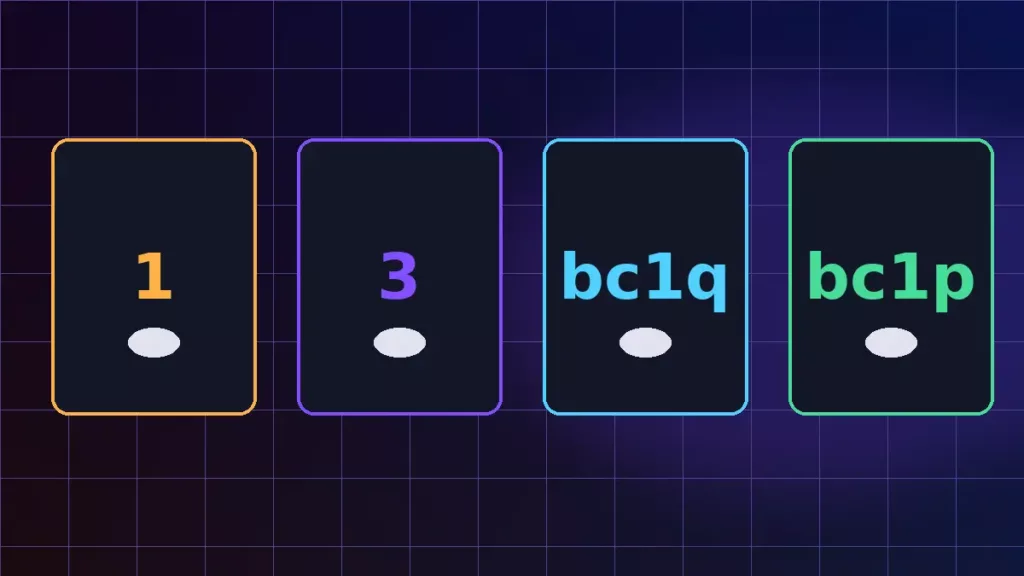
A Bitcoin wallet address is a string of letters and numbers, usually between 26 and 62 characters long depending on its format. The first few characters — the prefix — tell you which format it is.
1A1zP1eP5QGefi2DMPTfTL5SLmv7DivfNa34 characters. Base58Check encoding, so it mixes uppercase and lowercase letters and excludes easily confused characters like 0, O, I and l. This particular address is the one that received the very first block reward in 2009, which is why you will see it quoted in Bitcoin documentation.
3J98t1WpEZ73CNmQviecrnyiWrnqRhWNLy34 characters. Also Base58Check. A P2SH address commits to a script rather than a single public key, which is why it is used for multisig arrangements and for older wrapped-SegWit setups.
bc1qw508d6qejxtdg4y5r3zarvary0c5xw7kv8f3t442 characters. Bech32 encoding, which is why it is all lowercase. Bech32 addresses are case-insensitive by design and are usually displayed in lowercase.
bc1p0xlxvlhemja6c4dqv22uapctqupfhlxm9h8z3k2e72q4k9hcz7vqzk5jj062 characters. Bech32m encoding, used for witness version 1 and above.
Do not send funds to any of the addresses above. They are published examples used for illustration only. Your own receiving address will always come from your wallet or exchange account.
You may also see a Bitcoin wallet address presented as a QR code. The QR code encodes the same string of characters — scanning it is simply a way to avoid typing or mis-pasting.
Check Live BTC to INR price
| Format | Prefix | Encoding | Relative transaction size | Support | Typically used for |
|---|---|---|---|---|---|
| Legacy (P2PKH) | 1 | Base58Check | Largest of the four | Universal | Older wallets and long-standing addresses |
| Script hash (P2SH) | 3 | Base58Check | Varies with the script | Very broad | Multisig, wrapped SegWit |
| Native SegWit (P2WPKH) | bc1q | Bech32 | Smaller than Legacy | Broad, occasional gaps on older platforms | Everyday receiving on modern wallets |
| Taproot (P2TR) | bc1p | Bech32m | Comparable to or smaller than native SegWit for simple spends | Growing, but the least universal | Newer wallets, privacy and script flexibility |
For ordinary receiving, use whichever modern format your wallet offers by default — usually native SegWit or Taproot. Use P2SH when a multisig setup or a specific platform requires it. Only pick Legacy if the sending platform genuinely cannot handle anything else, which is increasingly rare. If a platform rejects a bc1p address, generate a bc1q or 3 address from the same wallet instead — the funds still land in the same wallet.
Fee differences come from transaction size, not from the address itself. A smaller transaction occupies less block space, so at the same fee rate it costs less. The exact saving depends on the number of inputs and outputs in the transaction, so treat the size column above as a general ordering rather than a fixed percentage.
The original address type, introduced with Bitcoin itself. It commits to a hash of a single public key. Spending requires a signature from the matching private key. Addresses begin with 1.
Introduced to let senders pay to a set of spending conditions without needing to know what those conditions are. The address commits to a hash of a script; the spender reveals the script and satisfies it at spending time. Addresses begin with 3.
A common misconception: not every address starting with 3 is a SegWit address. P2SH is a broader mechanism, and SegWit-wrapped-in-P2SH is only one of the things it is used for. Multisig arrangements are another.
The native SegWit version of P2PKH. Signature data moves into the witness section of the transaction, which reduces the weight the transaction contributes to a block. Addresses begin with bc1q and use Bech32 encoding.
The native SegWit equivalent of P2SH, used for script-based conditions such as multisig. Also begins with bc1q, but the address is noticeably longer than a P2WPKH address because it commits to a 32-byte script hash rather than a 20-byte key hash.
Introduced with the Taproot upgrade. It can be spent either with a single signature along the key path, or by revealing one branch of a script tree. Simple spends look identical on-chain to any other Taproot key-path spend, which is where the privacy benefit comes from. Addresses begin with bc1p and use Bech32m, the encoding specified for witness version 1 and above.
You never choose the characters in your address. Your wallet derives them, and the derivation runs in one direction only.
When you set up a self-custody wallet, it generates a large random number: the master private key. This is usually presented to you as a seed phrase of 12 or 24 words, which is a human-readable encoding of the same secret.
The master private key produces extended public keys, often called xpubs, and each xpub can generate a long series of individual public keys. This is why one seed phrase can back up thousands of addresses.
The public key is passed through cryptographic hash functions to produce a shorter fingerprint. Hashing is one-way: you can go from public key to address, but not back from address to public key, and certainly not to the private key.
The hash is combined with a version prefix and a checksum, then encoded as Base58Check, Bech32 or Bech32m depending on the address type. That final encoded string is what you share.
The practical consequence: your seed phrase can regenerate every address your wallet has ever shown you, on any compatible wallet software. Your addresses are not stored anywhere that needs backing up — the seed phrase is the backup.
Every Bitcoin wallet address format includes a checksum — a few characters derived from the rest of the address. If a single character is altered, the checksum almost certainly no longer matches, and any competent wallet will reject the address as invalid before you can send anything to it.
This is a strong safety net against typos and truncation. It is not a safety net against sending to the wrong person. A valid checksum only tells you the string is a well-formed Bitcoin wallet address, not that it belongs to whoever you think it does.
So how much should you verify? Because the checksum catches accidental alteration, the widely used habit is to compare the first several and last several characters of the address on your signing screen against the address the recipient gave you. That catches the realistic accidents.
When that is not enough: if you are sending a large amount, or if there is any chance a deliberate attacker has substituted the address, compare the full string, and compare it against a copy you received through a channel the attacker would not control. An attacker who is generating look-alike addresses on purpose can match the first and last few characters — that is the entire premise of address poisoning, covered further down.
Read About: When will bitcoin bottom
Different address types represent different Bitcoin output structures and can have different transaction-size characteristics. Newer SegWit formats can be more block-space efficient than comparable older formats, which can reduce fees in some situations. Compatibility also matters: the sending wallet or platform must support the receiving format.
The route depends on whether you hold BTC on an exchange or in a wallet where you control the keys.
An exchange gives you a deposit address. The exchange controls the private keys behind it; you control the account.
Because you hold the keys, the seed phrase you wrote down at setup is the only recovery route. Nobody can reset it for you.
Most modern wallets show a new receiving address after each payment. That is normal behaviour, not a sign that anything has changed. Previously shown addresses generally keep working.
If you are in India, there are three practical ways to end up with a Bitcoin wallet address, and they differ mainly in who holds the keys.
You register on an FIU-registered platform, complete KYC with PAN and Aadhaar, fund the account in INR through UPI or bank transfer, and the platform gives you a BTC deposit address. This is the simplest starting point and the only one that connects directly to rupees. The trade-off is that the platform holds the private keys, so access depends on your account remaining in good standing.
You install a wallet app, it generates a seed phrase, and you get an address immediately — no KYC, no account, no minimum. You hold the keys and the full responsibility for the seed phrase. There is no recovery if you lose it.
Keys are generated and stored on a dedicated device that never exposes them to an internet-connected computer. This is the strongest option for meaningful amounts held long term. It costs money up front and involves buying from a reputable source, ideally directly from the manufacturer rather than a third-party marketplace listing.
A common pattern for Indian users is to combine them: buy in INR on an exchange, then withdraw to a self-custody wallet address for longer-term holding.
On tax and compliance. India applies a flat 30% tax on gains from transferring virtual digital assets, plus a 1% TDS on transactions above the prescribed thresholds. Moving BTC between two wallets you own is not a sale, but the reporting and TDS treatment of specific transaction types is detailed and changes — confirm your position with a qualified tax advisor rather than relying on a general guide.
Yes. A valid Bitcoin wallet address does not automatically stop working after one payment. However, repeated reuse can make it easier for observers to link transactions and build a clearer picture of your on-chain activity. Many modern wallets therefore generate a fresh receiving address for new payments. Using a fresh address when the wallet provides one is generally better for privacy.
The Bitcoin blockchain is public, so anyone can inspect transactions involving an address. The blockchain itself does not normally contain a verified real-world name for that address, but identity can sometimes be inferred from outside information — for example, if a person publishes an address, reuses it publicly or sends funds through a service that links blockchain activity to an account.
That is another reason address reuse matters. A new receiving address cannot make Bitcoin fully anonymous, but it can reduce simple address-level linking between separate payments.
No. A Bitcoin wallet address on its own cannot be used to spend anything. Spending requires a valid signature produced by the private key, and the private key cannot be derived from the address — the hashing that produces an address only works in one direction. You can share a receiving address publicly without putting the funds at risk.
What your address does expose is information. Anyone holding it can look it up on a block explorer and see every transaction involving it, the amounts, the timing, and what it currently holds. If they know the address belongs to you, they now have a window into that part of your activity — and if you have reused the address, that window covers everything it has ever received.
This is also why the practical risk around addresses is social, not cryptographic. Nobody breaks the maths. They persuade you to send to the wrong address, or persuade you to hand over the seed phrase.
Bitcoin uses unspent transaction outputs, or UTXOs, rather than a bank-account-style balance model. Transactions create outputs and later spend them. A wallet tracks the UTXOs it can spend across the addresses and keys it controls, then presents an aggregate BTC balance. Looking up one receiving address on a block explorer may therefore show only part of the BTC controlled by a wallet.
Because Bitcoin spends whole UTXOs, a transaction usually cannot send exactly the amount you intend without leftovers. If you hold a single 0.5 BTC output and want to send 0.1 BTC, the transaction spends the entire 0.5 BTC, sends 0.1 BTC to the recipient, and returns the remainder — minus the network fee — to an address your own wallet controls. That return destination is the change address.
Your wallet generates it automatically and it is usually not an address you have ever seen. Your balance accounts for it correctly, which is why the wallet total looks right even though the address you originally shared now shows a zero balance on an explorer.
This causes two recurring confusions worth knowing about:
A block explorer is a public search engine for the blockchain. You can look up any address without permission from its owner.
This is useful for confirming that a payment you sent has actually broadcast and how many confirmations it has, and for checking that a deposit address has received what you expected.
What an explorer cannot tell you:
Almost every real-world loss involving addresses comes from sending to the wrong destination, not from anything breaking cryptographically. Three patterns account for most of it.
The attacker sends a tiny or zero-value transaction to you from an address deliberately generated to share the first and last few characters of an address you have used before. It then sits in your transaction history looking familiar. Later, when you copy an address from your history rather than from the recipient, you copy theirs.
Defence: never reuse an address out of your own transaction history. Always take the destination from the recipient, fresh, for each payment.
Software on your device watches the clipboard for anything that looks like a crypto address and silently replaces it with the attacker’s when you paste. The address you copied and the address you pasted are different, and nothing on screen announces the swap.
Defence: after pasting, compare what is now in the field against the source. On a hardware wallet, verify the destination on the device’s own screen — that display is outside the reach of malware on your computer.
A QR code is unreadable to a human, which makes it an ideal place to hide a substituted address. Codes shared over social media, pasted into chat, or printed and displayed in public can be swapped without anyone noticing.
Defence: after scanning, read the address your wallet has actually filled in, and check it against a copy received through a channel you trust.
Across all three: for any transfer large enough to hurt, send a small test amount first, confirm it arrives, then send the rest.
Bitcoin transactions are generally irreversible after confirmation. If BTC is sent to an address controlled by someone else, recovery may be impossible without that person’s cooperation. When a centralised platform offers multiple withdrawal networks or token representations, follow the receiving platform’s instructions rather than choosing a network based only on how an address looks.
Sending through an unsupported network can make funds inaccessible or require a provider-specific recovery process, and recovery is not guaranteed. The safe approach is to verify both ends before sending.
Not everything you can send bitcoin to is a Bitcoin address, and mixing them up causes failed or stuck payments.
| What it is | What it looks like | Where it settles | |
|---|---|---|---|
| Bitcoin address | An on-chain receiving destination | Starts with 1, 3, bc1q or bc1p | On the Bitcoin blockchain |
| Lightning invoice | A request to be paid a specific amount over the Lightning Network, usually time-limited | A long string starting with ln | Off-chain, on a Lightning payment channel |
| Lightning address | A reusable human-readable handle that resolves to a Lightning invoice behind the scenes | Formatted like an email address | Off-chain, on Lightning |
Practical implications: a Lightning invoice is generally single-use and expires, whereas a Bitcoin wallet address does not expire. An on-chain wallet cannot pay a Lightning invoice, and a Lightning wallet cannot receive an on-chain payment to an invoice string. If a platform asks for a Bitcoin address, give it one starting with 1, 3, bc1q or bc1p — not an ln string and not an email-style handle.
Read About : Bitcoin Price History
Bitcoin runs a separate test network for developers, and it uses its own address prefixes so that test coins and real coins cannot be confused.
| Network | Prefixes |
|---|---|
| Mainnet (real BTC) | 1, 3, bc1q, bc1p |
| Testnet | m, n, 2, tb1q, tb1p |
Testnet coins have no monetary value and cannot be moved to mainnet. If a wallet or platform gives you an address starting with tb1 or m, you are on a test network — check which network your wallet is set to before doing anything else.
Read about: Is Bitcoin Traceable?
Read : Bitcoin Price Prediction
A Bitcoin wallet address is designed to be shared, but the credentials that control spending are not. Understanding the difference between addresses, keys and address formats makes transfers easier to verify. The most important habit is simple: check the asset, network, complete destination, amount and fee before signing because confirmed Bitcoin transactions usually cannot be reversed.
To keep learning, explore Mudrex Learn and follow the Mudrex YouTube channel for practical crypto education. Always assess product, custody, market and protocol risks before committing funds.If you are ready to trade Bitcoin then Download the app.
A Bitcoin wallet address is a shareable destination for receiving BTC. It represents a Bitcoin output type and is different from a wallet, private key or seed phrase.
Common mainnet addresses can begin with 1, 3, bc1q or bc1p, corresponding to different output and encoding formats.
No. A public key is cryptographic information used in spending and verification rules. A Bitcoin address is an encoded receiving destination derived from or associated with a script or key condition.
Yes, a receiving address is intended to be shared. However, its activity is public on the blockchain, so address reuse can reduce privacy. Never share your private key or seed phrase.
Generally, no. An old address may remain valid, but many wallets provide a new receiving address for privacy and address-management reasons.
bc1q is commonly used for native SegWit version 0 addresses encoded with Bech32. bc1p is used for Taproot/witness version 1 addresses encoded with Bech32m.
Usually, yes, if the sending wallet or platform supports the bc1p address format. Check the sender’s and receiver’s instructions before sending.
Funds can become inaccessible or require a provider-specific recovery process. Recovery depends on the platforms and wallets involved and is not guaranteed.
It depends on the format. Legacy and P2SH addresses are typically 26 to 35 characters. Native SegWit addresses starting with bc1q are usually 42 characters, and Taproot addresses starting with bc1p are 62. Length alone does not indicate whether an address is valid — the checksum built into every format is what determines that.
Open a Bitcoin wallet, select Bitcoin (BTC) and choose Receive. The wallet will display a Bitcoin receiving address and usually a QR code. Depending on the wallet, the address may begin with 1, 3, bc1q or bc1p.
Yes. You can enter a Bitcoin address into a blockchain explorer to view its transaction history and on-chain activity. A valid address lookup does not necessarily reveal who owns it.