
Cloud storage is one of those services most people use every day without thinking much about what happens behind the scenes. Photos, documents, backups and application data all need somewhere to live – and much of that storage is controlled by a relatively small number of large providers.
Sia takes a different approach. Instead of relying on a centralised cloud-storage company, it connects people who need storage with independent storage providers through a decentralised network.

That gives Siacoin (SC) a real use case. But a useful product does not automatically make a cryptocurrency a good investment. The bigger questions are whether Sia can attract sustained storage demand, whether the network can compete with established decentralised-storage projects, and whether SC can capture enough value to justify its risks.
The following figures are based on market data available on 15 September 2026. Cryptocurrency prices and market data change continuously.
| Metric | Siacoin |
|---|---|
| Current price | Approximately US$0.0009 |
| Price in India | Approximately ₹0.09 |
| Circulating supply | Approximately 56.03 billion SC |
| Market capitalisation | Approximately US$50–55 million |
| Maximum supply | No fixed maximum supply |
| All-time high | Approximately US$0.1117 |
| Consensus mechanism | Proof of Work |
| Primary utility | Decentralised storage payments |
| Network | Sia |
For the latest SC price and SC/INR chart, check the live Siacoin price on Mudrex.
Siacoin is the native cryptocurrency of the Sia Network, a decentralised storage marketplace.
The basic idea is simple: users who need storage, known as renters, can purchase storage from independent hosts. Hosts provide spare disk capacity and receive Siacoin as compensation.
The network uses blockchain-based storage contracts to coordinate these relationships. Files are encrypted, split into pieces using erasure coding and distributed across multiple hosts rather than being stored with one central provider.
This creates a marketplace where unused storage capacity can potentially be turned into a service.
SC is therefore more than a speculative token within the Sia ecosystem. It is used to pay for storage and participate in the network’s economic model.
Sia’s model involves several important participants and processes.
A renter selects the amount of storage they need and creates storage contracts with hosts on the network.
Before being stored, data is encrypted and processed so that pieces can be distributed across different hosts.
Independent hosts contribute disk space and bandwidth to the network. They receive SC for successfully providing storage according to the terms of their contracts.
The network uses cryptographic proofs to verify that hosts are actually storing the required data.
SC is used within the network’s storage economy, connecting demand from renters with supply from hosts.
This utility gives Siacoin a fundamental use case that many purely speculative tokens lack.
The value proposition for SC ultimately depends on activity within the Sia ecosystem.
Several factors matter:
The important distinction is that network utility and token price are related but not identical. A network can provide useful technology without its token necessarily becoming a strong investment.
Siacoin is an interesting but high-risk investment, rather than an obvious long-term winner.
The strongest argument for SC is its relatively clear utility. Sia is building decentralised storage infrastructure, and SC plays a direct role in that ecosystem.
The network has also continued development in 2026. Sia Storage launched in March 2026, while work has continued on its mobile experience, SDKs, S3 compatibility, developer resources and other infrastructure. The Sia roadmap also lists further work towards broader S3 protocol compatibility.
However, the investment case depends on adoption. Sia competes in a market that includes large centralised cloud providers as well as other decentralised-storage networks such as Filecoin.
SC also has a relatively small market capitalisation. That can create substantial upside during periods of strong demand, but it can also produce sharp declines when liquidity or investor interest disappears.
So, is Siacoin a good investment in 2026? It may make sense as a small, speculative position for investors who understand decentralised storage and are comfortable with significant volatility. It is much harder to justify as a core holding based purely on its historical price or the possibility of a future bull market.
A useful way to evaluate SC is to separate the network’s fundamentals from the token’s market performance.
Sia has a specific economic purpose: connecting storage demand with independent storage providers.
That is a stronger starting point than a cryptocurrency whose primary purpose is speculation.
Sia’s development activity remains an important part of the investment thesis. In 2026, the ecosystem has focused on making decentralised storage easier to access, including improvements to Sia Storage, SDKs and S3 compatibility.
The Sia ecosystem includes applications and projects built around decentralised storage. The official Sia ecosystem highlights more than 30 projects and ongoing grant support for ecosystem development.
SC does not have a fixed maximum supply. Mining rewards continue to introduce new SC into circulation, which means investors need to consider ongoing token issuance when evaluating long-term value.
This does not automatically make SC unattractive, but it means demand needs to grow sufficiently to offset the effects of additional supply.
SC’s relatively small market capitalisation is one of its most important investment characteristics.
A smaller market cap means that comparatively modest amounts of new capital can have a significant effect on price. However, the same characteristic can amplify downside when demand weakens.
SC’s all-time high was approximately US$0.1117 in January 2018.
Its historical peak should not be treated as a target. Cryptocurrency market structures, circulating supply, adoption and investor expectations can change considerably over time.
The bull case for SC depends primarily on real adoption rather than hype.
Several developments could strengthen the thesis:
If individuals, developers and businesses increasingly seek alternatives to centralised cloud providers, Sia could benefit.
Greater usage of Sia’s consumer-facing storage products could create additional demand for the network.
Better compatibility with existing cloud-storage tools could reduce the barrier to switching to decentralised infrastructure.
Better SDKs, documentation and infrastructure could make it easier to build applications on Sia.
Smaller-cap cryptocurrencies can experience significant capital inflows during speculative bull markets.
The strongest version of the bull case is therefore not simply “SC will go up.” It is that Sia becomes a more widely used decentralised storage network and SC remains central to that economic activity.
The bear case is equally important.
Decentralised storage has existed for years, but competing with established cloud providers is difficult. If real-world usage remains limited, SC may struggle to sustain long-term demand.
Sia competes with other decentralised-storage networks, including Filecoin, while also facing enormous competition from traditional cloud providers.
SC has no fixed maximum supply. Continued issuance means demand needs to grow alongside supply for scarcity-driven appreciation to become a meaningful factor.
A small market cap can create upside, but it also makes SC more vulnerable to volatility and changes in market liquidity.
Even if Sia’s technology improves, SC can still fall sharply during broader cryptocurrency market downturns.
A good technology concept does not guarantee successful adoption. Product development, user experience, developer adoption and network reliability all matter.
A move to $1 would require a very large increase in Siacoin’s market capitalisation.
With approximately 56.03 billion SC circulating, the implied market capitalisation at different prices would be approximately:
| SC price | Approx. market capitalisation |
|---|---|
| $0.001 | $56 million |
| $0.005 | $280 million |
| $0.01 | $560 million |
| $0.05 | $2.8 billion |
| $0.10 | $5.6 billion |
| $0.25 | $14 billion |
| $0.50 | $28 billion |
| $1.00 | $56 billion |
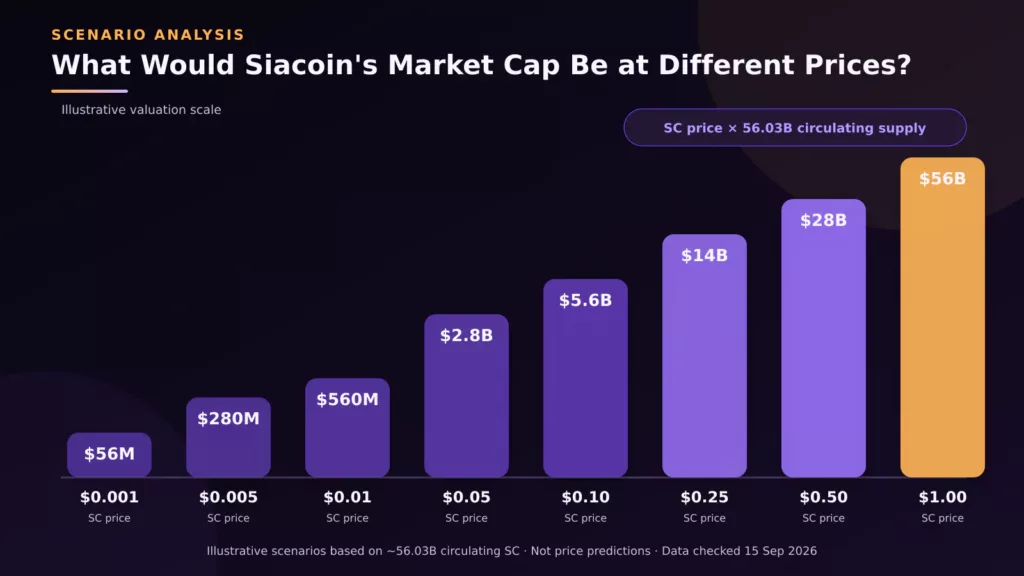
These figures are illustrative market-cap scenarios, not price predictions. They show why a $1 target should not be discussed without considering the size of the resulting network valuation.
For SC to sustain a $1 valuation, Sia would need substantially greater market demand and a market capitalisation capable of supporting that valuation.
SC’s price can be influenced by several factors at the same time.
More storage users and hosts could increase economic activity within the ecosystem.
The more useful decentralised storage becomes, the stronger the potential fundamental demand for Sia’s infrastructure.
Major improvements to Sia Storage, S3 compatibility, SDKs and developer tools can affect investor expectations around future adoption.
SC is still an altcoin, meaning its price can be heavily affected by Bitcoin’s performance and overall market sentiment.
Lower-liquidity assets can experience larger price movements from relatively small changes in buying or selling pressure.
Because SC does not have a fixed maximum supply, changes in circulating supply should be considered when assessing long-term price targets.
News, exchange activity, social-media attention and speculative trading can cause SC to move independently of its underlying network fundamentals in the short term.
Several developments would materially improve the long-term investment case.
1. Sustained growth in storage usage
Actual storage demand is more meaningful than temporary trading volume.
2. More active hosts
A larger and reliable host network can improve the availability and resilience of Sia’s storage marketplace.
3. More developers building on Sia
Developer adoption can create applications that generate additional demand for decentralised storage.
4. Easier onboarding
Consumer and business users need simple interfaces if decentralised storage is going to compete with mainstream cloud services.
5. Stronger S3 compatibility
Compatibility with familiar cloud-storage workflows could make Sia more accessible to existing users and developers. Sia’s 2026 roadmap identifies broader S3 compatibility as an ongoing development priority.
6. Growing economic activity
Ultimately, stronger storage demand, greater network usage and increasing ecosystem activity would provide a more convincing fundamental basis for SC appreciation.
SC may suit investors with a high risk tolerance and a long investment horizon, but it should not automatically be treated as a core cryptocurrency holding.
The long-term thesis depends on whether Sia can convert its decentralised-storage technology into sustained adoption.
Before investing, consider:
A low token price does not mean an asset is undervalued. Market capitalisation, supply, adoption and future demand matter far more than the number of zeros after the decimal point.
Siacoin and Filecoin both operate in the decentralised-storage sector, but they are not identical projects.
| Factor | Siacoin | Filecoin |
|---|---|---|
| Token | SC | FIL |
| Core use case | Decentralised storage marketplace | Decentralised storage and retrieval infrastructure |
| Storage providers | Hosts | Storage providers |
| Consensus | Proof of Work | Proof-based storage consensus |
| Market position | Smaller-cap project | Much larger decentralised-storage network by market capitalisation |
| Main investment consideration | Adoption of Sia’s storage ecosystem | Growth of Filecoin’s storage ecosystem and demand |
Filecoin’s substantially larger market presence means SC has more room to grow in percentage terms if Sia achieves meaningful adoption, but the smaller size also comes with greater liquidity and execution risks.
The better investment is therefore not necessarily the token with the lower price. Investors should compare network usage, developer activity, token economics, market capitalisation, liquidity and competitive positioning.
Read in detail here
Investing in Siacoin carries several significant risks.
SC can experience substantial price movements, particularly because of its relatively small market capitalisation.
The biggest fundamental risk is that decentralised storage does not gain enough users to create sustained demand.
Sia must compete with other decentralised-storage projects and established centralised cloud providers.
SC has no fixed maximum supply, so investors need to account for continued issuance.
Smaller cryptocurrencies can become harder to trade efficiently during periods of market stress.
Roadmaps can change, products can take longer than expected to mature, and technical improvements do not guarantee commercial success.
Cryptocurrency regulations can change across jurisdictions and may affect exchanges, token trading or decentralised-storage businesses.
SC remains exposed to Bitcoin cycles, liquidity conditions and overall investor sentiment.
Indian investors can check whether SC is available on a regulated crypto exchange that supports their preferred INR deposit and withdrawal methods.
Before buying, compare:
For a current SC/INR price reference and chart, you can use Mudrex’s live Siacoin converter.
Always verify the current availability, fees and applicable regulations before making a purchase.
Instead of relying on a Siacoin price prediction, use a simple fundamental-analysis checklist.
Look for evidence that actual users are storing data through Sia.
Follow developments involving Sia Storage, S3 compatibility, SDKs and developer infrastructure.
Understand SC’s issuance model and how additional supply could affect long-term holders.
Compare Sia with Filecoin and other decentralised-storage projects based on adoption, market capitalisation, technology and ecosystem development.
Use market-cap scenarios rather than assuming that SC can reach a particular price simply because it previously traded at a higher level.
A small-cap cryptocurrency can move much more dramatically than a large-cap asset.
If you invest, consider whether the position size reflects the project’s risk rather than simply its potential upside.
Sia’s outlook depends on whether decentralised storage can move beyond being an interesting blockchain use case and become infrastructure that people regularly use.
The project’s 2026 development roadmap provides several areas to watch, including Sia Storage, S3 compatibility, SDK improvements, file sharing and continued infrastructure development.
For investors, the most important signals are likely to be:
If these indicators improve together, the long-term case for SC becomes stronger.
If development continues but real-world adoption remains weak, the investment thesis becomes much less compelling.
Siacoin has a credible use case, but it remains a high-risk cryptocurrency investment.
Its strongest feature is that SC has a direct role in a decentralised storage network rather than being purely speculative. Sia’s continued product development in 2026 also gives investors several concrete developments to monitor.
However, the risks are substantial. Sia must compete with both decentralised-storage networks and established cloud providers. SC also has no fixed maximum supply, a relatively small market capitalisation and significant exposure to broader crypto-market cycles.
For that reason, SC may be worth researching for investors who believe decentralised storage will grow and who can tolerate substantial volatility. But the investment case should be based on network adoption, token economics, market capitalisation and competitive positioning, not simply on the hope that SC will return to its previous all-time high or reach $1.
In short, Siacoin has long-term potential, but potential is not the same as certainty. The key question for investors is whether Sia can turn its technology into sustained demand for decentralised storage.
Siacoin can be an interesting speculative investment because it has a defined utility within the Sia decentralised-storage network. However, it carries substantial risks, including volatility, competition, token inflation and adoption risk. Whether it is suitable depends on your risk tolerance and portfolio.
The future of SC largely depends on Sia’s ability to increase real-world adoption of its decentralised-storage products and infrastructure. Product development, storage demand, developer activity and ecosystem growth are key indicators to watch.
A $1 SC price would imply a market capitalisation of approximately $56 billion based on about 56.03 billion circulating SC. That would represent a very large increase from its current valuation and would require substantial growth in demand and market value. The figure should therefore be treated as a scenario rather than a prediction.
SC’s price can be affected by Sia adoption, storage demand, product development, token supply, liquidity, Bitcoin’s performance, overall crypto-market sentiment and speculative trading.
The main risks include high volatility, limited adoption, competition from Filecoin and centralised cloud providers, ongoing token issuance, liquidity risk, development risk, regulatory uncertainty and broader cryptocurrency-market downturns.
SC may be suitable for investors who understand the decentralised-storage sector and can tolerate high volatility. It is generally better viewed as a higher-risk speculative position than as a low-risk core investment.
SC availability depends on the exchange and current market conditions. Indian investors should compare supported SC/INR markets, fees, liquidity, withdrawal options and applicable tax and regulatory requirements before purchasing.
Both target decentralised storage, but they use different architectures and economic models. Filecoin has a much larger market presence, while Siacoin represents a smaller-cap alternative with potentially greater percentage upside but also greater risk.
Focus on actual storage adoption, network activity, product development, token supply, market capitalisation, liquidity, competitive positioning and the size of your potential portfolio allocation. Avoid relying solely on historical price targets or third-party price predictions.
Risk note: This article is educational and does not constitute financial advice. Crypto assets are volatile, and investors can lose their entire investment.