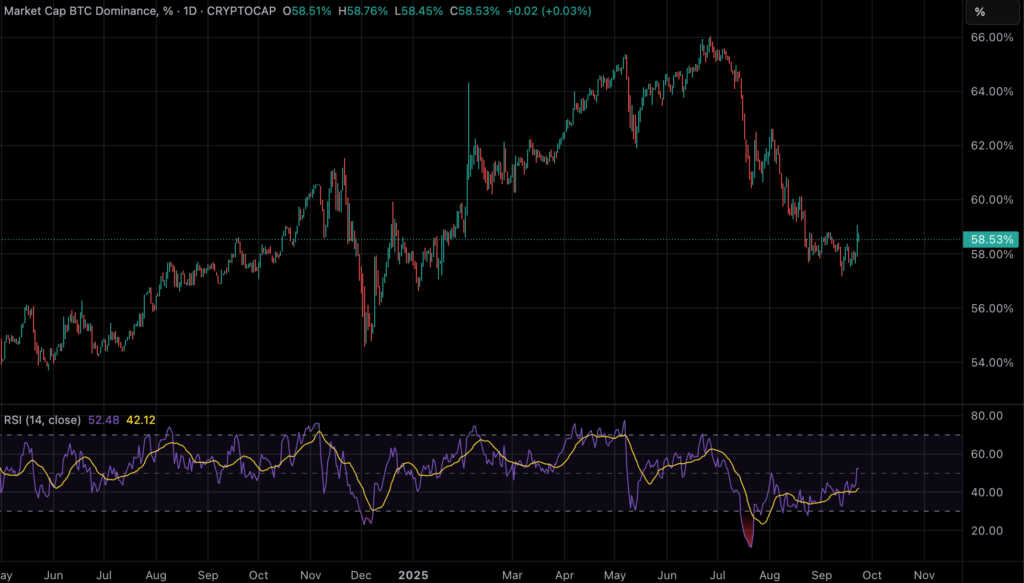
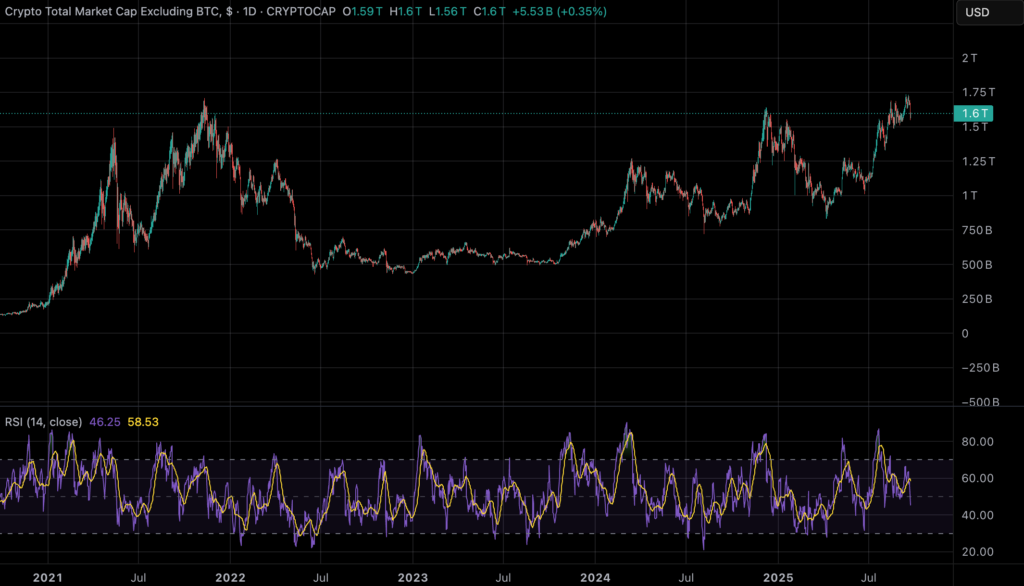
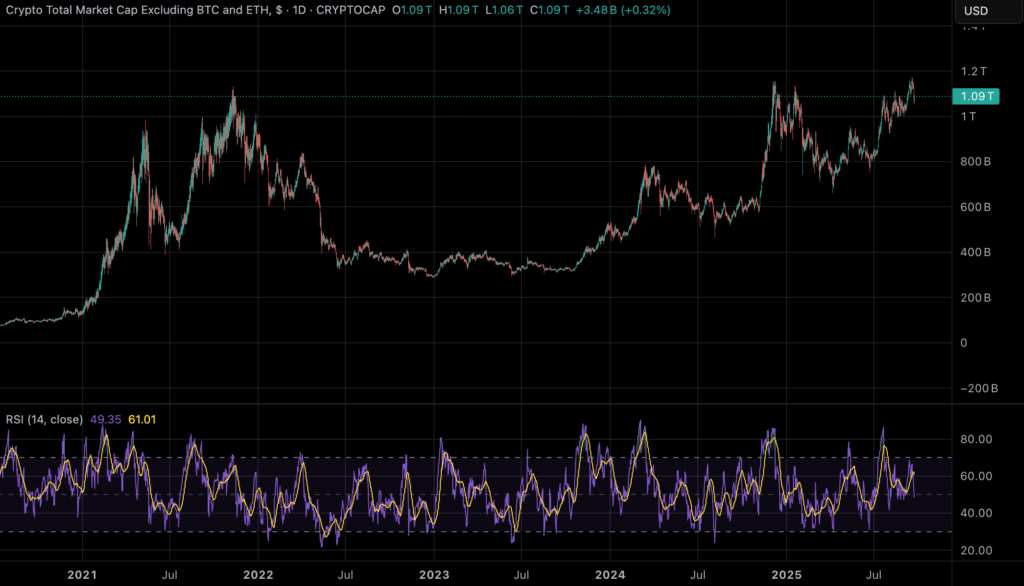
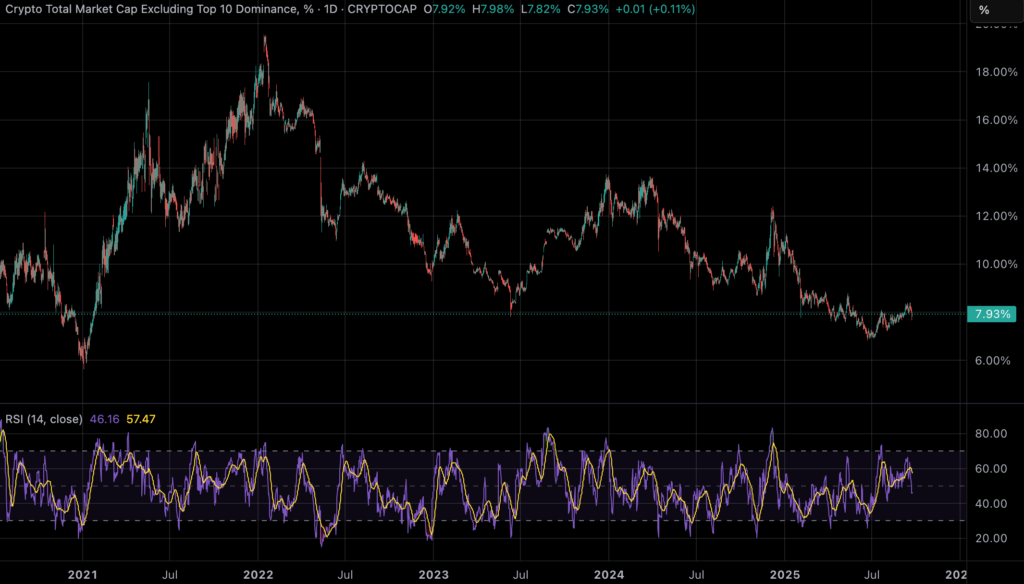
Altcoin dominance is simply the combined market share of all cryptocurrencies except Bitcoin. It can be computed as 100% minus BTC.D. For instance, if Bitcoin is 50% of the crypto market cap, altcoins make up the other 50%. When altcoin dominance is rising, it means that altcoins as a whole are appreciating faster (or falling slower) than Bitcoin, so they gain relative share. When alt dominance is falling, Bitcoin is capturing a larger slice of the capital.
Several related metrics help refine this picture:
Altcoin Dominance & Portfolio Allocation in Bull vs Bear Markets
BTC.D (Bitcoin Dominance): The percentage of total crypto market cap in BTC. It is the mirror of altcoin dominance. A rising BTC.D means Bitcoin is outperforming most alts; a falling BTC.D means altcoins are collectively winning. Analysts watch BTC.D for regime shifts: a break downward from a high BTC.D can herald an upcoming altcoin cycle.
Altcoin Dominance & Portfolio Allocation in Bull vs Bear Markets
TOTAL2 (Crypto Cap ex-BTC): The absolute USD market capitalization of all altcoins (every coin except Bitcoin). When TOTAL2 is rising on strong volume, it confirms that altcoins are truly gaining value (not just that Bitcoin fell). For example, if BTC’s price is flat but TOTAL2 climbs, it implies new money is flowing into alts.
Altcoin Dominance & Portfolio Allocation in Bull vs Bear Markets
TOTAL3: Same concept but excludes Ethereum as well (cap of all crypto except BTC and ETH). This measures the “smaller” alt market. TOTAL3 is useful for spotting rallies in mid- and small-cap coins; if TOTAL2 is up but TOTAL3 is flat, gains are concentrated in the biggest alts (like ETH) rather than broad-based.
Altcoin Dominance & Portfolio Allocation in Bull vs Bear Markets
OTHERS.D (Top-10 Excluded Dominance): This index shows the share of all crypto outside the top 10 by market cap (also excluding major stablecoins). It essentially filters out BTC, ETH, and the largest alts to highlight how much share the rest are taking. A rising OTHERS.D means smaller-cap coins are commanding more of the market – a classic late-stage altcycle sign when even tiny tokens are pumping.
Altcoin Dominance & Portfolio Allocation in Bull vs Bear Markets
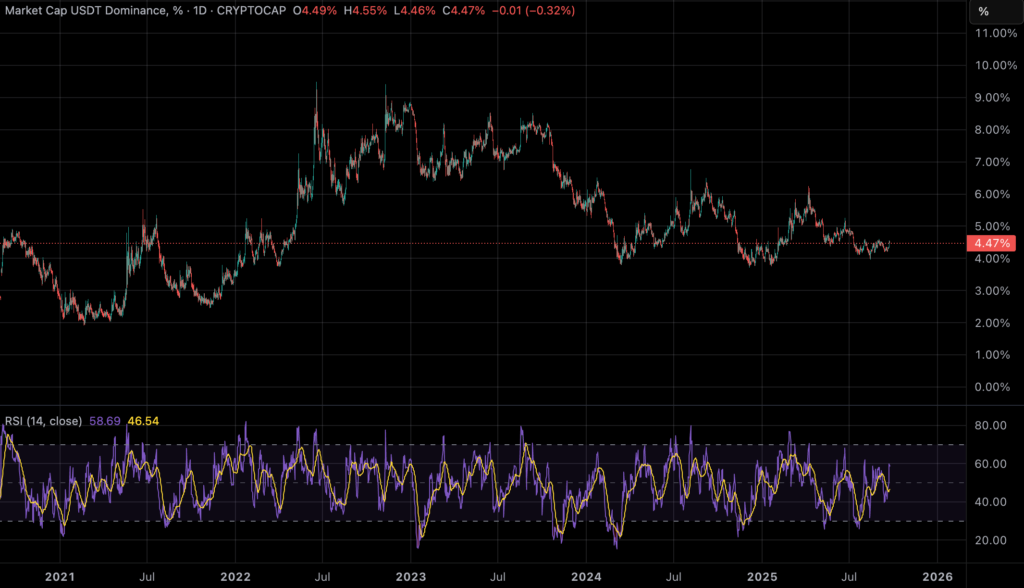
Stablecoin Dominance (e.g. USDT.D): The share of stablecoins (like USDT, USDC, etc.) in total crypto cap. Rising stablecoin dominance usually means a lot of money is parked in “cash” (flight-to-safety). Because stablecoins are technically part of the “altcoin” market cap, a big inflow into stables can fake an apparent altcoin rally. In fact, as the Mudrex analysis notes, Bitcoin’s share can fall just because investors sold everything into USDT, making it look like alt dominance is up. Thus analysts separately watch USDT.D; a drop in USDT.D (money leaving stables) combined with falling BTC.D and rising TOTAL2 is a more reliable alt-bullish signal.
Why Dominance Shifts (Bull vs Bear Mechanics)
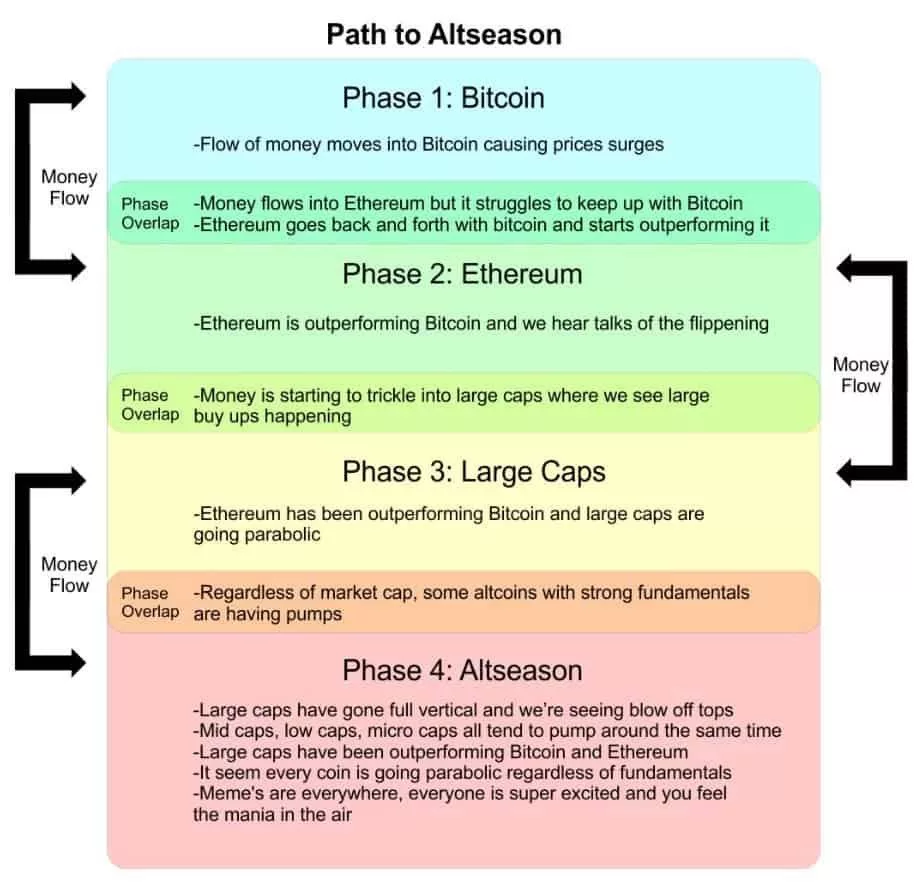
Portfolio capital tends to “rotate” through crypto markets along a risk hierarchy. In a bull market, money often starts in Bitcoin, then cascades into progressively smaller or more speculative sectors as the rally matures. A simplified rotation ladder might look like: Bitcoin → Ethereum/Solana (large-cap majors) → other large-caps (e.g. AVAX, DOT) → mid/small-caps → memecoins/niche tokens.
Liquidity & Macro: Loose monetary policy and inflows (ETFs, rate cuts) fuel risk-on and alt rotations; tightening pulls money back into BTC/stables.
Risk Appetite: As confidence grows, capital trickles from BTC into alts; leverage and positive funding accelerate the move.
Narratives: Each cycle has themes (2017 ICOs, 2021 DeFi/NFTs, today’s AI/gaming/memecoins) that drive bursts of alt dominance.
Leverage & Volatility: High funding and margin use boost bull legs; liquidations and volatility spikes often mark the shift back to risk-off.
Reading the Signals (Pre-Altseason & Risk-Off)
Bull-lead indicators
In bull markets, there are a few clear signs that altseason may be approaching. A common pattern is when Bitcoin rallies strongly and then begins to consolidate. Once Bitcoin’s gains slow, investors often rotate into altcoins in search of higher returns. A sustained decline in Bitcoin dominance (BTC.D) is another important signal, showing that Bitcoin is losing market share as capital moves into alts.
To confirm that this is genuine, traders also look at the overall market cap of altcoins. If charts like TOTAL2 or TOTAL3 are rising on strong volume, it indicates that money is truly flowing into altcoins rather than just shifting within the market. A drop in stablecoin dominance (such as USDT.D falling) adds further confirmation, as it means funds are leaving “cash” positions and moving back into crypto. Finally, a healthy altseason usually shows breadth—with multiple sectors like Layer-1s, DeFi, and NFTs all rallying together, not just one or two isolated coins.
Bear / risk-off indicators
On the other hand, bear or risk-off signals tend to look very different. When Bitcoin dominance and stablecoin dominance rise together, it shows that investors are moving to safety by parking capital in BTC and stables. At the same time, if TOTAL2 and TOTAL3 stall or begin to roll over, it suggests that demand for altcoins is fading. Negative breadth—where only a handful of alts are rising while the majority are falling—is another warning sign. Finally, sudden spikes in volatility or sharp shifts in funding rates often signal the start of a correction, as leveraged positions unwind.
The key takeaway is that no single indicator, such as falling BTC.D, is enough on its own. For a true altseason, signals need to align: Bitcoin dominance falling, altcoin market caps rising, stablecoin dominance dropping, and strong participation across multiple sectors. Likewise, if stablecoin dominance is climbing, it is often a red flag that the move is defensive rather than a genuine alt rally.
Portfolio Allocation Frameworks by Market Regime
Strategic core-satellite model
A simple way to structure a crypto portfolio is the core–satellite model. The core (about 60–80%) sits in blue-chip assets like Bitcoin and often Ethereum, which provide stability. The satellites (20–40%) are spread across higher-risk alts—layer-1/2s, DeFi, NFTs, or gaming tokens—aiming for bigger upside. The idea is that the core anchors your portfolio, while satellites capture growth.
Dynamic weights by dominance bands
You can also adjust weights dynamically based on Bitcoin dominance. When BTC.D is above 60% (post-bear or early bull), it makes sense to keep heavy BTC exposure (70–85%) and only small alt positions. In the mid-range (50–60%), reduce BTC slightly and add more majors and alts (BTC 55–70%, majors 15–25%, alts 10–20%). When BTC.D falls below 50% and keeps dropping (classic altseason), it’s safer to tilt further into alts (BTC 40–55%, majors 20–30%, alts 15–35%). These aren’t strict rules, but they highlight the principle: increase alt exposure as BTC dominance declines, and rotate back to BTC/stables when it rebounds.
Rebalance cadence
No matter the approach, rebalancing is key. This can be done periodically (monthly or quarterly) or when allocations drift too far (say 5–10% from target). The goal is to realign positions without chasing FOMO or panicking in drawdowns. For example, if BTC swells from 60% to 75% of your portfolio, you trim back to target and redistribute. Many investors use spreadsheets or exchange tools to automate these adjustments.
For systematic traders, you can codify dominance signals and risk filters into quant rules. For example:
Composite Dominance + Breadth Filter: Require simultaneous conditions like “BTC.D ↓ AND OTHERS.D ↑ AND USDT.D ↓” to confirm a bullish regime. In other words, Bitcoin losing share and smaller alts gaining share and stablecoin share falling. This ensures you only go long alts when dominance signals align.
Momentum Filter: Use price momentum (e.g. TOTAL2’s moving averages) to avoid false starts. For instance, check that TOTAL2’s 50-day MA is above its 200-day MA (a classic golden-cross) to confirm a sustained uptrend in the alt market. Similarly, require ETH/BTC to be rising before over-weighting altcoins, since ETH often leads alt runs.
Risk Guardrail: Limit total portfolio volatility or drawdown. You might cap the portfolio’s overall volatility (e.g. no more than 60% annualized crypto vol) or set a max drawdown stop (e.g. if portfolio falls 15% from the recent high, cut risk). Implementation could include ATR-based position sizing or even stop-loss orders on a basket. In practice, you might hedge downturns with inverse futures or simply reduce exposure as signals fade.
These rules can be backtested on historical data. The dominance + breadth composite, in particular, is a rule you can code and test to see if it reliably picks the altcoin rally phases in past cycles.
Sector Rotations Inside “Alts”
Within the broader “altcoin” bucket, different sectors often rotate in popularity. Examples include:
Layer-1 vs Layer-2: Core blockchain platforms (Ethereum, Solana, Avalanche, etc.) versus their scaling chains (Polygon, Arbitrum). Both can lead at different times.
DeFi: Decentralized finance protocols (Uniswap, Aave, Synthetix, etc.) often rally together when risk appetite is high. These tokens provide exposure to blockchain financial services.
Emerging Themes: New narratives like AI-related crypto, Perpetual DEXes, Real-World Asset (RWA) tokens, or others. Stay aware of what sectors are trending in the community.
Memecoins: Very high-beta social tokens tend to spike late in cycles after widespread bullishness, then crash hardest in bear phases.
Each sector has a different risk-return profile, so position sizes should reflect that. For instance, you might give larger allocations to proven sectors (large-cap DeFi platforms) and tiny allocations to memecoins. Also consider liquidity: it may make sense to scale up in deeper markets (e.g. ETH, SOL) and only micro-allocate to low-liquidity gems.
Stablecoins: The Hidden Variable
Stablecoin dominance can muddle your interpretation of dominance metrics. Recall that stablecoins count as “alts” in many indices. If traders dump crypto into USDT (for example) during a crash, total crypto cap stays high but speculative assets plummet. This causes BTC.D to drop and alt dominance to look like it’s rising – even though real altcoins are falling.
For example, if USDT.D jumps from 8% to 12%, it mechanically lowers BTC.D (and boosts reported alt share) without any genuine altcoin buying. That’s a “stablecoin season,” not an altseason.
To counter this, track stablecoins explicitly. Chart USDT.D (and USDC.D) on the side. Prefer periods when stable dominance is falling (money exiting cash) along with other bullish signals. You can also compute an alt dominance ex-stables metric: for instance, (1 – BTC.D – USDT.D), which tells you the share of non-BTC, non-USDT market cap. If this ex-stable alt dominance is rising, it’s a cleaner alt-bullish sign. In any case, when USDT.D is surging, the prudent move is to favor Bitcoin and actual cash (stablecoins) over jumping into flimsy alt projects.
Risk Management Essentials
Crypto markets are volatile, so solid risk controls are crucial. Key practices include:
Max Portfolio Risk & Position Caps: Limit how much of the portfolio can be lost. For example, impose a maximum drawdown (say 20%) at which you exit or hedge. Cap any single coin position (e.g. no more than 5–10% of portfolio per alt).
Exchange/Custody Risk: Don’t keep all coins on one exchange or wallet. Use reputable exchanges, consider hardware wallets for long-term holdings, and diversify where you custody coins.
Stop-losses & Hedging: Use stop-loss orders on exchanges to automatically sell portions if price crashes. For example, you might set 10% stop losses on a basket of alts when market conditions worsen. If you trade derivatives, you can hedge by buying inverse futures (opening a short position). The key is having a plan to cut risk if the market flips.
Funding/Borrow Costs: If you hold positions with leverage or margin, always monitor funding rates. High negative funding (you get paid to short, or you pay to long) can signal stress. Ensure you’re comfortable with the borrowing costs (which can eat into returns) or avoid high-leverage bets altogether.
Drawdown Plan: Predefine what actions to take at drawdown levels. For example, decide that at a 10% drawdown, you will liquidate weak positions; at 20%, you’ll hedge or move to full BTC/stables. Some investors use a de-risk ladder: gradually reduce alt exposure as losses mount rather than an all-or-nothing cutoff.
Remember that in crypto, capital preservation is as important as upside capture. Plan your risk limits before deploying capital, and stick to them.
Examples
Bullcase: Suppose Bitcoin dominance drifts from ~60% to ~52% while TOTAL2 is breaking out (alt market cap surging) and USDT.D is falling. This confluence signals a genuine altcycle. A disciplined approach would be to rotate perhaps 10–15% of your portfolio from Bitcoin into high-quality alts at that point. For instance, you might trim some BTC and buy Ethereum, Solana, and top large-cap altcoins. The idea is to ride the broad alt momentum
Bearcase: Conversely, imagine BTC.D rises from 48% to 56% and USDT.D ticks up. That indicates money flowing back to Bitcoin/stables. Here you would shift in the other direction: trim 10–20% of your alt positions (especially smaller caps) and allocate into Bitcoin or stablecoins. You may also tighten stops or move your core portion into cash. This defensive rebalance locks in gains and protects capital during the correction
These are illustrative. The exact percentages depend on your risk tolerance and timeframe. The key is responding to dominance signals according to plan, not by emotion.
Tools
Dominance Dashboards: Track key metrics live. TradingView offers built-in tickers like CRYPTOCAP:BTC.D, CRYPTOCAP:TOTAL2, CRYPTOCAP:TOTAL3, CRYPTOCAP:OTHERS.D, and CRYPTOCAP:USDT.D for real-time dominance charts. CoinGecko and CoinMarketCap also provide dominance charts. Use these to monitor BTC.D and alt dominance at a glance.
Allocation/Scenario Calculators: A simple spreadsheet can take current weights and alert you how far allocations have drifted from targets. You can build formulas that recalc your portfolio weights as prices move, or use portfolio tracker apps (like CoinStats) to visualize composition.
Rebalancing Templates: Pre-made templates or tools (Excel, Python scripts, or exchange features) can compute how much to buy/sell when rebalancing. Otherwise, keep a sheet where you list your target %, actual %, and trade amounts needed to rebalance.
Risk Budgeting Sheet: Maintain a risk overview document. Track metrics like current portfolio volatility, worst drawdown, and largest single-asset exposure. Tools or notebooks (like Google Sheets) can log your daily P&L and measure how it relates to risk budgets. This keeps you honest about whether you’re meeting your own limits.
Conclusion
Altcoin dominance is a contextual signal for portfolio allocation, not a magic bullet. As traders often warn, a falling BTC.D isn’t automatically an alt-buy – it could be driven by rising stablecoin inflows. The smart approach is to use dominance charts in concert with price action and breadth. In practice, maintain Bitcoin (and often Ethereum) as the portfolio core and only rotate into alt-heavy positions when multiple indicators (BTC.D down, TOTAL2 up, USDT.D down, etc.) align. Equally, have a plan to de-risk when those signals reverse.
In summary, let dominance charts inform your timing and allocation weights, but always apply sensible risk management. A rule-based strategy – for example, adjusting weights by BTC.D bands and rebalancing on drift – can help capture altcoin upside in bull runs while preserving capital in bear markets. By treating dominance as one piece of the puzzle (a “context signal”), and coupling it with clear rules and stop-losses, beginners can navigate crypto’s cycles more safely and systematically.
How does altcoin dominance affect portfolio allocation?
It shows when capital is rotating into or out of alts, guiding whether you lean heavier on Bitcoin, majors, or higher-risk altcoins.
What Bitcoin dominance level signals altseason?
Altseason usually starts when BTC.D drops below ~50% and keeps falling, showing money moving into alts.
How much should I allocate to Bitcoin vs altcoins?
Beginners often keep 60–80% in BTC/ETH as core, with 20–40% in altcoins depending on risk tolerance.
Why do altcoins fall when BTC falls?
Alts are higher-beta assets, so they typically drop harder when Bitcoin corrects and liquidity exits the market.
How many crypto coins should I hold in a portfolio?
Most investors do best with 5–10 well-researched coins across key sectors to balance upside with focus.
What’s the best way to rebalance a crypto portfolio?
Rebalance periodically (monthly/quarterly) or when allocations drift 5–10% from targets, using limit orders to cut slippage.
What happens when Bitcoin dominance goes down?
It means Bitcoin is losing market share; if TOTAL2 is rising, it’s usually because altcoins are outperforming.
How do stablecoins change dominance and signals?
Rising USDT.D/USDC.D means money is parked in cash, which can distort alt dominance and fake an “altseason” signal.
What are optimal crypto allocation rules in bull/bear markets?
In bulls, tilt more into alts as BTC.D falls; in bears, rotate back into BTC and stablecoins for defense.
Anush is a crypto researcher dedicated to making blockchain insights clear and accessible. A proud Solana maxi who still appreciates a good Layer 2 debate, he dives deep into market trends so others don’t have to (but really should). Passionate about simplifying crypto, he strives to make the space less intimidating and a lot more relatable, one report at a time.