Altcoin season (or “altseason”) is a period when many cryptocurrencies other than Bitcoin (so-called altcoins) surge in value, often outpacing Bitcoin’s gains. During these times, capital rotates out of Bitcoin and into altcoins, causing rapid price increases across the crypto market. Altcoin seasons are exciting – marked by massive gains and high volatility – but they can be tricky to navigate, especially for new investors.
In this blog, we’ll explain current market trends, key indicators like the altcoin season index and Bitcoin dominance, the typical money flow cycle in crypto, the “popcorn effect” during alt seasons, and strategies to approach an altcoin season wisely. Our aim is to keep things simple and educational for those just starting their crypto journey.
Current Trends
As of mid-2025, there are signs that an altcoin season could be brewing, though it’s not officially “altseason” yet. One useful gauge is the Altcoin Season Index, which measures whether a majority of top coins are outperforming Bitcoin (a value above 75 indicates a true altcoin season).
Recently, this index has been climbing – it jumped to around 49 out of 100 in July 2025, up nearly 150% from last month. In other words, more investors are shifting attention to altcoins, though the index hasn’t crossed the 75 threshold that would confirm a full-blown altseason.
Another key metric is Bitcoin Dominance, which is Bitcoin’s share of the total crypto market. Bitcoin’s dominance has been retreating lately, falling from about 64% at the start of July to around 61% as of this writing. A falling dominance means Bitcoin is losing relative market share as altcoins gain value.
Historically, when Bitcoin dominance drops significantly (often below ~40%), altcoins take the lead – that’s a classic sign of altcoin season. We’re not there yet, but the downward trend in dominance suggests a rotation of money into alts has started.
What’s driving this shift? In recent weeks, major altcoins have begun outperforming Bitcoin. For example, Ethereum (ETH) rose over 57% in a month, and other large-cap alts like Chainlink (LINK) jumped over 36%. Even some smaller altcoins saw explosive moves and older coin like Tezos and Litecoin spiked.
Such outsized gains in various individual alts hint that investors are increasingly willing to seek opportunities outside of Bitcoin. Bitcoin itself has been in a consolidation below its recent highs (around the $120k level), which often precedes funds rotating into altcoins in search of higher returns.
However, it’s important to note that as of now the altcoin season index is only mid-range, and Bitcoin still dominates ~60% of the market. We are likely in a transitional phase – sometimes called a “Bitcoin season” shifting toward a potential altcoin season. The momentum is building, but we haven’t hit the frenzy of a true altseason yet. This means it’s a good time to prepare a strategy.
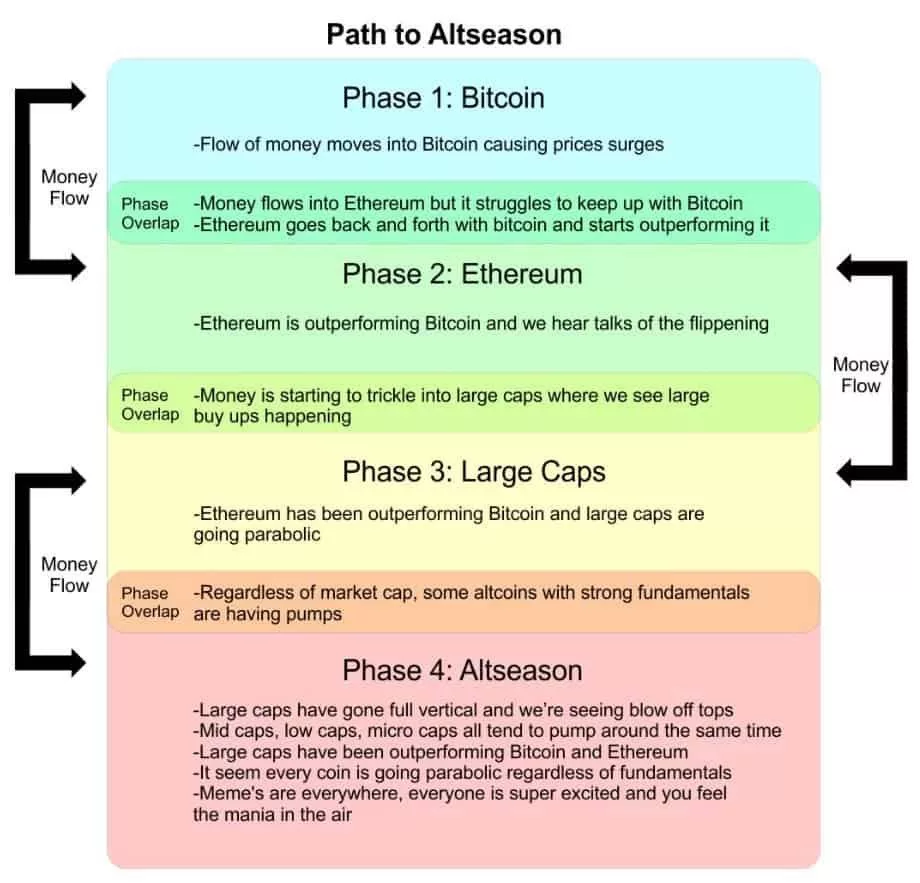
The Crypto Money Flow Cycle (Follow the Money)
Why do altcoin seasons happen in the first place? Crypto markets tend to move in cycles, and money flows through the ecosystem in a certain sequence during a bull run. Understanding this money flow cycle can help you anticipate what might be next:
From Fiat to Bitcoin: New money (fiat currency, or stablecoins equivalent to cash) usually enters crypto via Bitcoin. In the beginning of a bull market, investors buy Bitcoin first – it’s the largest, most well-known asset. Bitcoin often rallies hard initially, taking the spotlight while most altcoins lag. In this phase, Bitcoin dominance usually increases as BTC price surges ahead of the pack.
From Bitcoin to Large-Cap Altcoins: After Bitcoin has a big run and maybe starts to plateau or stabilize, investors holding big BTC profits look for the next opportunities. Often they rotate some of their gains into large-cap altcoins – especially Ethereum (ETH), which is the second-largest crypto and the foundation for many crypto projects. Ethereum tends to move after Bitcoin’s rally slows, and then other major alts like Binance Coin, Cardano, Solana, XRP, etc., start catching up. This is when we see large-cap altcoins rising against Bitcoin. Bitcoin dominance may start declining at this point, as money “trickles down” to other coins.
From Large Caps to Mid and Small Caps: Once the big-name alts have their run, the cycle often extends to mid-cap and small-cap altcoins. Traders become more willing to take on risk in search of higher returns. Money flows into lesser-known or more speculative coins, which can pump even harder (in percentage terms) because they have smaller market caps. This stage can be very volatile – many smaller alts might skyrocket by huge percentages in a short time. This is typically the heart of altseason, when the market sees an abundance of 10x or even 50x stories among small coins.
Exiting: Back to Bitcoin (or Stablecoins): The cycle often concludes with profits being taken out of the altcoins and moved back into the relative safety of Bitcoin or cashed out to fiat/stablecoins. When many traders start taking profits, Bitcoin can actually get a secondary boost (people swap alt profits back into BTC, temporarily lifting BTC again). But soon after, the entire market may cool off or correct. Altcoin rallies typically end with a sharp pullback, and Bitcoin often leads the market back down, resetting the cycle.
Importantly, this money flow cycle isn’t a strict rule – not every bull run will follow it perfectly, and sometimes there are mini-cycles within a larger cycle. But generally, Bitcoin rallies first, then large caps, then small caps, then back to Bitcoin.
Knowing this pattern helps you position yourself: for example, if you see Bitcoin exploding in price and dominating the market, it might be wise to later rotate some into quality altcoins before everyone else does. Conversely, if tiny meme coins are going 1000% in a week (end of cycle), it might be a signal that the market is peaking and it’s time to be cautious.
The “Popcorn Effect” in Alt Seasons
One fascinating aspect of altcoin seasons is what many traders refer to as the “popcorn effect.” Imagine a pot of popcorn on the stove the kernels don’t all pop at once. A few pop first, then others follow in quick, random bursts. That’s how altcoin rallies often play out not all coins or sectors move together. Instead, different sectors take turns heating up, with momentum rotating across categories like DeFi, AI, gaming, infrastructure, or meme coins.
For instance, you might see AI tokens surge one week, then stall, just as DeFi tokens begin a sharp rally the next. A few days later, attention might shift again suddenly gaming tokens or real-world asset (RWA) projects are leading the charge. This staggered pattern of performance is the essence of the popcorn effect. It’s less about individual coins popping in isolation, and more about sectors catching fire one by one, as investor attention and capital rotate through the market.
This is important for new investors because it shows that timing and positioning across sectors can be more effective than trying to chase single coins after they pump. Trying to jump into a coin after it’s already made a 100% move is like reaching for a popcorn kernel that just popped it might already be cooling off. Instead of treating your portfolio like a scatter of random coins, think of it as a set of buckets, each representing a promising sector.
Holding exposure to a few strong sectors increases your chances of being positioned in the right place when one of those buckets “pops.” For example, having well-researched positions across categories like DeFi, Layer 1s, gaming, and infrastructure means you’re more likely to benefit when rotation pushes capital into those narratives.
In short, the popcorn effect is a reminder that altcoin rallies happen in waves across sectors, not all at once. To navigate it well:
Don’t chase yesterday’s winner — the hype may have already peaked.
Diversify by sector, not just by individual coin.
Take profits when a sector you’re exposed to makes a big move the heat may shift soon.
This approach keeps you flexible and ready, without constantly needing to guess the next coin to moon. And in a fast-moving market like crypto, sector awareness can be your edge.
Strategy: How to Approach Altcoin Season (Tips for New Investors)
Altcoin season can be both thrilling and dangerous. The potential for quick gains comes with high risk, so you need a balanced strategy. Here are some key strategies and tips:
1. Diversify, But Do It Wisely
During altseason, it’s tempting to go “all in” on the hottest coin you hear about. Don’t! A golden rule is to diversify across several altcoins to spread out risk and opportunity. Focus on a mix of coins, including some large-cap alts (like ETH or other top projects) and some smaller ones you have researched. Large caps (e.g. Ethereum) may not skyrocket as dramatically as tiny caps, but they’re more likely to hold value and are usually the first to move when altseason starts.
You can then venture into mid-caps and a few high-conviction small caps for higher reward (understanding they carry higher risk). This tiered approach – big names first, then down the market cap list – mirrors the money flow cycle we discussed.
Importantly, don’t just buy something because it’s cheap. Many small tokens might pump on rumors or viral posts but lack real substance and could crash just as fast. As a new investor, try to pick projects with strong fundamentals – for example, a useful product, active development team, real user base, or backing by reputable community.
2. Have a Profit-Taking Plan
One of the biggest mistakes newcomers make in an altcoin season is not taking profits. When you see your portfolio going up day after day, greed can set in. But altcoin rallies can reverse suddenly – what goes up fast can drop fast.
It’s crucial to decide ahead of time how and when you will take some money off the table. For example, you might set targets: if an altcoin you hold has doubled (100% gain), maybe sell 20-30% of your position to lock in some profit. If it goes up 300%, perhaps you take out a larger portion. This way, you realize gains gradually on the way up.
A good strategy is tiered profit-taking: sell in increments at certain milestones (rather than trying to sell at the absolute top, which is nearly impossible to time).
By selling a bit into strength, you ensure you actually benefit from the rally. Remember, if you ride an altcoin all the way up and then all the way down without selling, you haven’t gained anything.
So set some realistic price targets or percentage gains where you’ll take some chips off the table. You can always keep a portion invested for potential further upside, but at least you’ve locked in rewards for your risk.
3. Manage Risk and Emotions
Rapid gains and the frenzy of altseason can cloud judgment. Stick to basic risk management rules. For one, never invest more than you can afford to lose, especially in volatile altcoins. It’s wise to use position sizing – perhaps decide that a risky small-cap coin will only ever be, say, 5% of your portfolio.
This way, if that coin drops, it won’t sink your whole account. If you’re trading actively, consider using stop-loss orders on some positions to automatically limit downside (though be aware that in very volatile conditions, stop-losses might not fill at the exact price you set).
Also, watch out for the psychological traps. FOMO (fear of missing out) is intense during altseason – seeing others post huge wins on Twitter or Discord might tempt you into rash decisions. Try to keep a level head: not every coin that jumps is a good investment, and you won’t catch every opportunity (and that’s okay).
Avoid impulsively buying something after it’s already had a leg up, without doing research. On the flip side, don’t panic sell everything at the first small dip. It’s about finding a balance: use logic and a plan, rather than getting swept up entirely by emotion.
One helpful trick is to stay informed but filter the noise. Follow reliable news sources or analysts for big-picture updates. Be wary of hot tips from random online forums or the latest meme coin craze unless you truly understand what you’re buying. In altseason, there will be lots of hype – some of it justified, much of it not.
By keeping your focus on your strategy (diversification, profit targets, etc.), you can enjoy the upside of altcoin season while keeping your risks in check.
4. Balanced Perspective: Upside and Downside
Finally, maintain a balanced perspective. Yes, altcoin seasons can produce life-changing gains in a short time. Tiny investments can turn into small fortunes if timed well. It’s the side of crypto that grabs headlines and excites newcomers. But always remember: there is no reward without risk. Many altcoins that go up during altseason can crash afterward. Some may never recover after the hype dies. As a new investor, treat altseason as a time of opportunity but also heightened risk. If you happen to make great profits, consider converting some back into a stable form (whether that’s Bitcoin, Ethereum, or cash) to secure it.
Also, not every altcoin will shine even during altseason – there is a selection effect. Often, certain sectors or themes lead an altseason (for example, DeFi coins in 2020, or AI-related coins in the recent trend). Other coins with no real activity might not move at all, or could pump much later. So don’t assume “all altcoins will go up.” Be selective and observant about where the momentum is shifting.
In summary, approach altcoin season with both excitement and caution. Enjoy the potentially explosive growth, but do so with a plan: diversify across solid projects, take profits on the way up, manage your risk, and don’t fall victim to hype.
Conclusion
Altcoin season can be one of the most rewarding times in crypto investing, especially for newcomers who see their portfolios jump for the first time. By understanding the current trends (like the altcoin index rising and Bitcoin dominance falling), recognizing how money flows through Bitcoin and altcoins, and being aware of unique behaviors like the “popcorn effect,” you’ll be better prepared to ride the wave. Crypto is a fast-moving market, but with a balanced approach, you can make the most of altcoin season while limiting the downsides. Remember, the goal is not just to make profits, but to keep them.
Anush is a crypto researcher dedicated to making blockchain insights clear and accessible. A proud Solana maxi who still appreciates a good Layer 2 debate, he dives deep into market trends so others don’t have to (but really should). Passionate about simplifying crypto, he strives to make the space less intimidating and a lot more relatable, one report at a time.