
There are three main ways for a resident Indian to invest in AMD, and in 2026 one of them has split in two. Tokenized spot gives you a token backed by an AMD share. An LRS broker gives you the share itself. GIFT City now offers both depository receipts and, since early 2026, direct access to US-listed stocks through IFSCA-regulated platforms.
The rules around these routes have also shifted. Budget 2026 changed TCS rates from 1 April 2026, and the Income-tax Act, 2025 replaced the 1961 Act on the same date. This comparison reflects the rules as they stand in September 2026. For background on the company, start with our complete guide to AMD (AMD) stock.
| Tokenized spot (Mudrex) | LRS broker | GIFT City: NSE IFSC Receipts | GIFT City: Global Access | |
| What you hold | AMDB token, backed 1:1 | The actual share | Depository receipt | US share, recorded in GIFT City books |
| Legal ownership | No | Yes | Beneficial interest via custodian | Yes, through the platform |
| Minimum | ₹100 | Depends on broker | A fraction of a share | Fractional |
| Pay in | INR | USD | USD | INR, converted to USD |
| Funded through | INR deposit | LRS remittance | LRS remittance | LRS remittance |
| Regulator | FIU-IND registration for the platform | US regulator for the broker | IFSCA | IFSCA |
| Trading hours | Around the clock | US market hours | US market hours | US market hours |
| TCS above ₹10 lakh a year | Not applicable | 20% on the excess | 20% on the excess | 20% on the excess |
| Tax on gains | 30% flat plus 1% TDS | 12.5% after 24 months, slab rate before | Generally foreign equity rules | Generally foreign equity rules |
| AMD available? | Yes, as AMDB | Yes | Check the current list | Yes, US-listed stocks |
GIFT City tax treatment should be confirmed with a chartered accountant for your situation.
If you read a guide from 2025, three updates matter.
TCS rates were rationalised, but not for investments. From 1 April 2026, Budget 2026 cut TCS to 2% for self-funded education and medical remittances above ₹10 lakh, and to a flat 2% for overseas tour packages. Investment remittances, including US stocks, still attract 20% TCS on amounts above ₹10 lakh in a financial year.
The ₹10 lakh threshold is shared. It applies across all your LRS remittances and all banks combined. A child’s tuition or a family trip earlier in the year uses up the same allowance.
GIFT City added direct share access. NSE IX launched its Global Access platform in February 2026, starting with US-listed stocks. Platforms authorised as Global Access Providers by IFSCA also let you buy US shares directly under IFSCA supervision.
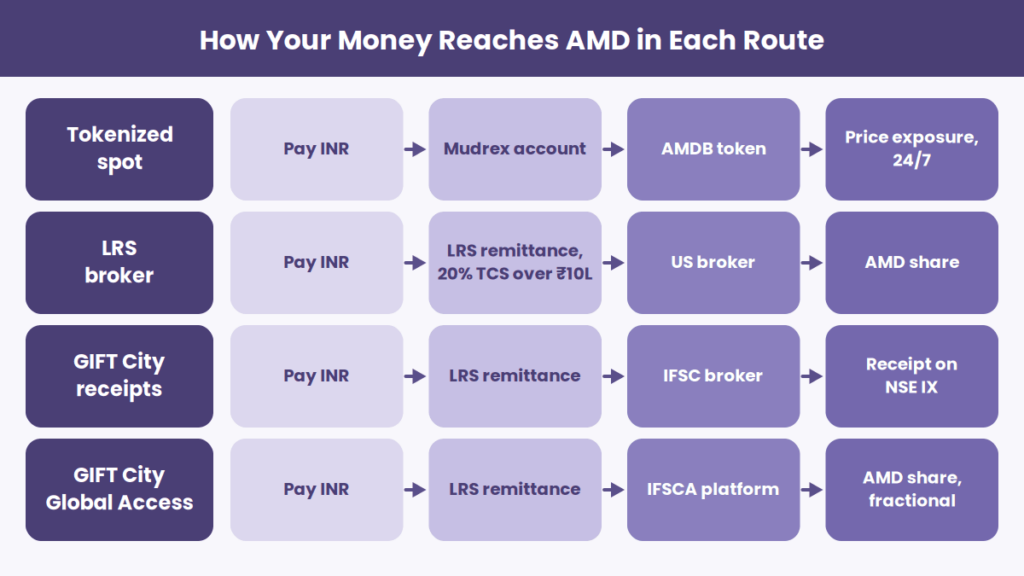
You deposit rupees, buy AMDB and hold it in your Mudrex account. The token is issued under the bStocks programme by BTECH Holdings Ltd and backed by a real share held with a regulated US broker-custodian.
Where it wins
Where it falls short
You open an account with an international broker or an India-partnered app, remit dollars through your bank under the RBI’s Liberalised Remittance Scheme, and buy the share on the Nasdaq.
Where it wins
Where it falls short
TCS example: You remit ₹4 lakh for a child’s education and later ₹12 lakh for US stocks in the same year. Your total is ₹16 lakh, so ₹6 lakh sits above the threshold (₹16 lakh minus ₹10 lakh). Since the education remittance came first, the full ₹6 lakh excess falls on the investment remittance, so TCS at 20% is ₹1.2 lakh collected upfront.
GIFT City is treated as offshore under FEMA, so both options below are funded under LRS and regulated by IFSCA rather than SEBI.
You open an IFSC trading account, remit dollars under LRS, and buy NSE IFSC Receipts, which are unsponsored depository receipts on US shares. Each receipt represents a fraction of a share.
HDFC Bank’s IFSC Banking Unit acts as custodian, with Deutsche Bank in New York holding the underlying shares at DTCC. Trades run during US market hours, and there’s no STT or stamp duty.
The limits: the list covers about 50 large S&P 500 stocks, with NSE IX planning to expand it to over 100 stocks and ETFs. Check whether AMD is currently listed before opening an account. You also don’t own the underlying share directly.
This is the newest option. NSE IX Global Access, launched through a dedicated subsidiary, lets resident Indians buy US-listed stocks with fractional investing. KYC is digital through DigiLocker, Aadhaar and PAN are mandatory, and no demat account is needed. You transfer rupees to NSE IX’s designated bank account, which are converted to dollars under LRS.
Global Access Providers such as INDmoney hold client shares at DTCC through US clearing brokers, with each client’s entitlement recorded in audited GIFT City books reported to IFSCA.
Where it wins: direct access to the broader US universe, including AMD, under an Indian regulator, with rupee funding and fractional buying.
Where it falls short: it still uses your LRS allowance, so TCS applies above ₹10 lakh, and trading follows US market hours.
Holding period decides which route costs less. Take a ₹1 lakh gain, before surcharge:
| Scenario | LRS broker or GIFT City | Tokenized spot |
| Held more than 24 months | 12.5% of ₹1 lakh = ₹12,500, plus 4% cess = ₹13,000 | 30% of ₹1 lakh = ₹30,000, plus 4% cess = ₹31,200 |
| Held less than 24 months, 30% slab | 30% of ₹1 lakh = ₹30,000, plus 4% cess = ₹31,200 | ₹31,200 |
For short holds in the top slab, the cost is similar. For long holds, owning the share wins clearly.
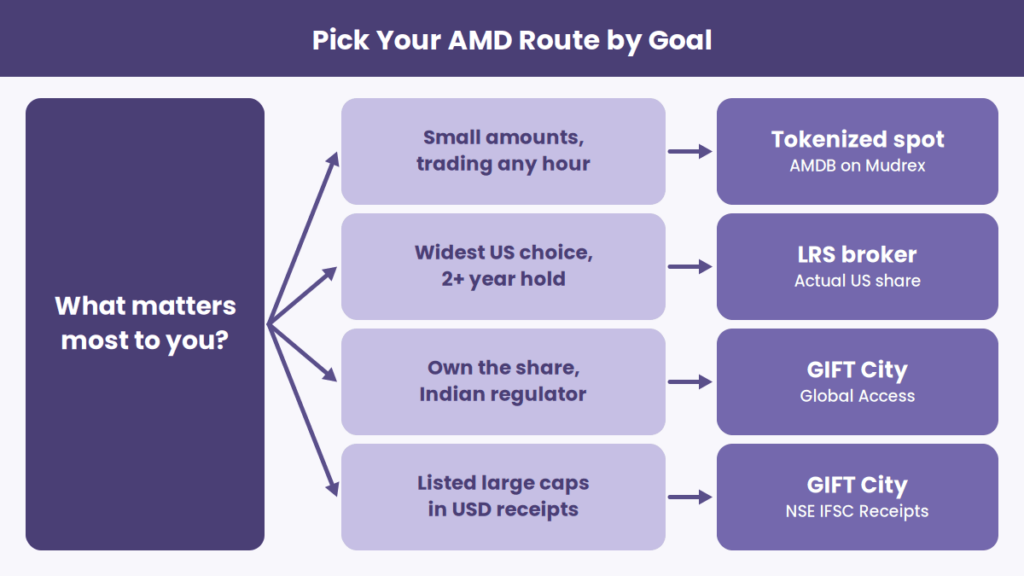
Many investors combine routes. A long-term core holding in actual shares, with AMDB for smaller, tactical positions around earnings, is a common setup.
READ MORE: For the exact Mudrex steps, see our guide to buying AMD stock in India. For the longer-term outlook, read our AMD stock price prediction for 2026 to 2030.
No. Budget 2026 cut TCS for education, medical and tour package remittances from 1 April 2026. Investment remittances still attract 20% above ₹10 lakh a year.
Yes. Resident individuals can remit up to USD 250,000 per financial year across all permitted purposes.
Yes, through Global Access platforms such as NSE IX Global Access, which offer US-listed stocks with fractional investing. NSE IFSC Receipts cover a narrower list, so check whether AMD is on it.
No. You pay in rupees on an Indian platform, so no foreign remittance takes place.
For small amounts and short holds, tokenized spot usually costs less. For large sums held beyond 24 months, owning the share through LRS or GIFT City wins on tax.
This article is for information only and is not investment, tax or legal advice. Rules and figures are as of October 2026.