

AMD designs the processors inside laptops, gaming consoles, servers and, increasingly, the AI data centres being built by OpenAI, Meta and Microsoft. In September 2026, its market value crossed $1 trillion for the first time, and on 2 October the stock closed at a record $633.91.
But what does the company actually sell? How much of the growth is AI? Is the price already too high? This guide answers each one in plain terms and then explains how you can invest from India.
| Item | Detail |
| Full name | Advanced Micro Devices, Inc. |
| Ticker | AMD |
| Exchange | Nasdaq |
| Founded | 1969 |
| Headquarters | Santa Clara, California |
| CEO | Dr. Lisa Su, chair and CEO |
| FY2025 revenue | $34.64 billion |
| Market value | About $1.03 trillion |
| Dividend | None |
| 52-week range | $188.22 to $645.46 |
Company figures from AMD’s Q4 and full-year 2025 results. Market data as of 5 October 2026.
The company designs chips but doesn’t manufacture them. Third-party foundries build them to AMD’s designs, a model known as fabless. That keeps AMD’s own factory spending low, but it depends on outside suppliers for capacity.
Its products fall into four broad families:
| Product family | What it is | Where you find it |
| EPYC | Server CPUs | Cloud data centres and enterprise servers |
| Instinct | AI accelerators (GPUs) | AI training and inference clusters |
| Ryzen and Radeon | PC processors and graphics cards | Laptops, desktops and gaming PCs |
| Semi-custom and embedded | Custom chips, FPGAs and embedded processors | Game consoles, cars, factories, telecom gear |
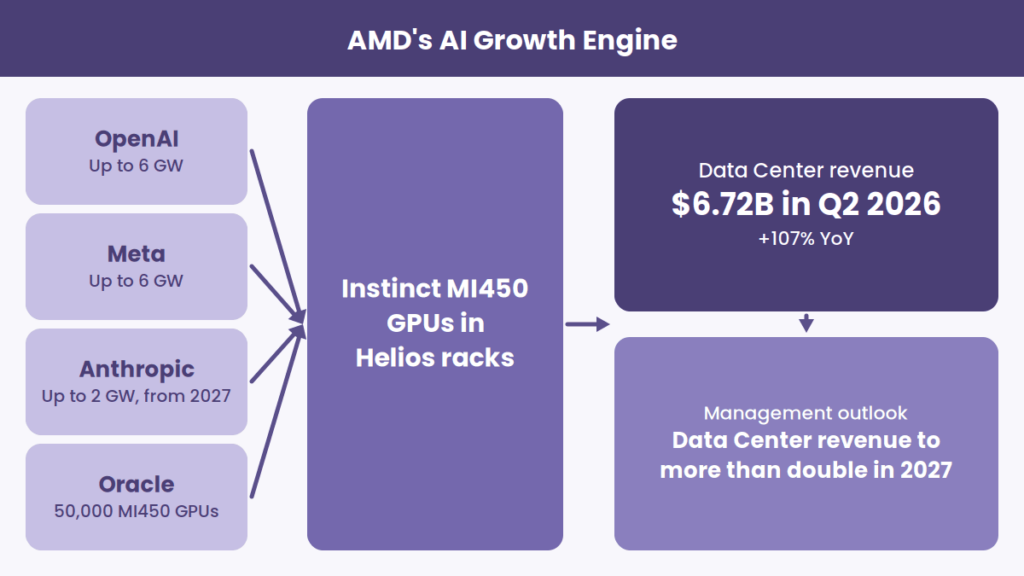
The newest product is Helios, a complete rack-scale AI system that bundles Instinct GPUs, EPYC CPUs and networking into one unit. AMD calls it the most powerful AI server rack available, and Anthropic, Meta, Microsoft, OpenAI and Oracle have all committed to it, according to the Q2 2026 results.
AMD reports three segments. Here is how revenue split in Q2 2026:
| Segment | Q2 2026 revenue | Year-on-year change | Share of total |
| Data Center | $6.72 billion | +107% | 58% |
| Client and Gaming | $3.84 billion | +6% | 33% |
| Embedded | $977 million | +19% | 8% |
| Total | $11.54 billion | +50% | 100% |
Share of total calculated from segment revenue divided by $11.54 billion. Figures may not sum exactly due to rounding.
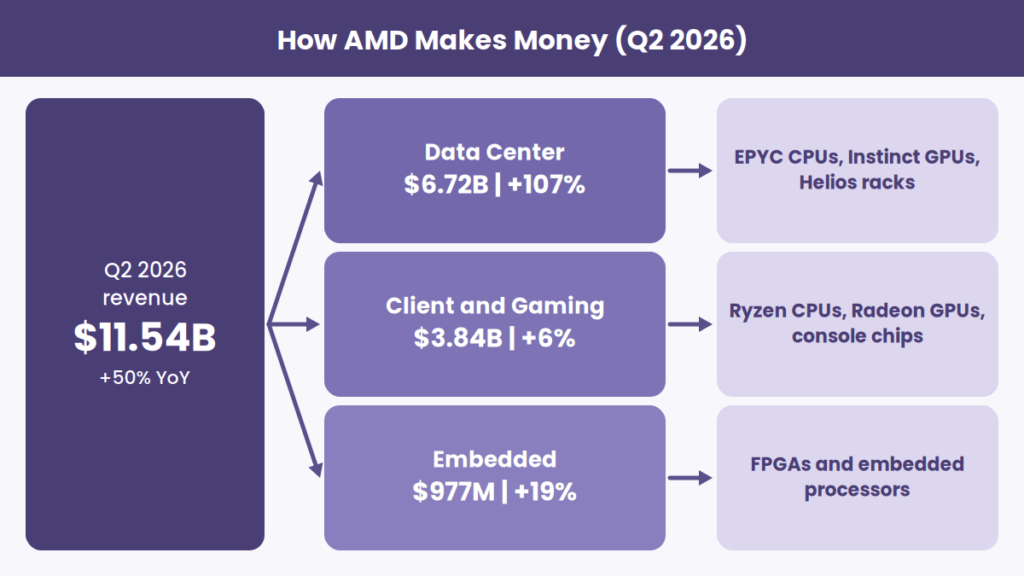
This includes EPYC server CPUs and Instinct GPUs. Revenue more than doubled in Q2 2026, and the segment earned $2.10 billion in operating income. On the Q2 call, management said it expects server CPU revenue to grow more than 80% in the second half of 2026, and Data Center revenue to more than double again in 2027 as Helios and the next-generation MI500 ramp.
Ryzen PC processors had a strong quarter, with Client revenue up 23% to $3.06 billion. Gaming fell 31% to $779 million because of lower sales of the custom chips used in game consoles. Management flagged possible PC market weakness in the second half of 2026.
This segment came largely from AMD’s 2022 acquisition of Xilinx. It sells chips for industrial, automotive, aerospace and communications equipment. It is smaller and slower, but steady and profitable, with $386 million in Q2 operating income.
Intel is still the larger company by revenue. It reported Q2 2026 revenue of $16.1 billion, up 25%, with its Data Center and AI segment up 59% to $6.3 billion. AMD’s Data Center segment, at $6.72 billion, is now larger than Intel’s and growing faster. That shift, from challenger to leader in data centre revenue, is a big part of why the market values AMD so highly.

| Year | Milestone |
| 1969 | Founded in California |
| 2014 | Lisa Su becomes CEO |
| 2017 | Launches Ryzen and EPYC, restarting its competition with Intel |
| 2022 | Completes the Xilinx acquisition |
| 2025 | Signs a 6-gigawatt GPU deal with OpenAI |
| 2026 | Signs a 6-gigawatt deal with Meta and a 2-gigawatt deal with Anthropic, and crosses a $1 trillion market value |
For much of the 2010s, AMD was the underdog in both PCs and servers. The turnaround under Lisa Su rebuilt its CPU lineup, and it has since taken share in server chips. The AI story is the newer chapter, and it is the one moving the stock today.
Nvidia still dominates AI chips. AMD’s pitch is that customers want a second strong supplier, and in the last 12 months several of the biggest AI buyers have signed on.
OpenAI. In October 2025, AMD and OpenAI announced a deal for OpenAI to deploy up to 6 gigawatts of AMD GPUs over several years, starting with the MI450 series. The first 1 gigawatt is due in the second half of 2026. AMD also issued OpenAI a warrant for up to 160 million AMD shares, which vests only as deployments scale, as AMD’s share price hits set targets and as OpenAI meets technical and commercial milestones.
Meta. In February 2026, AMD and Meta signed a similar agreement for up to 6 gigawatts of AMD Instinct GPUs, starting with a custom MI450-based chip built for Meta’s workloads. Shipments for the first gigawatt are scheduled for the second half of 2026. Meta also received a performance-based warrant for up to 160 million AMD shares, with vesting tied to GPU shipments and stock price thresholds.
Anthropic. In July 2026, AMD and Anthropic announced a partnership to deploy up to 2 gigawatts of MI450 series GPUs in Helios racks, with the first gigawatt starting in the first half of 2027. AMD committed to invest up to $5 billion in Anthropic.
Oracle and Microsoft. Oracle is deploying 50,000 MI450 GPUs starting in Q3 2026, and Microsoft is rolling out Helios racks on Azure.
On the Q2 call, Lisa Su said AMD’s revenue per gigawatt of deployed compute remains in the “double-digit billions” of dollars. With up to 14 gigawatts committed across OpenAI, Meta and Anthropic (6 plus 6 plus 2), you can see why investors are excited.
A note on dilution: if both the OpenAI and Meta warrants vest in full, up to 320 million new shares would be issued (160 million plus 160 million). Against about 1.63 billion shares outstanding today, that is roughly 20% more shares (320 million divided by 1,630 million). Existing shareholders would own a smaller slice, although both deals are designed so this only happens alongside large GPU purchases.
| Metric | FY2024 | FY2025 | Change |
| Revenue | $25.79 billion | $34.64 billion | +34% |
| Data Center revenue | Not applicable | $16.6 billion | +32% |
| GAAP operating income | Not applicable | $3.7 billion | Not applicable |
| GAAP net income | Not applicable | $4.3 billion | Not applicable |
| GAAP diluted EPS | Not applicable | $2.65 | Not applicable |
| Non-GAAP diluted EPS | Not applicable | $4.17 | Not applicable |
AMD reported Q2 2026 results on 4 August 2026.
| Metric (Q2 2026) | Value | Year-on-year change |
| Revenue | $11.54 billion | +50% |
| Gross margin (GAAP) | 54% | Up from 40% |
| Operating income (GAAP) | $1.99 billion | Up from a $134 million loss |
| Net income (GAAP) | $2.30 billion | +163% |
| Diluted EPS (GAAP) | $1.38 | Up from $0.54 |
| Diluted EPS (non-GAAP) | $1.66 | Up from $0.48 |
| Free cash flow | $1.56 billion | Up from $1.18 billion |
The year-ago quarter included about $800 million of inventory charges tied to US export restrictions on MI308 chips for China, which makes the comparison look stronger than the underlying trend. Even so, revenue growth of 50% is exceptional for a company of this size.
For Q3 2026, AMD expects revenue of about $13 billion, plus or minus $300 million. The midpoint implies 41% growth from a year earlier and 13% from Q2. It expects a non-GAAP gross margin of about 56%.
You’ll see two sets of numbers in AMD’s releases. GAAP follows standard accounting rules. Non-GAAP strips out items like stock-based compensation and amortisation from past acquisitions, mainly Xilinx. The gap is large: in Q2 2026, GAAP operating income was $1.99 billion, while non-GAAP was $3.09 billion. Analysts mostly quote non-GAAP, but GAAP shows what actually reached the bottom line.
At the end of June 2026, AMD held $13.1 billion in cash and short-term investments against total debt of $3.2 billion, a comfortable position.
It has been one of the best-performing large-cap stocks of the past year. AMD closed at a record $633.91 on 2 October 2026, after touching an intraday all-time high of $645.46 the same day. TradingView shows the stock up about 276% over the past 12 months, and it has gained nearly 200% so far in 2026.
After Q2 results, shares fell almost 9% in after-hours trading despite beating estimates, as management flagged tight server CPU supply and a possible PC slowdown. The stock closed about 7% lower the next day. It then rallied through September.
A few more facts for new investors:
| Bull case | Bear case |
| Data Center revenue grew 107% in Q2 2026 | Trailing GAAP P/E is above 160 |
| Up to 14 gigawatts committed across OpenAI, Meta and Anthropic | Growth depends heavily on a few large customers |
| Helios gives AMD a full-system AI product | Nvidia remains the clear leader, especially in software |
| Strong balance sheet with little debt | OpenAI and Meta warrants could add about 20% more shares |
READ MORE: For a view on where the price could head, see our AMD (AMD) stock price prediction for 2026 to 2030.
AMD’s Q3 2026 results are listed for 3 November 2026, after the US close. Check the investor relations site for AMD’s own confirmation.
The US moves to standard time on 1 November, so a 5:00 PM Eastern call on 3 November would start at 3:30 AM IST on 4 November.
Watch revenue against the $12.7 billion to $13.3 billion range, Data Center growth, any update on the 2027 outlook, and commentary on MI450 and Helios shipments to OpenAI, Meta and Oracle.
AMD trades only in the US. From India, you have four practical options as of October 2026:
Our step-by-step guide to buying AMD stock in India walks through the Mudrex process. Our comparison of tokenized spot, LRS and GIFT City breaks down cost, tax and ownership.
If you want to trade around news at night or on weekends, read how to trade AMD stock 24/7 in India.
The business is easy to picture: AMD makes the chips that computers and AI systems run on. It is profitable, growing fast and has little debt.
The stock is a different matter. After rising more than threefold from its 52-week low, it is priced for a lot of success, and chip stocks can drop quickly in a single disappointing quarter. A sensible approach is to keep the position modest, invest in instalments rather than all at once, and decide your holding period before you buy, since tax treatment depends on the route and the time you hold.
It also helps to follow one or two numbers each quarter rather than every headline. For AMD, Data Center revenue growth and the gross margin tell you most of what you need to know about whether the AI story is on track.
Advanced Micro Devices. It trades on the Nasdaq under the ticker AMD.
Processors and accelerators: EPYC server CPUs, Instinct AI GPUs, Ryzen PC chips, Radeon graphics cards, custom console chips and embedded products.
No. The company reinvests its cash and does not pay a dividend.
58% in Q2 2026. Data Center revenue was $6.72 billion, up 107% from a year earlier.
Shares dropped almost 9% after hours even though results beat estimates. Management pointed to tight server CPU supply and a possible PC slowdown in the second half, and the stock had already run up sharply before the report.
OpenAI and Meta have each agreed to deploy up to 6 gigawatts of AMD GPUs, and each holds a warrant for up to 160 million AMD shares that vests as shipments and share price targets are met. Anthropic plans up to 2 gigawatts from 2027, with AMD investing up to $5 billion in the company.
Data providers list 3 November 2026, after the US close. That is early on 4 November in India.
No. AMD tokenized stock tracks the share price and is backed 1:1 by a real share in custody, but you hold a token, not the share, and you don’t get voting rights. It is available as AMDB on Mudrex.
For shares bought through LRS or GIFT City, gains on holdings over 24 months are generally taxed at 12.5%, and shorter holdings at your slab rate. Tokenized stocks are taxed as virtual digital assets at a flat 30% plus cess, with 1% TDS on transfers.
This article is for information only and is not investment, tax or legal advice. Figures are as of October 2026.