
AMD’s biggest price moves rarely happen at a convenient hour for Indian investors. Its earnings calls start in the middle of the Indian night. Deal announcements and peer results often land before the US market opens. And on weekends, the Nasdaq doesn’t trade at all.
Tokenized spot lets you trade AMD through all of it. This guide explains when the US market is open in Indian time, what sets the token’s price when it isn’t, and five rules to follow before placing an off-hours trade. New to the company? Start with our complete guide to AMD (AMD) stock.
The Nasdaq’s regular session runs from 9:30 AM to 4:00 PM US Eastern time. In IST, that shifts with US daylight saving:
| Period | Nasdaq session in IST | AMD earnings call in IST |
| US daylight saving (March to early November) | 7:00 PM to 1:30 AM | 2:30 AM |
| US standard time (early November to March) | 8:00 PM to 2:30 AM | 3:30 AM |
AMD holds its earnings call at 5:00 PM Eastern, per its Q2 2026 release. IST is 9.5 hours ahead of EDT and 10.5 hours ahead of EST.
This matters right now. The US switches to standard time in early November, around when AMD’s Q3 2026 results are expected. If the report comes after the switch, the call will start an hour later in India than the Q2 call did.
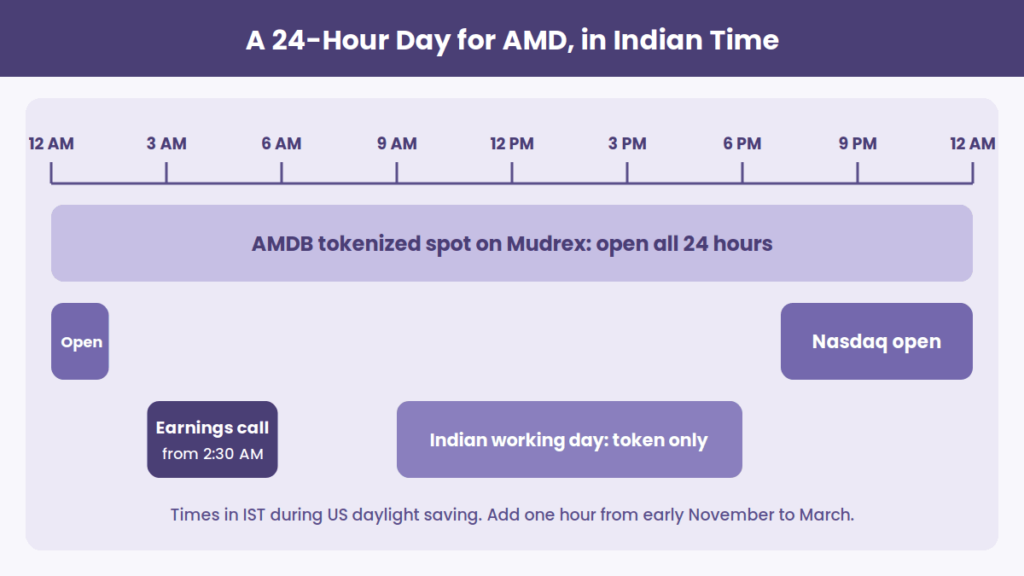
On Mudrex, tokenized US stocks trade around the clock, including weekends and both Indian and US holidays. So while the share only trades for six and a half hours on weekdays, AMDB is always open.
Several kinds of news regularly hit AMD when the Nasdaq is shut:
Say AMD reports on a Tuesday during US standard time.
The release comes out after the US close, around 2:30 AM IST on Wednesday, and the call starts at 3:30 AM. With actual shares, the earliest you could react in the regular session is Wednesday at 8:00 PM IST, more than 16 hours later. With AMDB, you can read the results over breakfast and act the same morning.
That head start works both ways. You can react early, but so can everyone else, and prices can overshoot before the US open.
During US hours, AMDB tracks the real share closely, because traders can profit from any gap between the two.
Outside US hours, there’s no official share price to anchor to. The token’s price comes from token buyers and sellers reacting to news. Think of it as the market’s live estimate of where AMD will open.

When Nasdaq reopens, the token and the share realign. If the off-hours move was right, early traders gained an edge. If it overshot, the price corrects at the open.
AMDB is part of the bStocks programme, issued by BTECH Holdings Ltd, a Binance group affiliate. Each token is issued against a real AMD share held by a regulated US broker-custodian, with a daily Proof of Collateral.
You get price exposure, not legal ownership or voting rights. AMD pays no dividend, so there’s nothing to reinvest.
If you’ve never bought AMDB, our step-by-step guide to buying AMD stock in India covers sign-up and KYC in detail. In short: complete KYC with Aadhaar and PAN, add INR through UPI or bank transfer, search for AMDB and place your order from ₹100. Selling works the same way, at any hour.
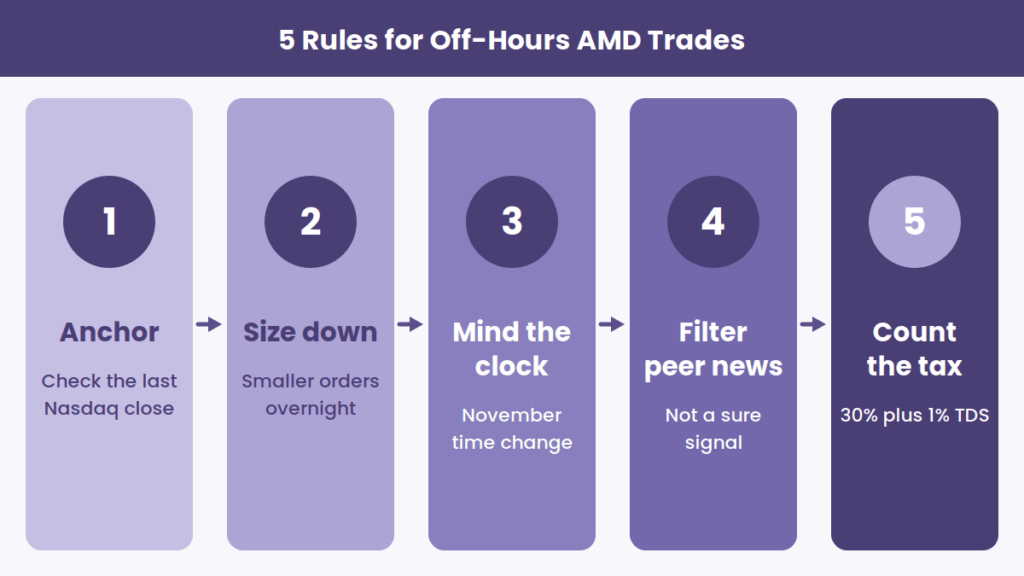
Before you trade on a Saturday, check where the actual share closed on Friday. If AMDB is well above or below that, find out why before joining the move.
Fewer people trade overnight, and there’s no official price to lean on. Prices can move further on less activity. Keep off-hours orders smaller than you would during the US session.
The shift to US standard time in early November moves the session and AMD’s earnings call an hour later in IST. Set reminders by IST, not by habit.
A strong or weak result from another chipmaker can move AMD overnight, but the link isn’t one to one. AMD’s business mix of server CPUs, AI GPUs and PC chips means it can react differently.
Each sale is taxable under India’s VDA rules: a flat 30% on gains plus 4% cess, 1% TDS on transfers and no set-off of losses against other income. Frequent trading adds up.
Example: You buy ₹15,000 of AMDB before earnings and sell it for ₹16,500 the next morning.
| Item | Calculation | Amount |
| Gain | ₹16,500 minus ₹15,000 | ₹1,500 |
| Tax at 30% | 30% of ₹1,500 | ₹450 |
| Cess at 4% | 4% of ₹450 | ₹18 |
| Total tax | ₹450 plus ₹18 | ₹468 |
| TDS on sale | 1% of ₹16,500 | ₹165 (adjusted against the ₹468) |
If the same trade had lost ₹1,500 instead, that loss couldn’t reduce tax on any other income.
Mudrex also offers US stock perpetual futures. Both trade around the clock, but they’re built for different jobs.
| AMDB (spot) | US stock perps | |
| What it is | A token backed 1:1 by a real share | A derivative contract tracking the price |
| Direction | Gains when the price rises | Long or short |
| Leverage | None | Available |
| Main risk | Price falls | Moves against you, plus liquidation |
| Suited to | Building a position | Short-term trading |
If you are new, start with spot. Leverage magnifies losses as much as gains.
It fits if you want to react to AMD news at a sensible hour in India, invest small amounts in rupees, or manage positions during your working day rather than at 2 AM.
It fits less well if you plan to hold for years. Owning the actual share through LRS or GIFT City gets you legal ownership and 12.5% tax on gains after 24 months. Our comparison of tokenized spot, LRS and GIFT City for AMD covers the 2026 rules for each route. For a longer view on the stock itself, read our AMD stock price prediction for 2026 to 2030.
Yes, through tokenized spot. AMDB on Mudrex trades around the clock, including weekends and holidays.
The Nasdaq session runs from 7:00 PM to 1:30 AM IST during US daylight saving time, and 8:00 PM to 2:30 AM IST the rest of the year.
AMD holds its call at 5:00 PM Eastern, which is 2:30 AM IST during US daylight saving and 3:30 AM IST in US standard time.
When Nasdaq is closed, token buyers and sellers set the price based on news. It realigns with the share once regular trading resumes.
No LRS remittance is involved when you trade AMDB in rupees on Mudrex, so LRS TCS doesn’t apply. The 1% TDS on VDA transfers does.
This article is for information only and is not investment, tax or legal advice. Figures are as of October 2026.