An ad promises big returns in 60 seconds. All you do is tap “up” or “down.” That is how many people first meet binary options trading in India.
Here is the catch. RBI says binary trading in foreign exchange is not permitted in India, and NSE warns investors to avoid binary options sold on unregulated platforms. Popular apps such as I Q Option, Olymp Trade, Quotex and Binomo are named on RBI’s Alert List. Every trade is also all-or-nothing, so the payout math works against you from the first tap.
This guide explains how binary options work, what RBI, NSE and FEMA rules say, why most traders lose, and how to spot a scam. It also covers regulated alternatives, including crypto on an FIU-registered platform, if you want real market exposure instead of a coin flip.
Binary options trading is a bet on a yes-or-no question: will an asset’s price be higher or lower than it is now when a timer ends? If you are right, you get a fixed payout. If you are wrong, you lose your entire stake.
Definition: Binary option A contract that pays a fixed amount if a price condition is true at expiry, and nothing if it is false. It is also called a digital or all-or-nothing option.
A few terms come up on every binary options app:
| Term | What it means |
|---|---|
| Strike price | The price level that decides whether you win or lose |
| Expiry time | The exact moment the result is settled |
| Call / High | A bet that the price finishes above the strike |
| Put / Low | A bet that the price finishes below the strike |
| Payout | The fixed profit you get if your prediction is right |
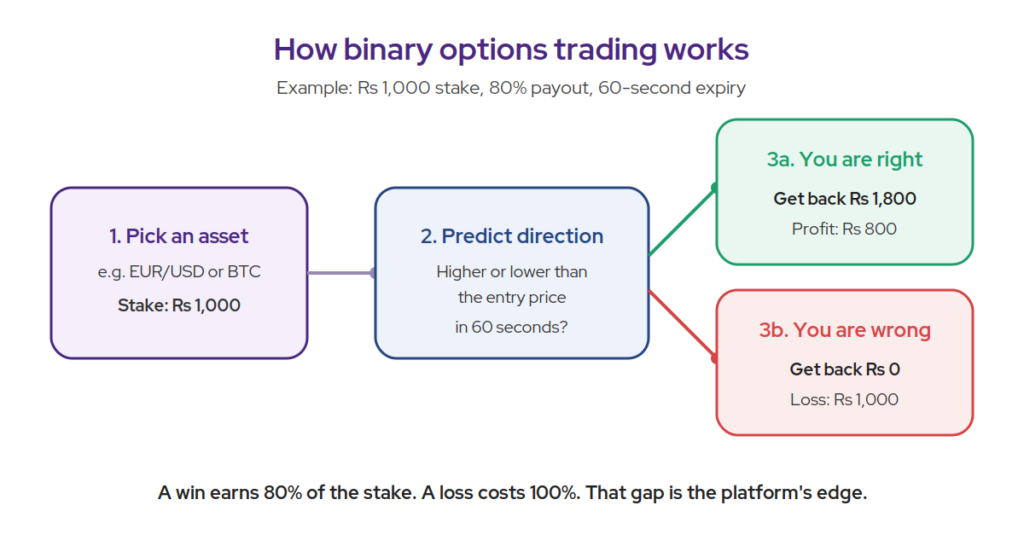
Here is the same example as numbers. Assume a ₹1,000 stake and an 80% payout.
| Outcome | Stake | Amount returned | Profit or loss |
|---|---|---|---|
| Prediction right | ₹1,000 | ₹1,800 | +₹800 |
| Prediction wrong | ₹1,000 | ₹0 | −₹1,000 |
Being very right does not pay more. If the price beats the strike by ₹100 instead of ₹1, you still get the same ₹800. Being wrong by ₹1 also costs the same ₹1,000 as being wrong by ₹100.
Regular options pay more the further the price moves in your favour, while binary options pay the same fixed amount whether the price beats your target by a lot or a little. The table below shows the key differences that matter to an Indian trader.
| Feature | Binary options | Regular options in India |
|---|---|---|
| Payout | Fixed amount or zero | Varies with the price move |
| Typical expiry | Seconds to minutes | Weekly or monthly contracts |
| Where traded | Offshore apps and websites | NSE, BSE and other recognised exchanges |
| Indian regulator | None | SEBI |
| Can you exit early? | Often limited; depends on the app | Yes, by selling the contract |
For Indian residents, there is no authorised route to binary options trading in India. RBI states that binary trading in foreign exchange is not permitted, NSE classes online binary options as unregulated products, and the best-known offshore apps are on RBI’s Alert List.
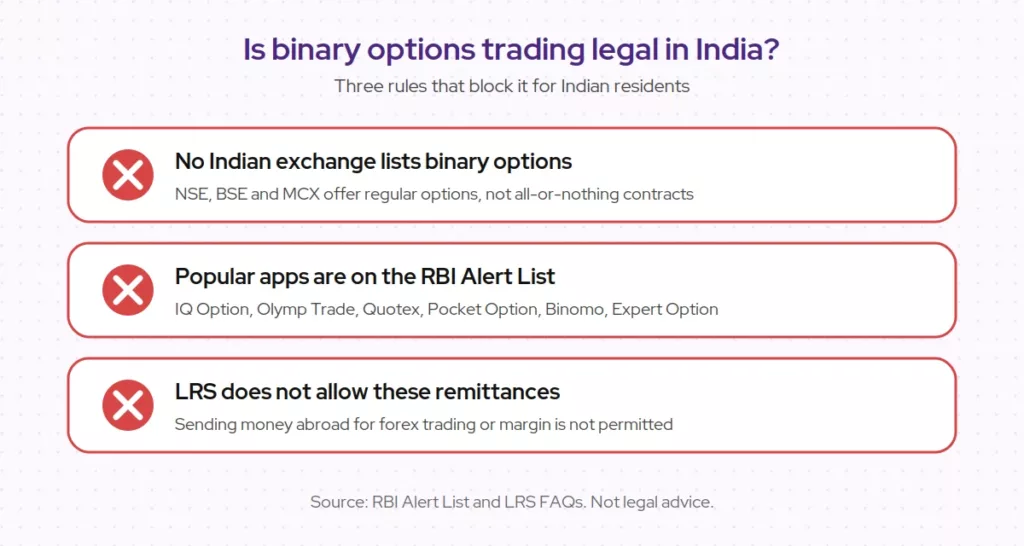
RBI has answered this directly: binary trading and Contract for Difference (CFD) in foreign exchange are not permitted in India (RBI). Residents may deal in forex only with authorised persons, on authorised platforms, for permitted purposes under FEMA.
The list keeps growing. By November 2025 it held 95 names, according to Outlook Money.
NSE treats binary options sold online as unregulated products. Its investor awareness note says some internet platforms offer CFDs and binary options on currencies, global stock indices, commodities and cryptocurrencies, often with promises of guaranteed returns and huge leverage. NSE asks investors to deal only with registered intermediaries and to stay away from unregulated products (NSE).
This also answers a common question: binary options are not SEBI-regulated contracts, and you will not find them on NSE or BSE.
Several of the most advertised binary options apps in India appear on the RBI Alert List. Always check the live list before trusting any platform, because RBI adds names regularly.
| Platform | On RBI Alert List? |
|---|---|
| I Q Option | Yes |
| Olymp Trade | Yes |
| Quotex | Yes |
| Pocket Option | Yes |
| Binomo | Yes |
| Expert Option | Yes |
In most cases, no. RBI’s LRS FAQs prohibit remittances for trading in foreign exchange abroad, and for margins or margin calls to overseas exchanges or counterparties. Those are exactly the payments forex-based binary apps depend on.
Definition: LRS (Liberalised Remittance Scheme) The RBI scheme that lets resident individuals send up to USD 2,50,000 abroad each financial year for permitted purposes only.
Some websites call binary options trading in India a grey area because no Indian law uses the words “binary options.” For forex-based binaries, that reading no longer holds: RBI has said plainly they are not permitted. For binaries on other assets, NSE still classes them as unregulated products, and LRS limits still apply to how you fund them.
This is general information, not legal advice. If you are unsure about a specific platform or transaction, speak to a qualified legal professional.
India is not alone in its caution. Many major regulators restrict or ban binary options for retail traders.
| Region | Status for retail traders |
|---|---|
| European Union | ESMA banned retail sales from 2 July 2018; since July 2019, most national regulators enforce their own permanent bans |
| United States | Legal only on registered exchanges or designated contract markets; regulators warn against unregistered online platforms (CFTC/SEC) |
| India | Forex binaries not permitted (RBI); online binaries treated as unregulated (NSE) |
Most binary options traders lose because a win pays less than a loss costs. A win might return 80% of your stake, but a loss takes 100%. So even a trader who guesses right half the time slowly bleeds money.
You need to win more than half your trades just to stand still. The break-even win rate equals 1 divided by (1 + payout). At an 80% payout, that is 1 ÷ 1.8, or about 55.6%.
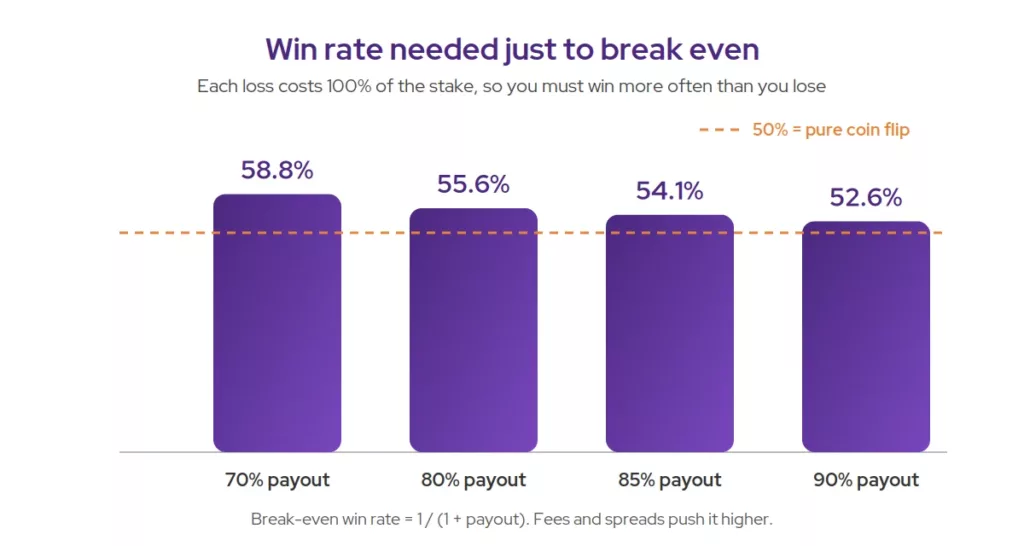
The table shows what happens to a trader who wins exactly half of 100 trades, staking ₹1,000 each time.
| Payout on a win | Break-even win rate | Result after 100 trades at a 50% win rate |
|---|---|---|
| 70% | 58.8% | −₹15,000 |
| 80% | 55.6% | −₹10,000 |
| 85% | 54.1% | −₹7,500 |
| 90% | 52.6% | −₹5,000 |
US regulators make the same point. A CFTC and SEC investor alert explains that when a loss costs about 100% and a win pays far less, the expected return is negative, so an average trader should expect to lose money (CFTC/SEC).
No strategy, signal or indicator can remove the built-in gap in binary options. Tools like moving averages, RSI or Bollinger Bands can describe past trends and volatility. They cannot tell you where the price will sit at one exact second.
Structurally, binary options behave much like a fixed-odds bet. You pick one of two outcomes, wait for a timer, and the payout is set so the platform has an edge. You also never own an asset, which is the main thing that separates investing from betting.
The legal label differs from country to country, so “gambling” is not an official Indian classification here. For you, the more useful question is whether the product and platform are authorised and offer real investor protection. With binary options apps, they do not.
The payout math is only the first problem. Offshore binary options apps add several more.
These complaint categories come from the CFTC/SEC investor alert, which covers platforms targeting US customers. The same risks apply to offshore apps marketed in India.
The quickest test is the RBI Alert List: if a platform or its promoter is on it, walk away. Beyond that, scams in binary options trading in India tend to share the same warning signs.
Stop depositing first. Many platforms ask for a “tax,” “fee” or “verification deposit” before they will release a withdrawal; paying it usually just deepens the loss.
If your goal is to save, invest or learn about markets, choose a product based on your objective, not the thrill of a 60-second result. Regulated alternatives include fixed deposits, mutual fund SIPs, stocks and crypto on a registered platform. Each carries a different level of risk, liquidity and return potential.
None of these options guarantee returns. The key difference is that they involve real assets, regulated products or genuine economic activity, instead of an all-or-nothing bet against a platform.
| Option | What you own or trade | Main risk | Who oversees it |
|---|---|---|---|
| Fixed deposit | A bank deposit | Returns may trail inflation | RBI |
| Mutual fund SIP | Units of a fund | Market ups and downs | SEBI |
| Stocks | Shares in a company | Price falls, company risk | SEBI |
| Exchange-traded F&O | Listed futures and options | Complex and leveraged; large losses possible | SEBI |
| Crypto (spot) | The coin you buy | High volatility | FIU-IND registration (AML/KYC) |
| Binary options (offshore) | Nothing | Total loss per trade; no recourse | No Indian regulator |
Crypto trading is not risk-free, and it should never be pitched as guaranteed income. But crypto spot trading and binary options work in fundamentally different ways. In spot trading you buy a real asset, there is no forced expiry, and your gain or loss tracks how far the price actually moves.
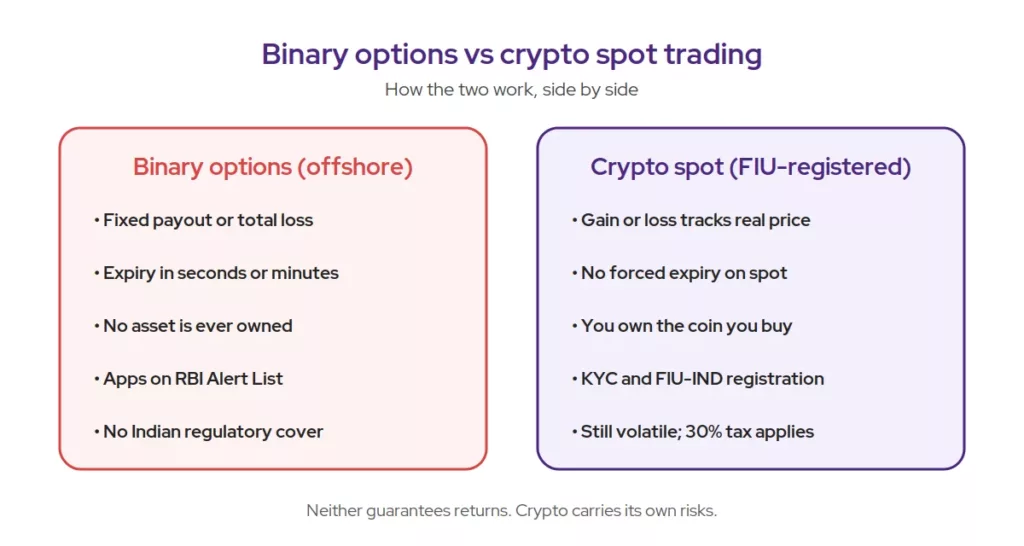
Crypto assets can be highly volatile. Before trading, understand the product, fees, custody arrangements, tax obligations and risk disclosures. In India, crypto gains are taxed at a flat 30% (plus 4% cess), losses cannot be set off, and 1% TDS applies on transfers. Budget 2026 left these rules unchanged. Our guide to crypto legal status in India explains the framework, and the crypto tax calculator helps you estimate what you would owe.
For users who want to learn about crypto markets instead of participating in colour-prediction rounds, Mudrex provides a market-based platform and educational resources.Mudrex is a multi-asset trading platform where users can buy crypto, tokenized US stocks and Web3 assets, as well as trade tokenized commodity futures with up to 50x leverage..
Mudrex supports an INR-focused experience for Indian users, including crypto prices and conversion tools such as the BTC-to-INR converter. Users can review market values in rupees and use supported INR deposit and withdrawal options, subject to KYC, product terms and applicable checks.
The Mudrex Learn library explains crypto concepts, market behaviour, trading approaches and risk-related topics. Beginners can use educational content to understand an asset and a product before deciding whether it is suitable for them.
Crypto markets provide observable prices, charts, market information and other tools that users can study. These tools do not predict the future or eliminate losses, but they allow users to make decisions using market data rather than a colour-result sequece.
Mudrex offers low trading fees on Spot and Futures, tight spreads and deep liquidity to help users execute trades efficiently with potentially lower slippage. Actual costs may vary by asset, order size and market conditions.
Mudrex is registered with FIU-India and the platform operates with ISO 27001:2022 and SOC 2 Type 2 security standards. These registrations and certifications support compliance and security processes, but they do not remove crypto-market volatility or guarantee investment performance.
If you are drawn to short-term trading, understand the risks first. Futures use leverage, which magnifies both gains and losses. Our guide on leverage in futures trading explains how it works before you place a trade. If you came here from prediction-style apps, our explainer on what colour trading is covers a closely related risk.
Binary options trading in India offers speed and simplicity, but the costs are hard to ignore. RBI says forex binaries are not permitted, NSE calls online binaries unregulated, popular apps sit on the RBI Alert List, and the payout math means even a 50/50 guesser loses over time. Add the scam risk and the lack of any Indian regulatory cover, and the case against binary options trading in India is strong.
If you want market exposure, pick a regulated product that matches your goal and risk appetite. Crypto spot trading on an FIU-registered platform is one option, as long as you understand its volatility and tax rules first.
Ready to learn about real markets? Download the Mudrex app and watch beginner-friendly explainers on the Mudrex YouTube Channel.
Trading in crypto, futures or any market-linked product involves a high risk of loss, and you may lose some or all of your capital. Leverage magnifies both gains and losses. The examples in this article are for illustration only and are not financial, legal or tax advice. Please consult a qualified advisor before making any trading or investment decision.
RBI states that binary trading in foreign exchange is not permitted in India, and NSE classes online binary options as unregulated products. There is no authorised route for residents to trade them.
No. Binary options are not SEBI-regulated contracts and are not listed on NSE or BSE.
No. RBI says binary trading and CFDs in foreign exchange are not permitted, and residents may deal in forex only through authorised channels.
Both I Q Option and Quotex appear on the RBI Alert List of unauthorised forex trading platforms. Indian residents should not deposit money with them.
There is no RBI-authorised binary options app for Indian residents. An app being downloadable or accepting UPI does not make it authorised.
On a standard all-or-nothing contract, you can lose 100% of the amount placed on each trade. Repeated trades can wipe out your whole account quickly.
Short-term wins happen, but the payout structure means you must win well over half your trades just to break even. US regulators say the expected return is negative for an average trader.
No. Indicators read past prices and cannot predict the price at an exact future second, so “100% accurate” signals are a red flag.
The legal label varies by country, but structurally it works like a fixed-odds bet: two outcomes, a timer and a payout set in the platform’s favour.
RBI has flagged demo trading promoted on social media as a way to pull users onto unauthorised platforms. A free demo often leads to real deposits on the same app.
Binary options pay a fixed amount or nothing on a yes-or-no prediction, while crypto spot trading means buying a real asset whose value moves with the market. Crypto is still highly volatile and can cause large losses.