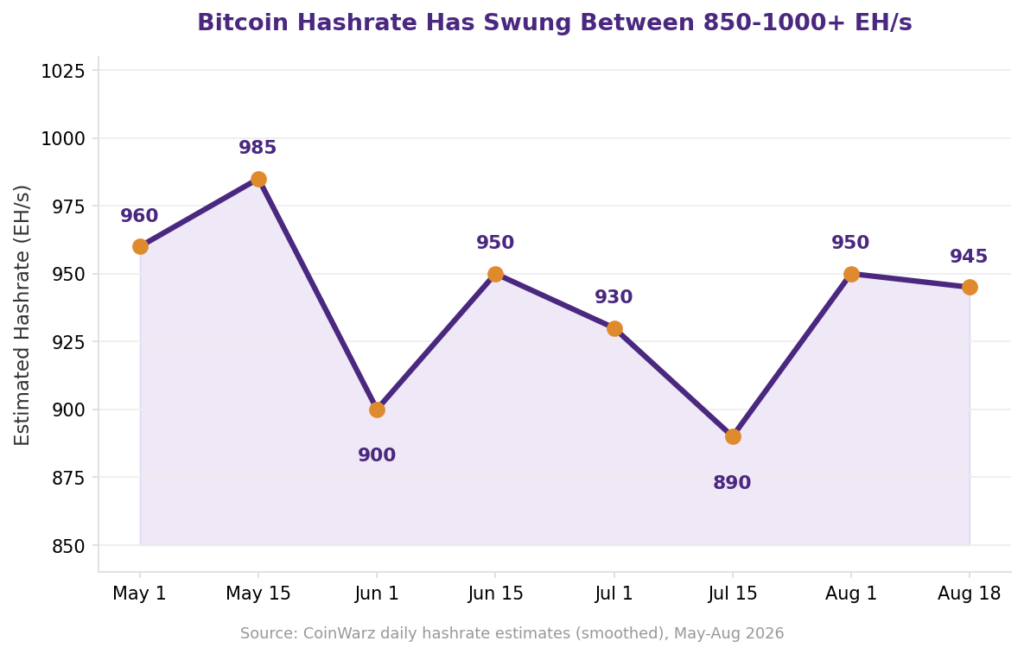
If you’ve seen headlines about Bitcoin’s hashrate hitting record highs or crashing overnight and wondered what that number actually means, here’s the short version. Bitcoin hashrate measures how much computing power is working to secure the network at any moment, and it sits at the center of how Bitcoin stays both functional and hard to attack. It’s currently sitting around 945 EH/s, down from an all-time high of roughly 1.44 ZH/s last September.
Understanding what moves this number, and what it doesn’t tell you, makes the rest of Bitcoin’s mining mechanics much easier to follow.
TL;DR
Bitcoin hashrate is the estimated total computing power (in hashes per second) that miners worldwide are using to secure the network.
It’s currently around 945 EH/s, down about 35% from its all-time high of 1.44 ZH/s in September 2025.
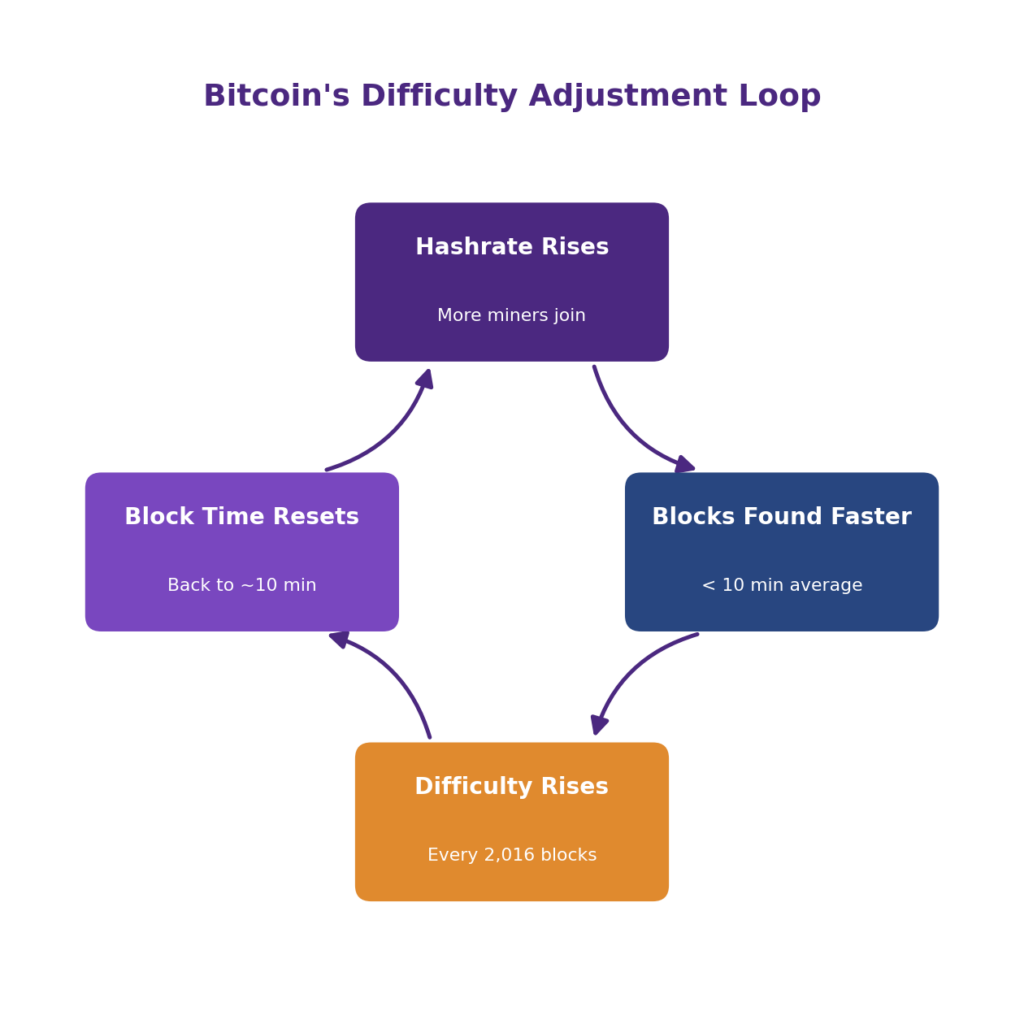
Mining difficulty is a separate, related number that automatically adjusts every 2,016 blocks (about two weeks) to keep block times near 10 minutes as hashrate rises or falls.
A higher hashrate makes the network more secure and harder to attack, but it does not directly move Bitcoin’s price.
When hashrate falls sharply, it usually means mining has become unprofitable for some operators, not that the network is unsafe.
What Is Bitcoin Hashrate?
Bitcoin hashrate is the estimated number of cryptographic calculations, or hashes, that all miners on the network are performing every second to find valid new blocks. Think of it as the total computing horsepower currently pointed at securing Bitcoin.
It’s expressed in hashes per second (H/s), scaled up to terahashes (TH/s), petahashes (PH/s), exahashes (EH/s), or zettahashes (ZH/s) as the network has grown.
It reflects global mining activity, not any single miner’s output.
It’s an estimate, not a direct count, since no one can see every machine on the network at once.
Bitcoin’s current network hashrate sits at roughly 945 EH/s.
Definition: Hash A hash is a fixed-length string of characters produced by running data through a cryptographic function (SHA-256, in Bitcoin’s case); even a tiny change to the input produces a completely different hash.
How Is Bitcoin Hashrate Calculated?
Bitcoin hashrate can’t be measured directly the way you’d measure electricity use, because no central server tracks every miner’s machine. Instead, it’s estimated using two things the network does record: mining difficulty and how quickly blocks are actually being found.
The standard formula looks like this: hashrate ≈ difficulty × 2³² ÷ block time (in seconds). If blocks are being found faster than the 10-minute target while difficulty stays fixed, that implies more computing power has joined the network, and vice versa.
This is also why single-day hashrate readings jump around so much. Block discovery has some natural randomness built in, so analysts typically look at 7-day or 30-day averages rather than any one day’s number to get a reliable picture. CoinWarz data shows this clearly: Bitcoin’s daily hashrate swung between roughly 728 EH/s and 1.28 ZH/s over just a few months in 2026, even though the underlying trend was far smoother.
Bitcoin Hashrate & Mining Difficulty Explained
What Is Bitcoin Mining Difficulty, and How Is It Different From Hashrate?
Bitcoin mining difficulty is a separate number that measures how hard it currently is to find a valid block, while hashrate measures how much computing power is being used to try. They move together, but they’re not the same thing, and difficulty is the one the protocol actually controls directly.
Definition: Target Hash This is a threshold value that a block’s hash must be lower than for the block to be considered valid; difficulty adjusts how strict that threshold is.
Miners aren’t solving a math problem in the traditional sense. They’re repeatedly guessing a random number called a nonce, combining it with the block’s data, and hashing the result, hoping the output falls below the current target hash. Difficulty controls how narrow that target is: greater difficulty means a smaller range of acceptable hashes, so it takes more attempts and more hashrate to find one by chance.
Why Does Bitcoin Difficulty Adjust Every 2,016 Blocks?
Bitcoin mining difficulty adjusts every 2,016 blocks, roughly every two weeks, so that the average time between blocks stays close to Bitcoin’s 10-minute target regardless of how much hashrate joins or leaves the network.
Bitcoin Hashrate & Mining Difficulty Explained
Here’s the mechanism in practice. If a wave of new miners joins and blocks start arriving faster than every 10 minutes, the network responds at the next 2,016-block checkpoint by raising difficulty, making each block harder to find again. If miners power down and blocks slow down, the opposite happens: difficulty drops at the next checkpoint, making it easier for the remaining miners to keep the network running smoothly. Bitcoin’s difficulty adjustment fell roughly 19-20% between November 2025 and July 2026 as miners went offline during a period of tighter margins, a real-world example of this mechanism working as designed.
This self-correcting design is one of Bitcoin’s more elegant features: the network doesn’t need anyone to manually manage it. It adjusts automatically based purely on observed block times.
Does a Higher Hashrate Make Bitcoin Safer?
Yes. A higher Bitcoin network hashrate makes the blockchain more expensive and difficult to attack, because rewriting transaction history requires out-computing the entire honest network, not just a single machine.
What Is a 51% Attack, and How Does Hashrate Protect Against It?
A 51% attack happens when a single miner or coordinated group controls more than half of the network’s total hashrate, giving them enough power to reverse their own recent transactions or block others from confirming.
Definition: 51% Attack A scenario where one entity controls a majority of a network’s mining power, theoretically allowing them to double-spend coins or censor transactions, though rewriting older, deeply buried blocks remains extremely costly even then.
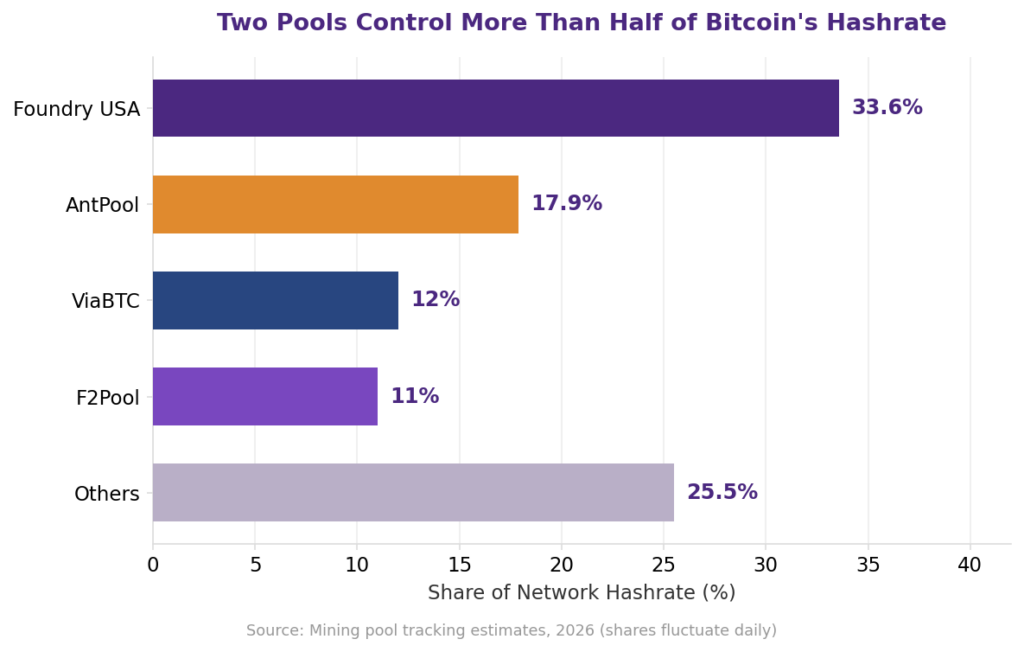
In practice, this is more of a structural risk than an imminent threat. As of 2026, two mining pools, Foundry USA and AntPool, together control more than half of Bitcoin’s hashrate, which has raised legitimate centralization concerns even though neither pool operator controls the hardware itself.
Bitcoin Hashrate & Mining Difficulty Explained
The distinction matters: pool concentration is a governance and censorship risk, since pool operators choose which transactions to include, but actually rewriting Bitcoin’s history would still require enormous sustained hashrate and cooperation that would be both technically difficult and economically self-defeating for participants with a financial stake in the network’s credibility.
Does Bitcoin Hashrate Affect Price?
Bitcoin hashrate does not affect price directly. It does not feed into its spot price the way supply and demand do, and the two metrics can move in opposite directions for extended periods.
The relationship runs more through miner economics than through price discovery itself. Higher BTC prices tend to make mining more profitable, which attracts more hashrate over time. Lower prices, or higher electricity costs, tend to push less efficient miners offline, which shows up as falling hashrate. That lag means hashrate is a trailing indicator of profitability more than a leading indicator of price. Our guide on Bitcoin’s 2026 price outlook covers how miner behavior fits into the broader picture analysts watch.
What Happens When Bitcoin Hashrate Falls?
When Bitcoin hashrate falls sharply, it usually signals that mining has become unprofitable for a share of operators, forcing them to power down equipment rather than mine at a loss. This is often called miner capitulation.
Difficulty adjusts downward at the next 2,016-block checkpoint, making mining easier for whoever remains online.
Remaining miners see improved margins, since a smaller network is sharing the same block rewards and fees.
Network security dips slightly during the transition, though Bitcoin has never experienced unplanned downtime even through its steepest hashrate declines.
Forced miner selling can increase, since operators under financial pressure often sell BTC holdings to cover costs.
Bitcoin’s mining difficulty fell roughly 19-20% between its November 2025 peak and July 2026, one of the steepest declines since China’s 2021 mining ban, as rising electricity costs and thinner margins pushed less efficient hardware offline.
What Is Hashprice, and Why Does It Matter to Miners?
Hashprice measures how much revenue a miner earns per unit of hashrate, typically expressed in dollars per petahash per second per day. It’s the metric that actually determines whether mining is profitable at any given moment, combining BTC price, block rewards, transaction fees, and network difficulty into a single number.
Definition: Hashprice The expected daily dollar revenue generated by one unit of hashing power (usually one petahash per second), used by miners to judge real-time profitability.
Hashprice fell to the high-$20s to low-$30s per petahash per day for stretches of 2026, below the roughly $35 breakeven point for older mining hardware. This single number explains why difficulty adjustments and hashrate swings happen in the first place: when hashprice drops below a miner’s operating costs, shutting down machines becomes the rational choice, and the network’s difficulty adjustment mechanism absorbs the resulting change in participation.
How Can You Track Bitcoin Hashrate and Mining Profitability?
If you want to follow these numbers yourself, a few tools cover most needs. Block explorers and mining-focused sites publish live hashrate and difficulty charts updated continuously, usually alongside 7-day and 30-day averages that smooth out daily noise.
For anyone evaluating whether mining makes financial sense, a Bitcoin mining calculator lets you plug in your hardware’s hashrate, power draw, and local electricity rate to estimate daily and monthly returns before committing to hardware. Our guide to Bitcoin mining software walks through the tools miners actually use to manage hardware, join pools, and track these numbers in practice, and also breaks down the profitability formula in more detail. If you’d rather track BTC’s live price alongside these network metrics, Mudrex’s Bitcoin price page updates continuously.
For most people, though, tracking hashrate is more about understanding network health than deciding whether to mine. If you’re weighing indirect exposure instead, our overview of proof of work versus proof of stake explains how Bitcoin’s mining-based security model compares with staking-based alternatives like Ethereum.
Conclusion
Bitcoin hashrate is the clearest real-time signal of how much computing power is protecting the network, and understanding it makes headlines about mining difficulty, miner capitulation, and network security far easier to interpret. It doesn’t predict Bitcoin’s price, but it does explain why difficulty adjusts every two weeks, why a handful of mining pools controlling too much hashrate raises real governance questions, and why sharp hashrate declines usually point to miner economics rather than any flaw in the network itself. The next time hashrate makes headlines, you’ll know exactly what’s moving and why.
Ready to track BTC yourself? Download the Mudrex app for Android or iOS to follow live prices, or subscribe to the Mudrex YouTube channel for weekly market breakdowns.
FAQs
What is Bitcoin hashrate?
Bitcoin hashrate is the estimated total computing power, measured in hashes per second, that all miners worldwide are using to secure the network and find new blocks.
How is hashrate measured?
It’s estimated from network difficulty and how quickly blocks are actually found, since no central system can directly count every miner’s hardware in real time.
What is Bitcoin mining difficulty?
Mining difficulty is a protocol-controlled number that sets how hard it is to find a valid block; it rises and falls to keep block production close to Bitcoin’s 10-minute target.
Why does difficulty adjust every 2,016 blocks?
Roughly every two weeks, Bitcoin recalculates difficulty based on how fast the previous 2,016 blocks were found, keeping average block time stable as hashrate changes.
Does a higher hashrate make Bitcoin safer?
Yes, a higher hashrate makes attacking the network more expensive and harder to sustain, since an attacker would need to out-compute the entire honest network.
Does hashrate predict BTC price?
No, hashrate doesn’t directly move price. It tends to follow profitability, rising when mining is lucrative and falling when it isn’t, making it a trailing rather than leading indicator.
What is hashprice?
Hashprice is the expected daily dollar revenue per unit of hashrate, combining BTC price, block rewards, fees, and difficulty into the number miners use to judge real-time profitability.
Siri is a writer venturing into the exciting realms of blockchain technology, cryptocurrency, and decentralized finance (DeFi), eager to explore the transformative potential of these innovations. She brings a unique perspective that bridges traditional industries and cutting-edge technology, often infused with a touch of humor through memes. She has a rich background in real estate and interior design, having previously contributed to NoBroker, where she crafted blogs and assets on these topics.