The term “Bitcoin winter” gets thrown around a lot, and it’s more precise than it sounds, not just a gloomy nickname for a bad few months. Bitcoin summer vs Bitcoin winter isn’t colorful crypto slang: it’s a specific framework tied to Bitcoin’s four-year halving cycle, with its own average durations and return patterns pulled from over a decade of price history.
Right now, Bitcoin sits roughly 49% below its October 2025 peak of $124,700, which by this framework’s own definition puts it squarely in winter territory. Here’s what separates summer from winter, how long winter has historically lasted, and the signs that tend to show up right before it ends.
Key Takeaways
Bitcoin summer and Bitcoin winter are two of four phases in a recurring market cycle tied to the halving, not just informal names for “bull” and “bear.”
Winter has averaged about 13 months across four historical cycles, with peak-to-trough declines of 73-87%.
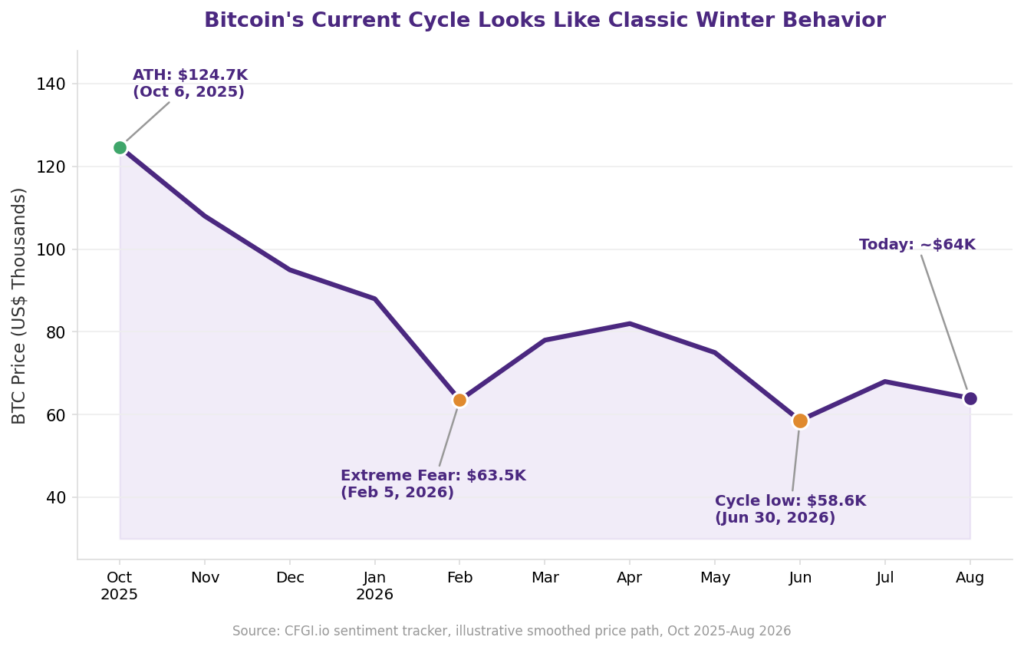
The current cycle is behaving like a classic winter: down roughly 49% from its October 2025 high, with a brief Extreme Fear reading in February 2026.
Summer and “bull market” aren’t interchangeable terms. Summer specifically starts at the halving and ends at the prior all-time high.
Several concrete signals, not just gut feeling, tend to mark winter’s end: miner capitulation, a falling price-to-thermocap multiple, and a sustained bounce off the lows.
What Is the Difference Between Bitcoin Summer and Bitcoin Winter?
Bitcoin summer is the recovery and rally phase that starts right after a halving and ends once price reclaims its prior all-time high, while Bitcoin winter is the extended downturn that runs from a new peak down to the next price trough.
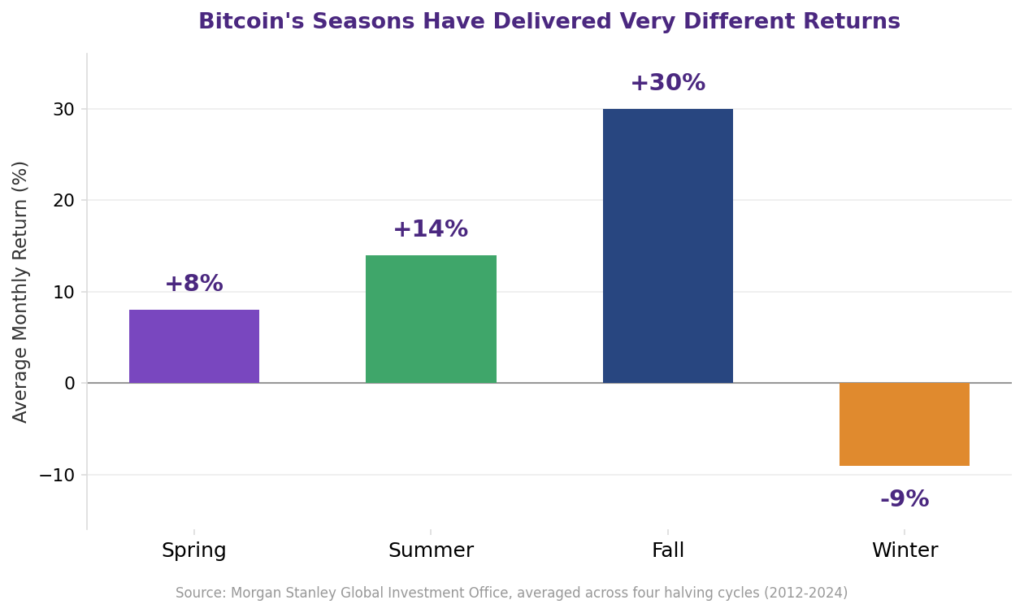
Bitcoin summer: begins at the halving event, has historically lasted about 6 months on average, and delivered average monthly returns near +14%.
Bitcoin winter: begins once a new high is reached and prices start falling, has historically lasted about 13 months on average, and delivered average monthly returns near -9%.
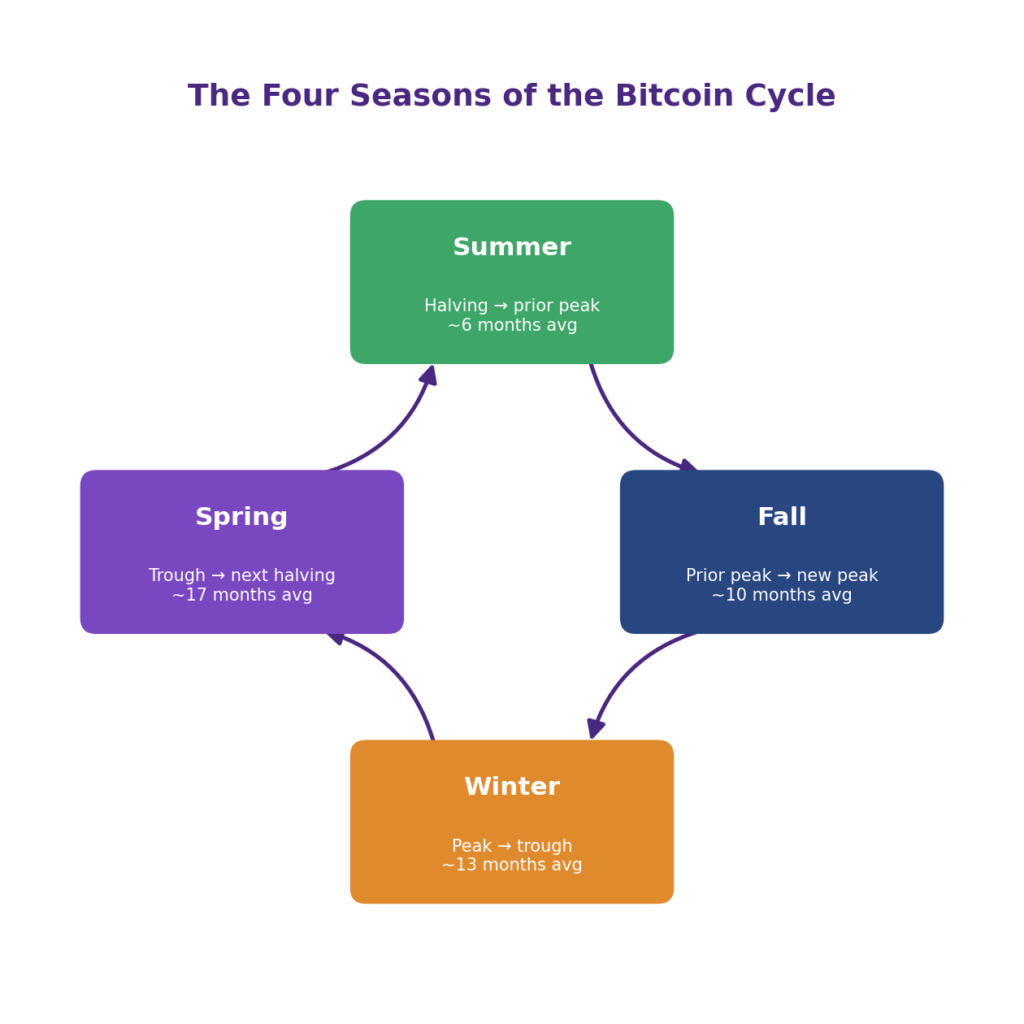
Both are part of a larger four-season cycle that also includes fall (the euphoric blow-off top phase) and spring (the recovery phase before the next halving).
The terms come from crypto market seasons analysis popularized by Wall Street research desks studying Bitcoin’s post-halving behavior.
Definition: Crypto Winter An extended period of falling cryptocurrency prices, typically running from a market peak down to its eventual bottom, often accompanied by reduced trading activity and weaker investor sentiment.
What Are the Four Seasons of the Bitcoin Market Cycle?
Bitcoin market seasons extend beyond just summer and winter into a full four-phase cycle that repeats roughly every four years, anchored to the Bitcoin halving, a framework popularized by Morgan Stanley’s Global Investment Office research.
Bitcoin Summer vs Bitcoin Winter: What Is the Difference?
Each season has a distinct trigger and, historically, a distinct return profile:
Season
Definition
Avg. Duration
Avg. Monthly Return
Spring
Trough to next halving
17 months
+8%
Summer
Halving to prior peak
6 months
+14%
Fall
Prior peak to new peak
10 months
+30%
Winter
Peak to trough
13 months
-9%
Bitcoin Summer vs Bitcoin Winter: What Is the Difference?
Fall stands out as the strongest season by average monthly return, which makes sense: it’s the euphoric, media-driven blow-off phase where price pushes past the old high and attracts the most new capital before the cycle turns. Winter is the only season with negative average returns, which is exactly why it gets so much attention from investors trying to time entries and exits.
How Long Does a Bitcoin Winter Usually Last?
A Bitcoin winter has historically lasted around 13 months from peak to trough, based on four complete cycles observed since 2011, though the depth of the decline has varied more than the duration.
Cycle
Winter Period
Duration
Peak-to-Trough Decline
2013-2015
Dec 2013 – Jan 2015
~13 months
-75%
2017-2018
Dec 2017 – Dec 2018
~12 months
-83%
2021-2022
Nov 2021 – Nov 2022
~12 months
-73%
2025-2026 (current)
Oct 2025 – ongoing
~10+ months so far
~-49% to -53%
Crypto winter duration has stayed fairly consistent across cycles even as the specific catalysts changed each time, from exchange collapses to leverage unwinds to regulatory crackdowns. The current cycle’s decline, while sharp, remains shallower than the three prior winters at this point, though Bitcoin briefly touched a cycle low of $58,621 on June 30, 2026, before a partial recovery back toward the mid-$60,000s.
How Is Bitcoin Summer Different From a Regular Bull Market?
Bitcoin summer vs bull market is a common point of confusion, but they’re not quite the same thing. A bull market is any sustained period of rising prices, with no fixed start or end point tied to a specific event. Bitcoin summer is a specifically defined phase that starts exactly at the halving and ends exactly when price reclaims its prior peak.
In practice, this means a bull market can span both summer and fall, since both feature rising prices. The distinction matters for expectations: summer’s historical average return (+14% monthly) is meaningfully lower than fall’s (+30% monthly), even though both would just get lumped together as “the bull market” in casual conversation. Investors using the season framework specifically to time entries would treat these as two different windows with different risk-reward profiles, not one continuous phase.
How Does Investor Behavior Change Across Bitcoin’s Market Seasons?
Investor behavior across Bitcoin’s seasons roughly maps to four psychological phases: accumulation, markup, distribution, and markdown, a framework that predates crypto but fits its cycles closely.
Definition: Accumulation The phase where informed or patient investors quietly build positions while prices are flat or depressed and public interest is low, typically occurring late in winter and early in spring.
Accumulation (late winter/early spring): Smart money buys quietly while sentiment is still poor and headlines are negative.
Markup (summer/early fall): Price begins trending up, media attention returns, and broader participation grows.
Distribution (peak of fall): Early accumulators sell into strength as retail FOMO peaks and prices reach unsustainable levels.
Markdown (winter): Prices decline as demand dries up, leveraged positions unwind, and pessimism sets in.
This behavioral pattern is also why crypto summer meaning matters beyond just price: it describes a shift in who’s buying and why, not just the direction of the chart. Our breakdown of crypto bull run phases covers this accumulation-to-distribution pattern in more detail, including how Bitcoin, Ethereum, and altcoins tend to take turns leading each phase.
What Are the Signs That Bitcoin Winter Is Ending?
Several concrete signals, rather than just sentiment, have historically clustered together near the end of a Bitcoin winter.
Cycle length: Bitcoin has typically bottomed 12-14 months after the prior peak, with spring historically beginning about 18 months before the next halving.
Drawdown depth: Prior winters have produced 73-87% peak-to-trough declines; a smaller drawdown than that historical range can suggest more downside may remain.
Miner capitulation: Weaker miners shutting down operations, followed by a trough in mining difficulty, has reliably clustered near past bottoms.
Price-to-thermocap multiple: A falling ratio of price to total historical investment in the network has coincided with prior troughs.
Exchange problems: Past cycle lows have often coincided with exchange failures or solvency scares, which shake confidence right before sentiment turns.
Price action confirmation: A roughly 50% bounce off the low has served as a common (though not perfectly reliable) confirmation signal in past cycles.
No single signal is definitive on its own, and past cycles have included false starts where a strong rebound was later followed by a retest of the lows. Watching several of these signals together, rather than any one in isolation, has historically been the more reliable approach.
Where Does the Current Cycle Stand?
As of August 2026, Bitcoin’s current cycle shows several classic winter characteristics, though with some notable differences from prior downturns.
Bitcoin Summer vs Bitcoin Winter: What Is the Difference?
Bitcoin peaked at $124,677 on October 6, 2025, then fell as low as $58,621.70 by June 30, 2026, a decline of roughly 53% from the high. Sentiment tracking data from CFGI.io shows the market touched Extreme Fear (a reading of 10 out of 100) on February 5, 2026, with the price at $63,548.50 that day, one of the more severe sentiment readings of the current downturn. Institutional flows told a similar story: Bitcoin ETFs saw an estimated $3.7 billion in net outflows between October 2025 and February 2026, before flows began stabilizing.
Compared to the three prior winters (-75%, -83%, and -73% peak-to-trough), the current cycle’s roughly 53% decline sits on the milder end, which several analysts have attributed to a stronger market structure and deeper institutional participation than in past cycles. Whether this marks a genuinely different pattern or just a temporary reprieve before further downside remains an open question that only time will answer. Our analysis on whether 2026 is a crypto bear market walks through the specific liquidity and on-chain signals worth tracking from here.
How Can You Prepare for a Bitcoin Winter?
A few structural approaches have historically helped investors manage the psychological and financial strain of a prolonged downturn, without requiring perfect market timing.
Dollar-cost averaging (DCA/SIP): Buying a fixed amount on a regular schedule smooths out entry prices and removes the pressure of trying to call the exact bottom. Our guide to starting a Bitcoin SIP covers how this works in practice.
Reducing overall crypto allocation: Simply holding less crypto lowers portfolio volatility and keeps you within your comfort zone during sharp drawdowns.
Hedging with futures: More active investors sometimes use short futures positions to offset downside risk on existing holdings during confirmed downturns, rather than exiting spot positions entirely.
Tracking cycle position, not just price: Understanding roughly where the market sits in the halving cycle, using signals like the ones above, helps separate a normal winter from a structural break in the pattern.
None of these approaches eliminate risk, and past cycle patterns are not a guarantee of how any future cycle will play out.
Conclusion
Bitcoin summer vs Bitcoin winter describes a specific, repeating four-phase pattern tied to the halving cycle, not just informal shorthand for good and bad markets. Winter has historically lasted around 13 months with steep declines, while summer delivers strong but more measured gains before fall’s euphoric peak.
The current cycle shows real winter characteristics, a roughly 53% drawdown from October 2025’s high, but a milder decline than the three winters before it. Whether that holds, or whether more downside lies ahead, will likely be clearer once the concrete signals above, not just sentiment, start lining up together.
Ready to track BTC through every season? Download the Mudrex app for Android or iOS to follow live prices.
Bitcoin summer is the recovery phase that begins at a halving event and ends once Bitcoin’s price reclaims its prior all-time high, historically lasting about 6 months.
What is Bitcoin winter?
Bitcoin winter is the extended downturn that runs from a new price peak down to the next market trough, historically lasting about 13 months with declines of 73-87%.
How are they different from bull and bear markets?
Bull and bear markets are general terms for rising or falling prices with no fixed timeframe, while Bitcoin summer and winter are specifically defined phases tied to the halving cycle.
How long can a crypto winter last?
Historically, crypto winters have lasted 12-13 months on average across four cycles since 2011, though individual cycles have varied somewhat in both length and depth.
What signals the start of crypto summer?
Crypto summer begins precisely at the Bitcoin halving event, though prices don’t always react immediately; historically, most gains have come in the months following the halving.
Does the Bitcoin halving cause crypto summer?
The halving reduces new BTC supply, which has historically preceded bull runs, but many analysts increasingly point to global liquidity conditions as an equal or greater driver in recent cycles.
Can crypto summer and altcoin season overlap?
Yes. Altcoin season, when non-Bitcoin assets outperform, has historically clustered in late summer and fall as capital rotates out of Bitcoin after its initial run.
Risk Disclaimer
Cryptocurrency investments, including Bitcoin, carry a high risk of loss and are highly volatile. Any use of leverage or futures magnifies both potential gains and potential losses. The historical patterns, figures, and examples in this article are illustrative and for educational purposes only; past cycle behavior does not guarantee future results, and this is not financial advice. Please DYOR before making any investment decisions.
Siri is a writer venturing into the exciting realms of blockchain technology, cryptocurrency, and decentralized finance (DeFi), eager to explore the transformative potential of these innovations. She brings a unique perspective that bridges traditional industries and cutting-edge technology, often infused with a touch of humor through memes. She has a rich background in real estate and interior design, having previously contributed to NoBroker, where she crafted blogs and assets on these topics.