How to Use the Crypto Season Index to Predict Bitcoin or Altcoin Runs
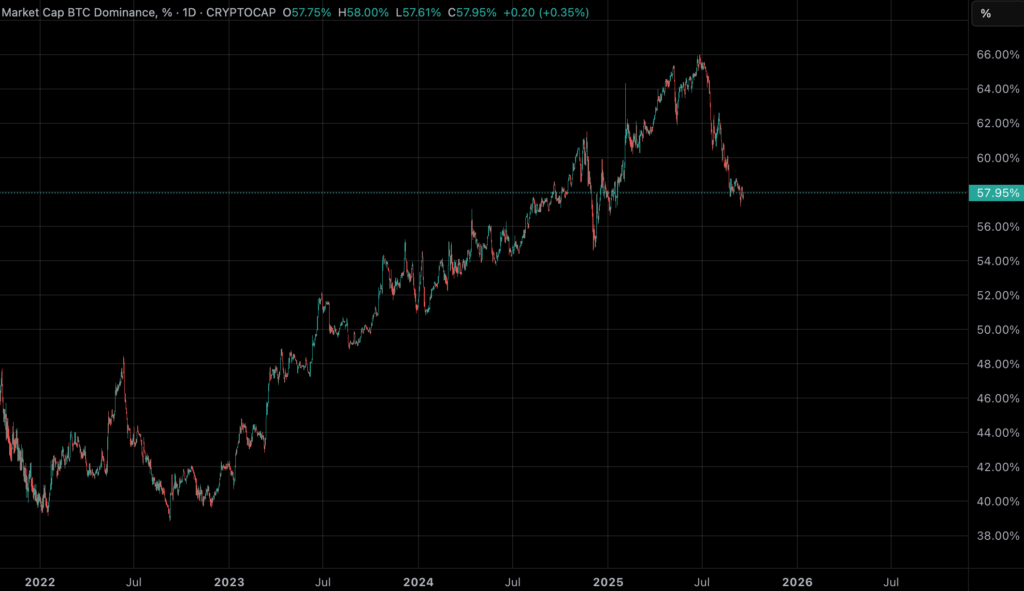
Bitcoin Dominance is the percentage of total crypto market cap held by Bitcoin. When BTC.D is rising, Bitcoin is capturing a larger share of the market – a sign of a “Bitcoin season” where BTC tends to outperform alts. Conversely, a falling BTC dominance (especially after a high peak) signals money rotating out of BTC into altcoins. Historically, ~60% BTC dominance has been a key pivot: above ~60–65% the market feels BTC-centric, but once dominance decisively breaks below ~60%, it has often triggered broad altcoin rallies.
The Altcoin Season Index (ASI) tracks how many top altcoins are outperforming Bitcoin over the last 90 days. If 75% of top coins (excluding stablecoins and pegged tokens) have outgained BTC in that period, it’s considered Altcoin Season; if only 25% or fewer are outperforming, it’s Bitcoin Season. In practice, an ASI reading above ~75 indicates a broad altcoin rally, whereas a low reading (sub-25) means BTC has beaten most alts (BTC-led market). For example, in mid-2025 the index was in the low-40s (well below the 75 alt-season threshold), confirming a BTC-dominated cycle at that time.
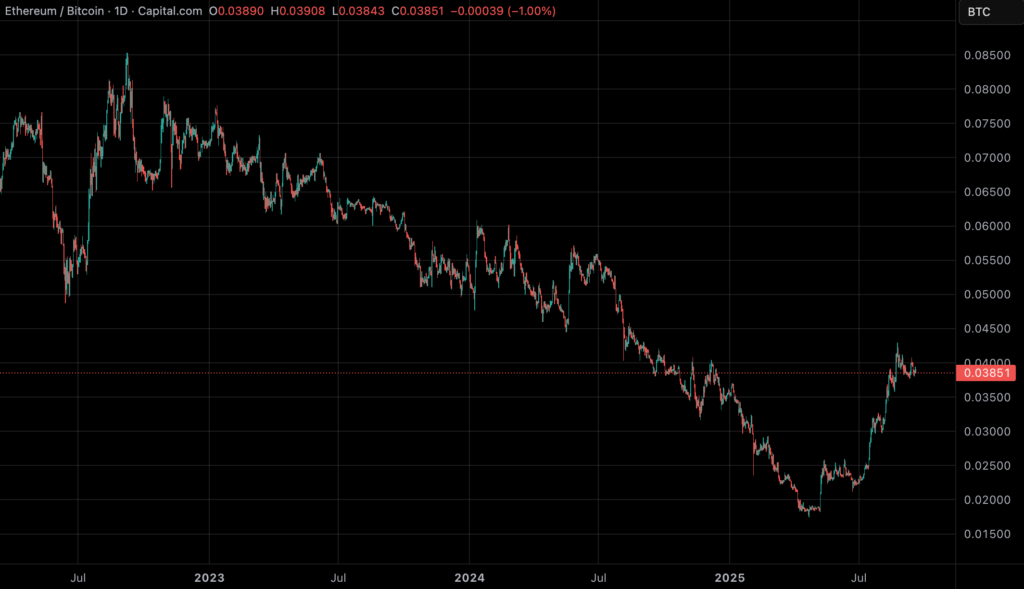
ETH/BTC & TOTAL2: ETH/BTC up + TOTAL2 up = broad alt bid
ETH/BTC chart
Beyond dominance and ASI, check Ethereum’s strength vs Bitcoin (ETH/BTC) and the total altcoin market cap (TOTAL2). When ETH/BTC is in an uptrend and breaking out, it signals investors rotating into ETH – often a leading indicator of a broader altcoin run.
Likewise, TOTAL2 (total market cap excluding BTC) making higher highs means the aggregate value of altcoins is climbing, confirming a broad-based bid for alts. Both ETH/BTC rising and TOTAL2 climbing together is a strong confirmation of an altcoin-friendly regime (capital flowing into the alt market). On the other hand, if ETH/BTC is stagnant or falling and the alt market cap is lagging, it suggests the market bias remains with Bitcoin or only a few large caps (no broad altseason yet).
What is the Crypto Season Index?
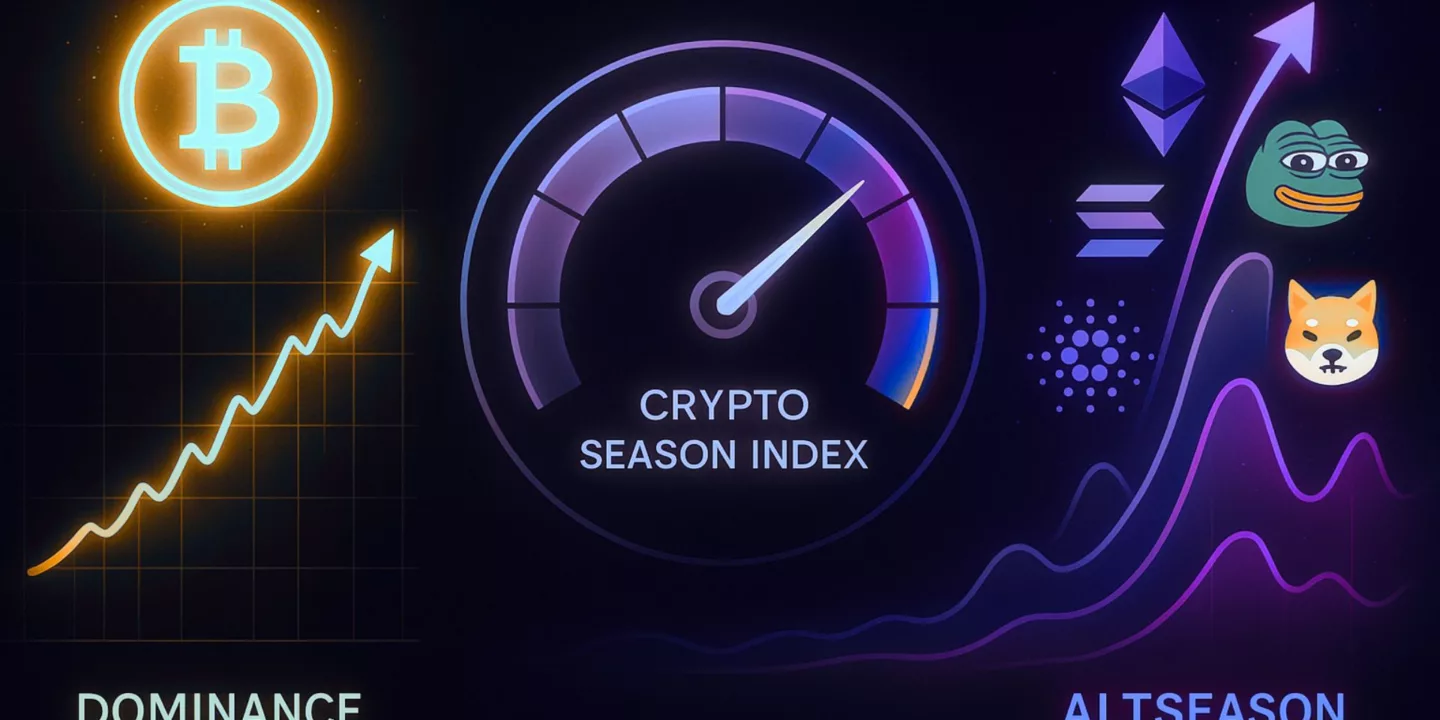
In crypto, market leadership oscillates between Bitcoin and the altcoin pack. The term “Crypto Season Index” informally refers to tools that gauge these rotations – essentially distinguishing Bitcoin season vs Altcoin season. Rather than a single metric, it’s a concept based on a combination of indices and indicators that together tell us which side of the market (BTC or alts) is gaining momentum.
Altcoin Season Index (ASI)
The Altcoin Season Index (ASI) measures whether altcoins are outperforming Bitcoin. It compares the returns of top cryptocurrencies (excluding BTC) against Bitcoin over set timeframes:
Altcoin Season (90-day view): If 75%+ of alts beat BTC in the past 90 days, it’s an Altcoin Season; if <25%, it’s a Bitcoin Season. The index scales 0–100 to reflect this percentage (e.g., ASI 80 = 80% of alts outperformed BTC).
Altcoin Month (30-day view): Same logic over a rolling month. A high month index can hint at a shift before it shows in the 90-day metric.
Altcoin Year (365-day view): A longer-term lens, though less commonly used.
Trackers (e.g., BlockchainCenter, CoinMarketCap) use top 50–100 coins, excluding stablecoins, to avoid skew. A high ASI signals broad-based alt strength, while mid-range (40–60) suggests no clear leader.
In essence, ASI answers: “Is it altcoin season right now?” That said, this is often considered a lagging indicator, meaning by the time it flashes “Altcoin Season,” the rotation has often already begun.
Bitcoin Season Index (dominance-based view)
There is no official “Bitcoin Season Index,” but traders infer it from the inverse of the Altcoin Season Index (ASI). When ASI falls below ~25, it signals a strong Bitcoin-led market—commonly referred to as Bitcoin season.
The main proxy for this is Bitcoin Dominance (BTC.D), which measures Bitcoin’s share of total crypto market cap. High dominance means Bitcoin is absorbing most capital, leaving less for altcoins. Historically, BTC.D above 60–65% aligns with periods when Bitcoin rallies or holds steady while alts lag—common in bear markets or the early stages of bull runs. For example, in mid-2025, BTC.D was around 65% while ASI hovered in the 40s, reflecting a BTC-driven market where Bitcoin neared new highs but many alts remained far below theirs.
A falling dominance, however, often marks the start of rotation. When BTC.D drops out of the 60s into the 50s (or lower), alts gain market share—an early clue that altseason may be underway. Past cycles show this tipping point clearly: in 2017, BTC.D plunged from ~85% to ~38% at the peak of altcoin mania, while in 2021, a break below 60% triggered a surge in alt gains.
In short, Bitcoin season is when Bitcoin dominates performance—its market share is high or rising, and most alts fail to keep up. Conceptually, it can be thought of as 100 minus the ASI, but in practice, traders rely on BTC Dominance and ASI together to judge the balance of power.
Why combining indices beats using one
No single metric can define market cycles, which is why traders combine multiple signals to avoid false reads. The Altcoin Season Index (ASI) is a lagging indicator—by the time it shows 75+, altcoins have usually been outperforming for a while. Similarly, Bitcoin Dominance (BTC.D) can drop for reasons unrelated to alt strength, such as Bitcoin correcting while alts also fall.
To filter out fake outs, traders look for alignment across indicators. For instance, in September 2025 the ASI briefly spiked above 75 and alt volumes overtook Bitcoin’s, sparking claims that altseason had arrived. But BTC dominance was still high (upper-50s%), market sentiment remained muted, and many top alts were still down 80–90% from prior highs. That rally quickly faded, showing how reliance on one metric can mislead.
A stronger approach is multi-confirmation: combine BTC dominance trends, ASI readings, ETH/BTC strength, total market cap data, and sentiment checks. A genuine altcoin season usually shows them all moving in sync—BTC.D trending down, ASI high and sustained, ETH/BTC gaining, and alt markets broadly rising in price and volume. If only one of these flashes altseason while others remain neutral, caution is warranted.
In short, the real signal comes from confluence, not from a single index in isolation.
The Step-by-Step Playbook
Here’s a five-step process to identify whether the market favors Bitcoin or altcoins—and how to trade accordingly.
Step 1 — Define the regime
Start by checking Bitcoin Dominance (BTC.D) on daily or weekly charts. If BTC.D is in an uptrend (higher highs, bullish moving average crossovers), Bitcoin is likely to outperform. If BTC.D breaks down below major averages or trendlines, it often signals the start of capital rotation into altcoins. For example, in July 2025 BTC dominance peaked near 65% before rolling over, coinciding with altcoin market cap bouncing higher. Recognizing whether BTC is “in charge” or faltering sets your trading bias.
Step 2 — Confirm breadth
Next, check whether altcoin outperformance is broad or narrow. The Altcoin Season Index (ASI) helps here. If ASI is low (20–30s), breadth is weak and BTC likely still leads. If ASI is rising toward 60+, more alts are outperforming, and momentum is shifting. An ASI above 75 signals full altseason, but the climb toward that level is often the key tell. In August 2025, ASI hit ~80, meaning 40 of the top 50 alts beat BTC—a classic breadth confirmation.
Step 3 — Cross-check signals
With BTC dominance weakening and ASI climbing, look for confluence across other indicators:
ETH/BTC: If Ethereum outperforms BTC, it often leads altseasons.
Volume: Alt volumes overtaking BTC volumes show participation.
Sentiment & funding: Moderate greed and neutral funding are healthy. Extreme greed or frothy funding rates are red flags.
A real altseason usually shows all these factors moving together. If one lags (e.g., ETH/BTC stagnant), wait for confirmation.
Step 4 — Entry and exit rules
Bitcoin-run setup: If BTC.D rises and ASI stays low, overweight Bitcoin. Avoid chasing small-cap alts—they often bleed value during BTC-led runs. Take profits as BTC hits technical targets or if dominance nears historical peaks.
Alt-run setup: If BTC.D is falling, ASI is >60 and rising, and ETH/BTC is breaking out, rotate into altcoins. Start with large caps (ETH, SOL, XRP), then mid-caps (DeFi, Layer-2s), and finally small caps in the late stage. Take profits in stages—trim large caps as they rally, then recycle gains into mids and, cautiously, into small caps. Always plan exits: if ASI dips below 75 or BTC dominance stabilizes, rotate back toward BTC or stablecoins.
Step 5 — Manage risk
Crypto cycles are volatile, so discipline is key:
Size positions by volatility (smaller stakes in small caps).
Use ATR or major support levels for stops—tight stops often fail in volatile alts.
Take profits gradually instead of aiming for exact tops.
Avoid chasing illiquid meme coins late in the cycle—they often mark the peak.
Rebalance regularly and hedge if needed.
Stay emotionally disciplined—altseasons end fast, and greed is usually the top signal.
Thresholds & Examples
Traders use certain thresholds as guideposts, not hard rules. The Altcoin Season Index (ASI) is central: ASI above 75 signals a classic altseason, while below 25 favors Bitcoin. Values between 40–50 often act as an early tell, as seen in 2021 when ASI climbed from ~30 to 75 before alts surged.
Bitcoin Dominance (BTC.D) around 60% is another pivot. Above 60–65%, Bitcoin tends to lead; below 60% opens the door for alts. Other markers include 50% (often mid-altseason) or extremes like 70% resistance and 40% support. Though stablecoins now affect dominance, the psychological “over half vs under half” split remains powerful.
ETH/BTC serves as a bellwether. Breakouts above levels like 0.065–0.07, or reclaiming the 200-day moving average, often confirm alt strength. Likewise, rising Ethereum dominance signals leadership among large caps.
The Fear & Greed Index above 80 warns of euphoria and late-cycle risks, while sub-20 readings during falling dominance can mark contrarian buy zones. Similarly, high funding rates (>0.1% per 8h) or record open interest (OI)suggest crowded long positioning—conditions that often precede shakeouts. In Sept 2025, altcoin OI hit ~$39B, rivaling Bitcoin, just before a pullback.
False springs occur when one or two indicators flash green without broad confirmation: ASI spikes briefly then fades, BTC.D chops sideways, majors like ETH stay weak, or volume and sentiment remain muted. September 2025 was a textbook case: ASI hit ~80, but big alts stayed depressed and sentiment never flipped euphoric, and the rally soon fizzled.
Late-cycle warnings include parabolic charts, extreme leverage, Fear & Greed above 85–90, and frothy pumps in meme coins or low-quality tokens. When majors have already run and small caps start doing 10x overnight, the cycle is likely peaking.
The lesson: thresholds guide the map, but only confluence confirms the journey.
Trade Templates
Traders often think in “seasons.” Here are three simplified playbooks for positioning:
1. Bitcoin Season Template
Bias: Heavy Bitcoin, light alt exposure.
Setup: BTC dominance rising, Altcoin Season Index (ASI) low, ETH/BTC weak.
Strategy: Allocate ~70% to BTC, 20–25% to ETH/top-10 alts, avoid small-caps. Focus on BTC technicals for entries and exits, trail stops closely, and cut any alt severely underperforming. Active traders may even short weak alts vs BTC. This phase continues until BTC.D stalls or ASI trends higher, hinting at rotation.
2. Early Alt Season Template
Bias: Rotate into large-caps, especially ETH.
Setup: BTC dominance peaks and rolls over, ASI climbs from 40→60, ETH/BTC breaks out.
Strategy: Shift to ~30–40% BTC and 60–70% alts, concentrated in ETH and other top-20 names like SOL, ADA, or XRP. Add exposure to strong narrative sectors (e.g. DeFi, Layer-2s). BTC remains a safety anchor, but the upside lies in majors. Risk management: set stops below key supports, cut laggards, and favor leaders. Example: In July 2025, ETH and SOL led double-digit rallies as BTC.D dropped, rewarding this allocation.
3. Full Alt Season Template
Bias: Broad exposure to mid-caps and select small-caps, with sector rotation.
Setup: ASI above 75, BTC.D in the 40–50% range, ETH/BTC strong but smaller alts outperforming.
Strategy: Diversify across baskets (Layer-1s, DeFi, Metaverse, Meme coins). Rotate profits as each sector peaks—e.g., from SOL/ETH to DeFi, then into gaming or memes. Keep some BTC/stables (10–20%) as a hedge. Risk management: use smaller positions in illiquid names, trail stops, and avoid chasing late movers. Example: In a classic alt frenzy, large-caps pump first, then mid-caps 3–5x, with meme coins marking the final blow-off.
In short, adapt allocation to the season: ride BTC strength, pivot to majors as dominance cracks, then broaden to alts while managing rotations and risk.
Tools & Dashboards
Tracking Crypto Season indicators is easier with the right dashboards and alerts. Here are the essentials.
Where to Track
Altcoin Season Index (ASI): BlockchainCenter and CoinMarketCap both host ASI dashboards. BlockchainCenter shows whether it is officially “Altcoin Season” or “Bitcoin Season” and charts top-50 coin performance. CoinMarketCap offers similar historical graphs. Bookmarking one of these pages lets you check the ASI daily.
Bitcoin Dominance (BTC.D): TradingView has a chart for BTC.D where you can draw trendlines and overlays. You can also monitor “OTHERS.D” for the alt market share excluding BTC and ETH. CoinMarketCap shows BTC dominance on its homepage as well.
TOTAL2 and TOTAL3: On TradingView, TOTAL2 tracks the market cap of all alts excluding BTC, while TOTAL3 excludes both BTC and ETH. These reveal whether gains are broad-based or ETH-led.
ETH/BTC Pair: Available on all major exchanges and TradingView. Watch trendlines and the 200-day moving average; a breakout often signals the start of an alt rotation.
Sentiment Gauges: The Crypto Fear & Greed Index on Alternative.me or CryptoQuant offers daily sentiment context.
On-chain & Derivatives Data: Platforms like CoinGlass, Glassnode, and Santiment provide funding rates, open interest, and activity metrics for deeper insights.
Alerts to Set
BTC Dominance Breaks: Set TradingView alerts when BTC.D falls below key thresholds (e.g., 60%) or breaks trendlines, often the trigger for altseason.
Altcoin Season Index Levels: Manually track or script alerts for ASI > 50 (early signal) and ASI > 75 (confirmation). Watch for drops back below these levels as a cooling sign.
ETH/BTC Breakouts: Place alerts on the 200-day moving average or horizontal levels (e.g., 0.065, 0.08). ETH strength often leads the broader alt rally.
TOTAL2/TOTAL3 or Sector Indexes: Alert on breakout levels for overall alt caps or specific sectors like DeFi or gaming.
Sentiment Extremes: Optional alerts when Fear & Greed exceeds 80 or spikes rapidly, which can flag overheated conditions.
Bottom Line & Checklist
Navigating Bitcoin vs Altcoin runs is clearer with a structured routine. Use this 5-point checklist each week (or when conditions shift):
1. Bitcoin Dominance Trend – Check BTC.D.
Rising dominance = Bitcoin season.
Falling dominance = Altcoin rotation. A breakdown of key levels (e.g., below 60%) is a strong altseason clue.
2. Altcoin Season Index (ASI) – Watch the index.
Low (<25–40) = Bitcoin season.
High (>60–75) = Altseason.
Mid-range/rising = momentum building. The 75/25 rule is the guidepost.
3. ETH/BTC + Alt Market Caps – Confirm leadership.
ETH/BTC uptrend + TOTAL2/TOTAL3 rising = broad alt strength.
ETH/BTC weak or TOTAL2 stagnant = BTC still in control.
4. Sentiment & Leverage – Gauge market heat.
Healthy: neutral-to-positive sentiment, normal funding.
Risky: extreme greed (>80) or high funding = late-stage pump.
5. Cross-Indicator Agreement – Look for alignment.
3+ signals pointing to BTC = overweight Bitcoin.
3+ signals pointing to alts = overweight alts.
This framework helps you adapt dynamically, tilting toward where momentum and capital are flowing,so you catch the season early, not after it’s obvious. Open an account with Mudrex, explore our curated CoinSets for diversified exposure to crypto.
FAQs
How to predict altcoin season? Watch for BTC dominance rolling over, Altcoin Season Index (ASI) rising toward/above 60–75, ETH/BTC breaking up, and TOTAL2 making higher highs—when 3+ of these align, rotation into alts is likely.
How to read the Altcoin Season Index? It’s the % of top alts that outperformed BTC over ~90 days: >75 = Altcoin Season, <25 = Bitcoin Season, middle = mixed/transition; the Month view (30d) gives earlier, shorter-term signals.
Where does Bitcoin dominance need to be for altcoin season? There’s no hard line, but sustained drops from the 60–65% area historically precede broad alt runs; deeper pushes below ~60% add confidence that rotation is underway.
Is ETH/BTC a good altcoin season signal? Yes—ETH/BTC trending up or breaking out is one of the cleanest early tells that capital is rotating from BTC into large-cap alts, often before the smaller caps follow.
How long does altcoin season last? It varies by cycle, typically weeks to a few months; it often starts with large caps (ETH, majors), then mid caps, and ends with small caps/memes before cooling off.
When is the next altcoin season? No fixed date—wait for the checklist: BTC.D rolling over, ASI >60–75 and rising, ETH/BTC breakout, TOTAL2 strength, plus healthy volumes and non-extreme sentiment.
Is VWAP/SMA better than dominance for timing? (brief compare) They answer different questions: VWAP/SMA help time trend entries on a single asset, while BTC dominance tells you where capital is flowing (BTC vs alts); use both—VWAP/SMA for entries, dominance for rotation bias.
Which indicators work best with the Crypto Season Index? Pair ASI with BTC.D trend, ETH/BTC, TOTAL2/TOTAL3, volume breadth, funding rates/OI, and Fear & Greed; add MA/trendline breaks on BTC.D and ETH/BTC for cleaner confirmations.
Anush is a crypto researcher dedicated to making blockchain insights clear and accessible. A proud Solana maxi who still appreciates a good Layer 2 debate, he dives deep into market trends so others don’t have to (but really should). Passionate about simplifying crypto, he strives to make the space less intimidating and a lot more relatable, one report at a time.