You’re weighing whether to buy real CRCL or the tokenized version, and the two things that matter most for a long-term holder, getting paid and getting a say, don’t automatically come with a token. Assume they do, and you might only find out otherwise the day a dividend check goes to someone else’s account, or a shareholder vote happens without you.
Does Circle (CRCL) tokenized stock pay dividends or give voting rights? Neither, and here’s exactly why, plus what CRCLB gives you instead. For the broader ownership-vs-exposure distinction, start with the full CRCL overview.
Key Takeaways
Circle Internet Group doesn’t currently pay a dividend at all, so that gap applies equally to real and tokenized holders today, it isn’t a tokenization-specific loss right now.
Voting rights are the more concrete gap: CRCLB doesn’t put you on Circle’s shareholder register, so your position carries no voting weight regardless of size.
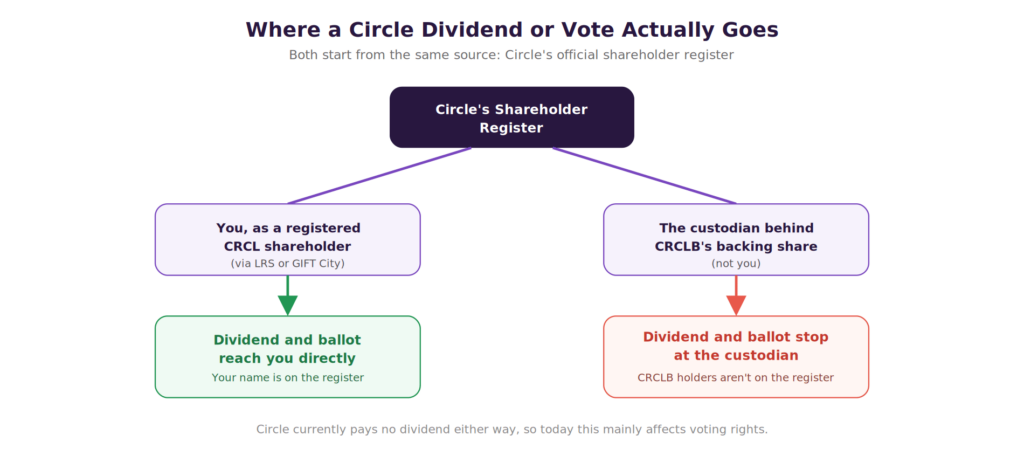
Both gaps come from the same root cause: dividends and votes attach to registered shareholders, and a price-tracking token isn’t built to register you as one.
What CRCLB does give you is price exposure to CRCL, designed to move with the stock without the legal and governance rights attached to real ownership.
If dividends (should Circle ever pay one) or voting matter to you, direct CRCL ownership via LRS or GIFT City is the route built for that.
Does Circle Actually Pay a Dividend Right Now?
No, and this is worth stating plainly before anything else: as of this writing, Circle Internet Group doesn’t pay a dividend at all, to anyone, tokenized or not. That makes the dividend question genuinely moot today, unlike a mature dividend payer where token holders are visibly missing out on a real, recurring payment.
That could change. Circle is a young, fast-growing fintech still early in its life as a public company, and companies at this stage typically reinvest profits rather than distribute them. If Circle does start paying a dividend down the line, that payment would go to registered shareholders only, and CRCLB holders wouldn’t be on that list, for the same structural reason covered below.
So What’s the Real Issue: Voting Rights
With no dividend currently in play, voting rights are actually the more concrete gap for Circle right now. A company’s shareholders get a say in board elections, executive pay, and major corporate decisions, and that right is tied to being on the company’s official shareholder register.
CRCLB doesn’t put you on that register. The custodian holding the backing share is the registered shareholder, not you, so however large your CRCLB position gets, it carries zero voting weight at Circle’s shareholder meetings. For most retail-sized positions this changes little in practice, one small holding rarely swings a vote either way, but it’s a real difference if part of why you wanted Circle exposure was having some say in how the company is run.
Why Neither Right Transfers to a Token
Both gaps trace back to the same root cause: dividends and votes are legal entitlements that attach to whoever’s name sits on the shareholder register, and a token that tracks price movement isn’t built to put your name there.
It’s worth contrasting this with something you might already assume works the same way: a regular US brokerage account. When you buy a stock through a broker, your shares are often held in “street name,” meaning the broker, not you, is technically the one on the company’s register. Even so, brokers are required to forward dividend payments and proxy voting materials to you as the beneficial owner, so the money and the vote still reach you in practice.
Custodial tokenization doesn’t work the same way. The custodian holding CRCLB’s backing share generally doesn’t pass dividends or voting rights down to token holders, even though the underlying structure, someone else technically on the register, looks similar on paper.
There’s a model where rights genuinely could pass through, and it’s worth knowing it exists. The SEC’s own January 2026 statement on tokenized securities describes an “issuer-sponsored” approach, where a company integrates token records directly into its official shareholder register, making the token itself the legal security rather than a separate claim on one held elsewhere. If Circle, or any issuer, moved to that model, tokenized rights could look meaningfully different from what CRCLB offers today. CRCLB, like most tokenized stocks currently available through crypto platforms, uses the custodial model instead, not the issuer-sponsored one.
None of this is a Mudrex-specific limitation. It’s how price-exposure-style tokenized stocks work across the industry, as opposed to a model where the token itself is the registered security. We’re plain about this with our own tokenized US stocks: you get price exposure, not the underlying shares, which is exactly why dividend and voting entitlements don’t carry over.
Ownership Rights, Side by Side
Does Circle (CRCL) Tokenized Stock Pay Dividends or Votes?
Real CRCL shares
Tokenized CRCLB
Tracks Circle’s price
Yes
Yes
Dividend entitlement
Would apply if Circle ever pays one
No
Voting rights
Yes, proportional to holding
No
On the shareholder register
Yes
No
Access route
International broker, LRS, or GIFT City
Mudrex app
What CRCLB Gives You Instead
What you do get is straightforward: a position designed to move with CRCL’s price. If Circle stock climbs 5% in a session, a properly functioning CRCLB position should track that move closely. This is sometimes called economic exposure without ownership, you participate in the price outcome without picking up the legal and governance strings attached to being a shareholder.
For someone trading Circle’s price swings rather than settling in for years, that’s usually a fair trade: the price movement is the whole point, not a dividend that doesn’t exist yet or a vote most retail holders wouldn’t cast anyway. If you’re specifically after long-term compounding or an actual governance stake, real CRCL ownership through LRS or GIFT City is the better-suited route, not a substitute tokenized position pretending to be one.
Getting Exposure to Circle Without the Ownership Overhead
If speed and price exposure are what you’re after, not dividends or a vote you’d likely never cast anyway, you can buy CRCLB directly on Mudrex and hold it right alongside your existing crypto.
No. Tokenized CRCL positions, such as CRCLB on Mudrex, give you price exposure but don’t pass through dividends, since holding the token doesn’t make you a registered Circle shareholder.
Does Circle (CRCL) pay a dividend at all?
Not currently. As of this writing, Circle Internet Group has not declared a dividend.
Do I get voting rights with tokenized Circle stock?
No. Voting rights belong to registered shareholders. A tokenized position like CRCLB doesn’t register you as a Circle shareholder, so it carries no voting weight regardless of position size.
If I own real CRCL shares, do dividends and voting rights come automatically?
Yes, proportional to your holding, though the exact process for dividend crediting and proxy voting depends on your specific broker. However, it is crucial to note that CRCL shares do not come with dividends as of yet.
Can I get both price exposure and shareholder rights on Mudrex?
Not through CRCLB specifically, it’s built for price exposure, not shareholder rights. If dividends or voting matter to you, direct CRCL ownership through an international brokerage, LRS, or GIFT City is the route built for that.
Risk Disclaimer
Trading tokenized stocks and other virtual digital assets carries risk of capital loss. Tokenized stocks currently sit outside SEBI’s regulatory framework in India. This article is illustrative only and not financial advice; consult a qualified advisor before investing.
Siri is a writer venturing into the exciting realms of blockchain technology, cryptocurrency, and decentralized finance (DeFi), eager to explore the transformative potential of these innovations. She brings a unique perspective that bridges traditional industries and cutting-edge technology, often infused with a touch of humor through memes. She has a rich background in real estate and interior design, having previously contributed to NoBroker, where she crafted blogs and assets on these topics.