

An Ethereum transaction is a cryptographically signed instruction initiated by an account that requests a change to Ethereum’s state. The most familiar example is sending ETH from one wallet to another, but transactions can also interact with smart contracts, transfer tokens, and trigger other operations supported by the Ethereum Virtual Machine (EVM).
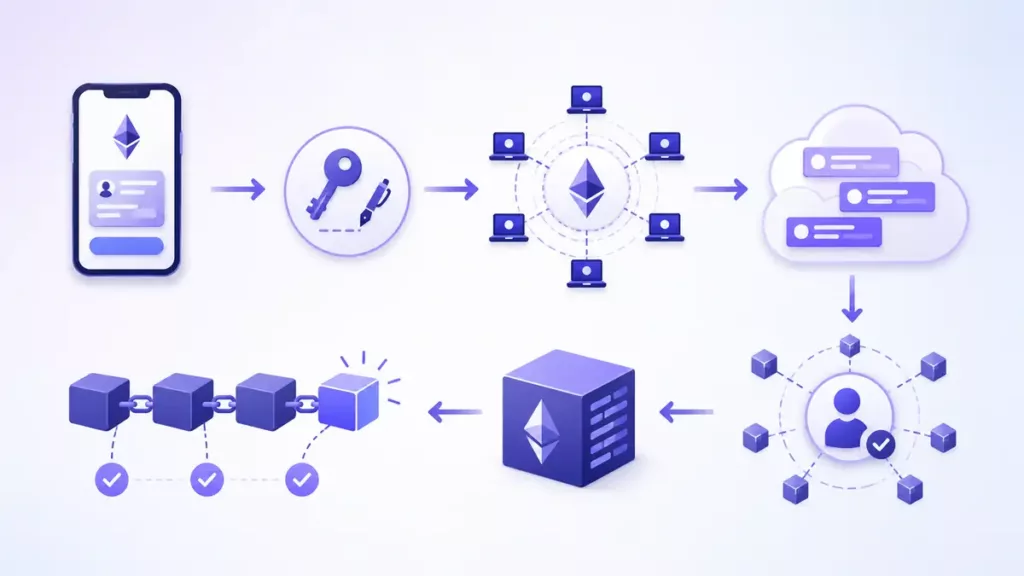
When you press Send in an Ethereum wallet, the transaction does not immediately become part of the blockchain. It is created, signed, broadcast to the network, processed according to Ethereum’s rules, and eventually included in a block. Subsequent blocks provide confirmation depth, while Ethereum’s Proof-of-Stake consensus can ultimately finalize the block.

Understanding this lifecycle makes it easier to interpret an ETH transaction, check its status, understand transaction fees, and troubleshoot pending or failed transactions.
At its simplest, an Ethereum transaction is a request from an externally owned account (EOA) to change the state of the Ethereum blockchain.
For a basic ETH transfer, this means moving a specified amount of ETH from a sender to a recipient. A transaction can also call a smart-contract function or interact with a decentralized application.
An Ethereum transaction can contain information such as:
Not every transaction uses these fields in the same way. A simple ETH transfer may contain little or no input data, while a smart-contract interaction can include information specifying the function and parameters being requested.
Suppose you want to send 0.1 ETH to another Ethereum address.
Your wallet creates a transaction containing the recipient, value, nonce, and fee parameters. It then uses the private key associated with your account to cryptographically sign the transaction.
The signature authorizes the transaction without revealing your private key.
Once signed, the wallet broadcasts the transaction to Ethereum’s network. At this stage, it has been submitted but has not necessarily been added to the blockchain. It must first be received by network participants and become eligible for inclusion in a block.
A transaction that has been broadcast but has not yet been included in a block is generally held by network participants in a mempool, short for memory pool.
The mempool is not one single global waiting room shared identically by every Ethereum node. Different nodes can hold different sets of pending transactions depending on what they have received and accepted.
A transaction therefore does not need to appear in every node’s mempool to eventually be included in a block.
While a transaction is pending, validators can consider it for inclusion in a future block. Network conditions, fee settings, nonce ordering, and transaction validity can all affect how quickly this happens.
Ethereum uses Proof of Stake, so validators—not miners—are responsible for proposing and validating blocks.
A validator selected to propose a block selects transactions available to it, executes them according to Ethereum’s rules, and proposes a block containing those transactions.
The proposed block is then propagated through the network, where other validators check it and participate in the consensus process.
If the block is accepted, the transactions included in it become part of Ethereum’s blockchain history.
However, block inclusion is not the same as finality. A transaction can be included in a block before Ethereum’s Proof-of-Stake consensus has finalized that block.
A signed transaction can be identified by a unique cryptographic identifier known as a transaction hash, or transaction ID.
The Ethereum transaction hash is a hexadecimal string that allows users and applications to locate and inspect a particular transaction on the blockchain.
The hash is an identifier, not the transaction’s authorization mechanism. The cryptographic signature authorizes the transaction, while the hash makes it possible to identify and retrieve information about it.
A transaction hash can be used to look up details such as:
This makes the transaction hash particularly useful when checking or troubleshooting an ETH transaction.
Every Ethereum transaction that requires execution consumes gas, which measures the computational resources needed to process it.
Gas is paid for in ETH, while gas prices are commonly expressed in gwei.
For transactions using the EIP-1559 fee mechanism, the fee structure includes a base fee and a priority fee. The base fee is determined by Ethereum’s fee market and is burned, while the priority fee is paid to the validator.
A transaction also specifies a gas limit, which is the maximum amount of gas it is allowed to consume.
The gas limit is not necessarily the amount the user pays. The actual fee depends on the gas used and the effective gas price.
In simplified terms:
Transaction fee = gas used × effective gas price
The effective gas price is the amount actually paid per unit of gas, reflecting the base fee and priority fee applicable to the transaction.
This is why a transaction’s max fee per gas is not necessarily the amount ultimately paid.
The nonce is a sequential transaction number associated with an Ethereum account.
It helps keep transactions from the same account in the correct order and prevents the same transaction from being processed more than once.
For example, if an account has processed transactions with nonces 5, 6, and 7, its next transaction will normally use nonce 8.
Nonce management becomes particularly important when transactions are pending. If one transaction is still waiting for inclusion, subsequent transactions from the same account can also be affected by transaction ordering.
The nonce is also important when attempting to replace or cancel a pending transaction, which we’ll cover in Part 3.
Not every Ethereum transaction simply transfers ETH.
A basic transfer moves ETH from one address to another. A smart-contract transaction sends information to a contract address and requests that the EVM execute specific instructions.
For example, interacting with a decentralized exchange may involve a transaction that calls a smart contract rather than simply transferring ETH to another wallet.
The transaction can contain input data describing the requested operation.
Smart-contract transactions can also consume substantially more gas than simple ETH transfers because they may require more computation.
The amount of ETH being transferred is therefore not the only factor determining an Ethereum transaction’s fee.
A typical transaction can be summarized as:
Create → Sign → Broadcast → Pending → Included in a block → Confirmations → Finalized
Not every transaction reaches the final stages. It can remain pending, or it can be included in a block but fail during execution.
The transaction hash, nonce, gas parameters, block inclusion, execution result, and finality status together provide a clearer picture of what happened to an Ethereum transaction.
Once an Ethereum transaction has been submitted, the next step is usually to check whether it went through.
A wallet may show a transaction as pending, successful, or failed, but a blockchain explorer such as Etherscan provides more detail. Using the Ethereum transaction hash, you can inspect the transaction’s status, block, confirmations, fees, addresses, and execution details.
Also Read: What is Etherscan?
After sending ETH, your wallet will usually provide a transaction hash. Copy the hash and search for it on Etherscan.
The transaction page can show:
You do not need to understand every field to check a transaction. Start with its status and block information, then look at confirmations, addresses, value, and fees if you need more detail.

An Ethereum transaction can generally appear in one of three states when you inspect it.
A pending transaction has not yet been included in a block.
It may have been broadcast successfully and received by some network participants, but a validator has not yet included it in a proposed block.
Pending does not automatically mean something has gone wrong. The transaction may simply be waiting for inclusion.
However, a transaction can remain pending because of factors such as network conditions, fee settings, nonce ordering, or transaction validity.
A successful transaction has been included in a block and its execution completed successfully.
For a simple ETH transfer, this means the specified amount was transferred from the sender to the recipient.
For a smart-contract interaction, it means the requested execution completed without reverting.
A failed transaction has been included in a block, but its execution did not complete successfully.
This can happen for several reasons, particularly when interacting with smart contracts. A transaction might run out of gas, violate a contract condition, or encounter another execution error.
A failed transaction can still consume gas because Ethereum processed the transaction even though the intended operation did not successfully complete.
When a transaction is included in a block, that block becomes part of Ethereum’s blockchain history.
As additional blocks are added after it, the transaction gains confirmation depth.
For example, if your transaction is included in block 20,000,000 and several newer blocks have since been added, those blocks provide additional confirmations.
More confirmations indicate that more blockchain history has been built after the transaction’s block. However, confirmations should not be confused with Ethereum’s protocol-level finality.
There is no universal number of confirmations that every Ethereum transaction needs. Exchanges, wallets, and other services can set their own requirements depending on their risk policies.
Confirmations refer to the additional blocks built after the block containing a transaction.
Finality is a stronger property provided by Ethereum’s Proof-of-Stake consensus. Once a block is finalized, reverting that finalized history would require a severe consensus failure and significant economic penalties for the validators responsible.
A transaction can therefore have multiple confirmations without those confirmations being identical to protocol-level finality.
The practical sequence is:
Submitted → Included in a block → Confirmations accumulate → Finalized
This distinction is especially important when an exchange or other service continues waiting after your wallet shows that a transaction has been completed.
There is no single fixed time for every ETH transaction.
A transaction moves through several stages:
1. Broadcast: The wallet sends the signed transaction to the network.
2. Pending: The transaction waits to be included in a block.
3. Inclusion: A validator includes it in a proposed block.
4. Confirmation: Additional blocks are added afterward.
5. Finality: Ethereum’s consensus finalizes the relevant block.
The time to inclusion can vary depending on network conditions, fee settings, nonce ordering, and other factors.
Finality is a separate stage from initial block inclusion, which is why different wallets and services may use different thresholds before considering a transaction fully settled.
The block number identifies the Ethereum block containing the transaction.
If a transaction has a block number, it has been included in a block. If it does not yet have one, it may still be pending.
The block number also provides the reference point for determining confirmation depth.
A transaction page can also display a timestamp associated with the block containing the transaction. This helps establish when the transaction was recorded on the blockchain.
The timestamp should not be interpreted as the exact moment the user clicked “Send.” A wallet can create and broadcast a transaction before a validator eventually includes it in a block.
When checking an Ethereum transaction, you may see both gas limit and gas used.
The gas limit is the maximum amount of gas the transaction is permitted to consume.
Gas used is the amount actually consumed during execution.
A higher gas limit does not automatically mean the user paid for that entire amount. The transaction fee depends on the gas used and the effective gas price.
For a transaction using Ethereum’s EIP-1559 fee mechanism, the effective gas price reflects the applicable base fee and priority fee.
In simplified terms:
Transaction fee = gas used × effective gas price
This makes gas used and effective gas price more useful for understanding the actual cost of a transaction than the maximum fee settings alone.
The nonce is the sequential transaction number associated with the sender’s Ethereum account.
It helps Ethereum process transactions from the same account in the correct order.
Nonce information becomes particularly useful when troubleshooting pending transactions. If one transaction is stuck, subsequent transactions from the same account can also be affected by transaction ordering.
A replacement transaction generally uses the same nonce as the pending transaction it is intended to replace.
We’ll look at replacement and cancellation in more detail in Part 3.
The input data field contains additional information attached to a transaction.
A simple ETH transfer may contain little or no input data. A smart-contract transaction can use this field to specify the function being called and the parameters being passed to the contract.
This is why a transaction involving a decentralized application can look very different from a straightforward ETH transfer.
The recipient may be a smart-contract address, and the ETH value alone may not explain what the transaction actually did.
Wallets simplify blockchain information, while block explorers expose more technical details.
For example, your wallet might display:
“Transaction complete.”
Etherscan can additionally show the block number, confirmations, gas used, transaction fee, nonce, and execution status.
These displays do not necessarily contradict each other.
A wallet may consider a transaction complete once it has been included in a block, while an exchange or other service may wait for additional confirmations or finality before crediting a deposit.
The underlying transaction can be the same even though different services use different thresholds.
Also Read : Ethereum Wallet detailed Guide
When checking an Ethereum transaction, use this order:
1. Check the status. Is it pending, successful, or failed?
2. Check the block number. A block number confirms that the transaction has been included in a block.
3. Check confirmations. See how much additional blockchain history has been built afterward.
4. Verify the addresses. Confirm the sender and recipient are the addresses you expected.
5. Check the ETH value. Make sure the amount transferred is correct.
6. Review the fee. Check gas used, effective gas price, and the total transaction fee.
7. Check the nonce if there is a pending transaction. This can help identify transaction-ordering or replacement issues.
8. Review input data when interacting with a smart contract. This can help identify the operation the transaction requested.
With these fields, you can usually determine what happened to an Ethereum transaction without needing to interpret every technical detail on the blockchain explorer.
An Ethereum transaction does not always move from submission to successful completion without a problem. It can remain pending, fail during execution, or require a replacement when its nonce or fee settings prevent it from being processed as intended.
Understanding these situations makes it easier to troubleshoot an ETH transaction without assuming that every delay means the funds are lost.
A pending Ethereum transaction has been broadcast but has not yet been included in a block.
A short delay is not necessarily a problem. However, a transaction can remain pending because of several factors.
Ethereum processes transactions in blocks rather than instantly. When network activity increases, transactions can compete for inclusion and some may take longer to be processed.
Under Ethereum’s EIP-1559 fee mechanism, a transaction includes a maximum fee per gas and a maximum priority fee per gas.
If its fee parameters are not competitive with current network conditions, it may take longer to be included.
It is more accurate to describe this as a fee-setting issue rather than saying the transaction has “low gas.” Gas measures computational work; the fee determines how much ETH is offered for that work.
Transactions from the same Ethereum account use sequential nonces.
If an earlier transaction is still pending, a later transaction with a higher nonce can also be affected. This can make one stuck transaction appear to hold up subsequent transactions from the same wallet.
A transaction must also satisfy Ethereum’s transaction-processing rules. Issues involving the sender’s balance, nonce, fee parameters, or transaction format can prevent it from being accepted or included as expected.
A failed transaction is different from a pending transaction.
A pending transaction has not yet been included in a block. A failed transaction has been included in a block, but its execution did not complete successfully.
For smart-contract transactions, failure can happen when the contract rejects the requested operation or execution reaches a condition that causes it to revert.
Common causes include:
A failed transaction does not normally undo the entire blockchain state. Instead, Ethereum records the transaction and its unsuccessful execution according to the protocol.
Also Read : Does ETH have a maximum supply?
Yes.
Gas pays for computation performed by the network. If Ethereum processes a transaction and executes it before the transaction fails or reverts, that computation can still consume gas.
The transaction can therefore incur a fee even when the intended operation does not succeed.
For example, suppose you interact with a smart contract and the execution eventually reverts. The intended state change may not occur, but Ethereum has still performed the computation required to process the transaction.
A failed transaction is therefore not automatically free.
An out-of-gas error occurs when a transaction uses all of its available gas before execution can finish.
This is particularly relevant for smart-contract interactions, which can require substantially more computation than a simple ETH transfer.
The gas limit determines how much gas the transaction is allowed to consume. If the required computation exceeds that limit, execution can fail.
It is important to distinguish gas limit from gas price:
Increasing the gas limit does not guarantee that a transaction will succeed. The transaction’s parameters and the smart contract’s conditions must also be valid.
A nonce too low error usually means the transaction is using a nonce that Ethereum has already processed or that is no longer valid for the account’s current transaction sequence.
For example, if an account has already processed a transaction with nonce 10, submitting another transaction with nonce 10 can result in a nonce conflict.
Nonce errors can become more confusing when a wallet has multiple pending transactions.
If you are troubleshooting a pending transaction, checking its nonce against other recent transactions from the same address can help identify whether transaction ordering is causing the problem.
A pending transaction cannot simply be deleted from Ethereum once it has been included in a block.
Before inclusion, however, a user may sometimes replace a pending transaction by submitting another transaction with the same nonce and appropriate fee parameters.
The replacement competes for the same nonce. If it is accepted and included instead, the original transaction will not be the transaction executed for that nonce.
Some wallets describe this process as canceling a transaction. Technically, this generally means submitting a replacement transaction rather than deleting the original transaction from the network.
A replacement is not guaranteed to work. It depends on the transaction’s state, wallet behavior, node policies, and applicable replacement rules.
Because replacement transactions can have real consequences, verify the nonce, recipient, value, and network before submitting one.
Ethereum transactions are generally not reversible once they have been included in the blockchain.
If you send ETH to the wrong address, Ethereum does not provide a central authority that can simply reverse the transaction.
Recovery depends on who controls the receiving address. If it belongs to another person or entity, recovering the ETH generally requires the recipient’s cooperation. If the address is inaccessible or belongs to a contract that cannot return the funds, recovery may not be possible.
This is why checking the recipient address before confirming an Ethereum transaction is essential.
Sending assets through the wrong network is different from sending ETH to the wrong address.
Before sending funds, verify:
A small test transfer can also be useful when moving a significant amount for the first time.
If you have already used the wrong network, first determine which network was used and whether the receiving wallet or platform supports recovery. Avoid sending another transaction until you understand what happened.
Also Read : Ethereum Smart Contracts
If an Ethereum transaction does not behave as expected, start with the transaction hash and check:
1. Status: Is it pending, successful, or failed?
2. Block: Does it have a block number? If so, it has been included in a block.
3. Nonce: Could transaction ordering be causing a problem?
4. Gas: How much gas was used, and what fee was charged?
5. Addresses: Is the recipient address correct?
6. Network: Was the transaction sent on the intended network?
7. Smart-contract execution: If it failed, did the contract revert or reject the requested operation?
If a transaction is pending, investigate its status and nonce before submitting another transaction. This can help prevent an additional transaction from creating further confusion.
Most Ethereum transaction problems become easier to understand once you distinguish pending transactions from failed transactions.
A pending transaction has not yet been included in a block. A failed transaction has been included but did not execute successfully, and it can still incur a gas fee.
Nonce problems can affect transaction ordering, while replacement transactions may sometimes resolve a pending transaction before inclusion. Transactions that have already been included in the blockchain generally cannot be reversed, making it essential to verify the recipient, network, nonce, and transaction details before confirming a transfer.
With these basics, you can use the transaction hash and a block explorer to determine whether an Ethereum transaction is simply delayed, has failed, or requires further action.
To make better crypto decisions, keep learning how Ethereum, wallets, fees and smart contracts work, and apply careful transaction checks before moving funds. Explore more guides on Mudrex Learn and continue learning with the Mudrex YouTube channel.
An Ethereum transaction is a cryptographically signed instruction from an externally owned account that requests a state change, such as transferring ETH, deploying a contract or calling a smart-contract function.
A transaction hash is the unique identifier used to locate an Ethereum transaction on a block explorer. It can be used to check status, block inclusion, addresses, fees, nonce and execution details.
Copy the transaction hash from your wallet and search it on an Ethereum explorer such as Etherscan. Start with status and block number, then verify addresses, value, gas, nonce and confirmations.
A transaction remains pending until a validator includes it in a block. Fee settings, an earlier pending nonce, network conditions or transaction validity can delay inclusion.
A transaction can be included but fail during execution because a contract reverted, parameters were invalid, conditions were not met or the transaction ran out of gas.
Yes. Ethereum may already have performed computational work before the failure. The intended state change can revert while the gas used for processing the transaction is still charged.
There is no universal number. Wallets, exchanges and other services choose their own confirmation policies. Ethereum’s protocol-level finality is a separate concept and currently takes roughly 15 minutes under normal conditions.
Generally, no. Once included in the blockchain, an Ethereum transaction cannot simply be reversed by a central authority. Recovery from an incorrect transfer depends on the destination and circumstances.
Transaction finality is the point at which the block containing a transaction has been finalized by Ethereum’s Proof-of-Stake consensus. Finality is different from confirmation count: a transaction can have multiple confirmations before the relevant block reaches protocol-level finality.