

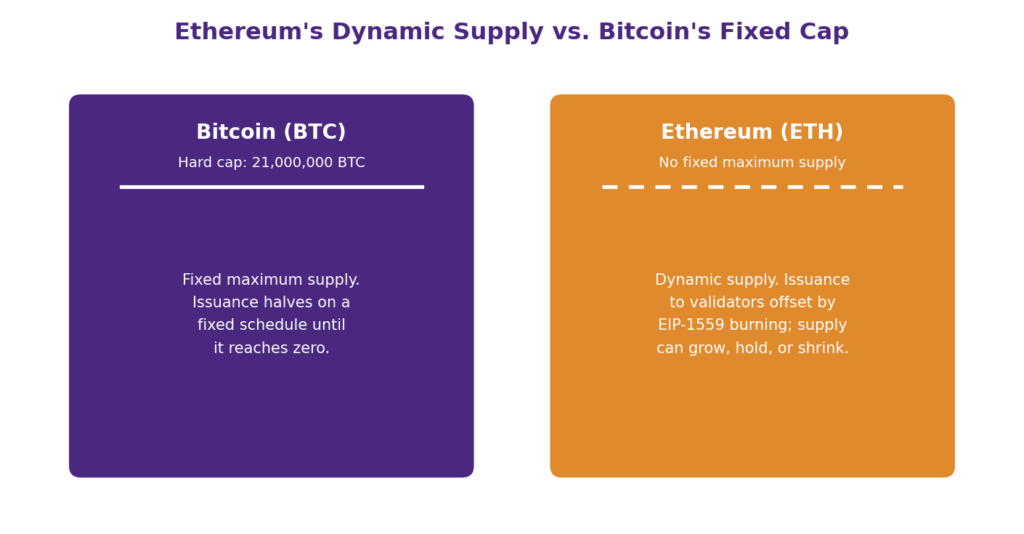
Ethereum does not have a fixed maximum supply. Unlike Bitcoin, which has a hard cap of 21 million BTC, Ethereum uses a dynamic supply model in which new ETH is issued to validators while ETH is burned through the network’s transaction-fee mechanism. The balance between these two forces determines whether Ethereum’s total supply grows, remains relatively stable, or declines over time.
That distinction is central to understanding Ethereum’s monetary policy. There is no predetermined number that represents the maximum amount of ETH that can ever exist. Instead, Ethereum’s supply changes according to protocol rules governing issuance and burning, as well as the economic activity taking place on the network.

For anyone asking “Does Ethereum have a maximum supply?”, the short answer is no. The more useful question is how Ethereum manages supply without a fixed ceiling-and what that means for ETH’s scarcity, monetary policy, and value.
Visit Ethereum Detail Page for Live Chart and Market Data
The Ethereum total supply changes through two opposing forces:
Issuance adds new ETH. Burning removes existing ETH.
New ETH is primarily issued as rewards to validators that secure Ethereum through Proof of Stake. At the same time, under EIP-1559, the base fee associated with transactions is burned, permanently removing that ETH from the supply.
This creates three possible outcomes:
The basic calculation is:
Net issuance = ETH issued − ETH burned
This is why looking only at how much ETH exists today does not tell the whole story. The direction and pace of supply growth also matter.
Ethereum’s supply model is therefore better described as dynamic and governed rather than unlimited or uncontrolled.
Ethereum was not designed around a predetermined supply ceiling.
Instead, its monetary policy has evolved alongside changes to Ethereum’s consensus and fee mechanisms. The transition from Proof of Work to Proof of Stake significantly changed how new ETH enters the system, while EIP-1559 introduced a mechanism for permanently removing ETH through the burning of transaction base fees.
This means Ethereum’s supply is determined by protocol rules rather than a fixed maximum number of coins.
That distinction is important when comparing Ethereum with Bitcoin. Bitcoin’s monetary policy is built around a predetermined maximum supply, while Ethereum’s supply can change according to its issuance and burning mechanisms.
A lack of a hard cap does not mean ETH can be created without limits or according to an arbitrary schedule. New ETH is issued according to Ethereum’s Proof-of-Stake rules, while burning can reduce the existing supply.
Check Live ETH TO INR price
One of the most important changes to Ethereum’s supply model came with The Merge, completed on September 15, 2022.
The Merge moved Ethereum from Proof of Work to Proof of Stake. This eliminated mining as the mechanism for producing new blocks and changed how ETH was issued. Since The Merge, execution-layer issuance has been zero, while new ETH is issued through the Proof-of-Stake consensus layer as validator rewards.
Before The Merge, Ethereum’s Proof-of-Work system issued new ETH to miners as compensation for helping secure the network.
After The Merge, those mining rewards disappeared.
The result was a substantial reduction in the rate at which new ETH enters the supply compared with the previous Proof-of-Work system.
However, The Merge did not create a maximum supply. It changed the issuance mechanism.
That distinction is important:
The Merge reduced new ETH issuance.
EIP-1559 burns the base fee associated with transactions.
The two mechanisms affect Ethereum’s supply in different ways.
Under Proof of Stake, Ethereum relies on validators rather than miners to help secure the network.
Validators deposit ETH to participate in consensus and can receive rewards for performing their duties correctly. They help propose and attest to blocks, maintain consensus, and secure the network. In return, the protocol distributes ETH rewards according to its Proof-of-Stake rules.
This process is known as ETH issuance.
The amount of ETH issued is determined by Ethereum’s Proof-of-Stake rules and varies with factors including the amount of ETH participating in staking and validator performance.
This creates an important distinction between gross issuance and net issuance.
Gross issuance measures how much new ETH is created. Net issuance accounts for both new ETH created and ETH burned.
That distinction is central to understanding Ethereum’s supply after EIP-1559.
Total supply refers to the amount of ETH that exists at a given time after accounting for issuance and burning. Circulating supply is a separate metric intended to represent the ETH considered to be available in circulation, and different data providers may define or calculate it differently.
ETH used for staking, for example, has not been destroyed or permanently removed from Ethereum’s total supply. It remains ETH even while it is being used to help secure the network.
This is why simply looking at the amount of ETH available on exchanges does not provide a complete picture of Ethereum’s supply.
For a supply analysis, it is more useful to consider:
The result is a clearer picture of Ethereum’s monetary system than a single supply figure can provide.
Supply matters because it influences the economic relationship between ETH availability and demand.
If the amount of ETH grows faster than demand, each unit represents a smaller share of the total supply. If supply growth slows or reverses while demand remains strong, scarcity can increase.
But supply alone does not determine the value of ETH.
This is an important distinction. An asset can become scarcer while demand falls. Conversely, an asset can experience supply growth while its value rises if demand increases faster than supply.
Ethereum’s supply model matters because it determines how quickly supply can change and what forces are responsible for that change.
That makes net issuance a more informative metric than simply asking whether ETH has a maximum supply.
The phrase Ethereum supply limit can be misleading because it may suggest that Ethereum has a predetermined maximum number of coins.
It does not.
Instead, Ethereum has protocol rules that govern issuance and burning. Those rules can result in supply growth or reduction depending on network conditions.
This means Ethereum can have scarcity without having a fixed maximum supply.
Scarcity can emerge when the rate at which ETH enters the system is limited while ETH is simultaneously being removed through burning.
But the degree of scarcity can change.
If validator issuance rises relative to burning, supply growth can accelerate. If burning increases relative to issuance, supply growth can slow or become negative.
Ethereum’s monetary model is therefore dynamic rather than capped.
Ethereum’s supply model also has a connection to network usage.
EIP-1559 ties part of Ethereum’s supply dynamics to transaction activity because the base fee is burned. When demand for block space changes, the amount of ETH burned can change as well.
This creates a relationship between network demand and ETH supply:
Network demand → gas usage and base fees → ETH burned
The relationship is not perfectly linear. The amount of ETH burned depends on both the base fee and the amount of gas used.
Nevertheless, network activity is one of the factors influencing Ethereum’s burn rate.
This is why ETH inflation cannot be understood simply by looking at validator issuance. Burning must also be considered.
Ethereum can be either inflationary or deflationary depending on the balance between issuance and burning.
When new ETH exceeds the amount burned, the total supply increases. When burning exceeds new issuance, the supply decreases.
Neither condition is permanent.
This means describing Ethereum as simply “inflationary” or “deflationary” without specifying a period can be misleading. The relevant measure is net issuance over the period being analyzed.
Ethereum’s supply model can therefore be summarized as:
Proof of Stake creates new ETH → EIP-1559 burns ETH → the balance determines net supply growth.
This also explains why the question “Is Ethereum supply unlimited?” needs a more nuanced answer. Ethereum has no fixed maximum, but its supply is governed by protocol mechanisms rather than being created without rules.
Ethereum’s lack of a fixed maximum supply is not, by itself, a weakness or a strength.
It simply means that ETH uses a different monetary model from assets with predetermined supply caps.
The important issue is how issuance and burning interact with demand.
If Ethereum’s network continues to attract users and applications, demand for block space can influence the amount of ETH burned. At the same time, validators continue to receive ETH under Proof of Stake.
The resulting balance determines whether supply is growing or contracting.
This makes Ethereum’s total supply only one part of the broader picture. To understand the monetary outlook for ETH, it is necessary to examine the forces changing that supply.
That is where issuance, burning, network activity, staking, and net supply growth become important.
Also Read: Ethereum Smart Contracts
Ethereum’s supply changes through two opposing forces: new ETH issuance and ETH burning.
Issuance adds ETH to the supply, primarily through rewards paid to validators under Proof of Stake. Burning removes ETH when the base fee associated with transactions is destroyed under EIP-1559.
The difference between these two flows determines net issuance. Understanding that relationship explains why ETH can experience periods of inflation, near-zero supply growth, or deflation.
Ethereum’s transition to Proof of Stake changed how new ETH enters the network.
Before The Merge, Ethereum used Proof of Work, and miners received newly issued ETH for helping secure the blockchain. After The Merge in September 2022, mining was removed and validator issuance became the primary source of new ETH.
Validators participate in Ethereum’s consensus mechanism by depositing ETH and operating validator software. They help propose and attest to blocks, maintain consensus, and secure the network. In return, the protocol distributes ETH rewards according to its Proof-of-Stake rules.
This process is known as ETH issuance.
The amount of ETH issued is determined by Ethereum’s Proof-of-Stake rules and varies with factors including the amount of ETH participating in staking and validator performance.
This creates an important distinction between gross issuance and net issuance.
Gross issuance measures how much new ETH is created. Net issuance accounts for both new ETH created and ETH burned.
That distinction is central to understanding Ethereum’s supply after EIP-1559.
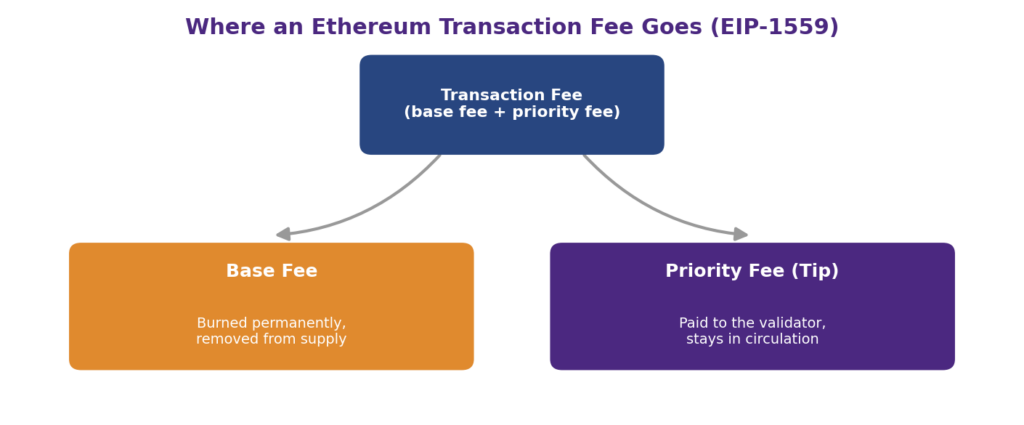
EIP-1559 changed Ethereum’s transaction-fee system by introducing a base fee that is burned.
Under the mechanism, the base fee associated with a transaction’s gas usage is permanently removed from the supply, while the priority fee, sometimes called a tip, is paid to the validator.
When ETH is burned, it is permanently destroyed. It is not transferred to another wallet or held by the protocol for future use.
In simplified terms:
ETH burned = base fee × gas used
This makes Ethereum’s burn mechanism directly connected to network usage.
When demand for block space rises, the base fee can increase, potentially increasing the amount of ETH burned. When network activity declines, the base fee can fall and the burn rate can decrease.
EIP-1559 therefore created a link between demand for Ethereum’s block space and the rate at which ETH is removed from supply.
Also Read : Ethereum Wallet Guide
Not every part of an Ethereum transaction fee is burned.
The base fee is burned, while the priority fee goes to the validator as an incentive for including the transaction in a block.
This distinction matters when calculating Ethereum’s supply change.
For example, if a user pays a total transaction fee of 0.01 ETH, the entire amount is not necessarily burned. Only the portion represented by the base fee is destroyed. The priority fee remains part of the existing ETH supply after being paid to the validator.
The validator can then hold, spend, stake, or otherwise use that ETH.
For this reason, the amount of ETH burned should be measured from the base-fee burn rather than from total transaction fees.
Ethereum’s supply mechanics are closely connected to gas fees because gas measures the computational resources required to process transactions and execute operations on the network.
The base fee is denominated in gwei and changes according to network demand. Ethereum’s fee market adjusts the base fee based on how much block space is being used relative to the protocol’s target.
When demand for block space rises, the base fee can increase. When demand falls, it can decrease.
This creates a simple relationship:
Network demand → gas usage and base fee → ETH burned
The relationship is not perfectly linear because both the amount of gas used and the base fee affect the amount burned. Nevertheless, network activity is one of the factors influencing Ethereum’s burn rate.
This is why ETH inflation cannot be understood simply by looking at validator issuance. Burning must also be considered.
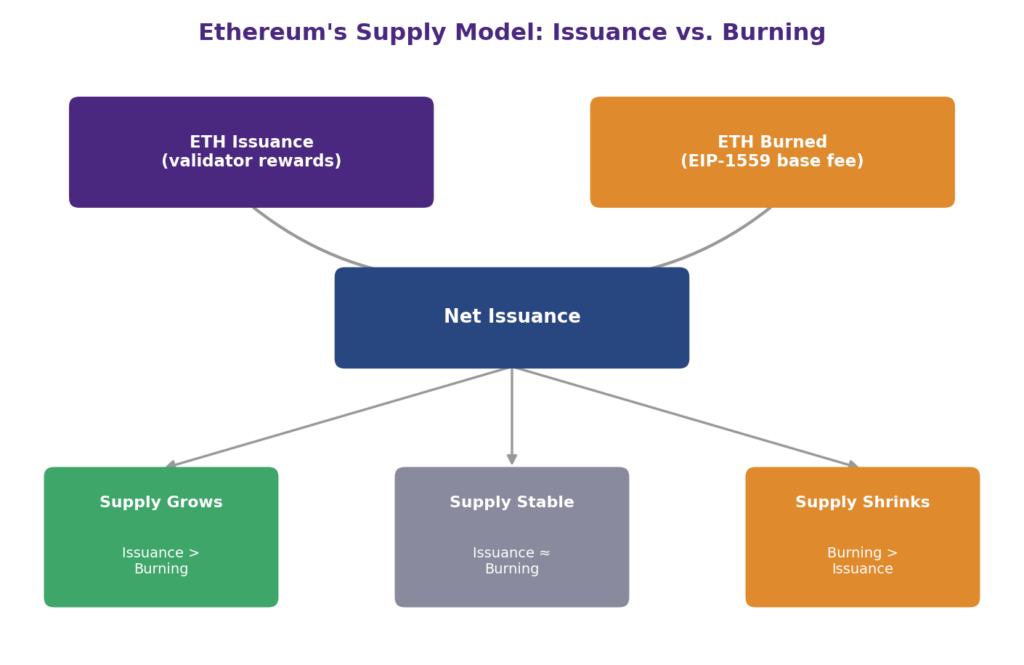
The most useful way to understand Ethereum’s changing supply is to compare ETH issued with ETH burned.
The basic calculation is:
Net issuance = ETH issued − ETH burned
There are three broad outcomes.
If validators receive more newly issued ETH than the network burns, Ethereum’s total supply increases.
For example:
The network has experienced positive net issuance, meaning the supply has increased over the period.
If Ethereum issues 10,000 ETH and burns approximately 10,000 ETH, the net change is close to zero.
The supply remains relatively stable even though both issuance and burning are taking place.
This illustrates why gross issuance alone can be misleading. A network can create substantial amounts of new ETH while experiencing little overall supply growth if a similar amount is burned.
If Ethereum burns more ETH than it issues, total supply decreases.
For example:
This represents negative net issuance, commonly described as net deflation.
The balance can change over time as network activity and validator economics change.
There is no fixed amount of ETH that Ethereum burns each year.
The ETH burn rate changes with network activity, gas usage, and the prevailing base fee. During periods of heavy Ethereum usage, more ETH can be burned because users consume more block space and the base fee can rise. During quieter periods, the amount burned can fall.
This makes the burn rate an important metric for understanding ETH supply growth.
Analysts can compare:
Together, these metrics show whether Ethereum’s supply is expanding, stabilizing, or contracting.
A live Ethereum supply tracker is therefore more useful for monitoring current conditions than a static supply figure published at a single point in time.
Staking is another important part of Ethereum’s supply economics.
Validators must deposit ETH to participate in Proof of Stake. The amount of ETH participating in the validator system influences Ethereum’s validator economics and issuance structure.
However, staked ETH should not be treated as ETH removed from the total supply. Staked ETH still exists on the blockchain and remains part of Ethereum’s total supply, even though it may be less actively traded while being used to secure the network.
This distinction is important when considering Ethereum’s circulating supply.
Staking affects how existing ETH is used and where it is deployed within the network, while issuance and burning determine how the total supply itself changes.
Also Read: How to Stake Ethereum
The Merge is important because it changed the issuance side of Ethereum’s supply equation.
Before Proof of Stake, Ethereum issued ETH to compensate miners for securing the Proof-of-Work network. After The Merge, those mining rewards disappeared.
Ethereum continued to issue ETH to validators, but the amount of new ETH entering the system became substantially lower.
At the same time, EIP-1559 continued burning the base fee.
The result was a major change in Ethereum’s supply economics:
Lower issuance + ongoing fee burning = lower potential net supply growth
This did not guarantee that ETH would always be deflationary. It reduced the amount of new ETH that needed to be offset by burning before Ethereum could reach zero or negative net issuance.
The distinction is important:
These mechanisms work together, but they perform different functions.
Ethereum’s monetary policy can ultimately be understood as two competing flows.
Issuance adds ETH. Burning removes ETH.
Proof of Stake determines how new ETH is issued to validators, while EIP-1559 determines how the base fee associated with transactions is burned. Network conditions influence the amount of ETH burned, while the staking system influences the amount issued.
The result is a dynamic supply model rather than a fixed issuance schedule or hard supply ceiling.
This also explains why Ethereum’s maximum supply is not the most useful metric for analyzing ETH. Ethereum does not have a predetermined maximum, but its supply is governed by protocol-defined rules that determine how ETH enters and leaves the system.
For anyone analyzing Ethereum’s monetary policy, the more useful question is whether the forces behind supply growth or reduction are changing over time.
This framework sets up the next part of the analysis: what these supply mechanics mean for ETH scarcity, valuation, inflation, deflation, and investors.
Also Read : Ethereum Price Prediction
Understanding how ETH is issued and burned is only part of the picture. The more important question is what those mechanics mean for ETH scarcity, valuation, inflation, deflation, and investors.
Ethereum does not rely on a fixed supply cap to create scarcity. Instead, scarcity is dynamic and depends on the relationship between new ETH issuance, ETH burning, network activity, and demand.
That makes Ethereum’s monetary model fundamentally different from Bitcoin’s-and means ETH supply needs to be evaluated in terms of both supply growth and demand.
A fixed maximum supply is one way to define scarcity. Bitcoin’s 21 million BTC limit, for example, provides a predetermined ceiling on how many coins can ever exist.
Ethereum works differently. ETH can continue to be issued, while EIP-1559 can permanently remove ETH through its base-fee burn mechanism.
The more useful measure is therefore net supply growth, rather than simply asking whether Ethereum has a maximum supply.
If issuance exceeds burning, ETH supply grows. If burning offsets most of the issuance, supply growth slows. If burning exceeds issuance, total supply contracts.
This means ETH can become more or less scarce depending on conditions across the Ethereum network.
However, scarcity alone does not create value. An asset can become scarcer while demand falls. Conversely, an asset can experience supply growth while its value rises if demand increases faster than supply.
For ETH, the relationship between supply and demand is therefore more important than supply in isolation.
A declining ETH supply can support scarcity, but it does not automatically push the price higher.
Asset prices depend on the interaction between supply, demand, expectations, liquidity, and broader market conditions. A period of negative net issuance may reduce the amount of ETH available, but if demand for crypto assets is weakening at the same time, ETH’s market price can still fall.
The opposite can also happen. ETH can appreciate during a period of positive net issuance if demand for ETH grows faster than the supply.
Ethereum’s network activity makes this relationship particularly important.
Greater Ethereum activity can increase demand for ETH because ETH is used to pay transaction fees on Ethereum and plays a central role in interacting with the network and its applications. At the same time, stronger demand for block space can increase the amount of ETH burned through EIP-1559.
The relationship can be summarized as:
Greater network activity → greater demand for block space → potentially higher ETH burn
This is not a guaranteed price mechanism. Ethereum’s market value is also influenced by adoption, competition, liquidity, regulation, macroeconomic conditions, and investor sentiment.
The key financial point is that deflation can affect the supply side of ETH’s valuation, but it cannot determine price on its own.
Ethereum’s changing supply model has led to the popular “ultrasound money” narrative.
The phrase emerged within the Ethereum community as a contrast with Bitcoin’s “sound money” narrative. It became particularly prominent after EIP-1559 and The Merge because Ethereum could, under certain conditions, burn more ETH than it issued.
The idea is based on the possibility that ETH’s supply can become deflationary when network demand is sufficiently strong.
However, “ultrasound money” is a narrative, not a formal monetary-policy target.
Ethereum does not have a permanent promise that its supply will continually decline. The network can experience positive or negative net issuance depending on the relationship between validator issuance and ETH burned.
A period of deflation therefore shows that burning exceeded issuance during that period. It does not guarantee that ETH will remain deflationary in the future.
For that reason, the more useful approach is to examine the underlying issuance, burn, and demand data rather than relying on a particular monetary label.
Ethereum’s supply model creates an important connection between network activity and the ETH burn rate.
When users demand more block space, the base fee can rise and the amount of ETH burned can increase. If the burn rate becomes high enough relative to validator issuance, net issuance can move toward zero or become negative.
When network activity declines, the amount of ETH burned can also fall, potentially allowing issuance to exceed burning.
This means Ethereum’s supply dynamics can partly reflect the economic activity taking place on the blockchain.
Several metrics can provide useful context when assessing the direction of ETH supply:
No single metric tells the complete story. A rising burn rate, for example, can indicate stronger demand for block space, but it does not by itself establish that ETH is undervalued or likely to appreciate.
ETH valuation depends on the interaction between supply dynamics, network demand, and broader market conditions.
Supply dynamics show how quickly the amount of ETH is changing.
Network demand reflects how much users, applications, and other participants value Ethereum’s block space and the economic activity built on the network.
Broader market conditions include factors such as liquidity, interest rates, risk appetite, competition, regulation, and cryptocurrency market cycles.
This is why Ethereum price cannot be predicted simply by determining whether ETH is inflationary or deflationary.
For example, negative net issuance can reduce supply, but weak demand can still put downward pressure on price. Conversely, positive net issuance does not necessarily prevent price appreciation if demand grows more rapidly than supply.
The key financial concept is therefore relative supply and demand, not supply reduction alone.
It is also important to distinguish between a change in Ethereum’s underlying supply dynamics and a short-term market reaction. Markets price assets based not only on current conditions but also on expectations about future network activity, adoption, monetary conditions, and demand for ETH.
For someone evaluating ETH as an asset, supply data can provide useful context rather than a standalone investment signal.
Instead of looking only at the current ETH total supply, it is more informative to examine how supply is changing and what is driving that change.
Net issuance shows whether ETH supply is expanding or contracting after accounting for burning.
A sustained positive figure indicates supply growth, while a sustained negative figure indicates supply reduction over the measured period.
The burn rate shows how much ETH is being removed from supply over a particular period.
Changes in the burn rate can provide information about network activity and demand for Ethereum block space.
Tracking ETH issuance shows how much new supply is entering the system through Proof of Stake.
Changes in issuance can affect the amount of ETH that needs to be burned for the network to reach zero or negative net issuance.
The amount of ETH participating in staking provides context about how much ETH is being used to secure Ethereum rather than actively traded.
However, staked ETH should not be treated as permanently unavailable or destroyed. It remains part of Ethereum’s supply.
Network activity helps explain changes in the burn rate. Stronger demand for block space can contribute to higher base fees and greater ETH burning.
Looking at these metrics together provides a more complete picture than focusing on a single supply number.
The absence of a fixed maximum supply is not automatically a weakness, but it makes Ethereum’s monetary model different from Bitcoin’s.
Bitcoin has a clearly defined maximum of 21 million BTC. Ethereum does not offer the same hard numerical limit.
Instead, ETH’s supply is governed by protocol rules that determine how new ETH is issued and how existing ETH is burned.
That makes Ethereum’s supply flexible but governed.
This flexibility allows its monetary system to respond to changes in staking, network activity, and protocol design. At the same time, it means today’s supply conditions should not automatically be assumed to continue indefinitely.
For investors, the important question is therefore not simply whether Ethereum has a maximum supply. It is whether the combination of issuance, burning, network demand, and adoption is creating a favorable or unfavorable supply-demand environment.
This also means that ETH investment decisions should not be based on the assumption that a lower supply automatically produces higher returns.
Supply is one part of the valuation equation, not the entire equation.
Yes. Ethereum is a decentralized protocol that can be upgraded through its development and governance process.
Changes to issuance, fee markets, consensus, or other protocol mechanisms could potentially affect Ethereum’s future supply dynamics.
That does not mean supply rules can be changed arbitrarily. Major Ethereum upgrades require technical development, testing, community coordination, and adoption across the Ethereum ecosystem.
Still, the possibility of protocol evolution is an important distinction between Ethereum and an asset whose maximum supply and issuance schedule are designed to remain rigid.
For anyone making an ETH investment decision, historical supply data should therefore be viewed in context. Past issuance or burn rates do not guarantee future conditions.
Ethereum’s monetary model is best understood through the interaction between issuance, burning, network activity, and demand.
The important question is not simply how much ETH exists today or whether its supply happened to be inflationary or deflationary during a particular period. It is how quickly supply is changing, what is driving that change, and whether demand for Ethereum is growing alongside it.
Ethereum does not need a fixed maximum supply to have scarcity, but its supply is not uncontrolled. It is shaped by protocol rules, validator incentives, and the economic activity taking place on the network.
For anyone evaluating ETH, net issuance, burn activity, and network demand are therefore more useful measures of its monetary outlook than a maximum-supply figure alone.
That is the central takeaway from Ethereum’s supply model: ETH has no fixed supply ceiling, but its supply is governed by a defined set of protocol mechanisms that can expand or reduce the amount of ETH in existence.
Understanding those mechanisms provides a more useful foundation for evaluating Ethereum than focusing on a single supply number-and helps explain why ETH’s monetary policy is fundamentally different from Bitcoin’s.
No. Ethereum does not have a fixed maximum supply or hard supply cap. Unlike Bitcoin, which has a predetermined maximum of 21 million BTC, Ethereum’s supply changes dynamically through the interaction of ETH issuance and ETH burning. New ETH is issued primarily through Proof of Stake validator rewards, while the base fee associated with transactions is burned under EIP-1559. Whether Ethereum’s total supply grows or declines depends on the balance between these two mechanisms.
Ethereum’s total supply changes continuously as new ETH is issued and existing ETH is burned. Because there is no fixed supply cap, a single supply figure can become outdated quickly. For the most accurate current figure, readers should use a live Ethereum supply tracker that reflects the latest issuance and burn activity.
Ethereum has no predetermined maximum supply, but calling it simply “unlimited” can be misleading. ETH issuance is governed by Ethereum’s Proof-of-Stake protocol, while EIP-1559 removes ETH from supply through the base-fee burn. As a result, Ethereum’s supply can increase, remain relatively stable, or decrease depending on the relationship between issuance and burning.
ETH issuance is the creation of new ETH by the Ethereum protocol. Since The Merge, Ethereum has used Proof of Stake, with new ETH issued primarily as rewards to validators for helping secure the network and maintain consensus. This newly issued ETH increases total supply unless it is offset by an equivalent or greater amount of ETH being burned.
Under EIP-1559, the base fee associated with a transaction’s gas usage is burned, permanently removing that ETH from the supply. The priority fee, or tip, is paid to the validator and is not burned. The amount of ETH burned therefore depends on the base fee and the amount of gas used. Higher network activity can lead to greater ETH burning when it results in higher base fees and gas usage.
ETH can be deflationary when the amount of ETH burned exceeds the amount newly issued over a given period. When issuance is greater than burning, ETH supply increases instead. Ethereum is therefore not permanently inflationary or permanently deflationary. Its supply condition depends on net issuance, calculated as ETH issued minus ETH burned.
Yes. Ethereum is an upgradeable decentralized protocol, so future protocol upgrades can potentially affect mechanisms related to ETH issuance, transaction fees, or burning. However, such changes require technical development, testing, community coordination, and adoption across the Ethereum ecosystem. Historical issuance and burn rates should therefore not be assumed to remain unchanged indefinitely.