Two blockchains share the same founding code, the same first three years of history, and even the same original name, yet Ethereum vs Ethereum Classic today looks like a comparison between a global financial infrastructure and a niche, low-activity network.
ETH now secures roughly $42 billion in DeFi value and runs on proof of stake; ETC secures a small fraction of a percent of that on the original proof-of-work design it never abandoned. The split traces back to a single event in 2016, and the decisions made in its aftermath still explain almost every difference between the two chains today.
Key Takeaways
Both chains share an identical history up to July 2016, when a hack of a smart contract called The DAO forced the Ethereum community into a decision that split it in two.
Ethereum (ETH) reversed the hack through a hard fork and kept evolving, eventually moving to proof of stake in 2022. Ethereum Classic (ETC) refused to alter history and still runs the original proof-of-work design.
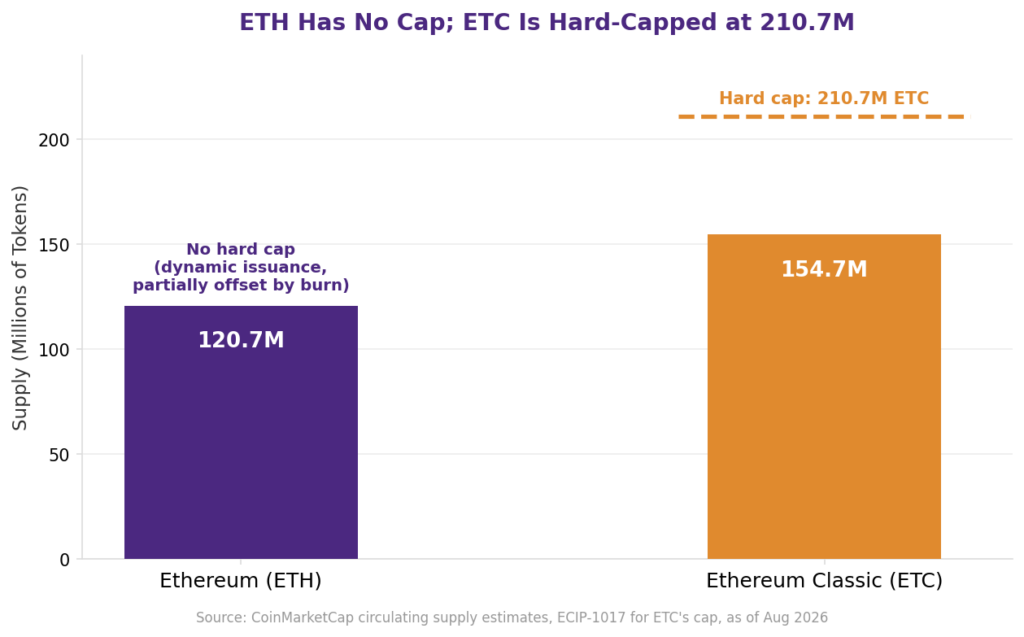
ETH has no hard supply cap; ETC is hard-capped at approximately 210.7 million tokens by protocol rule (ECIP-1017).
Ethereum Classic has suffered five confirmed 51% attacks (two in 2019, three in 2020), a direct consequence of its smaller network being easier to out-hash. Ethereum’s proof-of-stake model faces a structurally different attack calculus.
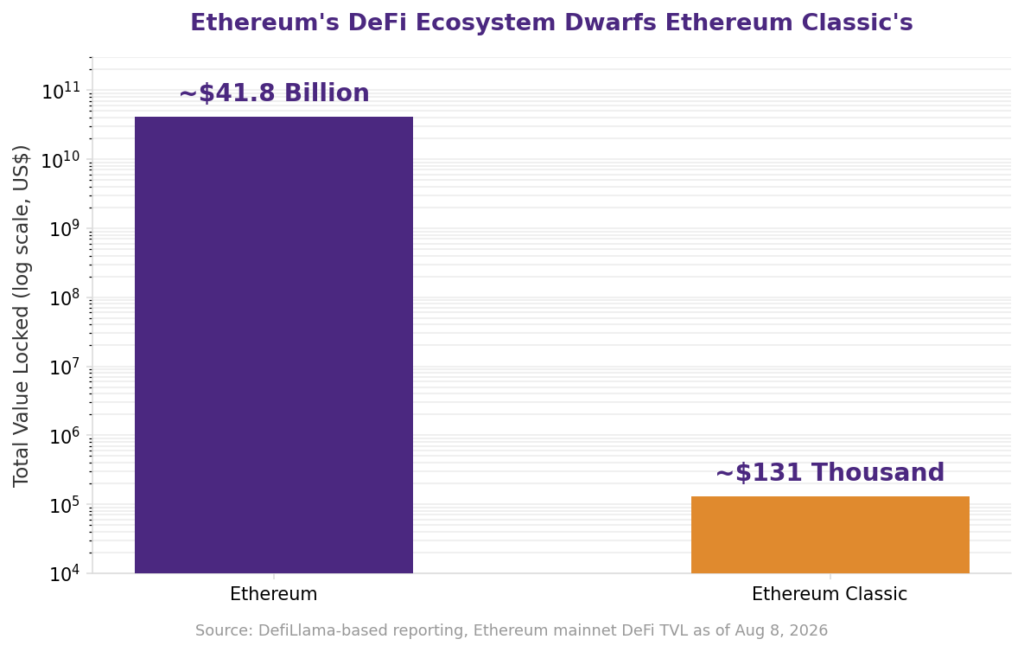
The ecosystem gap is stark: Ethereum’s DeFi ecosystem holds roughly $42 billion in value versus Ethereum Classic’s roughly $131,000, a difference of more than five orders of magnitude.
What Is the Difference Between Ethereum and Ethereum Classic?
The main difference between Ethereum and Ethereum Classic is how each chain responded to the 2016 DAO hack: Ethereum reversed it through a hard fork and kept developing, including a later move to proof of stake, while Ethereum Classic rejected the reversal and still runs the original proof-of-work code.
Ethereum (ETH): the actively developed, majority chain; proof of stake since 2022; no fixed supply cap; home to the vast majority of DeFi, NFTs, and dApp activity.
Ethereum Classic (ETC): the unaltered original chain; still proof of work; hard-capped at ~210.7 million ETC; minimal DeFi or dApp activity today.
Both run EVM-compatible smart contracts and share the same technical lineage up to the fork.
The split is fundamentally a philosophical one: whether blockchain history should ever be altered, even to undo a theft.
Definition: Hard Fork A permanent split in a blockchain’s protocol rules that creates two separate, incompatible chains going forward, typically because the community cannot agree on a proposed change.
Why Did Ethereum and Ethereum Classic Split?
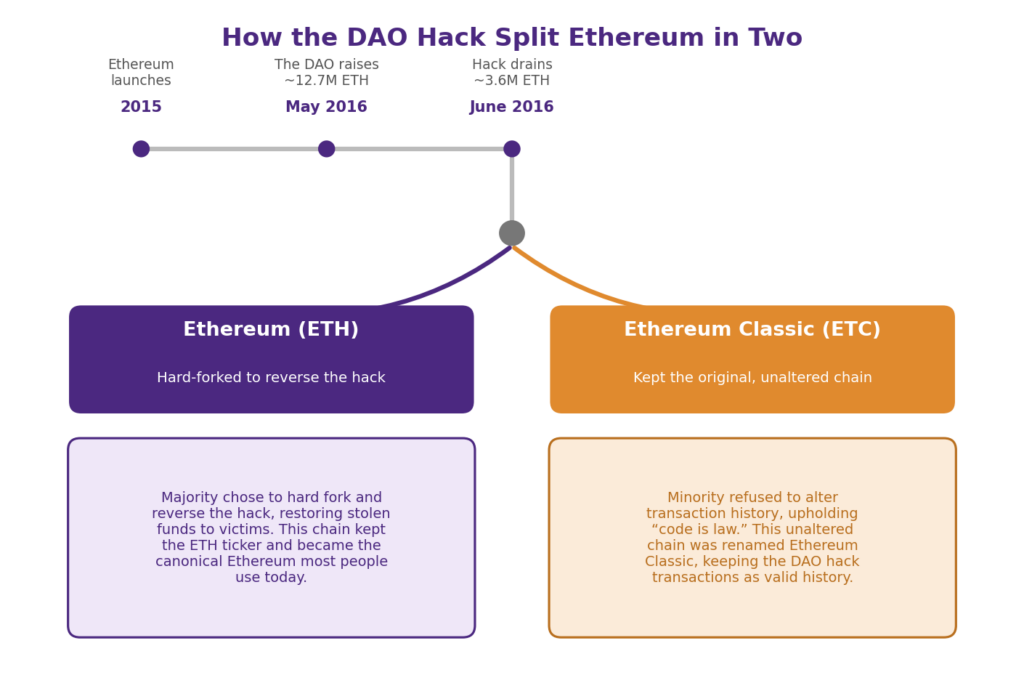
Ethereum and Ethereum Classic split because of an irreconcilable disagreement over how to handle the 2016 hack of The DAO, a decentralized investment fund that lost roughly 3.6 million ETH to an exploited smart-contract bug.
Ethereum vs Ethereum Classic: Key Differences
The DAO had raised roughly 12.7 million ETH from thousands of contributors before an attacker exploited a re-entrancy bug to drain funds into a child contract. With so much value at stake, roughly 14% of all ETH in circulation at the time, the Ethereum community faced a stark choice: let the theft stand, or roll back the chain’s history to return the funds.
The majority chose to hard fork, rewriting history to return the stolen ETH to its original owners. This forked chain kept the ETH ticker and became the Ethereum most people use today. A minority rejected this on principle, arguing that altering recorded transactions, even to undo a theft, violated blockchain’s core promise of immutability. This unaltered chain, DAO hack transactions included, was renamed Ethereum Classic.
Does Ethereum Classic Still Use Proof of Work?
Yes. Ethereum Classic still uses proof-of-work mining via an algorithm called Etchash, while Ethereum has used proof-of-stake exclusively since its Merge upgrade in September 2022.
Definition: Proof of Work A consensus mechanism where miners compete to solve a computational puzzle using specialized hardware, with the winner earning the right to add the next block and collect a reward.
This is arguably the single biggest practical difference between the two chains today. When Ethereum switched to proof of stake, a wave of displaced ETH miners looked for a new home, and many redirected their hardware to Ethereum Classic, since Etchash is nearly identical to Ethereum’s old algorithm. This briefly pushed ETC’s hashrate up substantially, from roughly 24 TH/s to over 150 TH/s in the months following the Merge, and ETC is now sometimes described as the largest proof-of-work blockchain that still supports smart contracts. Our guide on ether mining in 2026 covers where displaced ETH miners went in more detail, including why ETC became a common landing spot.
For a deeper look at how these two consensus models actually work under the hood, our guide to proof of work vs proof of stake breaks down the mechanics on both sides of this split.
How Do Ethereum and Ethereum Classic Compare on Supply and Monetary Policy?
Ethereum has no fixed maximum supply, with issuance and fee-burning working together to push net supply growth up or down depending on network activity, while Ethereum Classic has a hard-capped maximum supply of approximately 210.7 million ETC, enforced directly by protocol rule.
Ethereum vs Ethereum Classic: Key Differences
Metric
Ethereum (ETH)
Ethereum Classic (ETC)
Maximum supply
None (dynamic)
~210.7 million (ECIP-1017)
Circulating supply
~120.7 million
~154.7 million
Issuance model
Validator rewards, partially offset by fee burn
Fixed block reward, reduced 20% every 5 million blocks
Can supply shrink?
Yes, during high-activity periods when burn exceeds issuance
No, supply only grows until the cap is reached
Definition: ECIP-1017 The Ethereum Classic Improvement Proposal that established ETC’s fixed monetary policy, cutting the block reward by 20% every 5 million blocks until issuance effectively stops near the 210.7 million supply cap.
Ethereum Classic’s capped supply is a direct expression of its “sound money” philosophy, similar in spirit to Bitcoin’s 21 million cap. Ethereum’s dynamic model instead prioritizes flexibility, letting issuance respond to network security needs and usage rather than locking in a number in advance.
Which Is More Secure, Ethereum or Ethereum Classic?
Ethereum is generally considered more secure in practice, largely because its far larger validator set and total value at stake make an attack economically irrational, while Ethereum Classic’s smaller network has a documented history of successful attacks.
Ethereum Classic has suffered five confirmed 51% attacks: two in January 2019 and three in July-August 2020, together resulting in more than $9 million in double-spent funds from exchanges, according to Coinbase’s own incident report on the 2020 attacks. A 51% attack happens when a single miner or pool gains majority control of a network’s hashing power, letting them rewrite recent transaction history and double-spend coins.
Date
Attack Details
Approximate Loss
Jan 5 & 7, 2019
Two chain reorganizations targeting exchanges
~$450,000-1.1 million
Jul 31, 2020
51% attack, deep chain reorg
~$5.8 million (800,000 ETC)
Aug 1 & 5, 2020
Two further 51% attacks
~$3.2 million (460,000 ETC)
These attacks were possible because ETC shares a mining algorithm family with the much larger (at the time) Ethereum network, making it easy for an attacker to temporarily rent enough hash power to overwhelm ETC’s smaller miner base. Since then, the network has adopted additional defenses, including a checkpointing system called MESS designed to make deep reorganizations harder. Ethereum’s move to proof of stake sidesteps this specific attack vector entirely, replacing “rent enough hash power” with “acquire and stake enough ETH to control the network,” a structurally different and, at Ethereum’s scale, dramatically more expensive proposition.
ETH vs ETC Smart Contracts and Ecosystem: How Do They Compare?
Both networks support EVM-compatible smart contracts written largely in Solidity, but Ethereum’s ecosystem is active and enormous while Ethereum Classic’s is minimal by comparison.
Ethereum vs Ethereum Classic: Key Differences
Ethereum’s DeFi ecosystem holds roughly $41.8 billion in total value locked on its base layer. Ethereum Classic’s total value locked, by contrast, sits around $131,000, down from a high of about $1.34 million in December 2024. That’s a gap of more than five orders of magnitude, reflecting a near-total absence of active DeFi protocols, developer activity, or dApp usage on ETC today.
This gap matters beyond bragging rights. A smart-contract platform’s real security and utility come partly from the depth of its ecosystem, since more usage means more scrutiny of code, more liquidity, and more reasons for the network to stay maintained and defended. ETC’s technical capability to run smart contracts hasn’t translated into meaningful adoption of them.
Can Ethereum Classic Replace Ethereum?
Realistically, no, not in its current form. Ethereum Classic’s “code is law” philosophy and fixed monetary policy appeal to a specific, values-driven audience, but the network lacks the developer activity, liquidity, and security budget that make Ethereum useful as a general-purpose smart-contract platform today.
That doesn’t make ETC irrelevant. It functions more as a philosophical statement and a niche proof-of-work store of value than as a competitor to Ethereum’s application layer. Investors and developers evaluating Ethereum vs Ethereum Classic investment potential should treat them as serving fundamentally different purposes rather than as substitutes for each other.
Conclusion
Ethereum vs Ethereum Classic comes down to one decision made in 2016 and everything that followed from it. Ethereum chose to reverse a theft and kept evolving, ultimately trading proof of work for proof of stake and building the largest smart-contract ecosystem in crypto. Ethereum Classic chose immutability over intervention and has stayed proof-of-work ever since, at the cost of a smaller, more attack-prone network and a fraction of Ethereum’s ecosystem activity. Both are legitimate expressions of different blockchain values, but they are not interchangeable investments or platforms.
What is the difference between Ethereum and Ethereum Classic?
Ethereum reversed the 2016 DAO hack via a hard fork and kept developing, including moving to proof of stake, while Ethereum Classic rejected the reversal and still runs the original proof-of-work code.
Why did Ethereum split into ETH and ETC?
A hacker exploited a bug in the DAO smart contract, stealing roughly 3.6 million ETH. The community disagreed on whether to reverse this via a hard fork, and the disagreement split the chain.
Which chain kept the original transaction history?
Ethereum Classic kept the original, unaltered transaction history, including the DAO hack transactions. Ethereum’s chain reflects a rewritten history that returned the stolen funds.
Does Ethereum Classic still use proof of work?
Yes. Ethereum Classic still uses proof-of-work mining (Etchash), while Ethereum has used proof-of-stake exclusively since its September 2022 Merge upgrade.
Which network has more developers and dApps?
Ethereum, by a very wide margin. Ethereum’s DeFi ecosystem holds roughly $42 billion in value versus Ethereum Classic’s roughly $131,000.
Is ETC supply capped?
Yes, at approximately 210.7 million ETC by protocol rule (ECIP-1017). Ethereum has no equivalent fixed cap on ETH.
Which is more secure, ETH or ETC?
Ethereum is generally considered more secure due to its far larger validator base and economic security. Ethereum Classic has suffered five confirmed 51% attacks since 2019.
Can Ethereum Classic replace Ethereum?
Not realistically in its current form. ETC lacks the developer activity, liquidity, and ecosystem depth that make Ethereum a general-purpose smart-contract platform today.
Risk Disclaimer
Cryptocurrency investments carry a high risk of loss and are highly volatile. Any use of leverage or futures magnifies both potential gains and potential losses. The historical figures, security incidents, and comparisons in this article are illustrative and for educational purposes only; they are not financial advice or a guarantee of future performance. Please consult a qualified financial advisor before making any investment decisions.
Siri is a writer venturing into the exciting realms of blockchain technology, cryptocurrency, and decentralized finance (DeFi), eager to explore the transformative potential of these innovations. She brings a unique perspective that bridges traditional industries and cutting-edge technology, often infused with a touch of humor through memes. She has a rich background in real estate and interior design, having previously contributed to NoBroker, where she crafted blogs and assets on these topics.