Ethereum and Hyperledger both get called “enterprise blockchain platforms” in vendor decks, but they solve genuinely different problems for genuinely different audiences. Ethereum vs Hyperledger isn’t really a head-to-head contest, since one is a public, permissionless network anyone can build on, and the other is a set of tools for building private, permissioned networks that businesses fully control.
One more thing worth knowing upfront: “Hyperledger” itself changed in 2024. Its governing foundation folded into a larger umbrella called Linux Foundation Decentralized Trust, and one of its most Ethereum-relevant projects dropped the Hyperledger name entirely. Here’s what actually separates these platforms, and which one fits which kind of project.
Key Takeaways
Ethereum is a public, permissionless blockchain; Hyperledger is a collection of frameworks, led by Hyperledger Fabric, for building permissioned, private networks.
The Hyperledger brand changed in 2024. Its foundation merged into Linux Foundation Decentralized Trust, and Hyperledger Besu was renamed simply “Besu,” while Hyperledger Fabric kept its name.
Ethereum uses Solidity and a single global EVM state; Fabric uses chaincode written in general-purpose languages like Go, Java, or Node.js, with no shared global state across channels.
Fabric benchmarks far higher raw throughput in controlled tests, but Ethereum’s real-world scalability increasingly comes from Layer 2 rollups rather than the base layer alone.
Besu is the literal bridge between both worlds: it’s simultaneously an Ethereum mainnet execution client and an EVM-compatible option for permissioned enterprise networks.
What Is the Main Difference Between Ethereum and Hyperledger?
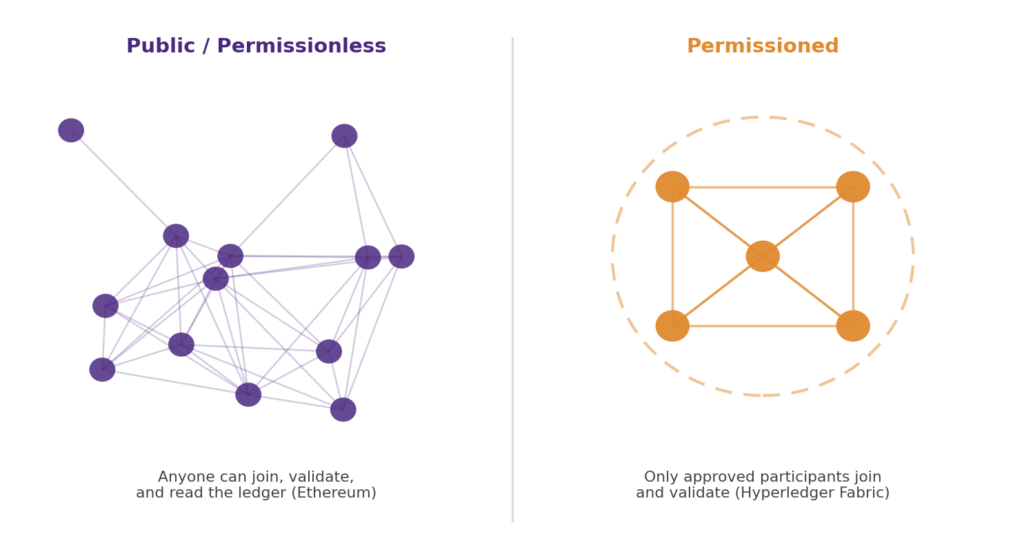
The main difference between Ethereum and Hyperledger is network access: Ethereum is a public, permissionless blockchain anyone can join, while Hyperledger provides frameworks for building permissioned blockchains that only approved participants can access.
Ethereum: open network, native cryptocurrency (ETH), smart contracts in Solidity, public and pseudonymous by default.
Hyperledger Fabric: permissioned network, no native cryptocurrency required, chaincode in general-purpose languages, participants identified and vetted.
Both support smart contract-style programmable logic, just under very different trust models.
The choice usually comes down to who needs to see and validate your data: the general public, or a defined group of business partners.
Definition: Permissioned Blockchain A blockchain network where participants must be authorized before they can join, view transaction data, or help validate new blocks, in contrast to a public blockchain that anyone can access.
What Is Ethereum, and How Does It Work?
Ethereum is a public, decentralized blockchain that runs smart contracts through the Ethereum Virtual Machine (EVM), letting anyone deploy code that executes exactly as written, with no central operator able to change the outcome.
Every full node on Ethereum maintains an identical copy of the network’s state. Transactions are bundled into blocks by validators under a proof-of-stake consensus system, and a block reaches full finality, meaning it’s economically irreversible, after roughly 12.8 minutes (two epochs of about 6.4 minutes each). Anyone can run a node, become a validator by staking ETH, or deploy a smart contract without asking permission from anyone.
This openness is Ethereum’s core value proposition for public use cases like DeFi, NFTs, and tokenization, but it also means every transaction and its data are visible to anyone who looks. Our guide on Bitcoin vs Ethereum covers more background on how Ethereum’s architecture compares to the earliest public blockchain.
What Is Hyperledger Fabric, and How Does It Work?
Hyperledger Fabric is an open-source framework for building permissioned blockchain networks, where a known set of organizations, not the general public, control who can join, view data, and validate transactions.
Fabric networks are organized around channels, which are private sub-networks within the broader consortium. Two organizations can transact on a channel that a third organization in the same network never sees, giving businesses fine-grained control over data confidentiality that a fully public ledger can’t offer natively.
One important update worth knowing: Hyperledger Fabric is still called Hyperledger Fabric, but its parent foundation isn’t “Hyperledger” anymore. In September 2024, the Hyperledger Foundation merged into a broader Linux Foundation Decentralized Trust (LF Decentralized Trust) umbrella alongside Trust Over IP and other projects. Individual projects kept their own naming decisions: Fabric retained the Hyperledger name, but Hyperledger Besu was rebranded to just “Besu.”
Public vs Permissioned Blockchain: What’s the Real Difference?
Ethereum vs Hyperledger: Key Differences Explained
A public blockchain like Ethereum lets anyone join as a node, submit transactions, or validate blocks without seeking approval from any central party. A permissioned blockchain built with Hyperledger Fabric restricts these same actions to a pre-approved list of organizations, each with a verified digital identity.
This isn’t just a technical detail; it shapes what each network is good at. Public blockchain vs permissioned blockchain comparisons usually come down to a tradeoff: openness and censorship-resistance versus control and confidentiality. Neither is objectively better; they’re built for different trust assumptions entirely. A supply chain consortium of five known manufacturers has different needs than a global, anonymous DeFi protocol, and the architecture reflects that from the ground up.
How Do Ethereum vs Hyperledger Consensus Mechanisms Compare?
Ethereum uses proof-of-stake consensus (specifically, Casper FFG combined with LMD-GHOST for fork choice) across a public validator set, while Hyperledger Fabric supports multiple pluggable consensus options built for known, permissioned participants, most commonly Raft.
Definition: Consensus Mechanism The set of rules a blockchain network uses to agree on which transactions are valid and in what order, without needing a central authority to make that call.
Ethereum’s validators are pseudonymous participants worldwide who stake ETH to earn the right to propose and attest to blocks; misbehavior is punished by slashing staked funds. Fabric’s ordering service, most commonly using the Raft protocol, is instead run by known, permissioned nodes belonging to consortium members, offering crash fault tolerance rather than the byzantine fault tolerance Ethereum’s public validator set requires to defend against anonymous bad actors.
This distinction matters practically: Ethereum’s consensus has to assume some validators are actively malicious, since anyone can become one. Fabric’s consensus can assume participants are merely unreliable, not adversarial, since every node’s operator is identified and accountable, which is part of why Fabric’s ordering can run faster.
Ethereum Smart Contracts vs Hyperledger Chaincode: What’s the Difference?
Ethereum smart contracts are written in Solidity and run inside the EVM against a single shared global state, while Hyperledger chaincode is written in general-purpose languages like Go, Java, or Node.js and runs independently per channel with no shared global state.
Ethereum vs Hyperledger: Key Differences Explained
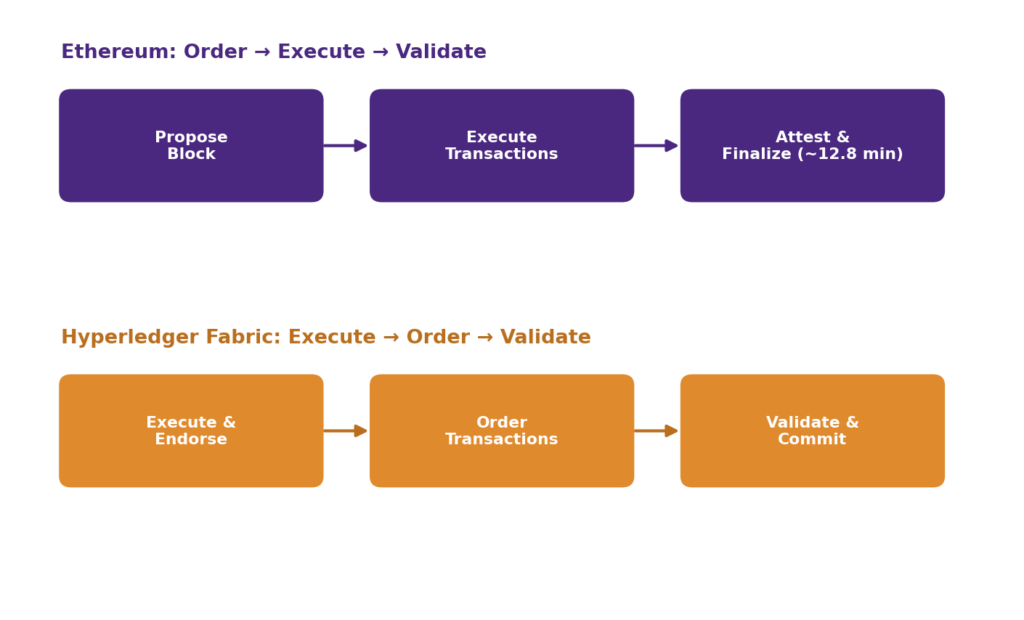
The execution order itself differs, and it’s one of the more consequential architectural choices either platform made. Ethereum follows an order-execute-validate flow: transactions are ordered into a block first, then every node executes them in that order to reach the same state. Fabric follows execute-order-validate: transactions are executed and endorsed by designated peers first, then ordered, then validated before committing. This lets Fabric parallelize execution across independent transactions, which is a meaningful part of why it benchmarks higher raw throughput in controlled tests, covered in the scalability section below. Our explainer on smart contracts covers the Solidity/EVM side of this in more depth.
Which Is More Scalable, Ethereum or Hyperledger?
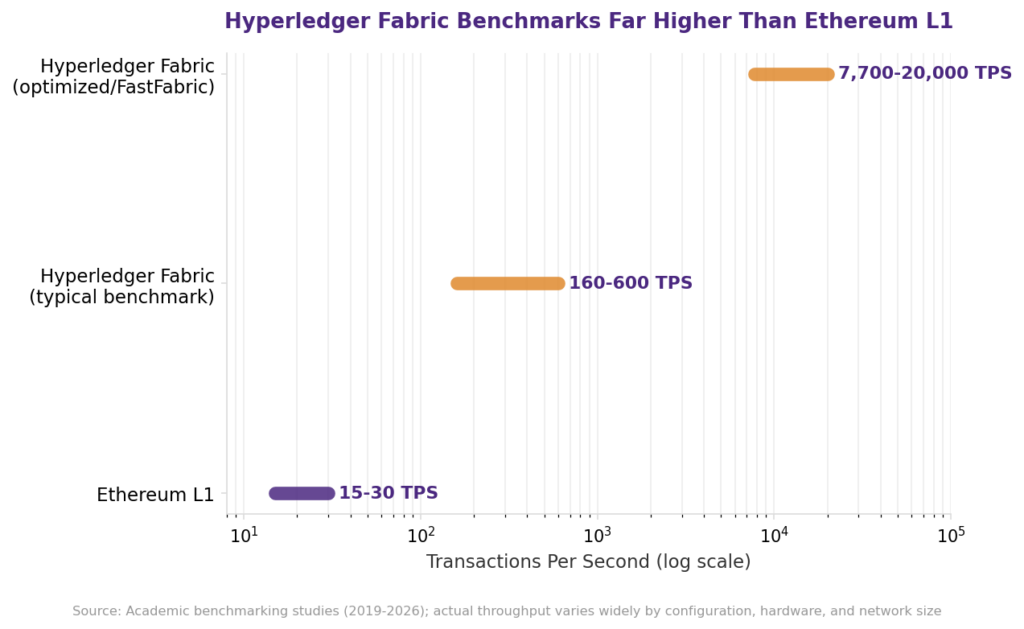
Hyperledger Fabric benchmarks substantially higher transaction throughput than Ethereum’s base layer in controlled academic tests, though the real-world comparison is more nuanced once Ethereum’s Layer 2 ecosystem enters the picture.
Ethereum vs Hyperledger: Key Differences Explained
Platform
Typical Throughput
Notes
Ethereum L1
~15-30 TPS
Constrained by public consensus and global state execution
Hyperledger Fabric (standard benchmark)
~160-600 TPS
Varies with endorsement policy, channel design, and hardware
Hyperledger Fabric (optimized configurations)
~7,700-20,000 TPS
Achieved in research settings like FastFabric; not typical production defaults
Ethereum L2 rollups
Thousands of TPS
Achieved off Ethereum’s base layer, settling back to L1 periodically
These numbers vary enormously by study, hardware, network size, and endorsement policy, so treat them as illustrative ranges rather than fixed benchmarks. The more durable takeaway is architectural: Fabric’s permissioned, execute-order-validate design was built from the start to prioritize throughput among known participants, while Ethereum’s public design deliberately trades some raw throughput for permissionless, byzantine-fault-tolerant security at global scale, and increasingly leans on Layer 2 to scale beyond its base layer’s own limits.
Ethereum vs Hyperledger: Privacy and Governance
On privacy, Ethereum’s ledger is public by default: anyone can inspect any transaction, wallet balance, or contract state, with pseudonymity as the only privacy layer, though privacy-focused Layer 2 tools are an active area of development. Hyperledger Fabric offers privacy natively through channels and private data collections, letting specific organizations transact confidentially even within a shared consortium network.
Definition: Private Data Collection A Hyperledger Fabric feature that lets a defined subset of organizations on a channel share data with each other while keeping it hidden from other channel members, without needing a separate channel.
Governance differs just as sharply. Ethereum’s protocol changes go through Ethereum Improvement Proposals (EIPs), debated openly by a global community with no single controlling entity. Hyperledger Fabric networks are governed by whichever consortium of organizations operates them, meaning the businesses running the network collectively decide on upgrades, membership, and rules, a structure suited to regulated industries that need clear accountability.
When Should a Business Use Hyperledger Instead of Ethereum?
A business should generally choose Hyperledger Fabric over Ethereum when data confidentiality, regulatory compliance, or control over network membership matters more than public accessibility. Common fits include supply chain consortiums, interbank settlement, healthcare data sharing, and trade finance, where participants are known businesses, not anonymous members of the public.
Ethereum remains the stronger choice for anything that benefits from public composability and open participation: DeFi protocols, NFT marketplaces, public token issuance, or any application where being permissionless and censorship-resistant is the actual point, not a limitation to work around.
The two aren’t always mutually exclusive. Besu, the Ethereum-compatible client that dropped the “Hyperledger” name in 2024, can run as both a public Ethereum mainnet execution client and as the engine behind a private, permissioned network, since it’s fully EVM-compatible either way. This makes it a genuine bridge for businesses that want Ethereum-style tooling and Solidity contracts inside a permissioned environment, rather than a strict either-or choice between ecosystems. For teams weighing consensus tradeoffs more broadly, our guide to proof of work vs proof of stake covers the public-network side of that decision in more detail.
Conclusion
Ethereum vs Hyperledger isn’t really a competition between two rivals fighting for the same use case; it’s a choice between two different trust models built for different problems. Ethereum’s public, permissionless design suits open applications where anyone should be able to participate and verify the ledger themselves. Hyperledger Fabric’s permissioned design suits businesses that need confidentiality, known participants, and direct control over their network. And with Besu now sitting squarely between both worlds, EVM-compatible tooling and Solidity contracts are no longer locked to one side of that choice at all.
What is the main difference between Ethereum and Hyperledger?
Ethereum is a public, permissionless blockchain open to anyone, while Hyperledger provides frameworks, mainly Hyperledger Fabric, for building permissioned, private blockchain networks.
Is Hyperledger a cryptocurrency?
No. Hyperledger Fabric and other Hyperledger frameworks don’t require or issue a native cryptocurrency, since they’re built for enterprise data-sharing rather than public token economies.
Is Ethereum public or permissioned?
Ethereum is public and permissionless. Anyone can run a node, become a validator, deploy smart contracts, or view any transaction without needing approval.
Which platform offers better privacy?
Hyperledger Fabric offers stronger built-in privacy through channels and private data collections, since Ethereum’s public ledger is visible to anyone by design.
How do smart contracts and chaincode differ?
Ethereum smart contracts are written in Solidity and run against one shared global state in the EVM; Hyperledger chaincode uses general-purpose languages like Go or Java and runs independently per channel.
Which is faster for enterprise use?
Hyperledger Fabric typically benchmarks higher raw transaction throughput than Ethereum’s base layer, since its permissioned design allows parallelized execution among known participants.
Can Hyperledger connect with Ethereum?
Yes, primarily through Besu (formerly Hyperledger Besu), an EVM-compatible client that works both as an Ethereum mainnet execution client and as the engine for permissioned enterprise networks.
Siri is a writer venturing into the exciting realms of blockchain technology, cryptocurrency, and decentralized finance (DeFi), eager to explore the transformative potential of these innovations. She brings a unique perspective that bridges traditional industries and cutting-edge technology, often infused with a touch of humor through memes. She has a rich background in real estate and interior design, having previously contributed to NoBroker, where she crafted blogs and assets on these topics.