Financial markets move in waves because people move in crowds. When many traders feel hopeful, prices rise in steps. When fear returns, prices fall in steps. EWT(Elliott Wave Theory) helps us read these as well structured stages, which you can use to make intelligent decisions in the crypto market
It began in the 1930s with Ralph Nelson Elliott and is still used by traders in stocks, crypto, and forex. In this guide, we will explain the concept and help you understand how to make use of it while crypto trading.
What Elliott Wave Theory says, and Why it is Relevant in Crypto Trading
Elliott Wave Theory says prices trend in deterministic five-wave impulses and correct in three-wave patterns.
This means that according to EWT, Price movements follow a predictable, non-random structure which is consistent with repetitive behavior of traders reacting to emotions like greed, fear, and optimism.
The same shapes appear across timeframes, which makes the method useful on weekly, daily, or intraday charts.
Crypto fits well because it trades 24/7 and reacts quickly to news, making impulses and corrections easy to spot. Still, Elliott is a framework, not a fortune-teller. Use it to organize structure, set invalidation, and map likely zones.
EWT is based on the observation that market price movements follow repetitive patterns driven by crowd psychology, with steps which usually looks like this:
Step
Pattern
Description
1
Price increase (initial surge)
Early buyers jump in due to optimism or positive news, starting an upward move.
2
Price pullback (dip)
Some traders take profits, causing a temporary decline as caution emerges.
3
Price surge (major rally)
Widespread greed or FOMO drives a strong, often the largest, price increase.
4
Price pullback (consolidation)
Traders pause or sell off, leading to another dip, but the trend remains intact.
5
Price increase (final push)
A last wave of enthusiasm pushes prices higher, though often weaker as momentum fades.
6
Price decline (initial correction)
Profit-taking or fear triggers a sharp move against the trend.
7
Price bounce (partial recovery)
Hopeful buyers step in, causing a temporary rebound.
8
Price decline (final correction, loopback point)
Panic or selling completes the correction, resetting the market for a new cycle to begin with another initial surge.
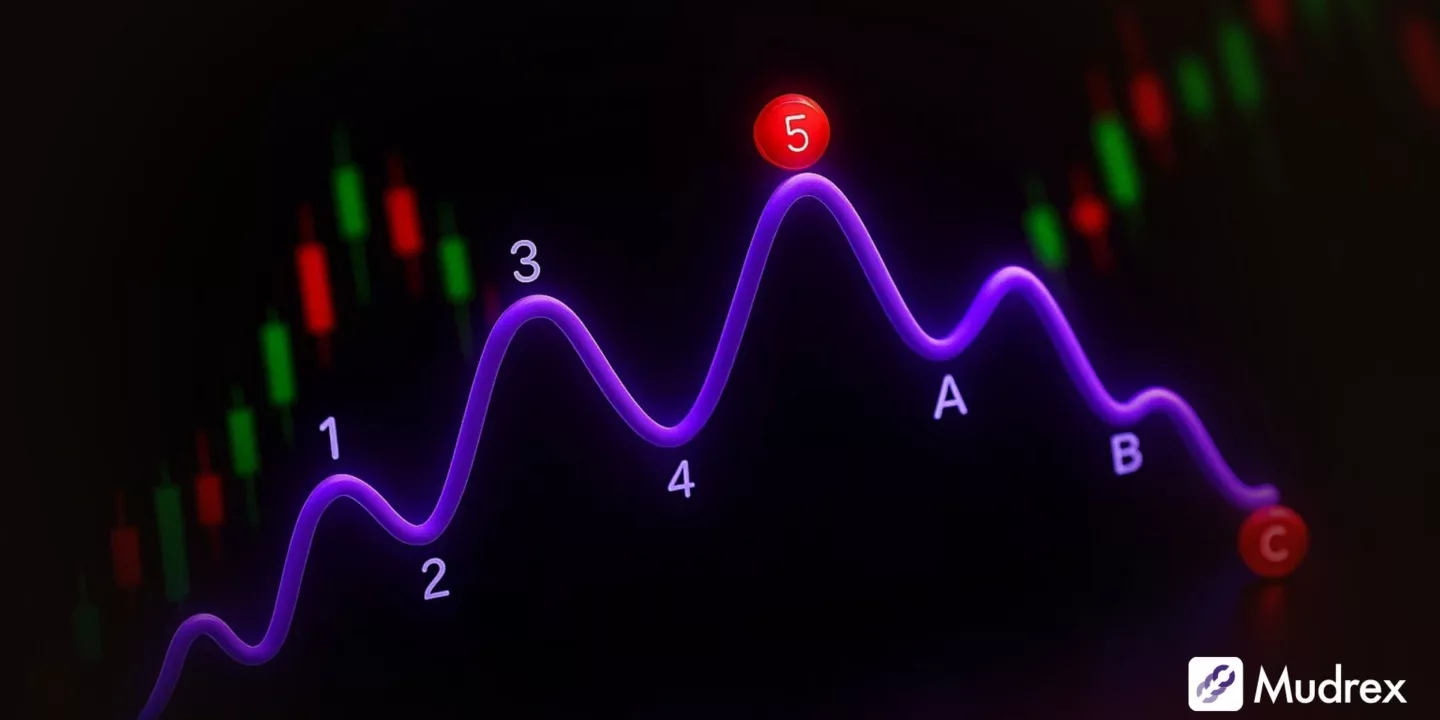
The Elliott Wave Theory (EWT) takes the repetitive patterns of market price movements labels and organises these stages as a structured cycle of waves, namely into:
A five-wave impulse (labeled 1-2-3-4-5) for the trending phase and
a three-wave correction (labeled A-B-C) for the countertrend phase.
Early buyers jump in due to optimism or positive news, starting an upward move.
Impulsive (Trend)
2
Wave 2
Price Pullback
Some traders take profits, causing a temporary decline as caution emerges.
Corrective (Trend)
3
Wave 3
Price Surge
Widespread greed or FOMO drives a strong, often the largest, price increase.
Impulsive (Trend)
4
Wave 4
Price Pullback
Traders pause or sell off, leading to another dip, but the trend remains intact.
Corrective (Trend)
5
Wave 5
Price Increase
A last wave of enthusiasm pushes prices higher, though often weaker as momentum fades.
Impulsive (Trend)
6
Wave A
Price Decline
Profit-taking or fear triggers a sharp move against the trend.
Corrective (Countertrend)
7
Wave B
Price Bounce
Hopeful buyers step in, causing a temporary rebound.
Corrective (Countertrend)
8
Wave C
Price Decline
Panic or selling completes the correction, resetting the market for a new cycle to begin with another initial surge.
Corrective (Countertrend)
Here is a short, visual threads help beginners “see” the rhythm in Crypto Markets. This BTC wave-count explainer walks through the logic from early cycles to recent structure, highlighting rules, likely alternatives, and invalidations.
A clear recent example of Elliott Wave Theory (EWT) in action is Bitcoin’s (BTC/USD) price action from early January 2025 to mid-September 2025.
This period featured
a volatile bull cycle starting from a low around $74,800 (post-2024 correction),
peaking at an all-time high of $124,500 in mid-August,
and then entering a corrective phase amid Fed rate cut expectations, leverage unwinds, and summer doldrums.
Analysts interpreted this as an impulsive five-wave advance (driven by post-election optimism and institutional inflows) followed by the early stages of a three-wave correction, with wave 3 extending strongly to fuel the rally.
Below is a mapping of this movement to EWT’s 5+3 schema, using approximate price levels and dates derived from market data and analyses.
Can We Use EWT to Calculate Where Waves Start or End?
Yes, it is possible to estimate the price points where waves are likely to start or end, but these are not exact calculations like a mathematical formula.
Instead, EWT uses probability-based projections rooted in historical patterns and crowd psychology and relies on Fibonacci levels, another popular concept that is used by Crypto Traders.
In short, Fibonacci Levels are supposed to be ratios where markets are likely to pause, reverse, or extend during EWT Wave patterns. They are significant because they reflect natural proportions where traders, driven by crowd psychology, tend to make decisions, aligning with EWT’s wave structure.
Determine whether the market is in a bullish (uptrend) or bearish (downtrend) phase, as EWT’s five-wave impulse moves with the trend, followed by a three-wave correction against it.
For this you can use Mudrex or any other charting platform to analyze price action across multiple timeframes (e.g., daily for long-term trends, 4-hour for short-term trades). Look for higher highs and lows (bullish) or lower highs and lows (bearish).
Establishing the trend sets the context for labeling impulsive EWT(1-2-3-4-5) and corrective (A-B-C) EWT waves.
2. Label the Wave Pattern
Next you have to Identify and label the eight-wave cycle (1-2-3-4-5 for impulse, A-B-C for correction) based on EWT rules:
wave 2 doesn’t retrace 100% of wave 1,
wave 3 is never the shortest,
and wave 4 doesn’t overlap wave 1’s price territory.
Start with a higher timeframe (e.g., daily) to spot the larger trend, then zoom into a lower timeframe (e.g., 4-hour) for precision.
Look for impulsive waves (strong moves with high volume) and corrective waves (smaller, choppy moves). Use candlestick patterns or momentum indicators (e.g., RSI) to confirm wave starts/ends.
Heres an Example: Bitcoin’s 2025 cycle (daily chart):
Wave 1: $74,800 to $95,000 (mid-Jan, optimism-driven).
Wave 2: $95,000 to $85,000 (late Jan, profit-taking).
Wave 3: $85,000 to $110,000 (mid-May, FOMO surge).
Wave 4: $110,000 to $105,000 (May-Jun, consolidation).
Wave 5: $105,000 to $124,500 (Aug 14, ATH).
Wave A: $124,500 to $110,000 (late Aug, sell-off).
Wave B: $110,000 to $115,000 (early Sep, rebound).
Wave C: $115,000 to $112,800 (Sep 22, ongoing).
Accurate EWT wave labeling provides the structure needed to apply Fibonacci tools for price levels.
Use Fibonacci retracement indicator to calculate where EWT waves are likely to start or end.
Here’s you you do it:
Draw a Fibonacci retracement tool from the start to end of a prior wave (e.g., wave 1’s low to `high) to find targets for wave 2 or 4. Example: For Bitcoin’s wave 1 ($74,800 to $95,000, a $20,200 move), wave 2’s retracement levels are:
Traders buy at these levels, expecting EWT wave 3 to start.
Draw a Fibonacci extension tool from the start of wave 1 to the end of wave 2 to project wave 3 or 5 targets. Example: For Bitcoin’s wave 1 ($74,800-$95,000) and wave 2 ($95,000-$85,000), wave 3’s extension from $85,000:
100%: $85,000 + $20,200 = $105,200.
161.8%: $85,000 + $32,684 = $117,684. (Actual high ~$110,000, mid-May.)
Wave 5 often targets a 100% extension of EWT waves 1-3 combined.
Corrective Waves A-B-C: Wave A retraces the impulse; wave B retraces 38.2-61.8% of wave A; wave C often equals wave A’s length (100%) or extends to 161.8%. Use TradingView or similar platforms to draw these levels automatically.
Next, Validate Fibonacci-derived EWT levels with technical indicators to increase confidence and reduce subjectivity. Using additional Indicators will reduce the risk of mislabeling waves, ensuring levels are high-probability.
Here are some ways you can do that:
Using RSI: Look for divergence (e.g., lower RSI highs at wave 5’s $124,500 peak in Aug 2025, signaling exhaustion).
Volume: High volume in impulsive waves (1, 3, 5) and low volume in corrective waves (2, 4, A-B-C) confirm wave counts.
Support/Resistance: Check if Fibonacci levels align with historical price zones (e.g., $85,000 as prior support in Jan 2025).
Crypto-Specific Signals: Monitor on-chain data (e.g., whale accumulation at $85,000) or sentiment (e.g., Crypto Fear & Greed Index showing fear at wave C’s $112,800 low).
4. Set Trading Levels and Risk Management
Once you have labelled the EWT levels correctly you can use these levels to set entry, exit, and stop-loss points, aiming for a favorable risk/reward ratio, say:
Entry: Buy at wave 2 or 4 retracements (e.g., $85,000 in Jan 2025 for wave 2) or short at wave 5 or A/C peaks (e.g., $115,000 in Sep 2025 for wave B top).
Exit: Take profits at Fibonacci extensions (e.g., $110,000 for wave 3) or when wave rules are violated (e.g., wave 4 overlapping wave 1).
Stop-Loss: Place below wave starts (e.g., below $74,800 for wave 1 long) or above prior highs for shorts.
Example Trade: Buy Bitcoin at $85,000 (wave 2, 50% retracement), target $110,000 (wave 3, 161.8% extension), stop-loss at $74,800.
The precision that the levels bring into your strategy will enable a more disciplined trading approach, mitigating crypto’s volatility and EWT’s subjectivity.
5. Monitor and Adjust for Crypto Volatility
You must continuously track price action and external factors (e.g., crypto news, regulations) to adjust EWT wave counts and levels. No matter what numbers and normalisations you may apply, Crypto’s 24/7 market and sentiment-driven moves require dynamic adjustments to stay accurate.
How?
Recount waves if rules are broken (e.g., if wave 4 dips below wave 1’s high, re-evaluate).
Watch X posts or news for sentiment shifts (e.g., ASK: Fed rate cut rumours? Has it caused levels to change?)
Elliott Wave Theory (EWT) is a robust tool for crypto trading, leveraging structured patterns to navigate market volatility.
Captures Market Psychology: Models crowd emotions (greed, fear) via five-wave impulses and three-wave corrections and reduces subjectivity for trade entries/exits.
Flexible Across Timeframes: Given the cyclical nature of Crypto, Fractal patterns apply to hourly, daily, or weekly charts, aiding short- and long-term trades.
Historical Consistency: Crypto cycles, like Bitcoin’s 2021 and 2025, align with EWT and Fibonacci, boosting reliability.
Combined with RSI/volume, EWT empowers informed trading decisions.
Yes, EWT is reliable for crypto trading when applied correctly, but its effectiveness depends on
How correctly you label
Second level confirmation using other indicators.
In other words, EWT like any other Crypto Technical Indicator should never be used standalone.
With disciplined application, backtesting, and risk management EWT’s structured approach can help you make better decision in the crypto Market
Eight practical EWT setups you can test this month
A short list of repeatable setups makes learning faster. For each, define entry, invalidation, targets, and position size before you act. Take partial profits at logical levels and trail stops under higher lows or above lower highs.
Start with two setups and add more after building confidence. The market rewards small, steady edges with more than one lucky guess. Your job is to execute a simple plan the same way each time.
Setup 1: EWT Wave 2 retrace breakout (simple and strict)
After a new uptrend begins, the first pullback is often tradable. Identify a clear Wave 1, then wait for Wave 2 near 0.5–0.618.
Enter on a minor trendline break or strong candle close. Place the stop below Wave 1 start because a break invalidates the impulse. First target is the prior high, then 1.272 and 1.618 extensions for a building Wave 3.
If Wave 2 is too shallow or price cuts far beyond 0.618 with momentum, skip and relabel. Small size helps you stay calm while learning to wait for clean structure.
Setup 2: Riding an extended EWT Wave 3 (momentum with structure)
Wave 3 often extends in crypto, so join strength when price closes above Wave 1 high with rising volume. Put your stop under the latest higher low inside Wave 3 so normal pullbacks do not shake you out.
Take partials at 1.272 and 1.618 extensions and trail the rest. Do not chase after a string of large candles. Wait for a small pullback inside Wave 3 to improve reward-to-risk.
If momentum fades and structure breaks, step aside and look for the Wave 4 dip, which tends to be calmer and easier to manage.
Trends often rest where they rested before. When an impulse matures, Wave 4 commonly pulls back into the prior Wave 4 zone from a smaller timeframe.
Price may coil sideways as a flat or triangle, not a sharp capitulation. Stops sit below the consolidation floor.
Targets aim for a new high into Wave 5, with partials at measured extensions. If Wave 4 overlaps Wave 1 in a standard impulse, consider whether you’re seeing an ending diagonal or a more complex correction. Do not force labels. Rules protect capital when emotions run high.
Setup 4: Ending diagonal near cycle tops (exit early, not late)
Late-trend ending diagonals look like rising wedges with overlaps. They warn that energy is fading and pullbacks can be swift. Avoid fresh longs into a clear diagonal; short-term traders may fade the breakdown with a stop above the terminal thrust.
First targets are the start of the diagonal and nearby supports. Confirm with a decisive break and retest to reduce whipsaws. On lower-cap coins, diagonal look-alikes are common, so be picky. Letting go near tops protects your equity curve better than calling perfect peaks.
Setup 5: ABC “buy the C” with confluence (structure + signal)
In healthy uptrends, ABC pullbacks offer second-chance entries. Label A down, B up, C down, then draw fibs from the prior impulse. Look for 0.5–0.618 confluence with a support zone.
Enter on a trendline break or strong bullish candle; place your stop below C to stay safe. Take partial profits at the recent high and at extensions. If the C-leg slices far beyond 0.618 with heavy volume, it may be turning into a deeper pattern. Stand down and relabel. Notes and screenshots speed up pattern recognition and confidence.
Setup 6: Running flat continuation (trend pressure is strong)
A running flat occurs when B makes a higher high and C does not undercut A in an uptrend. This shows strong trend pressure. Treat it as a pause, not weakness. Plan an entry on a close above B or near the C completion if momentum turns.
Stops can be tight, since failed running flats often morph into regular flats or zigzags. Targets look for continuation into the next impulse leg. If C breaks well below A, be quick to relabel and wait for a cleaner setup before risking capital again.
Setup 7: Triangle pause before a Wave 5 thrust (measured breakout)
Triangles mark coiling energy before a final push. Count A–B–C–D–E, draw the converging lines, and trade the breakout close with a stop back inside the triangle. A simple target is the triangle height added to the break point.
If price re-enters the triangle, cut fast because failed breakouts can reverse quickly. Triangles often appear as Wave 4, so check alternation versus Wave 2. Keep size reasonable; Wave 5 thrusts after triangles are brief yet sharp, which rewards plans and punishes hesitation.
Setup 8: Post-thrust fade (give-back after a terminal move)
After a strong Wave 5 thrust from a triangle or an ending diagonal, price often snaps back toward the origin. Fading this move is advanced but useful.
Wait for the first lower high on lower timeframes and place a stop just beyond the peak. Targets include the triangle apex or start of the diagonal. If momentum keeps pushing, respect the invalidation and step aside. This setup teaches emotional control because it asks for patience and strict stops. Keep it small until your timing improves through testing.
Risk management that fits Elliott (invalidation first, size second)
Risk comes first because even great counts can fail.
Define invalidation using Elliott’s rules before thinking of profit. Size positions by distance to stop so your percent risk per trade stays steady. Use staged exits at logical targets and trail the rest.
Avoid revenge trades after invalidation; update the count and wait for the next clear setup. Futures traders must be extra careful with leverage and liquidation thresholds. A calm, rules-first routine turns a wrong idea into a small loss, not a big setback.
Image suggestion: “illustration representing bar charts for account risk %, stop distance, position size.” Caption: Keep risk steady even when stops are wide or narrow.
Limits and critiques: use Elliott responsibly (and confidently)
Elliott is subjective, meaning two skilled traders might label the same move differently. Treat Elliott as structure + risk rules rather than a prediction machine. Use invalidation to cut losses, confluence to improve entries, and a journal to refine your personal playbook. Over time, the setups that suit your temperament will stand out, and the rest will fade.
Feeling confident to start crypto trading? Dont wait around ! Download Mudrex and place your first Futures trade! Mudrex offers you the best and easiest trading experience at your fingertips – whether you are comfortable to trade on your phone or on your PC screen.
1. Are Elliott waves accurate for crypto? They help you structure charts and set invalidation, but they are not perfect. Evidence and practice notes are mixed, so use waves with risk rules and simple confirmations rather than alone.
2. Which timeframes should I use to count waves? Work top-down: weekly for the big path, daily for structure, 4H for entries. This keeps labels consistent and avoids forcing patterns on noisy charts.
3. How do I confirm a wave count before entering? Look for confluence: a fib zone, a support or resistance cluster, and a simple trigger like a trendline break or momentum uptick. If a rule breaks, exit and relabel.
4. Can I use Elliott waves for futures and leverage? Yes, but keep leverage low and invalidation strict. Futures add liquidation risk, so size by stop distance and avoid revenge trades.5. How do Fibonacci levels connect to waves? Waves often respect 0.5–0.618 pullbacks in corrections and 1.272–1.618 extensions in impulses. Use them for entries, targets, and stop placement.
Krishnan is a Bangalore-based crypto writer dedicated to simplifying complex crypto concepts. He covers blockchain, DeFi, and NFTs, with a focus on real-world asset tokenization and digital trust. Previously he has written on Real Estate related assets for NoBroker. Krishnan holds a B.Tech degree from the College of Engineering Trivandrum.