A Good Faith Violation (GFV) is one of the most common ways first-time US stock investors accidentally get their account restricted, and it usually happens without them realizing they’ve done anything wrong.
It occurs in a cash account when you buy a security using cash from a sale that hasn’t technically settled yet, then sell that new security before the original cash clears. Since May 2024, US equity trades settle in one business day (T+1) rather than the two days, which changes the exact timing investors need to watch.
Here’s exactly what triggers a GFV, how it differs from the more serious violation called freeriding, and how to avoid either one.
TL;DR
A Good Faith Violation (GFV) happens in a cash account when you sell a security bought with unsettled funds before the original funds settle.
US stock trades now settle in T+1 (one business day), not T+2, following an SEC rule change on May 28, 2024.
Three GFVs within a rolling 12-month period trigger a 90-day restriction to settled-cash-only trading.
A GFV doesn’t carry a monetary fine, but the account restriction can meaningfully limit your trading flexibility.
GFVs apply to cash accounts, not margin accounts, and are a separate, less severe violation than freeriding.
What Is a Good Faith Violation (GFV)?
A Good Faith Violation (GFV) is a cash account trading violation that occurs when you sell a security that was purchased using proceeds from a prior sale that hadn’t yet settled.
Happens only in cash accounts, not margin accounts.
Triggered by selling a security bought with unsettled funds.
Recorded by your broker; three within 12 months trigger a restriction.
Carries no direct monetary fine, but does restrict future trading.
Definition: Settled Funds Cash in a brokerage account that has completed the official settlement process, either from a cash deposit or from the full settlement of a prior securities sale, and is therefore free to use for a new purchase without restriction.
How Does the US Settlement Cycle Work?
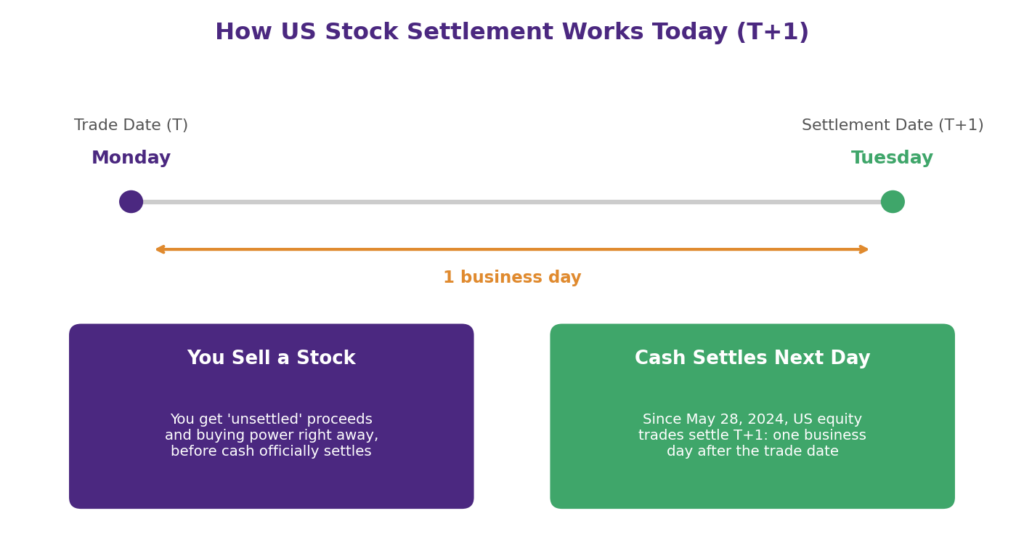
The US settlement cycle determines how long it takes for a stock trade to officially finalize after you place it, and as of May 28, 2024, that cycle is T+1, one business day after the trade date, for most securities.
Good Faith Violation (GFV): What It Is & How to Avoid It
Definition: T+1 Settlement A settlement cycle where a securities trade must be finalized within one business day of the trade date; “T” refers to the trade date and “1” refers to the number of business days until settlement.
Before May 2024, the standard cycle was T+2 (two business days), and many older articles and even some brokers’ own help pages still use T+2 examples. If you sell a stock on Monday under the current T+1 rule, the cash settles Tuesday, not Wednesday. Your broker shows you the sale proceeds as available “buying power” immediately, extended to you in good faith so you’re not stuck waiting to reinvest, but that convenience is exactly what creates GFV risk if you’re not tracking which of your funds are actually settled.
What Causes a Good Faith Violation?
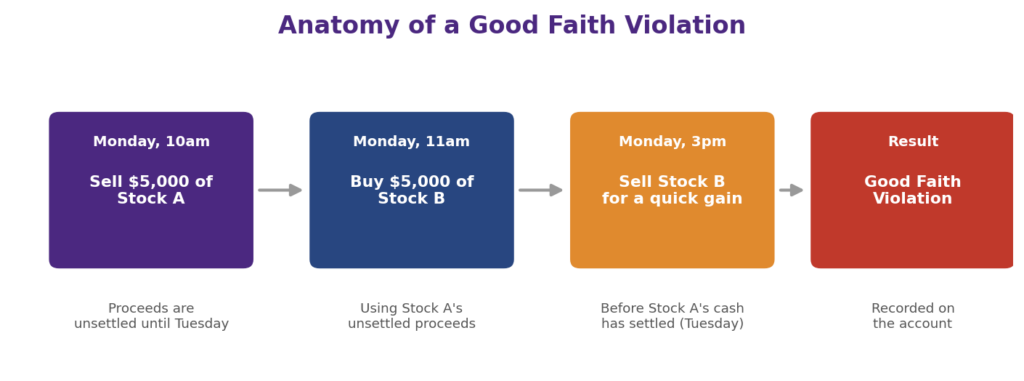
A Good Faith Violation is caused by a specific three-step sequence: selling Security A, using the unsettled proceeds to buy Security B, then selling Security B before Security A’s cash has settled.
Good Faith Violation (GFV): What It Is & How to Avoid It
Good Faith Violation Example
Here’s how it plays out with real numbers, using current T+1 timing:
Step
Action
Cash Status
Monday, 10:00 AM
You sell $5,000 of Stock A
Proceeds shown as available, but unsettled until Tuesday
Monday, 11:00 AM
You buy $5,000 of Stock B using those proceeds
Stock B was purchased with unsettled funds
Monday, 3:00 PM
You sell Stock B for a gain
This is a GFV, since Stock A’s cash hadn’t settled yet
If you had instead waited until Tuesday, after Stock A’s proceeds settled, to sell Stock B, no violation would have occurred. The violation isn’t about buying with unsettled funds; brokers allow that; it’s specifically about selling the newly purchased security before the original cash clears.
GFV vs Freeriding: What’s the Difference?
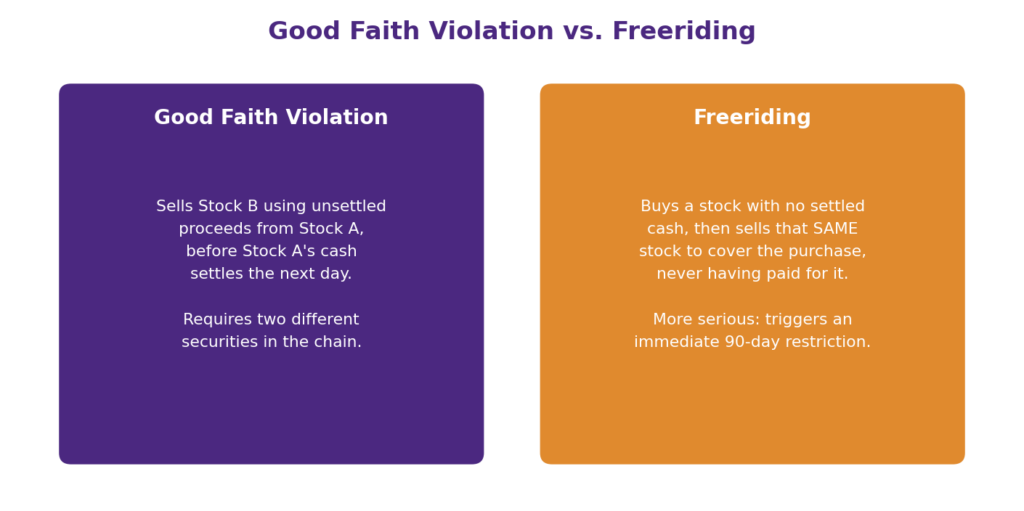
A Good Faith Violation involves two different securities in a sell-buy-sell chain, while freeriding involves buying and selling the exact same security without ever having settled funds to pay for it, and freeriding is treated as the more serious violation of the two.
Good Faith Violation (GFV): What It Is & How to Avoid It
Definition: Freeriding A violation of Federal Reserve Regulation T where an investor buys a security with no settled funds available, then sells that same security to generate the cash needed to cover the original purchase, having never actually paid for it.
The distinction matters for consequences too. A GFV is recorded and only restricts your account after the third occurrence within 12 months. Freeriding triggers an immediate 90-day cash-up-front restriction on the very first offense, since it’s considered a more direct violation of Regulation T’s credit rules.
Does a Good Faith Violation Result in a Fine?
No. A Good Faith Violation does not carry a direct monetary fine or penalty from FINRA, the SEC, or your broker. The consequence is a trading restriction, not a financial charge.
Definition: Self-Regulatory Restriction A consequence imposed by a brokerage under FINRA and Federal Reserve rules to manage settlement risk, distinct from a punitive fine or enforcement penalty issued directly by a regulator against an individual.
This is a deliberate design choice, not an oversight. GFV rules exist to protect the settlement system itself, since a broker extending you same-day buying power on unsettled funds is taking on risk if that cash never actually arrives. Restricting future trading, rather than charging a fee, addresses that risk directly without needing to calculate a penalty amount for each violation. A GFV also doesn’t get reported to credit bureaus and has no bearing on your credit score; it lives entirely within your brokerage account’s internal records.
That said, the restriction itself can carry a real indirect cost. For 90 days, you’ll need fully settled cash before placing any new purchase, which can mean missing a same-day opportunity, being forced to wait an extra business day before reinvesting, or having to keep a larger cash buffer than you’d otherwise want just to stay flexible. Some brokers also apply their own additional consequences beyond FINRA’s baseline 90-day rule, such as removing access to certain order types or adding extra scrutiny to the account, so it’s worth checking your specific broker’s policy rather than assuming every firm treats a GFV identically.
What Happens After Multiple Good Faith Violations?
After three Good Faith Violations within a rolling 12-month period, your broker restricts your cash account to settled-cash-only trading for 90 calendar days.
During the restriction, you can still sell existing positions and buy new ones, but only using cash that has already settled, meaning you lose the ability to use same-day sale proceeds as buying power. Different brokers may issue warnings before the third violation, and some display a running GFV count in your account dashboard. After 90 days, most brokers automatically reset the violation count and lift the restriction, provided no new violations occurred during that period.
How Can I Avoid a Good Faith Violation?
Track which funds are settled versus which are still pending, rather than trusting your displayed buying power alone.
Wait for settlement before selling a security purchased with recent sale proceeds; under T+1, that’s typically just one business day.
Use settled cash first when making new purchases if you plan to trade the position again quickly.
Check your broker’s dashboard; most platforms like Fidelity, Charles Schwab, and Robinhood clearly display settled versus unsettled cash balances.
When in doubt, hold for a day; a one-business-day wait under T+1 is a small price for avoiding a 90-day restriction.
Does a GFV Apply to Margin Accounts?
No. Good Faith Violations are specific to cash accounts. Margin accounts operate under a different framework, since margin buying power is extended based on the value of securities held as collateral, not on waiting for cash to settle, so the same sell-buy-sell timing issue doesn’t apply in the same way.
Definition: Margin Buying Power The amount a brokerage extends to an investor to purchase securities using existing holdings as collateral, calculated against portfolio value rather than settled cash, which is why margin accounts sidestep the cash-settlement timing that creates GFVs.
This is actually why some active traders deliberately move to a margin account specifically to avoid GFV risk, since a margin account lets you buy and sell the same day using your existing collateral rather than waiting on settlement. That trade-off comes with real costs of its own, though: margin accounts charge interest on borrowed funds, carry margin call risk if your collateral value drops, and can trigger forced liquidation of your positions if you can’t meet a maintenance requirement. None of those risks exist in a cash account.
Margin accounts also carry their own distinct rule that catches new traders off guard just as often as GFVs do: the Pattern Day Trader (PDT) rule. If you execute four or more day trades within five business days in a margin account holding under $25,000, FINRA requires your account be flagged as a pattern day trader and restricted from further day trading until the balance is brought above that threshold. It’s a different mechanism than a GFV, but the same underlying lesson applies: know which account type you’re trading in and which rules actually govern it.
Does This Apply to Tokenized US Stocks?
Not in the same way. GFV rules are a byproduct of the traditional US settlement cycle (T+1) and Regulation T, which govern trades made through a US-registered brokerage. Indian investors using LRS-based brokers like Vested or INDmoney to buy US stocks directly are subject to these rules exactly as described above.
Tokenized US stocks, available through platforms like Mudrex, work differently: you’re buying an on-chain token backed by a custodied share rather than placing a trade that settles through the traditional US clearing system. Since there’s no T+1 settlement cycle or Regulation T credit extension involved in that transaction structure, the specific GFV mechanic doesn’t apply the same way.
A Good Faith Violation comes down to one simple rule: don’t sell a security you bought with cash that hasn’t settled yet. Under today’s T+1 settlement cycle, that usually means waiting just one business day, a small discipline that avoids a 90-day trading restriction after three violations. It’s a separate, less severe issue than freeriding, applies only to cash accounts, and is easy to avoid entirely once you’re tracking settled versus unsettled funds rather than relying on your displayed buying power alone.
Exploring US stocks from India? Our guide on how to buy US stocks from India breaks down every available route, including LRS brokers where GFV rules apply directly, and tokenized stocks on Mudrex, which work differently. Download the Mudrex app for Android or iOS, or subscribe to the Mudrex YouTube channel for more explainers like this one.
FAQs
What is a Good Faith Violation?
A Good Faith Violation is a cash account violation that occurs when you sell a security bought with unsettled funds before the original funds have settled.
What causes a GFV?
Selling Security A, buying Security B with the unsettled proceeds, then selling Security B before Security A’s cash settles causes a GFV.
Does a GFV result in a fine?
No. There’s no direct monetary fine; the consequence is a 90-day trading restriction after three violations within 12 months.
How can I avoid a Good Faith Violation?
Track settled versus unsettled cash, wait for T+1 settlement before selling a newly purchased security, and use already-settled funds for trades you might reverse quickly.
What happens after multiple GFVs?
After three GFVs in a rolling 12-month period, your broker restricts your cash account to settled-cash-only trading for 90 calendar days.
GFV vs Freeriding: What’s the difference?
A GFV involves two different securities and takes three occurrences to trigger a restriction; freeriding involves the same security and triggers an immediate 90-day restriction on the first offense.
Does a GFV apply to margin accounts?
No. GFVs are specific to cash accounts; margin accounts operate under different rules based on collateral value rather than cash settlement timing.
Disclaimer
This article explains general US securities settlement rules and is for informational purposes only. Specific policies can vary by broker, so confirm the exact terms with your own brokerage before trading.
Siri is a writer venturing into the exciting realms of blockchain technology, cryptocurrency, and decentralized finance (DeFi), eager to explore the transformative potential of these innovations. She brings a unique perspective that bridges traditional industries and cutting-edge technology, often infused with a touch of humor through memes. She has a rich background in real estate and interior design, having previously contributed to NoBroker, where she crafted blogs and assets on these topics.