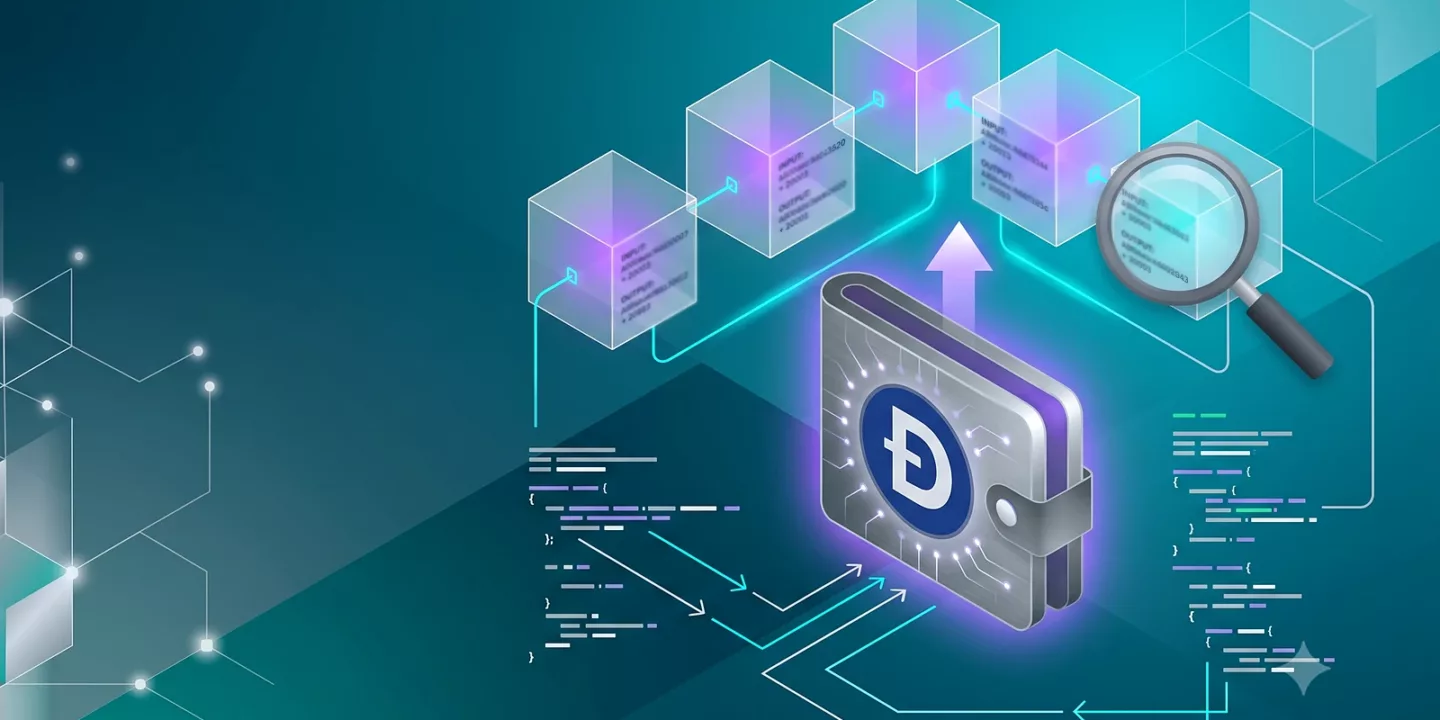

Dogecoin can feel private because your name is not written next to a transaction. However, its blockchain records the movement of DOGE between wallet addresses on a public ledger that anyone can inspect.
So, is Dogecoin a private cryptocurrency? No. Dogecoin is pseudonymous, not private or anonymous. Wallet addresses and transaction details are public, while the people controlling those addresses are not automatically identified on-chain.

This guide explains what the Dogecoin blockchain reveals, how DOGE transactions can be tracked, what someone can learn from a wallet address, and how Dogecoin’s privacy model compares with Bitcoin, Monero, and Zcash.
Dogecoin is a public cryptocurrency. Its network is open, its blockchain is publicly auditable, and standard DOGE transactions are not hidden by default.
The word “private” can cause confusion because it may refer to two different ideas:
Dogecoin is neither. It operates on an open network and does not hide standard transaction details. The official Dogecoin privacy guidance states that blockchain transactions are public and can be viewed using a public wallet address.
| Privacy question | Dogecoin |
|---|---|
| Is the blockchain public? | Yes |
| Are standard transactions publicly recorded? | Yes |
| Are wallet addresses visible? | Yes |
| Are transaction amounts visible? | Yes |
| Is a user’s real name displayed by default? | No |
| Is Dogecoin anonymous by design? | No |
| Is Dogecoin a privacy coin? | No |
The important distinction is between transaction visibility and personal identity. The blockchain can show that DOGE moved between addresses without automatically showing who controls those addresses.
The Dogecoin blockchain is a distributed public ledger. Instead of relying on a single company or database to store transaction records, blockchain information is distributed across the network.
When someone sends DOGE, the transaction is broadcast to the Dogecoin Network. Nodes verify the transaction, while miners use Proof of Work to add valid transactions to blocks. Dogecoin uses the Scrypt Proof-of-Work algorithm.
A simplified transaction flow looks like this:
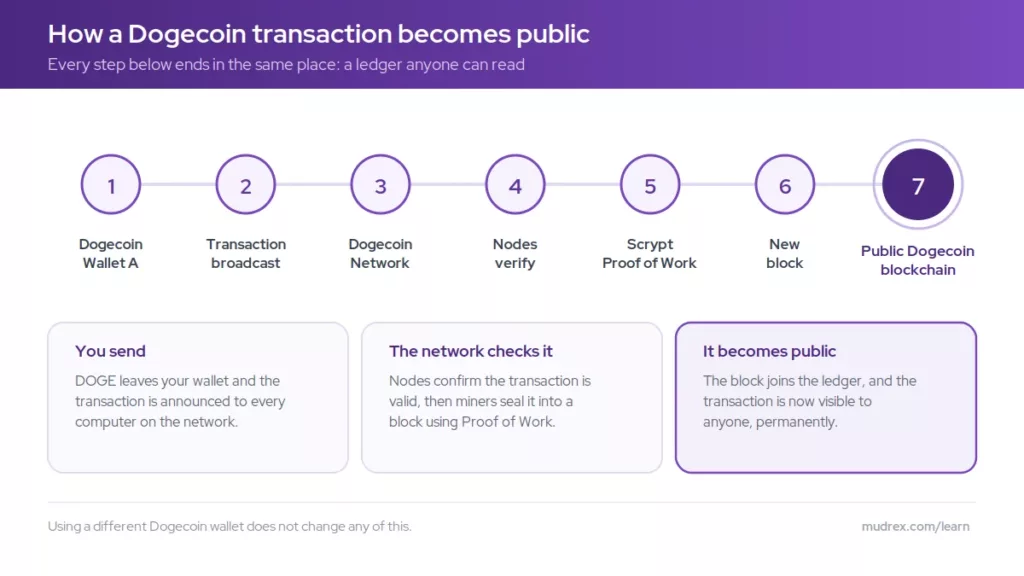
Wallet → Dogecoin Network → Verification → Block → Public Blockchain
Once recorded on the blockchain, the transaction becomes part of Dogecoin’s publicly accessible transaction history.
This transparency is fundamental to how the network works. Using a Dogecoin wallet does not make an on-chain transaction private.
A compatible blockchain explorer can display information connected with a Dogecoin address or transaction.
| Information | Publicly visible? | Important context |
|---|---|---|
| Input and output addresses | Yes | An explorer can display addresses involved in a transaction |
| DOGE amount | Yes | Standard transaction amounts are not hidden |
| Transaction ID | Yes | Each transaction has a searchable identifier |
| Transaction history | Yes | Previous activity associated with an address can be reviewed |
| Block details | Yes | This can include block height, timestamp, and confirmations |
| Address balance | Generally yes | This is the balance of that address, not necessarily a user’s entire wallet |
| Wallet owner’s name | Not automatically | Identity requires information beyond the address itself |
| Phone number or email address | No | These are not standard on-chain fields |
| Private key or seed phrase | No | These credentials must never be shared |
A wallet address, a wallet, and a private key are not the same thing:
Knowing an address allows someone to inspect its public activity. It does not give them control over the DOGE associated with that address.
Dogecoin is pseudonymous rather than anonymous.
The blockchain records addresses, not legal names. It may show that an address beginning with D... sent DOGE to another address, but it does not automatically add the owner’s name, phone number, email address, or home address.
Pseudonymity can weaken when outside information creates an identity link. For example:
Once an address is reliably associated with a person or organisation, its public transaction history may become easier to attribute. That is why pseudonymous does not mean private.
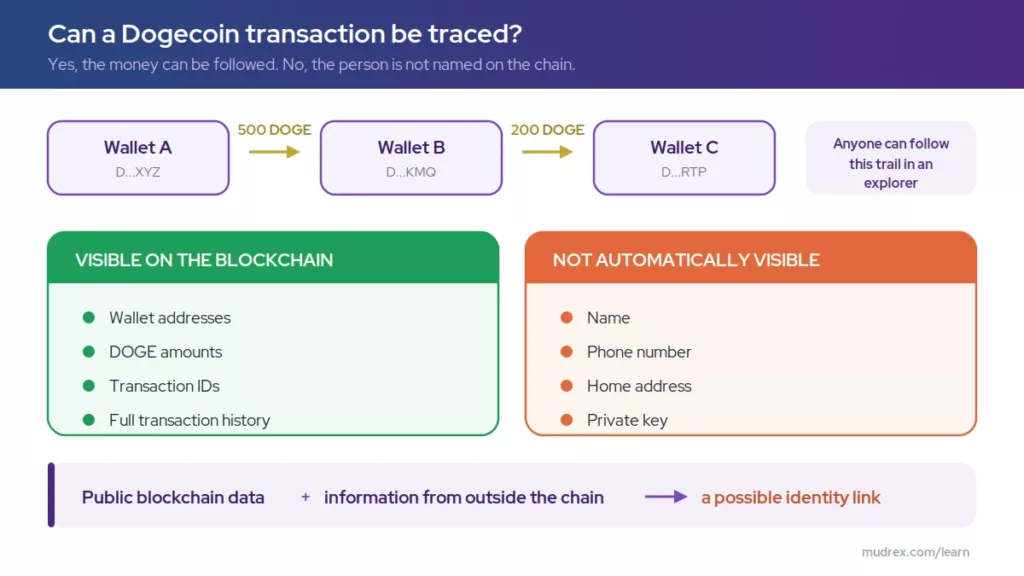
Yes. Dogecoin transactions can be followed on-chain because the ledger publicly records transaction data.
Suppose Wallet A sends 500 DOGE to Wallet B. Wallet B later sends 200 DOGE to Wallet C. An explorer can show the movement as:
Wallet A → 500 DOGE → Wallet B → 200 DOGE → Wallet C
An observer does not need the private keys to inspect this trail. They may still not know who owns Wallet A, B, or C, but they can see that the transactions occurred and follow related on-chain activity.
The two questions must be kept separate:
Real-world attribution generally requires off-chain evidence. A transaction trail alone should not be treated as conclusive proof that a particular person owns or controls every address in that trail.
You need either a public Dogecoin wallet address or a transaction ID. Never enter a private key, seed phrase, password, or recovery phrase into a blockchain explorer.
Open the wallet or platform used for the transfer and locate the public address or transaction ID.
Use an explorer that supports the Dogecoin Network. Dogecoin’s official resources list several network tools, while Blockchair’s Dogecoin explorer is one example that supports searches for blocks, transactions, and addresses.
Paste the public information into the explorer’s search field. Check every character carefully because blockchain identifiers are long and easy to mistype.
Depending on the explorer, you may see:
Searching an address rather than a single transaction may show its incoming and outgoing activity, address balance, and related transactions.
Open connected transactions to see where DOGE moved next or review earlier activity. Remember that an address may belong to an exchange, service, merchant, or wallet with many users, so do not infer ownership without reliable supporting evidence.
Also Read: What Is a Blockchain Explorer?
Not from the address alone. A public Dogecoin address does not contain a person’s name, phone number, email address, or physical address.
Identification may become possible when the address is combined with reliable outside information. Examples include a publicly posted payment address, exchange account records, merchant data, or other verified evidence. Blockchain analytics can reveal connections and patterns, but a suspected link is not automatically proof of identity or ownership.
This distinction matters because one person can control many addresses, while a custodial service can control an address on behalf of many users.
No. A privacy coin uses protocol-level technology to conceal or reduce the visibility of transaction information. Depending on the network, it may hide the sender, recipient, amount, or links between transactions.
Dogecoin’s standard transaction model does not provide these protections. Its blockchain remains publicly auditable, making its privacy model closer to Bitcoin’s than to privacy-focused cryptocurrencies.
| Privacy feature | Dogecoin | Bitcoin | Monero | Zcash |
|---|---|---|---|---|
| Base ledger | Public | Public | Public blockchain with privacy-preserving transactions | Public blockchain with transparent and shielded options |
| Standard transaction data | Transparent | Transparent | Sender, receiver, and amount are hidden by default | Depends on whether the transaction is transparent or shielded |
| Real-world identity shown by default | No | No | No | No |
| Transactions publicly traceable by default | Yes | Yes | Designed to prevent transaction tracing | Transparent activity is public; shielded activity protects transaction details |
| Privacy by default | No | No | Yes | Not for every transaction type |
| Privacy-focused design | No | No | Yes | Yes |
Also Read: Is DOGE a good investment in 2026?
Dogecoin and Bitcoin are both transparent, pseudonymous networks at the base layer. Bitcoin.org’s privacy guidance similarly explains that Bitcoin transactions are public and traceable even though addresses do not automatically reveal identity.
Monero’s official documentation explains that stealth addresses, ring signatures, and RingCT hide the receiver, sender, and amount. Monero applies transaction privacy by default, whereas Dogecoin does not provide comparable protocol-level concealment.
Zcash supports both transparent and shielded activity. According to the official Zcash privacy explainer, shielded addresses keep financial information private, while transparent addresses make it public. Dogecoin does not offer an equivalent shielded transaction option.
The practical takeaway is simple: Dogecoin’s privacy model is much closer to Bitcoin’s than to Monero’s default-private model or Zcash’s shielded model.
Also Read: Best Privacy Tokens in 2026
A wallet can affect security, key management, convenience, and address handling, but it cannot change the public nature of Dogecoin’s blockchain.
Using fresh receiving addresses can reduce address reuse and help separate some activity. Dogecoin’s official privacy guidance mentions creating new public addresses for new transactions. However, a fresh address does not erase earlier transactions, break every on-chain link, or make DOGE anonymous.
Treat new addresses as basic privacy hygiene, not guaranteed anonymity.
Also Read: Best Crypto Wallets in 2026
These steps can reduce unnecessary exposure, but they do not turn Dogecoin into an anonymous cryptocurrency.
An address is pseudonymous. It does not contain a name, but it can become associated with a person through outside information.
Standard transaction visibility does not depend on the transfer size. Small and large transactions are recorded on the same public blockchain.
Deleting an app or wallet file does not delete blockchain records. Confirmed transactions remain part of the distributed ledger.
A fresh address can reduce reuse, but it does not erase earlier transactions or guarantee that separate addresses cannot be linked through later activity.
Also Read: Dogecoin Price Prediction
Dogecoin is not a private cryptocurrency. It uses a transparent public blockchain where addresses, transaction amounts, transaction IDs, and historical activity can be inspected. The person behind an address is not automatically identified, which makes Dogecoin pseudonymous rather than anonymous.
Dogecoin’s privacy model is broadly similar to Bitcoin’s. Monero and shielded Zcash transactions use dedicated protocol-level mechanisms to protect transaction information, while Dogecoin does not.
The safest assumption is that your name may not appear on the Dogecoin blockchain, but your DOGE transactions can leave a public trail. Protect your credentials, limit unnecessary address exposure, and never confuse a public wallet address with Also a private key.
Explore the live Dogecoin price and DOGE market information on Mudrex.
No. Dogecoin uses a transparent public blockchain. Standard DOGE transactions can be inspected using public blockchain data and compatible explorers.
No. Dogecoin is pseudonymous. A wallet address does not automatically reveal its owner’s identity, but the transaction activity associated with that address is public.
Yes. Dogecoin’s blockchain is a public distributed ledger maintained across network nodes. Confirmed transaction records can be inspected by anyone.
Yes. Dogecoin transactions can be followed between addresses because transaction data is publicly recorded. Identifying the person behind an address requires separate, reliable evidence.
Yes. Search the transaction ID or a relevant public address in a Dogecoin-compatible blockchain explorer to review its status, confirmations, and connected activity.
Yes. If someone knows a public Dogecoin address, they can generally inspect its associated transaction history, DOGE amounts, and address balance. They cannot automatically see the owner’s name or private key.
Not from blockchain data alone. Ownership may be inferred or established only when the address is connected with reliable off-chain information, such as a public profile, merchant record, or verified account record.
No. A wallet can change how you manage keys and addresses, but it cannot alter the transparency of transactions already recorded on the Dogecoin blockchain.
Not at the base protocol level. Both use transparent public blockchains and provide pseudonymity rather than default transaction privacy.
Dogecoin uses a transparent transaction model. Monero hides key transaction details by default, while Zcash supports both transparent and shielded transactions. Dogecoin does not provide an equivalent built-in privacy option.