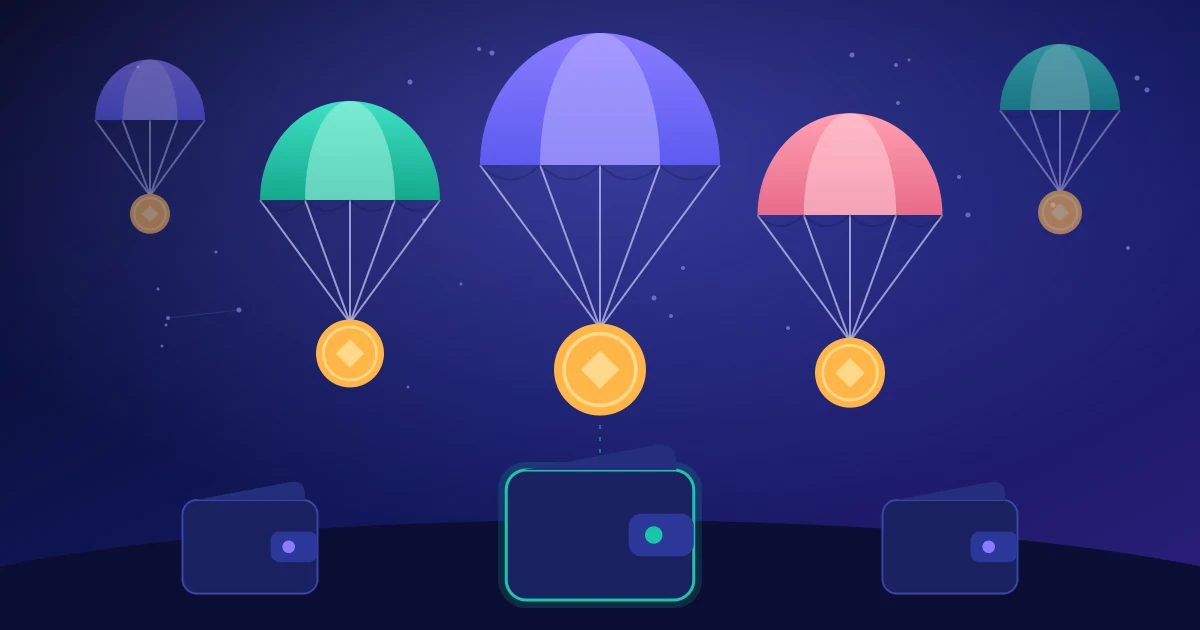

A crypto airdrop is the distribution of cryptocurrency tokens or NFTs to selected wallet addresses, often without requiring users to buy those tokens. Blockchain projects use airdrops to introduce a token, reward early users, grow a community or distribute governance rights.
For example, a decentralised exchange might give its new governance token to people who used the platform before a particular date. Eligible users may receive the tokens automatically or need to claim them through an official website.

An airdrop does not guarantee free money. Claiming can involve network fees, some tokens cannot be sold easily, and fake airdrops can be used to steal funds. This guide explains how genuine crypto airdrops work, the main types, how to participate safely and the tax considerations for users in India.
Key Takeaways
In cryptocurrency, an airdrop means sending or allocating digital assets to a group of users under a project’s distribution rules. The assets might be a fungible token, such as a governance token, or an NFT.
Unlike an ordinary purchase, users generally do not pay the issuer a purchase price for the airdropped allocation, although they may have incurred costs while qualifying or claiming it.
The project decides who is eligible. Depending on the campaign, someone might qualify by holding an existing token, using a decentralised application (dApp), contributing to a community or completing specified activities.
Other airdrops reward past activity that participants did not know would earn a reward.
Airdrops are recorded or fulfilled through blockchain technology, but they are not the same as Apple’s AirDrop file-sharing feature.
A project may distribute tokens to reward people who used its product early, encourage users to explore a new service, introduce governance rights to a community or generate awareness for a launch.
For a holder airdrop, the incentive may be to recognise an existing token or NFT community.
Some common reasons include:
However, distributing a token widely is not proof that it has a useful product, fair governance or sustainable demand. Some recipients sell quickly, creating volatility; others hold tokens that never develop an active market.
A cryptocurrency airdrop typically involves identifying eligible users and distributing tokens according to predetermined conditions.
For a snapshot-based distribution, the process often involves the following stages. They are not universal or always announced in this order.
The project establishes conditions for receiving tokens.
Eligibility may depend on:
Not every person who completes an activity will necessarily receive tokens.
Users perform the relevant activities, or their historical activity already satisfies the criteria.
For example, a project might reward wallets that interacted with its decentralised exchange several months before the token launch.
In a retroactive airdrop, users may not have known that their earlier activity could qualify them for rewards.
A snapshot records wallet balances or blockchain activity at a particular block or time.
For example, a project might check which wallets held a particular token on 1 October.
If a wallet acquired the token after the snapshot, it might not qualify.
However, snapshots are not mandatory for every airdrop, and some projects take snapshots before publicly announcing the distribution.
After identifying potentially eligible addresses, projects may verify whether those addresses satisfy their distribution rules.
They may also attempt to identify bots, duplicate accounts or multiple wallets controlled by a single participant.
These measures are sometimes called anti-Sybil checks.
Once eligibility is established, tokens may be:
Some claims require users to connect their wallets and approve a blockchain transaction. Others may involve no action from the recipient.
Example of a crypto airdrop
Suppose a blockchain project decides to reward users who interacted with its application before 1 October.
A wallet meets the qualifying requirements, and the project allocates 100 new tokens to it.
The user might receive those tokens automatically or need to claim them through the official application.
The 100-token allocation is hypothetical. Actual eligibility criteria and reward amounts vary by project.
A wallet address is public and can receive compatible tokens. A seed phrase or private key is secret and controls access to assets.
A legitimate airdrop never requires you to disclose your seed phrase or private key.
Learn more about choosing the right crypto wallet.
Cryptocurrency projects use different methods to determine who receives airdropped tokens.
There is no universal classification, and some distributions combine multiple methods.
| Type | How it works | Typical eligibility |
|---|---|---|
| Standard airdrop | Users register or provide an eligible wallet address, sometimes subject to a cap or draw. | Registration under campaign rules. |
| Bounty airdrop | Users complete specified tasks or contribute to a campaign. | Community participation, content contributions or other defined activities. |
| Holder airdrop | Tokens are allocated based on ownership of an existing asset. | Holding a qualifying token or NFT at a particular snapshot. |
| Exclusive airdrop | The project selects a defined group of recipients. | Historical contributions, community roles or specific eligibility conditions. |
| Retroactive airdrop | Projects reward activities completed before the distribution was announced. | Historical use of a blockchain protocol or application. |
Standard airdrops generally allow eligible users to register for a distribution or submit a supported wallet address.
Some campaigns impose limits on the number of participants or distribute tokens through a selection process.
Registering does not necessarily guarantee an allocation.
Bounty airdrops reward users for completing specified activities.
These might include creating educational content, participating in community initiatives or completing other tasks defined by the project.
Some campaigns use referral-based activities. Users should review the terms carefully because activity-based rewards may have different legal or tax implications from gratuitous token distributions.
Holder airdrops reward users who own a particular cryptocurrency or NFT at a specified snapshot.
For example, a project might allocate its token to people who hold another eligible token.
The quantity distributed may depend on the recipient’s balance or other campaign rules.
Holding tokens on a centralised exchange does not automatically guarantee eligibility.
Exclusive airdrops are directed towards a selected group of participants.
These may include early contributors, community members, developers or users meeting specific project-defined conditions.
Unlike an open registration campaign, eligibility may depend on being selected by the project.
Retroactive airdrops reward users for activity that occurred before an incentive was announced.
A project might distribute governance tokens to people who previously used its decentralised application.
These distributions are particularly relevant in decentralised finance, where projects can identify past interactions through blockchain records.
An NFT airdrop involves distributing non-fungible tokens instead of interchangeable cryptocurrency tokens.
These NFTs might represent:
An NFT airdrop may also follow standard, holder, exclusive or retroactive eligibility rules.
Therefore, an NFT airdrop describes the type of asset distributed rather than a completely separate eligibility mechanism.
Unknown NFTs can be used to lure users to malicious websites. Receiving an NFT does not mean the recipient should interact with its links or smart contracts.
Read more about what NFTs are and how they work.
Bitcoin (BTC) itself does not operate promotional airdrop campaigns.
However, Bitcoin-related blockchain projects may distribute separate tokens to eligible participants.
A blockchain fork may also create asset balances on another network for users holding coins at the time of the fork.
These are different mechanisms and should not be confused with a distribution of new BTC from the Bitcoin network.
Be cautious of websites promising free Bitcoin in exchange for sending a deposit, sharing wallet credentials or signing suspicious transactions.
Airdrop farming refers to using blockchain protocols or completing activities in the hope of qualifying for future token distributions.
For example, users might interact with decentralised exchanges, bridges or lending protocols because they believe a project may reward early activity.
Some participants operate multiple wallets to increase potential eligibility.
However, projects may use anti-Sybil systems to exclude coordinated or duplicate activity.
Airdrop farming carries several risks:
There is no guaranteed way to earn cryptocurrency through airdrop farming.
Several major blockchain projects have used token airdrops to distribute governance rights or reward historical participation.
Uniswap introduced its UNI governance token in September 2020.
The project allocated 15% of UNI’s initial token supply for an immediate distribution to historical users and liquidity providers, among others.
Eligible addresses that previously used Uniswap v1 or v2 could claim 400 UNI under the original launch rules.
This distribution became a prominent example of a retroactive airdrop because users were rewarded for earlier protocol activity rather than purchasing the newly introduced token.
Source: Uniswap’s official UNI launch announcement.
Arbitrum launched its ARB governance token distribution in March 2023.
The project used a snapshot dated 6 February 2023 to assess historical activity.
The initial distribution began on 23 March 2023, while the user claim period ended on 24 September 2023.
According to the Arbitrum Foundation, 11.62% of ARB’s initial supply was allocated to users through the airdrop.
This is an example of using historical blockchain interactions to determine token eligibility.
Source: Arbitrum Foundation’s official distribution documentation.
These are historical examples, not currently available claim opportunities.
It is also important to distinguish token airdrops from blockchain forks. For instance, the creation of Bitcoin Cash through a Bitcoin blockchain fork in 2017 was not the same mechanism as a promotional token airdrop.
Participating in a cryptocurrency airdrop generally requires understanding a project’s eligibility rules and using the correct wallet or application.
There is no guaranteed method of receiving airdropped tokens.
Begin with the project’s official website, documentation or verified communication channels.
Social media and community discussions can help users discover potential campaigns, but an announcement from an unknown account is not sufficient proof of legitimacy.
Avoid clicking shortened links or unsolicited direct messages.
Instead, independently navigate to the project’s official website and confirm the campaign details.
Read the distribution rules carefully.
Check whether the campaign requires:
An upcoming token launch does not automatically mean an airdrop has been confirmed.
On-chain airdrops generally require a wallet compatible with the relevant blockchain.
Depending on the campaign, you may need to connect a wallet, demonstrate historical activity or use the same wallet that qualified for the snapshot.
A project may not allow users to replace their eligible wallet addresses after the snapshot.
For additional information, see how to choose a crypto wallet.
Sometimes, but it depends on the exchange and the project.
When cryptocurrency is held through a custodial exchange, the on-chain wallet may be controlled by the exchange rather than the individual customer.
As a result, an exchange user may not be directly eligible for an airdrop that relies on blockchain wallet snapshots.
Some exchanges support particular token distributions and allocate eligible tokens to customers. Others do not.
Always check official announcements from both the blockchain project and the exchange.
Learn more about custodial and non-custodial wallets.
If an airdrop requires a wallet connection, verify:
A transaction that simply receives tokens is different from one granting a third-party smart contract permission to spend existing assets.
Avoid signing transactions you cannot understand or verify independently.
After a legitimate claim or distribution, check the relevant wallet or blockchain explorer.
If you intend to trade the token, verify whether it is transferable and whether a genuine market exists.
Also check liquidity, trading fees and the token’s availability on your intended platform.
Important: Never enter your seed phrase or private key on an airdrop website. Do not follow links embedded in unexpected tokens or NFTs.
Crypto airdrops are commonly described as free token distributions because eligible users may receive tokens without purchasing them from the issuer.
However, this does not mean participation is entirely cost-free.
| Potential cost or limitation | Explanation |
|---|---|
| Network fees | Claiming tokens through a blockchain transaction may require gas fees. |
| Qualifying activities | Users might spend time or money on swaps, transfers, bridging or other activities. |
| Taxes | Receiving or later transferring tokens may create tax obligations depending on the circumstances. |
| Limited liquidity | A token balance may not have a reliable market or accessible buyers. |
| Price volatility | Token prices can rise or fall sharply, including after a major distribution. |
For example, a user might qualify for a token allocation but need to pay a blockchain network fee to claim it.
If the token has little market demand, selling it may be difficult or uneconomical.
It is also important to distinguish legitimate blockchain transaction fees from suspicious requests for payment.
A project may require ordinary network fees for an on-chain transaction, but someone demanding that you send cryptocurrency to an unknown address to unlock a reward is a major warning sign.
Crypto airdrops can benefit blockchain projects and recipients, but their value depends on the project, token design and market conditions.
1. Access to new tokens
Users may receive tokens without purchasing the allocation directly.
2. Rewards for early participation
Projects can recognise people who supported or used their applications before a token launch.
3. Community participation
Governance-token distributions may allow eligible users to participate in protocol proposals or voting.
4. Exposure to blockchain applications
Some airdrops encourage users to learn about decentralised applications and decentralised finance (DeFi).
1. Token price volatility
Airdropped tokens may experience sharp price movements, particularly around listing or distribution events.
2. Low liquidity
Some tokens have limited trading activity or no meaningful market.
3. Cryptocurrency scams
Fraudulent websites may imitate legitimate projects and attempt to steal wallet credentials or obtain malicious transaction approvals.
4. Smart contract risks
Interacting with unfamiliar applications can expose users to vulnerable or malicious contracts.
5. Transaction costs
Qualifying for or claiming an airdrop may involve fees that exceed the value of the tokens received.
6. No guaranteed rewards
Completing project activities does not guarantee eligibility, distribution or financial returns.
Airdrops should be understood as high-risk token distributions, not a dependable source of income.
Fake airdrops are a common method of targeting cryptocurrency users.
Scammers may impersonate established blockchain projects, distribute spam tokens or create fake claim websites.
Their objective is often to convince users to disclose sensitive information or sign transactions that expose existing assets.
1. Requests for private keys or seed phrases
A legitimate crypto airdrop never requires you to disclose your wallet’s recovery phrase or private key.
2. Unverified website links
Fraudulent sites may use domains that closely resemble official project websites.
3. Suspicious token approvals
A claim page may request unlimited permission to spend assets already held in your wallet.
4. Guaranteed rewards
Promises of unusually high or guaranteed earnings should be treated cautiously.
5. Upfront deposits or unlock fees
Requests to send funds to an unknown wallet to release an alleged reward are major warning signs.
| What to check | More credible sign | Warning sign |
|---|---|---|
| Announcement | Official documentation links to the distribution. | Unsolicited direct message or unverified website. |
| Wallet information | Public address or understandable claim interaction. | Request for seed phrase or private key. |
| Transaction | Expected network and clearly understandable wallet approval. | Unexpected spending permission or asset transfer. |
| Payment | Transparent network fees where applicable. | Arbitrary unlock, verification or upfront deposit demand. |
| Deadline | Published distribution and eligibility terms. | Artificial urgency or unverifiable countdown. |
These are indicators rather than guarantees. A fraudulent project may also operate a polished website or publish believable campaign conditions.
Legitimate airdrops may require wallet signatures, so a request for a signature is not automatically fraudulent. The important question is what the signature authorises.
If you suspect that you approved a malicious contract:
Disconnecting a website from your wallet does not automatically revoke existing blockchain approvals.
Importantly, receiving an unsolicited token does not, by itself, reveal your private key. The main danger comes from interacting with malicious contracts or phishing websites afterwards.
For additional guidance, read Mudrex’s guide to common crypto scams and safe crypto-transfer practices.
You can also consult MetaMask’s official guidance on airdrop scams and token approvals.
Crypto airdrops, initial coin offerings and staking rewards are different ways users may acquire cryptocurrency tokens.
| Feature | Crypto airdrop | Initial Coin Offering (ICO) | Staking rewards |
|---|---|---|---|
| Primary purpose | Distribute tokens or reward eligible users. | Sell tokens, typically to raise funds. | Reward eligible staking participation. |
| User activity | Meets distribution rules or historical eligibility conditions. | Purchases tokens under an offering. | Stakes or delegates eligible assets. |
| Token purchase required | Generally not for the airdropped allocation. | Usually yes. | Staked assets are generally required. |
| Guaranteed returns | No. | No. | No. |
| Main risks | Fraud, gas fees, limited liquidity and volatility. | Project, offering and price risks. | Protocol, slashing, lock-up or counterparty risks, depending on the service. |
Although these methods may sometimes overlap, they are not interchangeable.
For instance, staking rewards are generally associated with committing or delegating eligible assets, whereas retroactive airdrops may reward historical product usage.
Crypto airdrops can be taxable in India, but not every airdrop automatically creates two separate tax liabilities.
The tax treatment depends on how the tokens were received, whether they were awarded for services, their value, and whether they are subsequently sold, swapped or otherwise transferred.
The relevant framework includes the Income-tax Act, 2025, as amended by the Finance Act, 2026, effective from 1 April 2026.
Receiving a cryptocurrency airdrop may create taxable income depending on the circumstances.
Under section 92(2)(m), specified property received without consideration can be taxable under the applicable conditions.
For qualifying movable property, the provision refers to an aggregate fair market value exceeding ₹50,000 during a tax year, subject to statutory definitions and exceptions.
Where the provision applies, the relevant value may be taxable as income from other sources at the applicable rates.
However, the ₹50,000 threshold should not be treated as a universal tax-free exemption for every crypto airdrop.
For example, a token distribution received as payment for promotional work, referrals or other services may require a different income classification.
Unsolicited tokens, inaccessible assets, restricted transfers and assets without a reliable market price can also create valuation and timing questions.
A wallet balance alone does not settle whether or when tax is payable.
The transfer of qualifying virtual digital assets is generally subject to a special tax regime in India.
Under section 194(1), Table serial number 4, income from the transfer of qualifying virtual digital assets is generally taxed at 30%, plus applicable surcharge and cess.
The law generally allows the cost of acquisition, if any, while restricting other expenditure deductions and specified loss adjustments.
The acquisition cost of an airdropped token requires careful consideration, especially when its value was previously taxed on receipt.
It should not automatically be assumed that the token’s receipt-date market price will qualify as its deductible acquisition cost in every case.
A qualifying payment to a resident for a virtual digital asset transfer may attract 1% tax deducted at source (TDS) under section 393(1), Table serial number 8(vi), subject to applicable thresholds and conditions.
TDS is a tax withholding mechanism and generally represents tax credited to the recipient.
It should not be described as an additional 1% income tax imposed on top of the 30% tax rate.
The application of TDS to specific transactions can depend on the parties, type of transfer and applicable legal conditions.
| Activity | Potential tax implication | Important consideration |
|---|---|---|
| Receiving tokens without consideration | Gift-like receipt rules may apply. | Aggregate value, statutory conditions and exemptions matter. |
| Receiving tokens for services | May be taxable under a relevant income category. | Gift-related thresholds may not apply. |
| Holding received tokens | Holding alone does not trigger a new VDA transfer tax. | Tax consequences may already have arisen on receipt. |
| Selling or swapping tokens | VDA transfer income is generally taxed at 30% plus applicable additions. | Cost basis and statutory loss rules must be considered. |
| Receiving payment for a qualifying VDA transfer | 1% TDS may apply. | Thresholds and withholding conditions apply. |
Users should maintain:
For substantial allocations, illiquid tokens or service-based rewards, consult a qualified Indian chartered accountant.
Note: This section provides general educational information, not personalised tax advice. Tax treatment depends on the circumstances of each transaction.
Receiving tokens is only one part of the process. Users should also assess the token’s authenticity, restrictions and practical value.
Check the project’s official contract address and blockchain network.
Malicious tokens can imitate the name or symbol of legitimate cryptocurrencies.
Airdropped tokens may have restrictions.
Some are subject to vesting periods, transfer limitations or other rules.
Receiving tokens does not automatically mean they can be sold immediately.
Before trading, check whether an active market exists.
A token may display a price on a portfolio application without having sufficient market depth for an actual sale.
Consider network fees, trading charges, bridging costs and withdrawal costs before moving or selling the asset.
Keep the relevant wallet activity, timestamps and transaction details for future reference and potential tax reporting.
Users may decide to hold an eligible token, trade it where a suitable market exists or avoid interacting with suspicious assets.
Never interact with an unfamiliar token merely because it appeared in your wallet.
Crypto airdrops are generally organised by the issuing blockchain projects, and holding cryptocurrency on Mudrex does not automatically make a user eligible for every on-chain airdrop.
However, if a token is supported and available for trading, users may prefer a platform that provides transparent information about security, available products and trading costs.
Mudrex is registered with the Financial Intelligence Unit of India (FIU-IND). FIU-IND registration relates to applicable reporting and compliance obligations. It does not mean that cryptocurrencies or investments on the platform are government-guaranteed.
Mudrex’s official website displays ISO/IEC 27001:2022 and SOC 2 Type 2 credentials.
The platform also describes security measures including two-factor authentication, restricted access controls, encryption and institutional custody arrangements.
These measures support platform security but cannot eliminate market, operational or custody-related risks.
Mudrex advertises access to 650+ cryptocurrency assets, along with spot and futures trading and diversified crypto products.
Available tokens and features depend on platform support and applicable eligibility.
Users should confirm whether a particular airdropped token is available before attempting to deposit, sell or transfer it.
Eligible Indian users can access supported INR deposit and withdrawal methods, subject to KYC requirements and payment availability.
Actual methods, limits and processing conditions depend on the account and applicable platform policies.
Mudrex publishes trading-fee information and volume-based Alpha tiers.
Users can review the applicable fee schedule before placing trades and evaluate costs alongside the risks of the cryptocurrency they intend to trade.
For current platform information, refer to Mudrex’s official website, compliance information and trading-fee schedule.
A crypto airdrop is a method of distributing cryptocurrency tokens or NFTs to eligible users, often to reward early participation, increase community involvement or introduce a blockchain project.
Different campaigns use different eligibility conditions. Some reward previous blockchain activity, while others depend on token holdings or community contributions.
However, airdrops are not guaranteed opportunities to earn money. Tokens can lose value, have limited liquidity or involve transaction costs, while fake claims can expose users to significant security risks.
Before participating, verify the project, understand the eligibility requirements, protect your wallet credentials and assess the potential costs and tax implications.
The most important principle is simple: receiving a token allocation and safely claiming it are two different things.
A cryptocurrency airdrop is the distribution of tokens or NFTs to eligible blockchain wallets. Projects may use airdrops to reward participants, introduce tokens or support community adoption.
Crypto airdrops generally involve eligibility conditions, possible blockchain snapshots, verification of eligible addresses and automatic distribution or manual claiming of tokens.
Follow legitimate blockchain projects through their official websites, review eligibility rules and participate only when you understand the conditions. No activity guarantees that a project will launch an airdrop or distribute tokens to you.
An airdropped token allocation may be free, but claiming or qualifying can involve network fees, transaction costs, time commitments and potential taxes.
Most on-chain airdrops require a compatible cryptocurrency wallet. Exchange-held assets qualify only when the exchange and project support the relevant distribution.
Claiming can be safe when the project is genuine and the transaction is verified. However, fake websites and malicious wallet approvals can expose users to losses. Never disclose your seed phrase or private key.
A retroactive airdrop rewards users for activities completed before the reward was announced. Eligibility is often determined through historical blockchain interactions.
An NFT airdrop involves distributing non-fungible tokens to eligible wallets. These might represent digital collectibles, community memberships or other blockchain-based assets.
Only if the token is transferable, a suitable trading market exists and the relevant trading venue supports it. Some tokens have lock-up periods or limited liquidity.
They can be. Depending on the circumstances, receiving an airdrop may have income-tax implications, while subsequent transfers of qualifying virtual digital assets can fall under India’s special VDA tax regime.
Sometimes. An exchange must support the particular distribution and allocate eligible tokens to customers. Holding cryptocurrency on an exchange does not automatically qualify users for an on-chain airdrop.
The Bitcoin network does not conduct promotional BTC airdrops. Separate Bitcoin-related projects may distribute their own tokens, while blockchain forks operate through a different mechanism.
There is no universal approval or prohibition specifically covering the receipt of all crypto airdrops. The applicable legal requirements depend on the asset, activity, payment arrangements and other circumstances.
क्रिप्टो एयरड्रॉप का मतलब किसी प्रोजेक्ट द्वारा पात्र वॉलेट धारकों को क्रिप्टो टोकन या NFT बांटना है। टोकन पाने के नियम अलग-अलग हो सकते हैं और हर एयरड्रॉप सुरक्षित या लाभदायक नहीं होता।
Disclaimer: This article is for educational purposes only and does not constitute investment, financial or tax advice. Cryptocurrency products are highly risky and may be subject to significant volatility, loss of value and limited regulatory protections. Historical airdrop examples are not currently available reward offers.