

Meta Platforms (NASDAQ: META) owns Facebook, Instagram, WhatsApp and Messenger, apps used every day by about 3.6 billion people. In 2026, it pushed hard into new hardware and AI: a personal AI agent called Muse, a new generation of Meta AI glasses, and a Meta Connect 2026 showcase that dominated tech headlines in September. It is also one of the largest companies in the world, and in 2026 it is spending more on AI infrastructure than almost any business in history.
This makes Meta stock both interesting and divisive. This guide explains what the company does, how it earns money, what its latest numbers show, why investors argue about its spending, and how you can invest in Meta stock from India.
| Item | Detail |
| Ticker | META |
| Exchange | Nasdaq |
| Founded | 2004, as Facebook |
| Headquarters | Menlo Park, California |
| CEO | Mark Zuckerberg, founder |
| Headcount | 75,472 (30 June 2026) |
| Market value | About $1.98 trillion |
| FY2025 revenue | $200.97 billion |
| Dividend | $0.525 per share each quarter |
| 52-week range | $520.26 to $779.82 |
Company figures from Meta’s Q2 2026 results. Market data as of press time, from CNBC.
At its core, the company runs free apps and sells ads inside them. People scroll Instagram, message on WhatsApp and browse Facebook. Businesses pay to show them ads, and the company uses what it knows about user interests to decide which ad goes where.
The business is split into two reporting segments.
This covers Facebook, Instagram, Messenger, WhatsApp and related services. It produces almost all of the revenue and all of the profit. In Q2 2026, Family of Apps revenue was $60.37 billion, with an operating income of $23.39 billion.
This is the hardware and immersive computing arm: virtual reality headsets, AI glasses and related software. It is still small and loss-making. In Q2 2026, it brought in $431 million of revenue and lost $4.62 billion. For the full year 2025, the loss was $19.19 billion.
AI touches both segments. It powers the systems that rank posts and match ads, and it now sits at the centre of new products. The company’s Meta Superintelligence Labs group builds its most advanced models, and in September 2026 it launched Muse, a personal AI agent that can handle tasks like email and travel bookings across connected apps.
| Year | Milestone |
| 2004 | Facebook launches |
| 2012 | Lists on the Nasdaq and buys Instagram |
| 2014 | Buys WhatsApp |
| 2021 | Renames itself Meta Platforms to reflect its virtual reality ambitions |
| 2024 | Starts paying a quarterly dividend |
| 2025 | Revenue crosses $200 billion |
| 2026 | Launches the Muse AI agent and guides capex of $130 to $145 billion |
The 2021 rename was a bet on the metaverse, and the costs of that bet still show up in Reality Labs losses. Since then, the company’s focus has shifted heavily towards AI, and its product event in September 2026 was built almost entirely around the Muse agent.
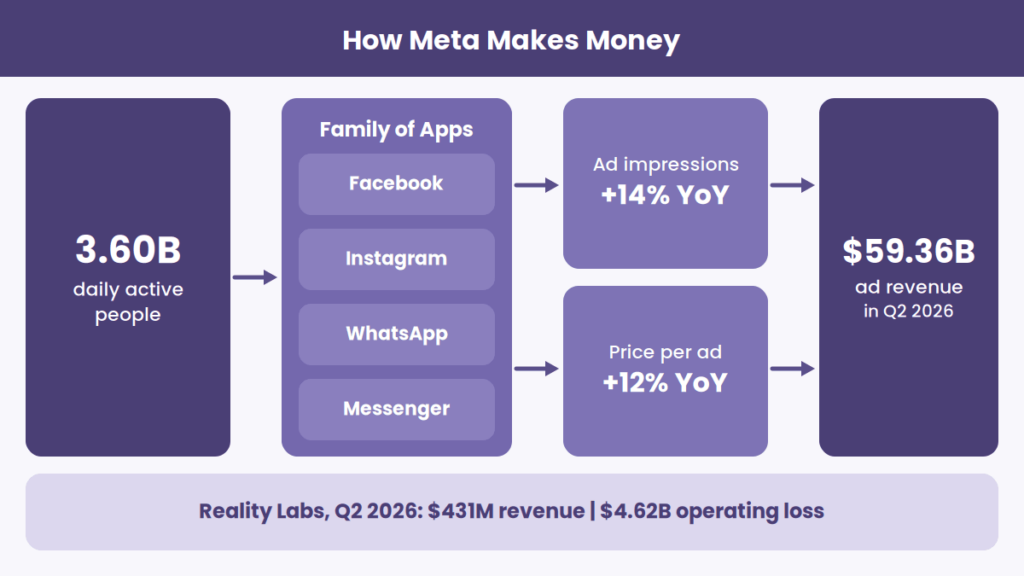
Advertising made up $59.36 billion of the $60.80 billion in total Q2 2026 revenue, or about 98%. That is calculated as $59.36 billion divided by $60.80 billion.
Ad revenue depends on two things:
Both rising together is the best case for an ad business. It means people are spending time on the apps and advertisers are paying more for that attention.

The user base underpins all of this. Family daily active people, which counts unique people using at least one of the apps each day, averaged 3.60 billion in June 2026, up 3% from a year earlier. User growth has slowed as the base has become enormous, so most revenue growth now comes from showing more ads and charging more for them, rather than from new users.
| Metric | FY2024 | FY2025 | Change |
| Revenue | $164.50 billion | $200.97 billion | +22% |
| Operating income | $69.38 billion | $83.28 billion | +20% |
| Operating margin | 42% | 41% | Down 1 point |
| Capital expenditure | Not applicable | $72.22 billion | Not applicable |
| Free cash flow | $52.10 billion | $43.59 billion | Down 16% |
| Share buybacks | Not applicable | $26.26 billion | Not applicable |
| Dividends paid | Not applicable | $5.32 billion | Not applicable |
Source: Q4 and full-year 2025 results. Free cash flow change calculated as ($43.59 billion minus $52.10 billion) divided by $52.10 billion.
Net income for 2025 came in at $60.46 billion, slightly below 2024. That dip came from a one-off tax charge linked to new US tax legislation. The company says its effective tax rate would have been 13% without it, compared with the reported 30%.
Meta reported second-quarter results on 29 July 2026.
| Metric (Q2 2026) | Value | Year-on-year change |
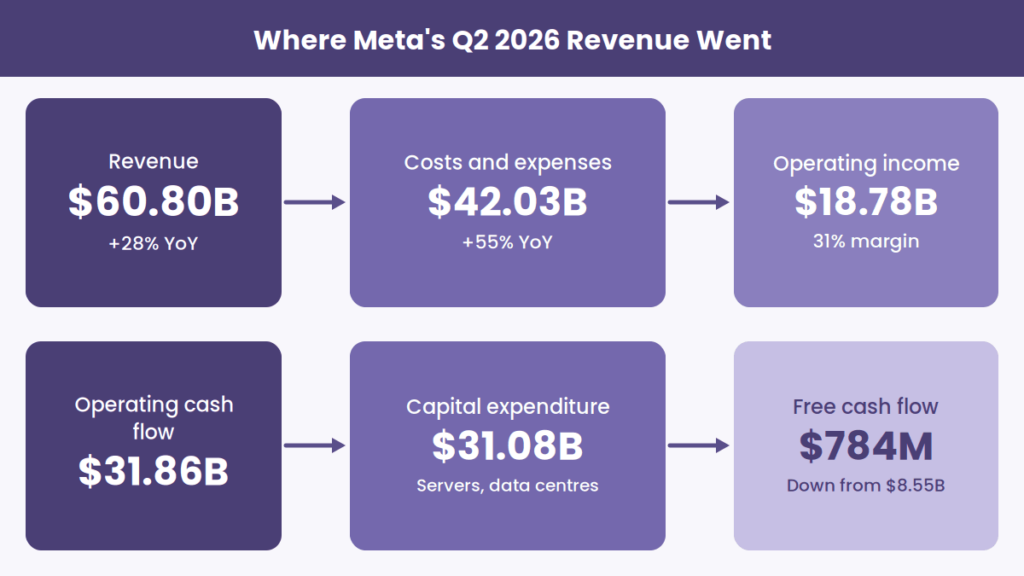
| Revenue | $60.80 billion | +28% |
| Total costs and expenses | $42.03 billion | +55% |
| Operating income | $18.78 billion | -8% |
| Operating margin | 31% | Down from 43% |
| Net income | $15.85 billion | -14% |
| Diluted EPS | $6.18 | Down from $7.14 |
| Capital expenditure | $31.08 billion | Not applicable |
| Free cash flow | $784 million | Down from $8.55 billion |
Revenue grew faster than it has in years. Profits fell anyway, for three reasons. Costs included $2.40 billion of legal charges and $1.18 billion of severance linked to a headcount cut of about 8,000 roles in May 2026. Research and development spending jumped to $21.66 billion, or about 36% of revenue. And depreciation on new data centres is starting to flow through. Excluding the legal and severance charges, management says operating income would have grown 9%.
The company ended June 2026 with $90.26 billion in cash and marketable securities and $83.66 billion in long-term debt. Debt has risen from $58.74 billion at the end of 2025, and the company raised $24.91 billion in new long-term debt in Q2 alone. It also paused buybacks in Q2 2026, compared with $10.17 billion spent in the same quarter a year earlier.
This is the single most important thing to understand about the stock in 2026.
Management expects 2026 capital expenditure of $130 billion to $145 billion, most of it on servers, data centres and network capacity for AI. That compares with $72.22 billion in 2025, so spending could roughly double.
Here is why that matters for investors:
The market reaction to Q2 showed the tension. Revenue beat estimates, but shares dropped about 9.6% after hours as investors focused on costs.
Management’s counterpoint is that AI is already lifting the core business. Revenue growth of 28% and ad price growth of 12% are, in its view, early evidence. The company also still expects 2026 operating income to come in above the 2025 level.
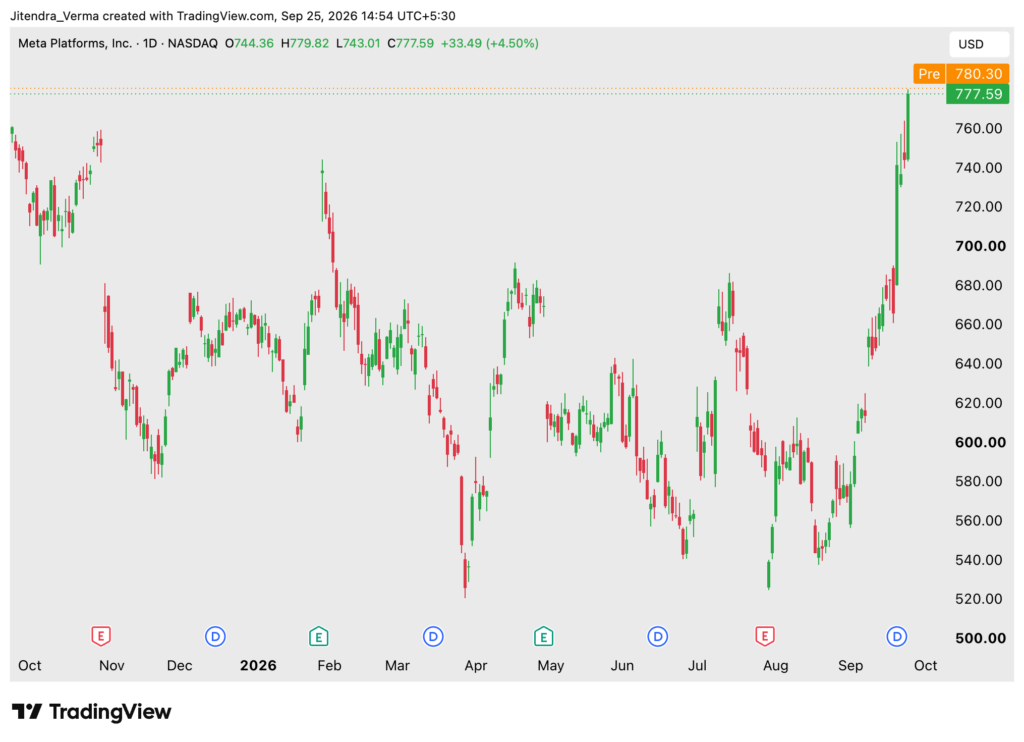
The last 12 months have been a swing in both directions. Shares hit their 52-week low of $520.26 on 27 March 2026, then recovered through the spring before falling again after Q2 results.
The mood changed in September. The company launched Muse on 8 September, then showed off new hardware at its Connect conference on 23 September, including the Muse Charm pocket device, audio-only Ray-Ban Meta glasses and a VR glasses product due in spring 2027. By 24 September, the stock traded around $775, touching a fresh 52-week high of $779.82.
A few facts matter for new investors:
Meta shares are listed only in the US, on the Nasdaq, so Indian investors reach them through one of three routes.
| Route | What you hold | Start from | Tax on gains |
| Tokenized spot | METAB token | ₹100 | Flat 30% plus 1% TDS |
| LRS broker | The actual share | Depends on broker | 12.5% after 24 months, slab rate before |
| GIFT City | Depository receipt | A fraction of a share | Generally foreign equity rules |
Our guide to buying Meta stock in India walks through the steps. If round-the-clock access matters to you, read how to trade Meta stock 24/7 in India.
And our comparison of tokenized spot, LRS and GIFT City helps you pick the route that fits you best.
Everything you need is free and published by the company:
For this stock, read the CFO outlook section of each release first. The capex and expense ranges there often move the share price more than the headline revenue.
It is one of the easier large companies to understand: free apps, paid ads, billions of users. It is profitable, pays a dividend and has a strong balance sheet.
The open question is the AI bill. If you buy, you are betting that the company earns a good return on over $100 billion a year of spending. A sensible approach is to size the position modestly, invest in instalments and decide your holding period in advance, since tax treatment differs by route.
The company trades on the Nasdaq as META. On Mudrex, the tokenized version is listed as METAB.
Mostly through ads. Advertising made up about 98% of revenue in Q2 2026, with the rest coming from other services and Reality Labs hardware.
Yes. It pays $0.525 per share each quarter. Holders of actual shares receive it in cash, while bStocks tokens reinvest it into the token balance.
Costs rose 55%, driven by AI infrastructure, higher R&D, $2.40 billion in legal charges and $1.18 billion in severance.
The division that makes VR headsets, AI glasses and related software. It lost $19.19 billion in 2025.
Yes. You can buy actual shares under LRS, receipts through GIFT City, or tokenized exposure in rupees on platforms such as Mudrex.
No. METAB tracks the share price and is backed 1:1 by a real share in custody, but you hold a token, not the share. There are no voting rights, and dividends are reinvested into the token rather than paid in cash.
For shares bought through LRS, gains on holdings over 24 months are taxed at 12.5%, and shorter holdings at your slab rate. Tokenized stocks are taxed as virtual digital assets at a flat 30%, with 1% TDS on transfers.
This article is for information only and is not investment, tax or legal advice. Figures are as of September 2026.