

There are three practical ways for an Indian resident to invest in Meta, and each gives you something different. Tokenized spot gives you a token, backed one-for-one by a real share, that you buy and hold in rupees. An LRS broker gives you the share itself. GIFT City gives you a depository receipt held through an Indian custodian.
This guide covers ownership, cost, dividends and tax so you can pick the route that fits. For detailed background on Meta’s business health, start with our complete guide to Meta (META) stock.
| Tokenized spot (Mudrex) | LRS broker | GIFT City | |
| What you hold | METAB token, backed 1:1 | The actual share | US share held via an IFSC broker |
| Legal ownership of the share | No | Yes | Yes, held through an IFSC broker |
| Minimum to start | ₹100 | Depends on broker | A fraction of a share |
| Pay in | INR | USD | USD |
| Funded through | INR deposit | LRS remittance | LRS remittance |
| Trading hours | Around the clock | US market hours | US market hours |
| Dividends | Reinvested into the token | Paid in cash, after US withholding | Passed on as a corporate action |
| TCS above ₹10 lakh a year | Not applicable | 20% on the excess | 20% on the excess |
| Tax on gains | Flat 30% plus 1% TDS | 12.5% after 24 months, slab rate before | Treated as foreign equity (confirm with a CA) |
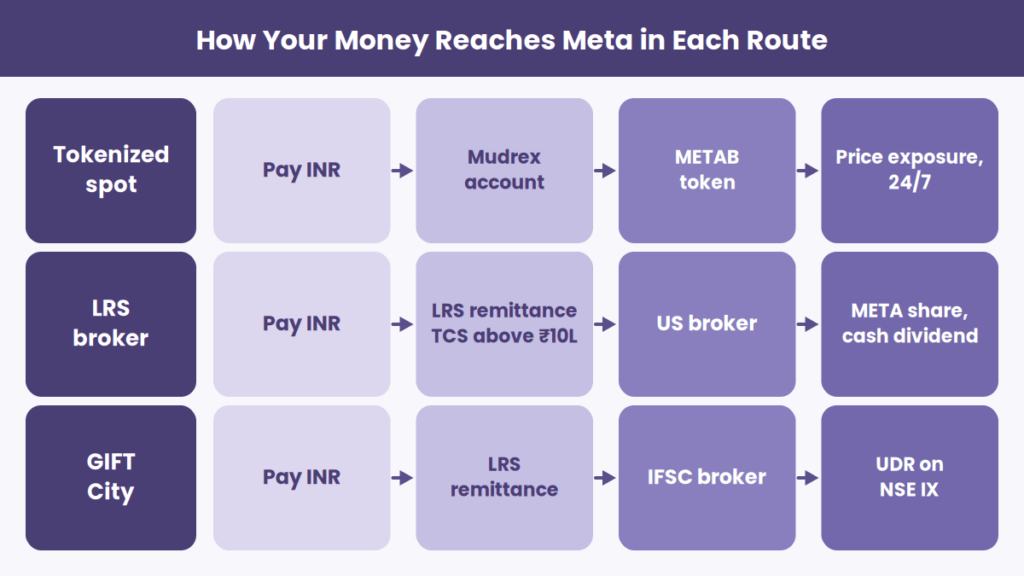
You deposit rupees, buy METAB and hold it in your Mudrex account.
Where it wins
Where it falls short
You open an account with an international broker or an India-partnered app, remit dollars through your bank under the RBI’s Liberalised Remittance Scheme, and buy the share on the Nasdaq.
Where it wins
Where it falls short
TCS example: If you remit ₹15 lakh in one financial year, TCS applies to ₹5 lakh (₹15 lakh minus ₹10 lakh). At 20%, that is ₹1 lakh collected upfront.
GIFT City is treated as offshore under FEMA, so every GIFT City investment is funded through the RBI’s Liberalised Remittance Scheme and regulated by IFSCA rather than SEBI. As of September 2026, there are two ways to buy Meta here.
You open an IFSC trading and demat account with a GIFT City broker, remit dollars under LRS and buy NSE IFSC Receipts. These are unsponsored depository receipts, and each one represents a fraction of a US share. Meta Platforms was among the first US companies offered when these receipts launched.
HDFC Bank’s IFSC Banking Unit acts as custodian, and Deutsche Bank in New York holds the underlying shares. Trading runs during US market hours, and there is no STT or stamp duty. Eligible holders receive corporate action benefits, including dividends.
The list covers about 50 large US stocks, and NSE IX plans to expand it to more than 100 stocks and ETFs. You hold a receipt, not the share itself.
This is the newer option. NSE IX went live with US market access on its Global Access platform in February 2026, through a dedicated subsidiary. It lets resident Indians invest directly in US-listed stocks and ETFs, so Nasdaq names like Meta fall within its scope.
IFSCA-authorised Global Access Providers offer a similar route.
What applies to both options
Meta pays $0.525 per share every quarter. Here is how that plays out on 10 shares’ worth of exposure.
| Route | What happens | Per quarter |
| LRS broker | $5.25 gross, minus 25% US withholding under the India-US tax treaty | $3.94 in cash |
| GIFT City | Dividend passed on through the custodian, after withholding | Depends on custodian terms |
| Tokenized spot | Net dividend reinvested into the token | Reflected in the token balance |
LRS calculation: 10 × $0.525 = $5.25. 2
5% of $5.25 = $1.31.
$5.25 minus $1.31 = $3.94.
On the LRS route, the dividend is also taxed as income in India, and you can claim credit for the US tax withheld when you file. At a yield of about 0.28%, dividends are unlikely to decide your route. They matter more if you plan a large, long-term holding.
Holding period decides which route costs less. Take a ₹1 lakh gain in each scenario, before surcharge:
| Scenario | LRS broker | Tokenized spot |
| Held more than 24 months | 12.5% of ₹1 lakh = ₹12,500, plus 4% cess = ₹13,000 | 30% of ₹1 lakh = ₹30,000, plus 4% cess = ₹31,200 |
| Held less than 24 months, 30% slab | 30% of ₹1 lakh = ₹30,000, plus 4% cess = ₹31,200 | ₹31,200 |
For short holds by someone in the top slab, the tax cost is similar. For long holds, actual shares come out well ahead. Tokenized gains also can’t be offset by losses elsewhere, which matters if you trade often.
On a small, frequent investment, the forex and wire costs on the LRS and GIFT City routes add up fast. On a large one-time investment, they matter less than the tax difference.
Scenario 1: small, regular buys. You want to put ₹3,000 into Meta each month and sometimes trade around earnings. Over a year that is ₹36,000 (₹3,000 × 12). Twelve LRS remittances would each carry forex and wire charges, so tokenized spot is the simpler fit.
Scenario 2: one large, long-term buy. You plan to invest ₹8 lakh once and hold for five years. If you have no other LRS remittances that year, you stay under the ₹10 lakh TCS threshold. After 24 months, gains qualify for 12.5% tax, and you collect dividends in cash. An LRS broker makes more sense here.
Scenario 3: USD exposure inside India’s regulatory system. You want to hold US stocks in dollars but through an IFSCA-regulated exchange and an Indian custodian. GIFT City fits, as long as the stocks you want are on the receipt list. Meta is.
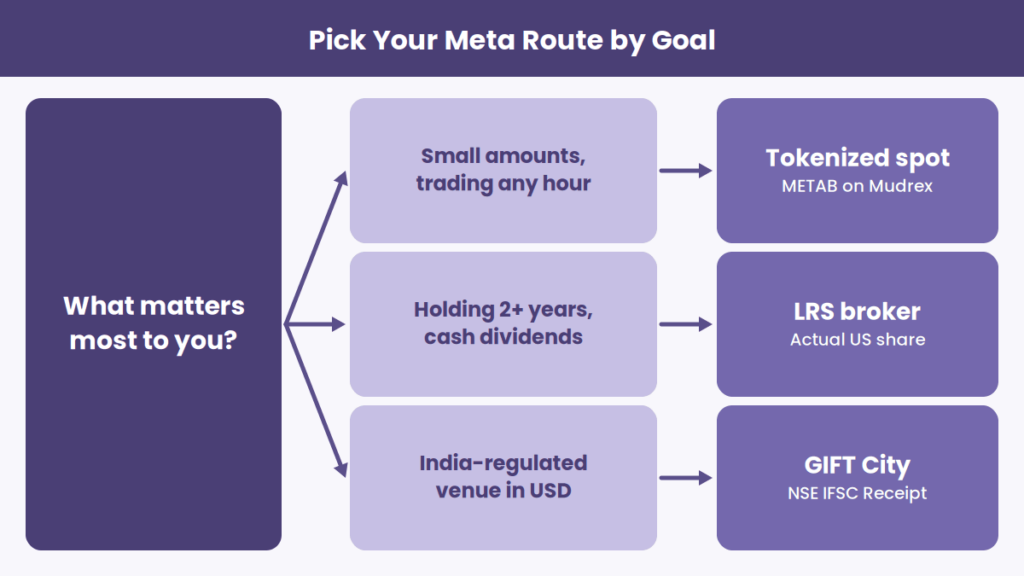
Plenty of investors use more than one: actual shares for a long-term core holding, and METAB for smaller, tactical positions around earnings or product launches.
READ MORE: For the exact steps on each route, see our guide to buying Meta stock in India.
For small amounts and short holds, tokenized spot usually costs less because there are no forex or wire charges. For large sums held beyond 24 months, actual shares through LRS win on tax.
The LRS route pays it in dollars after US withholding. GIFT City passes it through the custodian. Tokenized spot reinvests it into the token.
No. You pay in rupees on an Indian platform, so no foreign remittance takes place.
Yes. Meta Platforms was among the first US stocks offered as NSE IFSC Receipts.
Switching usually means selling on one route and buying on the other, with tax due on any gain.
Only tokenized spot. The LRS and GIFT City routes follow US market hours.
This article is for information only and is not investment, tax or legal advice. Figures are as of September 2026.