Money Flow Index (MFI) in Crypto: The Beginner-Friendly, Volume-Aware Oscillator
If the RSI Indicator is the “speedometer” of price, the Money Flow Index (MFI) adds fuel data—volume. That single addition helps you judge whether a move has “real push” behind it.
In this blog, we’ll decode the MFI formula, ideal settings, signals, and step-by-step strategies for crypto. You’ll also see common traps, a quick calculation, and ready-to-use workflows for Bitcoin and altcoins.
MFI blends price and volume to validate momentum and reversals.
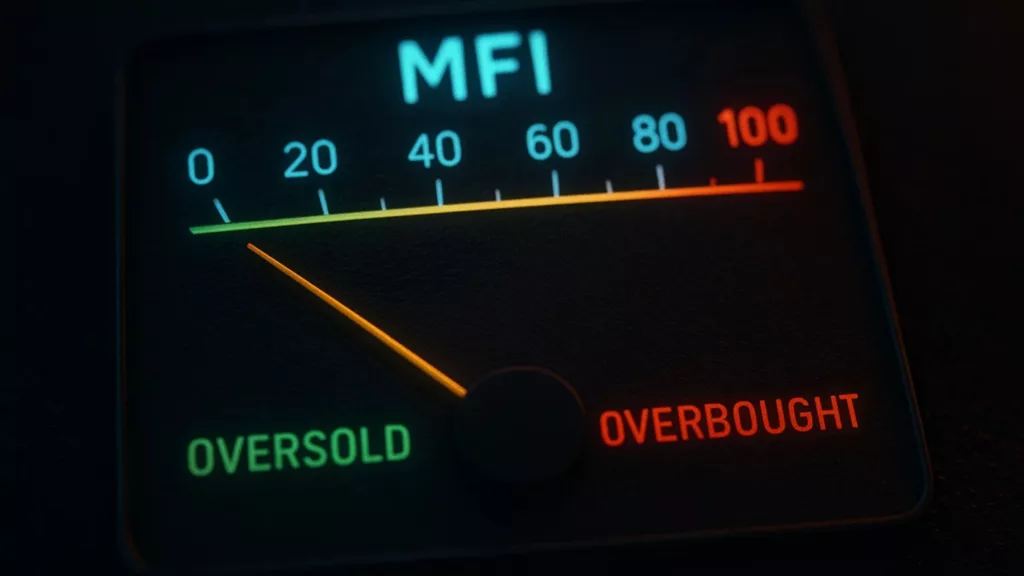
Think of MFI as RSI with volume. It oscillates between 0 and 100. Values above 80 flag overbought conditions; below 20 flag oversold. Traders also use divergences between price and MFI as early warnings. These basics are widely accepted in technical analysis, including mainstream references.
RSI only uses price changes, while Money Flow Index adds volume—useful in crypto where liquidity rotates fast. Volume-weighted signals sometimes lead price-only momentum oscillators. Multiple explainers highlight this practical difference. Use both for stronger confirmation: RSI for speed, MFI for conviction.
Start with 14-period MFI, overbought at 80, oversold at 20. These defaults are commonly recommended. Some sources note that 90/10 are “truer extremes,” but crypto rarely stays there. For very noisy intraday charts, shorten the period slightly; for swing trades, keep it at 14 or lengthen a bit.
The 9 Powerful Ways to Use Money Flow Indexin Crypto
1. Overbought/Oversold “First Look”
MFI above 80 signals overbought conditions; below 20, oversold. These extremes suggest overstretched markets, as excessive buying/selling often precedes reversals due to exhausted participants. Don’t auto-trade these levels—strong trends can persist.
Instead, use Money Flow Index > 80 as a short alert, waiting for bearish price action (e.g., lower high). For MFI < 20, seek bullish confirmation like a higher low. This approach leverages statistical reversal tendencies while filtering false signals with price action, ideal for crypto’s volatility.
These reflect shifts in money flow, hinting at reversals as volume fails to support price moves. Spot divergences on 4-hour/daily charts for reliability, confirming with support/resistance breaks or candlesticks.
For example, a bearish divergence at resistance with a pin bar signals a short. This high-probability setup, widely tracked, improves trade timing by highlighting momentum loss.
In sideways markets, Money Flow Index near 80 at range tops or 20 at bottoms signals potential reversals, as extreme money flow aligns with support/resistance.
This works because buying/selling peaks at range edges, increasing reversal odds. Fade moves when MFI hits 80/20 near range boundaries, but confirm with candlesticks (e.g., engulfing bar) to avoid whipsaws. For instance, short Solana at $150 resistance with MFI at 82 and a bearish candle, targeting the range bottom. This method capitalizes on cyclical range behavior, filtering low-conviction moves.
In uptrends, Money Flow Index holds above 40–50 on pullbacks; in downtrends, it fails below 50–60 on bounces, reflecting sustained money flow in the trend’s direction.
These “regime” levels show buyer/seller strength, guiding trend-aligned trades. Bias longs when MFI stays above 40 in uptrends, or shorts when it fails at 50–60 in downtrends. For example, in a Bitcoin uptrend, enter long if MFI dips to 45 but holds above 40 near support.
This keeps you aligned with the trend’s momentum, reducing counter-trend risks.
Before a breakout, a rising Money Flow Index signals strong participation, while a flat/declining MFI warns of weak follow-through.
Breakouts need volume-backed conviction; MFI’s volume weighting confirms this, reducing fakeout risks. Check MFI’s trend before entering: if it’s rising above 50, the breakout has “fuel” (e.g., Cardano breaking $0.50 with MFI at 60). If MFI stagnates at 45, avoid the trade.
This method filters low-conviction moves, aligning with trading principles emphasizing volume support.
When RSI rises but Money Flow Index lags, it signals a weak rally (thin volume); if RSI dips but MFI rises, a bear trap may form. MFI’s volume sensitivity catches participation shifts RSI misses, flagging low-conviction moves.
Avoid longs if RSI hits 70 but MFI drops to 50; consider longs if RSI falls to 30 but MFI rises to 40. For example, XRP’s RSI at 70 with declining MFI suggests a short. This improves selectivity in choppy crypto markets by highlighting momentum-participation mismatches.
After an MFI signal (e.g., divergence), use ATR to set stops beyond normal volatility.
Crypto’s fast moves can wick out tight stops; ATR accounts for average price swings, keeping you in high-probability trades. Calculate 1.5–2x ATR and place stops accordingly.
For instance, on an Ethereum bearish divergence with a $50 ATR, set a stop $75–$100 above entry. This buffers against noise while leveraging the Money Flow Index’s reversal signals, balancing risk in volatile markets.
A bullish MACD crossover above zero with rising Money Flow Index confirms strong trend continuation, as MACD tracks momentum and MFI ensures volume support. This synergy filters low-conviction moves, ideal for crypto’s trends.
Enter longs on a MACD crossover above zero when MFI rises above 50 (e.g., Chainlink’s MACD cross with MFI at 70). For bearish setups, use a MACD crossover below zero with falling MFI. This aligns momentum and participation for reliable trend trades.
When Bitcoin consolidates and Money Flow Index rises across mid-cap altcoins, it signals capital rotation into alts, a trader-favorite phase. Rising MFI reflects growing buying pressure, indicating “altcoin season” as funds shift from BTC.
Monitor BTC’s sideways action and MFI on alts like ADA or SOL. If MFI climbs above 50 across multiple alts, enter altcoin longs. This capitalizes on community-observed money flow cycles, timing high-return altcoin phases.
Plan: Enter on breakout of base. ATR-buffered stop below base low.
Manage: Scale partial at prior high; trail rest under higher lows. The point: Money Flow Index confirmed that buyers with volume were stepping in, not just thin bounces.
Where the Money Flow Index Shines—and Where It Struggles
Shines: During transitions (tops/bottoms), and breakouts with genuine participation.
Struggles:Strong trends where extremes persist; low-liquidity alts with noisy volume. Educational sources emphasize using confluence—MFI + structure + another indicator—for best results.
The Money Flow Index (MFI) gives you a simple, volume-aware read on whether a move has real participation. Start with 14-period, 80/20 levels, focus on divergences and regime behavior, and confirm with structure + MACD/RSI. Manage risk using ATR-buffered stops.
Want to put rules into action with less hassle? Mudrex lets you trade intelligently, invest systematically and track strategies seamlessly. Mudrex is the easiest way to learn, trade, and invest in crypto.
Give Mudrex a try. Download the app and start your crypto trading journey today.
FAQs
1. What is a “good” MFI value in crypto? There’s no “good” number in isolation. >80 often means overbought; <20 oversold. Mid-range readings (40–60) suggest neutral flow. Always combine with price structure.
2. Does MFI work better than RSI? They answer different questions. RSI reads price momentum; MFI adds volume. Many traders use both—if they agree, confidence increases.
3. What period should I use for MFI on crypto? Start with 14. Shorter (8–12) for faster intraday reads; longer (14–21) for swing smoothness. Keep 80/20 levels initially.
4. How do I calculate MFI quickly? Compute Typical Price, multiply by Volume for Raw Money Flow, tag as positive/negative, sum over the lookback, form the Money Ratio, then normalize to 0–100 MFI. Most platforms do this automatically.
5. Can I use MFI for altseason timing? Use it as a clue, not a standalone signal. Rising MFI across several alts while BTC is calm can hint at rotation, but confirm with dominance/season tools.
Krishnan is a Bangalore-based crypto writer dedicated to simplifying complex crypto concepts. He covers blockchain, DeFi, and NFTs, with a focus on real-world asset tokenization and digital trust. Previously he has written on Real Estate related assets for NoBroker. Krishnan holds a B.Tech degree from the College of Engineering Trivandrum.