Fair Value Gaps (FVGs) are essentially price gaps or “imbalances” on a chart – areas where one trading period’s closing price and the next period’s opening price have a significant gap with little to no trading in between. In fast-moving markets like Bitcoin, these gaps highlight zones where the market moved too quickly for liquidity to keep up, leaving behind a pocket of unfilled orders.
When trading Bitcoin (BTC), FVGs are important because they often act as liquidity zones – prices tend to revisit these gaps about 70–80% of the time as the market seeks to “fill” the inefficiency. This makes FVGs valuable for traders to identify potential support and resistance areas where big players might step in.
Today, with Bitcoin’s price fluctuating around all-time highs, FVGs matter more than ever. The current BTC market trend has seen rapid moves and pullbacks, creating notable gaps. In short, understanding FVGs can help work around Bitcoin’s volatile swings by pinpointing where hidden liquidity lies.
Understanding Fair Value Gaps
What is an FVG? In simple terms, it’s a gap on a candlestick chart where price jumped so quickly that a portion of the chart shows a “blank” between candles. Technically, an FVG occurs when there’s a noticeable difference between one period’s closing price and the next period’s opening price, with minimal or no trading in that range.
This often happens during high-impact news or sudden market surges/drops. The gap represents a market inefficiency, an area where buying and selling didn’t match up, leaving orders unfilled. Such gaps tend to magnetize price later as the market seeks equilibrium, either partially or fully “filling” the gap. In essence, an FVG shows that the market, in its haste, left behind a trail of liquidity that can become a future target for price action.
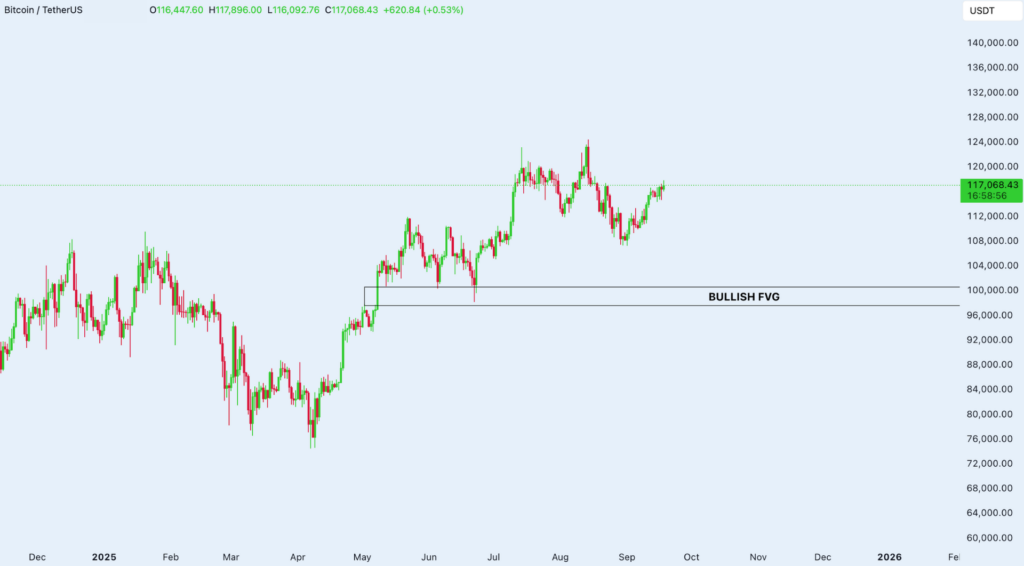
Bullish vs. Bearish FVG: An FVG can signal either potential support (bullish) or resistance (bearish) depending on its context. A bullish FVG occurs when price jumps upward, leaving a gap below the current price. In a classic three-candle pattern, you might see a large up candle (green) where its lowest wick stays above the highest wick of the candle two periods before – creating an empty space in between. This gap suggests an aggressive buy-side move; the market may later dip back into this gap, which often acts as a support zone for another rally.
Top Bitcoin FVG Levels to Watch in 2025: Step-by-Step Trading Guide
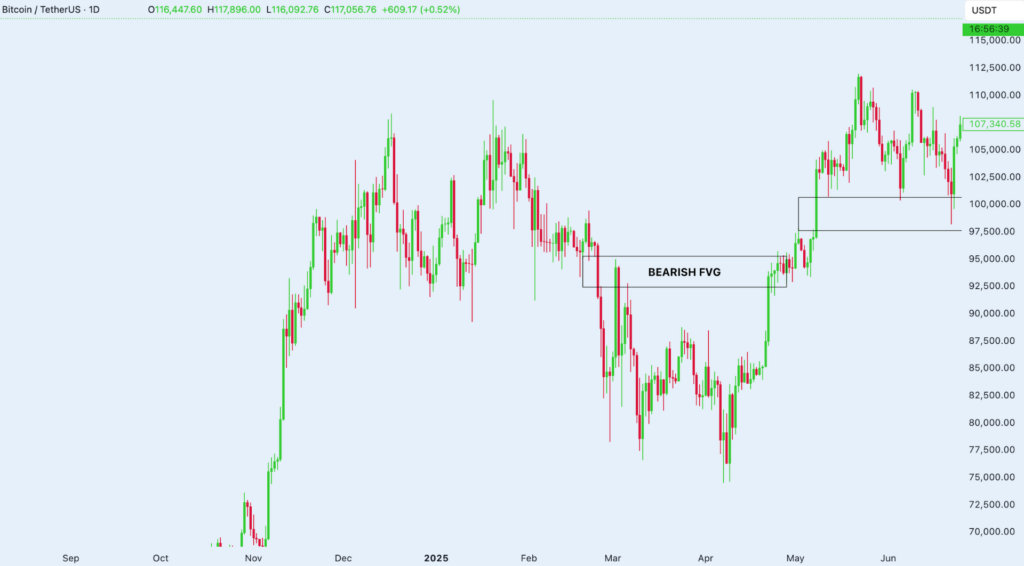
Conversely, a bearish FVG forms when price plunges downward, leaving a gap above the current price. Here, a big down candle (red) has a highest wick that remains below the lowest wick from two candles prior, so no overlap occurs. The resulting gap within that drop is an area of potential resistance, price may rebound up into this gap but then face selling pressure as the gap fills.
Top Bitcoin FVG Levels to Watch in 2025: Step-by-Step Trading Guide
Why do FVGs exist? They’re rooted in market psychology and liquidity. When Bitcoin’s price moves with extreme momentum, as it often can, not all pending orders get filled – creating a temporary void. Think of an FVG as an imbalance where buying far outweighed selling (or vice versa) for a short period. Traders who missed the move leave orders in the gap zone, and countertrend players (like profit-takers or big institutions) also see these unfilled areas as attractive levels to transact.
This is why gaps commonly get filled: they act like a magnet for price – drawing the market back to that level before the prior trend continues. In practical terms, a bullish gap signifies latent buy orders waiting below (support), while a bearish gap signals sell orders lurking above (resistance). By identifying FVGs, BTC traders gain insight into where liquidity pools lie, which often coincide with pivot points in the market.
How to Identify FVGs on BTC Charts
Identifying a Fair Value Gap on a Bitcoin chart is a step-by-step process. The easiest way is to look for the distinct three-candle pattern described above. Here’s a simple method to spot an FVG:
Step 1: Find a strong momentum candle. Look for an unusually large candlestick (green for up, red for down). This is the middle candle of the pattern. For example, suppose you see a big green daily candle where Bitcoin rocketed upwards.
Step 2: Check the neighbors’ wicks. Examine the candle immediately to the left (prior candle) and to the right (following candle). In a bullish FVG scenario, the high of the left candle should be well below the low of the right candle, leaving a visible gap in between. (For a bearish FVG, the left candle’s low would be above the right candle’s high, indicating a gap above)
Step 3: Mark the gap zone. Highlight the price range between the prior candle’s high and the following candle’s low – this zone is the FVG (the “inefficient” area). Often, charting tools or indicators can automatically mark these, but you can draw a rectangle on the chart for clarity.
Once identified, these gap zones are your key levels to watch. Let’s highlight some top FVG levels on Bitcoin as of mid-September 2025 (on the daily timeframe):
Daily timeframe FVGs: Bitcoin’s recent volatility has left a couple of notable bullish gaps below the current price. One FVG zone is around $107,000–$108,000, which formed during a previous surge and has since acted as support.
A second layer of gap support sits slightly lower, roughly around $106,200–$107,100. Traders are watching these two stacked FVG areas as buffers where buyers may step in if the price dips.
Trading Strategies Using FVGs
Spotting a Fair Value Gap is one thing; trading it effectively is another. Here are four streamlined strategies:
Entry on Gap Retrace: Wait for BTC to retrace into the gap, then trade in the original trend’s direction. In bullish gaps, buy the dip as the gap often acts as support. In bearish gaps, short the rally into the gap. Many traders place limit orders at the gap midpoint or edge. Example: If BTC jumps from $50K to $55K, leaving a $50K–$52K gap, an entry near $52K is a common strategy.
Confirmation Signals: More cautious traders look for confirmation before entering. This might be a bullish candle (hammer, engulfing) inside a bullish gap or a bearish reversal candle inside a bearish gap. Volume spikes or RSI divergences can also strengthen the case. This means entering slightly later but with more confidence.
Stop-Loss Placement: Always define risk. A simple rule is to place the stop just beyond the gap boundary. For a long on a bullish gap, the stop goes just under the gap; for a short, just above. In the earlier $50K–$52K example, a stop at $49.5K keeps risk controlled.
Take-Profit Targets: Aim for logical levels such as recent highs or lows outside the gap. Partial profit-taking is wise if the bounce is strong, while trailing stops can protect gains. Example: Buy at $52K, take first profit at $55K, second at $58K, moving the stop to breakeven after the first target.
These tactics make FVGs actionable while keeping risk in check. Remember: not all gaps fill cleanly, so patience and discipline are key.
Risk Management for FVG Trades
Fair Value Gaps offer high-probability entries, but Bitcoin’s volatility demands strict risk control:
Sensible Leverage: Keep leverage low. A 3x trade gives more breathing room than 10x or 20x, reducing the chance of liquidation if price overshoots the gap.
Margin Buffer: Never max out your account on one trade. Holding extra margin helps absorb deeper-than-expected retraces without immediate liquidation.
Strategic Stops: Always set stop-losses just beyond the gap. Risking only 1–2% of your account per trade ensures no single setup can wipe you out. Letting the exchange liquidate you is far more costly than exiting early.
Monitor Volatility: High volatility can slice through gaps. Adjust position size, widen stops, or stick to higher timeframe gaps during turbulent weeks. Also note that volatility often spikes around London/New York opens and daily closes.
In short: use moderate leverage, maintain a buffer, set hard stops, and size positions so losses are tolerable. Protecting capital comes first; profits follow from discipline.
Advanced Tips for FVG Trading
Pair FVG with Market Structure: Trade gaps with the trend. Bullish FVGs have higher odds in uptrends; bearish FVGs work better in downtrends. Favor gaps that confluence with key levels (prior swing highs/lows, moving averages, Fib zones, trendlines). More confluence = higher quality.
Multi-Timeframe Alignment: Start top-down. Weekly > Daily > 4H. A daily bullish FVG inside weekly supportbeats a lone 1H gap every time. Use higher timeframes for bias, lower ones to time the entry (e.g., lower-TF reversal inside a higher-TF gap).
Volume & Order-Flow Clues: Look for rising volume as price taps a gap (participation) and volume profile nodes near the zone. Thin volume inside a gap = higher chance of slice-through. Heatmaps/limit order walls at the gap add confidence.
Position Sizing: Size by risk to invalidation (entry → beyond gap). Keep per-trade risk ~1–2% of equity. If stop is 5% away, size so 5% move equals your dollar risk. Consider scaling in (top and mid of gap) and scaling out at targets.
Blend with SMC Tools: Stronger setups when FVGs overlap order blocks, follow liquidity sweeps, or appear after a market-structure break. Use a checklist: trend alignment, confluence, volume/flow, clear invalidation, defined targets. More boxes ticked = better odds.
Conclusion
Fair Value Gaps (FVGs) are imbalance zones where price moved too fast, often revisited later as liquidity is filled. To trade them effectively, mark the gap, wait for a retrace, and enter with the prevailing trend, setting stops just beyond the gap and targeting logical structure levels such as prior highs or lows.
FVGs serve as valuable tools to map support, resistance, and potential reaction zones. Risk management is critical, keep leverage modest, maintain a margin buffer, cap risk at 1–2% per trade, and always use stops. The best results come when FVGs align with broader market structure, multi-timeframe bias, and volume or order-flow confirmation. By following a structured process, planning the trade, sizing the risk, executing with discipline, and reviewing outcomes, FVGs can evolve from a simple chart pattern into a repeatable trading edge.
Anush is a crypto researcher dedicated to making blockchain insights clear and accessible. A proud Solana maxi who still appreciates a good Layer 2 debate, he dives deep into market trends so others don’t have to (but really should). Passionate about simplifying crypto, he strives to make the space less intimidating and a lot more relatable, one report at a time.