Bitcoin Gold Correlation Coefficient 2026: The Great Decoupling Explained
For the better part of a decade, investors treated Bitcoin and gold as twin siblings in the same family of “hard money” assets. Both were scarce, both were non-sovereign, and both were pitched as hedges against a weakening dollar and reckless central bank policy. In 2026, that assumption has been brutally broken, and the bitcoin gold correlation coefficient 2026 readings prove it.
The Bitcoin-to-gold correlation coefficient has swung to one of its most negative readings in years, and the numbers are telling a story that every investor needs to understand. Whether you hold BTC, XAUT, or both, the dynamics of 2026 are forcing a complete rethink of the “digital gold” thesis.
Bitcoin Gold Correlation Coefficient 2026: Full Breakdown
The correlation coefficient measures how two assets move relative to each other on a scale from +1 to -1:
+1 means perfect positive correlation (they move together).
0 means no relationship at all.
-1 means perfect inverse correlation (when one rises, the other falls).
For Bitcoin and gold, this number is typically calculated on a rolling 30-day or 1-year window using daily price returns. It is one of the cleanest ways to see whether investors are treating the two assets as substitutes or as genuinely independent holdings.
The Bitcoin Gold Correlation Coefficient 2026 Numbers: A Historic Divergence
The data from early to mid-2026 is striking. According to market analytics platform CryptoQuant, the Bitcoin-to-gold correlation recently hit a low of -0.88, marking its lowest level since the heat of the 2022 bear market. This came after the metric peaked at just 0.289 in October 2025, showing how quickly the relationship can flip.
Longer-term data confirms the shift. The 1-year rolling correlation has dropped to -0.17, implying that holding both assets offers genuine diversification rather than doubled exposure to the same thesis.
Here is how the correlation coefficient has moved through recent quarters:
Period
Correlation
Market Context
April 2025
-0.61
BTC at $80K, gold climbing
September 2025
-0.49
BTC rallying to new highs
October 2025
+0.29
BTC peaks at $126K
December 2025
-0.55
Gold weakens briefly
February 2026
-0.22
Early geopolitical stress
March 2026
-0.88
4-year low
Why Has the Bitcoin Gold Correlation Coefficient 2026 Collapsed?
Three forces have driven the 2026 decoupling, and understanding them matters more than the number itself.
1. Gold Became the Pure Geopolitical Hedge
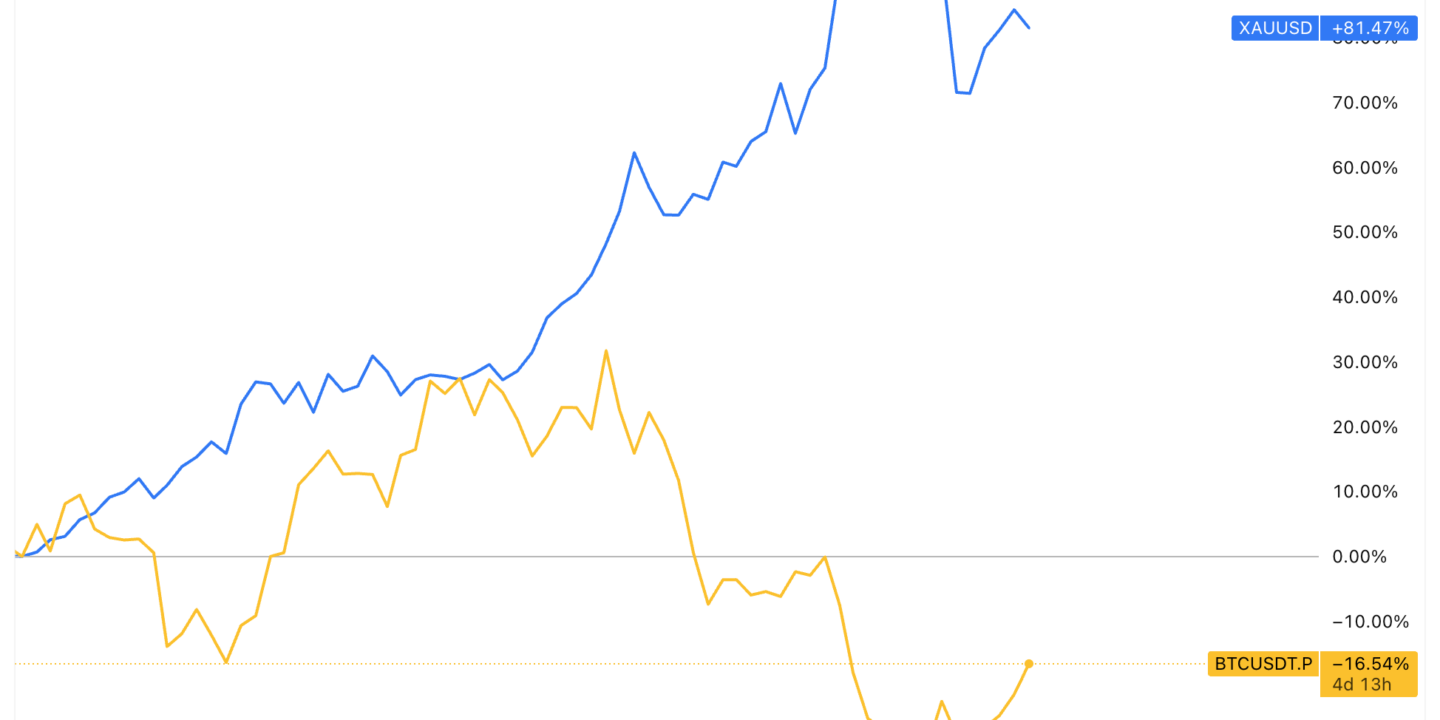
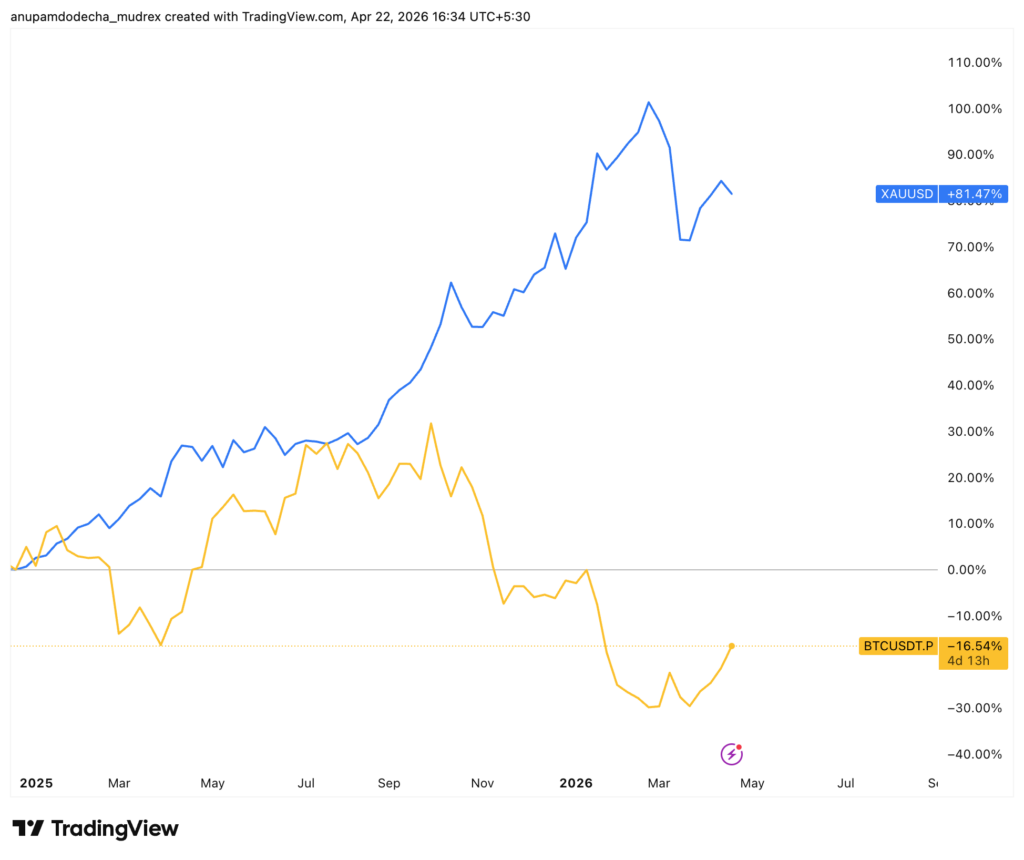
Gold has been the straightforward winner of every major shock in 2026. Gold hit a record high of $5,589 per ounce on January 28, 2026, and remains up around 80% since the start of 2025, while Bitcoin has shed roughly 20% this year after peaking at $126,000 in October 2025.
The U.S.–Iran conflict that began on February 28, central bank accumulation, and sticky inflation all played directly into gold’s historic role as crisis insurance. Bitcoin, meanwhile, struggled to catch that same bid.
2. Bitcoin Became a Liquidity and Tech Proxy
While gold behaved like a bunker, Bitcoin started behaving like a high-beta tech stock. Analysis from VanEck and JPMorgan confirms that Bitcoin now thrives when liquidity is expanding, rather than just when fear is rising.
The clearest evidence came mid-February, when BTC’s correlation with the Nasdaq swung from -0.68 to +0.72 in just two weeks. Bitcoin is now far more reactive to M2 money supply, Fed policy, and risk sentiment in equities than it is to geopolitical fear.
3. Investor Psychology Has Split
Institutional allocators have started putting Bitcoin and gold in separate buckets. Central banks buy gold. Tech-oriented funds and treasury companies buy Bitcoin. They are no longer competing for the same dollar, which mechanically reduces correlation.
What the -0.88 Reading Actually Means for Investors
A bitcoin gold correlation coefficient 2026 reading near -0.88 is unusual and historically short-lived. When the coefficient falls this deep, it has preceded meaningful rebounds.
According to market data, the last three times the correlation dropped below -0.48, it snapped back sharply. For example, when the coefficient dropped to -0.486 in September 2025, it recovered again as BTC spiked from $112,000 to its all-time high of $126,000 by October 2025.
There are two plausible paths out of extreme negative correlation:
Bitcoin outperforms gold. If BTC staged a rally from current levels, the correlation would mean-revert upward as both assets rise together again.
Gold pulls back. If profit-taking hits the gold trade after an 80% run, the correlation could normalize through gold declines rather than BTC gains.
The biggest practical takeaway from the bitcoin gold correlation coefficient 2026 trend is that Bitcoin and gold are no longer redundant holdings. Strategists are increasingly moving to what is called the barbell approach:
Gold (10–15%) — genuine crisis insurance, low volatility, protects against war, currency collapse, and systemic failure.
Bitcoin (5–10%) — high-upside bet on liquidity expansion, technology adoption, and regulated ETF flows.
Core portfolio (remainder) — equities, bonds, and cash for the rest.
The diversification math works precisely because the correlation is negative. When one zigs, the other zags, which reduces overall portfolio volatility without sacrificing expected return.
It is also worth remembering the volatility gap. Bitcoin’s annual volatility runs roughly 45–60% while gold’s falls around 12–18%. Equal dollar allocations are not equal risk allocations — size positions accordingly.
Is the “Digital Gold” Thesis Dead?
Not dead, but evolving. The original thesis — that Bitcoin would behave like gold, only better — was always an oversimplification. What the bitcoin gold correlation coefficient 2026 data has shown is that Bitcoin is its own asset class, with its own drivers, its own cycles, and its own liquidity profile.
For long-term holders, this is arguably good news. An asset that moves independently of gold, equities, and bonds is exactly what portfolio theory prizes. The “digital gold” label may have been too narrow all along.
Final Thoughts on the Bitcoin Gold Correlation Coefficient 2026
The bitcoin gold correlation coefficient 2026 tells a nuanced story. A reading near -0.88 is not a verdict against Bitcoin or a coronation of gold. It is a signal that the market has finally matured enough to price these two assets on their own merits.
For investors, the practical question is not “Bitcoin or gold?” but rather “How much of each, and why?” Track the bitcoin gold correlation coefficient 2026 chart the same way you watch moving averages — as a real-time gauge of how the market is thinking about fear, liquidity, and the future of money.
FAQs
What is the Bitcoin gold correlation coefficient in 2026?
As of early 2026, the Bitcoin-gold correlation dropped to -0.88, its lowest level since 2022. The 1-year rolling correlation sits near -0.17, meaning the two assets are moving in opposite directions.
Are Bitcoin and gold still correlated?
No, not in 2026. Bitcoin and gold have decoupled significantly. Gold is acting as a pure safe-haven asset, while Bitcoin is trading more like a tech stock tied to liquidity and risk sentiment.
Why did Bitcoin and gold decouple in 2026?
Three reasons: geopolitical tensions drove investors into gold, Bitcoin became a liquidity proxy tied to Nasdaq, and institutions started treating them as separate asset classes.
Is Bitcoin still “digital gold”?
Not in the traditional sense. In 2026, Bitcoin behaves more like a high-beta tech asset than a safe haven. It still has scarcity value, but it no longer moves like gold during crises.
What does a negative correlation between Bitcoin and gold mean for investors?
A negative correlation means the two assets move in opposite directions, making them excellent portfolio diversifiers. Holding both reduces overall risk without cutting expected returns.
How much Bitcoin and gold should I hold in my portfolio?
Many strategists recommend a barbell approach: 10-15% gold for safety and 5-10% Bitcoin for upside. Adjust based on your risk tolerance and investment horizon
Anupam has over 3 years of experience in the crypto industry, having worked with top indian crypto exchanges. He writes about Bitcoin, altcoins, AI, and emerging tech, helping readers understand what’s driving markets and where the digital asset ecosystem is headed.