What Are the Best Professional Crypto Futures Trading Indicators?
Leverage amplifies both opportunity and risk in crypto futures. Professional Crypto Traders do not guess. They use a small toolkit of proven indicators and clear rules to time entries, exits, and risk.
In this guide, you will learn exactly how professionals apply nine core indicators, how to combine them for confluence, and how to avoid the classic traps that liquidate accounts.
How to use These Indicators like a Professional Crypto Trader
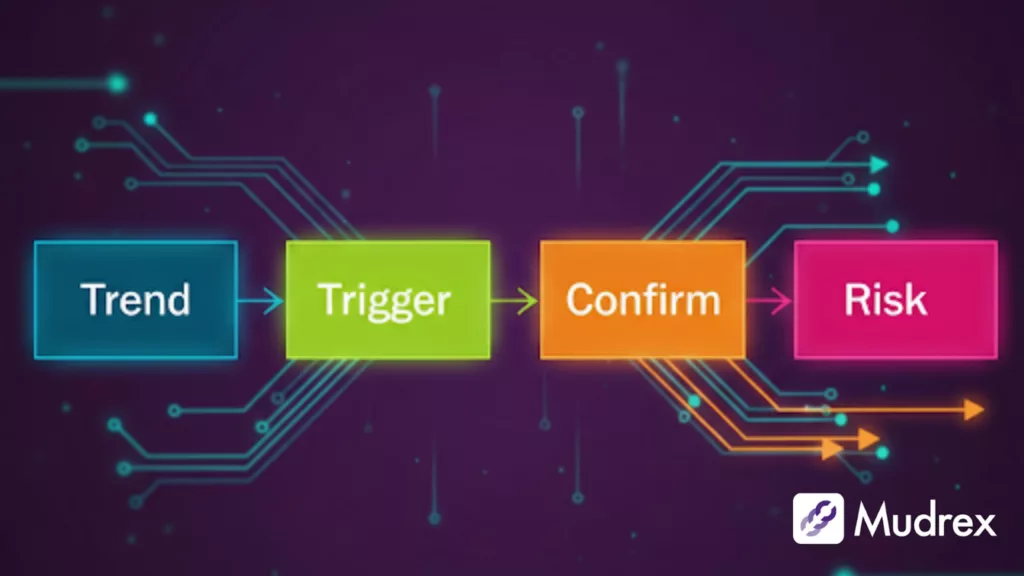
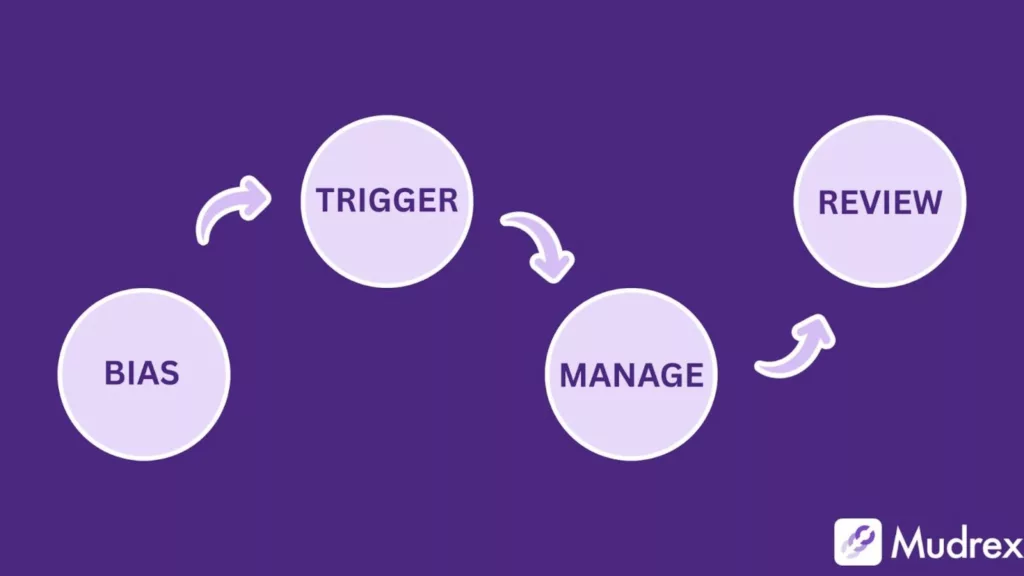
A clear four-step routine turns noise into repeatable actions.
Pick one higher timeframe to find the main trend. Many traders use the 4H or Daily. Then use a lower timeframe like 1H or 15m to enter.
Follow a simple rule. Use one tool to show the trend, one tool to trigger entry, and volume to confirm. Place your stop where your idea fails, not where liquidation sits.
What it is: A middle moving average with two bands above and below. The bands get tight when the price is calm. They spread out when the price runs.
How pros use it:
Squeeze to move: Wait for a tight squeeze. A close outside a band plus a rise in volume can start a trend.
Mean reversion: In ranges, a touch of the outer band can fade back to the middle line.
Tips: In strong trends, price can “walk the band.” Do not fight it too early. For breakouts, place stops beyond the opposite band or below a clear swing.
2. Fibonacci Retracement: Buy The Pullback In Trend
What it is: Fibonacci retracement helps traders spot potential support and resistance zones during a trend. When the price pulls back to levels like 38.2%, 50%, 61.8%, or 78.6%, many traders look for buying opportunities in an uptrend or selling setups in a downtrend.
How pros use it:
In an uptrend, many look for buys between 50 and 61.8, with a stop just below the level that breaks the structure.
Add strength by lining up a fib level with a moving average or a prior high or low.
Targets: You can scale out at old highs, or use extensions like 1.272 and 1.618 as guideposts.
ASTER tapped into the 23.6%–38.2% Fibonacci retracement zone, attracted fresh buyers, and launched into a breakout—printing new all-time highs and confirming a bullish sequence.
3. Moving Averages: Define Trend And Dynamic Support
What it is: Moving averages help traders identify the overall direction of the market by filtering out short-term price fluctuations. They can also act as dynamic support in an uptrend or resistance in a downtrend. EMAs respond quickly to recent price changes, making them useful for short-term trades, while SMAs provide a broader, slower view of the trend.
How pros use it:
Trend filter: Price above the 200 line suggests bullish bias. Below, it suggests a bearish bias.
Pullback entries: In an uptrend, pullbacks to the 20 or 50 can give simple entries with a stop just under the line.
Watch out: Moving average crossovers can give false signals in sideways or choppy markets, leading to whipsaws. That’s why traders often confirm the trend on a higher timeframe before acting on a crossover. This reduces the chances of getting trapped in short-lived moves.
4. Relative Strength Index (RSI): Read Momentum And Range Shifts
What it is: RSI measures the strength of price momentum and helps spot overbought or oversold conditions. In strong uptrends, RSI may hold above 40-50, while in downtrends it often stays below 50-60. Watching these shifts gives traders early clues about potential reversals or continuation of the trend.
How pros use it:
Range shifts: In an uptrend, RSI often stays above 40 to 50. In a downtrend, it often stays below 60.
Divergence: If price makes a new high but RSI makes a lower high, momentum may be slowing near resistance.
Note: Do not short only because RSI is high in a strong uptrend. Use RSI as context, not as the only trigger.
What it is: MACD combines trend and momentum into one indicator, making it useful for spotting shifts in market strength. When the MACD line crosses above the signal line near the zero line, it can signal the start of bullish momentum, while a cross below may suggest bearish pressure. The histogram helps visualize these changes, showing when momentum is building or fading.
How pros use it:
Use MACD to confirm a breakout from a Bollinger squeeze. A flip above zero with a rising histogram supports a long in a bullish market.
In downtrends, a drop below zero can back a short idea, if trend and volume agree.
Tip: Pair MACD with a 200 EMA trend filter and price structure. Let volume confirm the trigger candle.
6. Stochastic Oscillator: Time Turns Inside Ranges
What it is: The stochastic oscillator highlights overbought and oversold conditions, especially effective in range-bound markets. When %K crosses above %D near the 20 level, it can hint at a potential bounce, while a cross near 80 may suggest a pullback. Traders often use it to fine-tune entries and exits within sideways price action.
7. Hourly Moving Averages: The 1H As Your Workhorse
Why 1H: The 1-hour moving average gives traders a reliable balance between short-term signals and broader trend clarity. It’s fast enough to catch intraday moves but smooth enough to filter out excessive noise. Many swing and day traders use it as their go-to timeframe for spotting setups and managing trades.
A simple 1H plan:
Find the 4H trend first.
If the 1H 20 is above the 50 and both sit above the 200, look for pullbacks to the 20 with strong candles.
Place a stop just beyond the 50 or below the recent swing low.
Heads up: News spikes can cut through lines. Do not take trades right into events.
8. Ichimoku Cloud: Read Trend, Support, And Momentum In One Glance
What it is: The Ichimoku Cloud offers a full picture of the market by showing trend direction, potential support or resistance, and momentum shifts all at once. A price above the cloud often signals strength, while a price below points to weakness. Crosses of the Tenkan and Kijun lines add further confirmation, making it a versatile tool for both trend and range traders.
What it is: Volume reveals the strength behind price movements by showing how many participants are actively trading. A strong trend accompanied by high volume is more likely to continue, while moves on low volume may fizzle out. Traders use it as a “truth check” to confirm breakouts, reversals, or trend sustainability.
How pros use it:
Breakouts: If price breaks a range but volume stays low, the move can fail. A breakout with rising volume is stronger.
Volume profile: Areas with heavy past volume can act like magnets. Thin areas can see quick moves.
Note: Weekend activity can be slow. Thin pairs can show odd spikes. Choose pairs with steady volume.
Start with the bias on the Daily or 4H. Move down to the 1H or 15m to time entries. Use alerts so you are not glued to the screen.
Plan your exits before you enter. Take partial profits at old highs or at a simple fib extension. Move your stop only when structure changes, not because you feel fear.
A fixed routine cuts panic and helps you avoid random trades.
Leverage makes small mistakes big. Risk a small, fixed percent of your account per trade. Many traders keep it under 1 percent.
Set your stop where the idea fails. For example, below the 1H 50 in a 1H pullback plan. Use reduce-only orders to scale out. Keep a daily loss limit. If you hit it, stop for the day.
BTC breakout from a squeeze: A 4H Bollinger squeeze forms in an uptrend. Price closes outside the upper band on the 1H with a clear volume spike. MACD flips above zero. Entry comes on a small pullback. Stop goes below the mid-band. Profits are taken at the prior high and a small extension. Clean and simple.
ETH pullback to the golden pocket: Daily trend is up. On 1H, ETH pulls back into the 50 to 61.8 zone, right near the 20 EMA. RSI holds above 40. Stochastic crosses up. Entry is on a strong green candle. Stop sits below the 65 percent level. Profits taken at the last swing high and at 1.272.
Too many tools: Three tools with clear roles beat a busy chart.
No written idea: Always state what you expect price and volume to do.
Countertrend fades: Do not fight a strong trend with a single oscillator.
Chasing green candles: Wait for a pullback or a retest.
Moving stops too soon: Let structure guide you, not emotions.
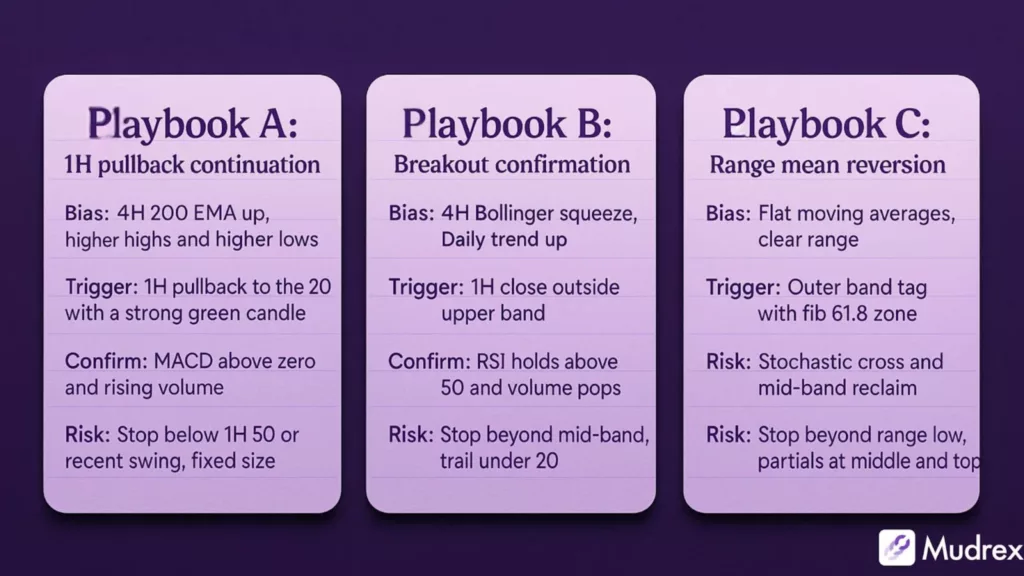
Starter Playbooks You Can Test
Playbook A: 1H pullback continuation
Bias: 4H 200 EMA up, higher highs and higher lows
Trigger: 1H pullback to the 20 with a strong green candle
Confirm: MACD above zero and rising volume
Risk: Stop below 1H 50 or recent swing, fixed size
Playbook B: Breakout confirmation
Bias: 4H Bollinger squeeze, Daily trend up
Trigger: 1H close outside the upper band
Confirm: RSI holds above 50 and volume pops
Risk: Stop beyond mid-band, trail under 20
Playbook C: Range mean reversion
Bias: Flat moving averages, clear range
Trigger: Outer band tag with fib 61.8 zone
Confirm: Stochastic cross and mid-band reclaim
Risk: Stop beyond range low, partials at middle and top
Small, written playbooks make your practice focused and calm.
Conclusion
Professional tools are simple. You pick a trend guide, a clear trigger, and a volume check. You place a stop where the idea fails. Over time, this routine helps you avoid noise and follow strong moves. Use the nine indicators in this guide to build two or three clear playbooks. Then practice, journal, and improve.
What is the best indicator for crypto futures trading?
There is no single best indicator. A strong mix is one trend tool like the 200 EMA, one trigger like a Bollinger breakout or a 1H pullback, and volume to confirm. This mix is simple, testable, and easy to repeat.
What indicators to use for futures trading?
A small, useful set is Bollinger Bands, Fibonacci levels, 20-50-200 moving averages, RSI, MACD, stochastic, Ichimoku Cloud, and volume. Pick two roles and keep one as a backup. Add volume each time.
Which indicator is 100 percent accurate?
None. Markets change. Indicators read price and crowd behavior. Good risk rules and steady practice matter more than any single tool.
What is the most successful futures trading strategy?
A common and robust plan is trend following. Find a 4H uptrend. Enter on a 1H pullback to the 20 EMA. Confirm with MACD above zero and rising volume. Use a fixed stop and take partial profits at old highs.
What is the strongest indicator in trading?
Volume is the best truth check. When many traders join a move, the push often continues. Breakouts with clear volume expansion are stronger than quiet breaks.
Krishnan is a Bangalore-based crypto writer dedicated to simplifying complex crypto concepts. He covers blockchain, DeFi, and NFTs, with a focus on real-world asset tokenization and digital trust. Previously he has written on Real Estate related assets for NoBroker. Krishnan holds a B.Tech degree from the College of Engineering Trivandrum.