Quantinuum (NASDAQ: QNT) is one of the market’s purest bets on quantum computing, and one of its most speculative. As of September 28, 2026, the stock trades near $49, about 18% below its $60 IPO price and 43% off its post-IPO high. Analysts are young and bullish, with an average target around $97, implying big upside, but that number is built on a roadmap, not today’s tiny $30 million revenue. This Quantinuum stock price prediction breaks down the numbers, the bull case, the bear case, and the risks.
Note: This article is about Quantinuum Inc., the Nasdaq-listed quantum-computing company (ticker QNTB on Mudrex). It is not about Quant Network, the crypto token that shares the same three letters ticker.
If you are eyeing Quantinuum stock, you probably have one question: is a sub-IPO price a bargain entry into quantum computing, or a warning sign? This Quantinuum stock price prediction walks you through it so you can decide for yourself.
Where Quantinuum Stock Stands Right Now
Before any Quantinuum stock price prediction can seem meaningful, let’s look at where things stand today.
Quantinuum (QNT) closed at $49.11 on September 28, 2026, down 0.85% on the day. The company is worth about $13 billion. It’s a very new stock, having only gone public in June 2026, and it currently trades below its $60 IPO price after a volatile few months.
Metric
Value
Price (Sep 28, 2026)
$49.11
Market cap
~$13 billion
IPO price (Jun 2026)
$60
Post-IPO range
$46.54 – $86.79
FY2026 revenue guide
$28–$32 million
Cash
~$2.1 billion
Next earnings
~Nov 17, 2026
quick snapshot
The big talking point for any Quantinuum stock forecast is the mismatch between the price tag and the sales. A $13 billion company on roughly $30 million of revenue is priced at hundreds of times sales. You’re not paying for today’s business, you’re paying for a roadmap and a $2.1 billion cash pile.
What Quantinuum Actually Is
Quantinuum is a full-stack quantum computing company. It builds the hardware (its H-series trapped-ion systems), the software (compilers, chemistry, and cybersecurity tools), and sells cloud access to it all. It was formed in 2021 by merging Honeywell Quantum Solutions with Cambridge Quantum, and Honeywell still holds nearly half the voting power.
The pitch is quality. Quantinuum’s trapped-ion approach aims for higher accuracy and a clearer path to error correction than some rival technologies, with commercial systems already in the field rather than just on slides. Its customers so far are mostly national labs and research institutes, plus a few enterprises (Oracle showed up in recent bookings). The whole story is about “leaving the lab” and becoming a real commercial business.
Importantly, this is not a mature tech stock. It’s a pre-profit science bet, better compared to other quantum names like IonQ, Rigetti, and D-Wave than to established software giants.
Quantinuum’s Financials: The Numbers Behind the Forecast
Every Quantinuum stock forecast has to start with a reality check on the financials. This is still a lab-plus-early-commercial business.
Metric
Value
FY2025 revenue
~$30.9 million
FY2025 net loss
~$193 million
Q2 2026 revenue
~$8 million (+279% YoY)
FY2026 revenue guide
$28–$32 million
2026 bookings target
≥$120 million
Cash
~$2.1 billion
Key Metrics
The growth rate looks huge (Q2 revenue up 279%), but that’s off a tiny base. The more important numbers are the losses and the cash. Quantinuum lost around $193 million in 2025, so the $2.1 billion it raised is essentially runway to fund years of research.
There’s also a concentration risk worth knowing: in 2025, a single customer (Japan’s RIKEN) made up roughly 60% of revenue. The bull story depends on broadening that customer base, and the 2026 bookings target of $120 million or more is the first real test of whether that’s happening.
In short, you’re buying a roadmap and a war chest, not a profitable business. That’s normal for a quantum stock, but it means the risks are real.
Quantinuum Stock Price Prediction 2026
So where could QNT finish the year? Here’s a simple Quantinuum stock price prediction 2026, broken into three scenarios.
Scenario
Target Range
What It Assumes
Bull case
$55–$71
Strong bookings, sector risk-on
Base case
$46–$55
Choppy, range-bound below IPO
Bear case
$35–$46
Lockup selling, weak earnings
2026 Price Targets
Base case ($46–$55)
The stock stays choppy and range-bound below its $60 IPO price as the market waits for the November earnings and navigates the December lockup. Reasons: Quantinuum trades below its issue price, with the only proven floor at $46.54 (its post-IPO low). The float is thin, so moves are exaggerated in both directions. Until there’s a clear catalyst, drifting between the mid-$40s and the mid-$50s fits the current setup.
Bull case ($55–$71)
This is a move back toward the IPO price and beyond. Reclaiming $60, then pushing toward the $68 to $71 day-one range, would need real good news. Reasons: If November earnings show bookings tracking toward the $120 million target, a second large enterprise customer emerges, or the broader quantum sector runs hot (IonQ often leads the group), sentiment could turn quickly. A young, bullish analyst crowd with an average target near $97 gives the upside room to run if the story delivers.
Bear case ($35–$46)
A break below the $46.54 floor if things go wrong. Reasons: The early-December lockup expiry is the key risk. Honeywell owns a huge stake and has been described as wanting to sell over time, so a wave of new supply could hit a thin float. Add a weak earnings print, persistent customer concentration, or a stumble at another quantum name dragging the whole group down, and QNT could fall into a “vacuum” below $46 where there’s little trading history to provide support.
For 2026, this is a high-risk, news-driven stock. The November earnings and December lockup are the two dates that matter most.
QNT Stock Prediction 2027
Look one year out and the Quantinuum stock price prediction 2027 comes down to a single question: is the commercial business actually scaling?
Analysts targets cluster around $90 to $100, which would put the stock well above its IPO price. But those targets rest on the belief that Quantinuum converts its roadmap and bookings into real, growing revenue. A $50 to $100 range captures the realistic spread for 2027, wide because the outcome is genuinely binary.
The bullish anchor is bookings and milestones. If the 2026 bookings target is met and 2027 revenue climbs meaningfully beyond $30 million while big customers diversify, the market may keep paying up for the leader in trapped-ion quantum. The risk is that revenue stays small while the cash burns, in which case the valuation looks very hard to justify.
Quantinuum Stock Price Prediction 2030
Long-term forecasts here are less about next quarter and more about whether quantum computing becomes commercially useful at scale, and whether Quantinuum is a winner if it does.
The most bullish view sees QNT reaching $100 to $200+ over the coming years if quantum advantage arrives and Quantinuum leads it. From today’s price near $49, the high end would be more than 300% upside. But this is a genuine moonshot, not a base case.
The logic is straightforward. Quantinuum has a differentiated technology, deep Honeywell industrial backing, a huge cash cushion, and federal support (including a $100 million CHIPS R&D award). If it turns those advantages into a real, profitable quantum business, the stock could multiply. Price would follow.
The honest caveat is time. By the company’s own language, useful quantum advantage at commercial scale is still a late-decade story. Until then, Quantinuum trades on narrative, cash, and a thin float, which means years of volatility and no guarantee the science arrives on schedule. That’s the tension in every long-term Quantinuum stock forecast: enormous potential, deeply uncertain timing.
Here’s how the scenarios stack up across timeframes:
Quantinuum Stock Price Prediction
The upside looks dramatic further out, but notice the near-term low sits below today’s price. That’s the reality of a brand-new, pre-profit quantum stock: huge potential paired with real near-term downside.
Quantinuum (QNT) Technical Analysis: Reading the Chart
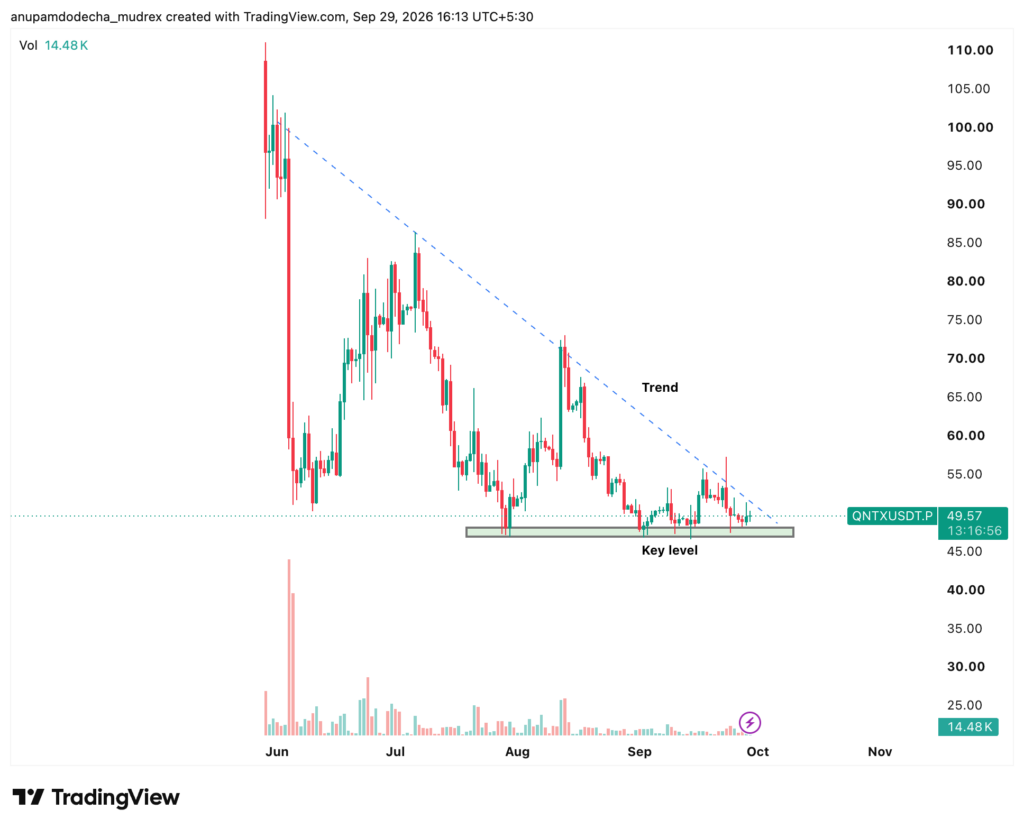
QNT is a four-month-old listing, so there’s no meaningful long-term chart yet, just a sharp IPO spike and a fade. It ran to $86.79 in early July, then sold off to $46.54 by September, and now sits in the high $40s.
With so little history, only a couple of levels really matter. The $46.54 post-IPO low is the one proven floor. The $60 IPO price is the first big supply shelf above, where early buyers may look to exit at breakeven.
Zone
Price
Post-IPO high
$86.79
Resistance
$60 (IPO price), then $68–$71
Near resistance
$51.30
Support
$48.20–$46.54
Invalidation
Daily close under ~$46.50
Key levels:
The setup is simple: below the $60 issue price and well off the highs. Treat $46.50 as the line in the sand, a break below it, especially with the December lockup approaching, would be an ugly tape with little support beneath. On the upside, the stock needs to reclaim $60 to signal the IPO buyers are back in control. Liquidity is IPO-thin, so expect wide swings on modest volume.
Latest Analyst Price Targets for QNT
Analyst coverage is young and bullish, which is standard for a hot IPO. The consensus leans Strong Buy, with an average target around $97, nearly double the current price.
Firm
Price Target
Rating
UBS
$93
Buy
Cantor
$90
Overweight
BofA
—
Buy
Consensus (avg)
~$97
Strong Buy
Morgan Stanley
—
Equal Weight (cautious)
Analysts Price Targets
Read these with care. These targets aren’t based on today’s $30 million of sales; they reflect the view that Quantinuum is the cleanest, best-backed quantum IPO, with Honeywell behind it and $2.1 billion in the bank. In other words, they price the roadmap, not the current book, so discount them accordingly.
Bull Case vs Bear Case: The Honest View
Every good Quantinuum stock forecast weighs both sides. Here’s the fair version.
The Bull Case (Why QNT Could Climb)
Technology edge. Trapped-ion systems with a strong fidelity story.
Honeywell backing. Deep industrial heritage and nearly half the voting power.
Cash cushion. ~$2.1 billion in the bank funds years of research.
Real customers. National labs plus enterprises like Oracle in bookings.
Federal support. A $100 million CHIPS R&D award and sector tailwinds.
The Bear Case (Why QNT Could Fall)
Tiny revenue. ~$30 million of sales against a $13 billion valuation.
Customer concentration. One customer was ~60% of 2025 revenue.
Lockup risk. December expiry plus a Honeywell stake to monetize.
Cash burn. Losses near $193 million a year and rising as it scales.
Long timeline. Useful quantum advantage is a late-decade story.
Is Quantinuum Stock Overvalued or Undervalued?
This is the question behind every Quantinuum stock price prediction, so let’s tackle it head-on.
On any traditional measure, Quantinuum looks wildly overvalued. Hundreds of times sales, deep losses, and no profit in sight. If you value it like a normal company, it doesn’t make sense.
But that’s not how the market prices early quantum names. The bet is on optionality: a small chance of an enormous payoff if quantum computing takes off and Quantinuum leads it. So the honest answer is: overvalued on today’s fundamentals, potentially undervalued only if you believe the late-decade quantum vision plays out. It suits high-risk investors who can afford to lose the position and wait years for the story to prove itself.
How to Buy/Trade Quantinuum Stock in India
Mudrex has expanded Spot and Perps trading to include tokenized US Stocks.
Open the Mudrex app and complete your KYC
Fund your account in INR.
Search for Quantinuum (QNTB) on Mudrex Spot.
Place a buy order; you can start with amounts far smaller than a full QNT share, since tokenized spot/perps trading typically allows fractional exposure.
The Bottom Line
Here’s the simple version of this Quantinuum stock price prediction. Analysts are bullish, with an average target near $97, but that’s a bet on the roadmap, not today’s tiny business. Quantinuum has a differentiated technology, Honeywell’s backing, and a huge cash pile, which makes it arguably the cleanest quantum IPO on the market.
But the risks are just as real: revenue is minuscule against a $13 billion valuation, one customer dominated recent sales, and a December lockup could flood a thin float with new shares. The upside is a genuine moonshot; the downside is a long, cash-burning wait. If you believe in the long-term quantum story and can stomach big swings, a sub-IPO price may appeal. If not, this is one to watch rather than own. The next big checkpoints are the November earnings and the December lockup.
Disclaimer: This article is for educational purposes only and is not investment advice. Prices are volatile and can fall as well as rise. Do your own research and consult a qualified financial advisor before investing. Invest only what you can afford to lose.
FAQs
What is the Quantinuum stock price prediction for 2026?
Most analysts are bullish long-term, but for 2026 the stock is likely to stay volatile in a $46 to $60 range, below its IPO price, as it navigates November earnings and a December lockup. The bull case reaches the high $60s to low $70s; the bear case breaks below $46 if lockup selling hits.
What is the latest analyst price target for QNT?
Analyst coverage is young and bullish, with a consensus near Strong Buy and an average target around $97, roughly double the current price. Recent initiations include UBS at $93 and Cantor at $90, while Morgan Stanley is more cautious. These targets price the roadmap, not current revenue.
Is Quantinuum stock a good investment for Indian traders?
It depends entirely on your risk appetite. Quantinuum is a pre-profit quantum-computing bet with tiny revenue, big losses, and a huge valuation, offset by strong technology, Honeywell backing, and $2.1 billion in cash. It’s a high-risk, long-horizon holding. It’s not investment advice, so do your own research first.
What could make QNT stock rise?
Bookings hitting the $120 million target, a second major enterprise customer, quantum hardware milestones, federal awards converting to revenue, the December lockup passing without heavy Honeywell selling, and a risk-on mood across quantum stocks could all lift Quantinuum stock.
What are the biggest risks for Quantinuum stock?
The main risks are tiny revenue against a $13 billion valuation, heavy customer concentration, the December lockup and Honeywell’s stake, ongoing cash burn near $193 million a year, and the long, uncertain timeline before quantum computing becomes commercially useful at scale.
Can Quantinuum stock return to its IPO high?
It’s possible but not guaranteed. The stock trades near $49, below its $60 IPO price and far below its $86.79 high. Returning there would likely require strong bookings, new customers, and continued enthusiasm for quantum stocks. In the near term, analysts and the lockup make the path choppy.
Anupam has over 3 years of experience in the crypto industry, having worked with top indian crypto exchanges. He writes about Bitcoin, altcoins, AI, and emerging tech, helping readers understand what’s driving markets and where the digital asset ecosystem is headed.