It’s 11 pm on a Tuesday in a hostel room in Warangal, and a 21-year-old final-year engineering student, part of the Gen Z cohort now flooding into India’s markets, is watching a US stock, Nvidia, climb on his phone between assignment deadlines. He does the math: ₹2,000, maybe ₹3,000, is all he wants to put in. He opens a broker app. It asks for a PAN-linked LRS declaration, a Form A2, proof of address, and a note that the money will take a few days to actually land in a US account. He opens a second app. Same story, different logo. By the third tab, he’s not evaluating platforms anymore, he’s doing a cost-benefit calculation on his own patience. He closes all three tabs and buys a meme coin instead, because that transaction took him ninety seconds.
This is the actual friction that tokenized U.S. stocks are quietly dissolving, and the pitch behind them is usually framed as democratization of access, letting anyone with a smartphone own a sliver of the world’s biggest companies. It’s worth understanding why that friction existed in the first place before deciding whether the fix is as good as the pitch makes it sound.
The Old Route Was Never Built for Someone Like This
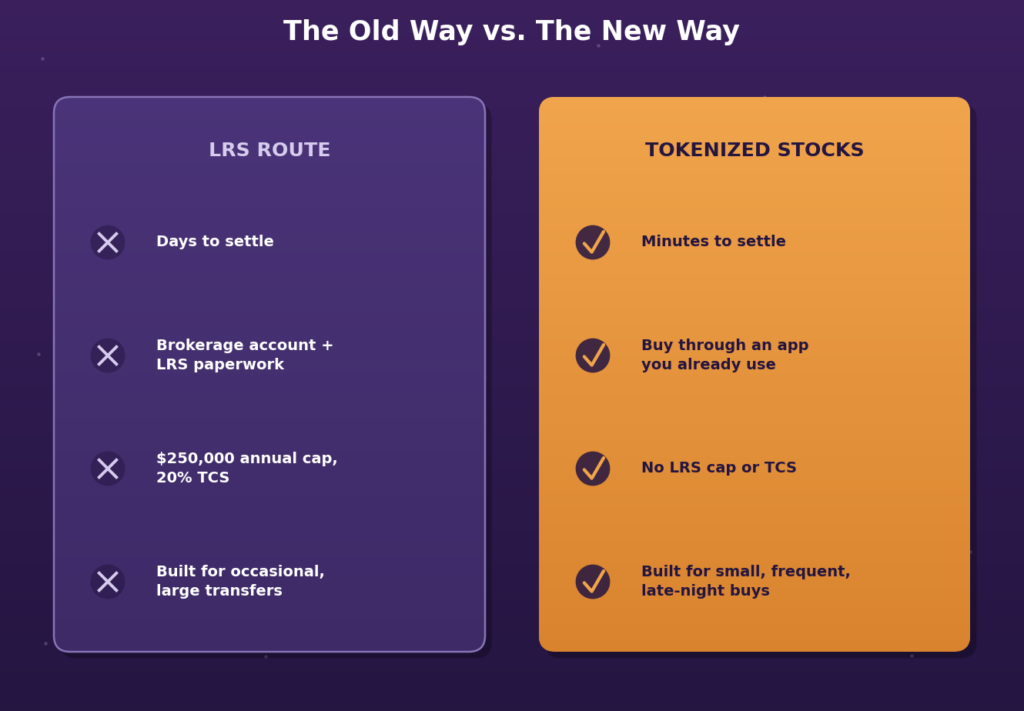
The traditional way to own a piece of the US market from India runs through the RBI’s Liberalised Remittance Scheme, LRS for short. It lets a resident Indian send up to $250,000 abroad each financial year for permitted investments, and above ₹10 lakh remitted, the government collects 20% tax at source, TCS, before your money even reaches a US broker. There’s a version through GIFT City too, fractional receipts called NSE-IX UDRs, IFSCA-regulated and slightly friendlier, but still capped at around fifty stocks and still drawing from the same LRS quota. Mudrex’s own walkthrough of every route to buy US stocks from India lays out just how many steps separate intent from ownership on the traditional side.
By design the traditional route appeases a completely different investor: someone moving meaningful capital abroad occasionally, with the patience for paperwork and the horizon for multi-day settlement. It was not designed for a 21-year-old who wants to put ₹2,000 into Nvidia on a whim and see it reflected in his account before he finishes his chai. The $250,000 annual cap is irrelevant to almost everyone under 25 reading this. The process wrapped around that cap is the actual wall.
What Tokenization Quietly Removes
A tokenized stock is, in the simplest honest terms, a crypto token meant to track the price of a real share, issued by a platform that claims to hold the underlying stock in custody on your behalf. You buy it the way you’d buy any other crypto asset, through an app, with money already sitting in your wallet, no remittance form in sight. Because it’s a fundamentally different kind of transaction, not a foreign exchange remittance, the $250,000 LRS ceiling and the 20% TCS simply don’t apply the way they do for the traditional route.
What that buys you, practically, is a few dollars’ worth of Nvidia at 2 am on a Sunday, settled in minutes, from an app that already knows your face and your bank account because you use it for something else too. It’s less a new investing behavior than a wrapper that finally matches a behavior this generation already had.
Tokenized US Stocks Could Rewire the Way Young Gen Z India Invests
Why Tokenized US Stocks Fit The Young Generation
The numbers back up the instinct. Nearly three in four Indian crypto investors today are under 35, according to a CoinSwitch study. Gen Z alone made up 72% of new crypto investors added in just the first half of this year, per WazirX data, and, tellingly, 44% of them entered financial markets through crypto rather than adding it onto an existing mutual fund or demat portfolio. Crypto wasn’t the alternative asset for this cohort. For a huge chunk of them, it was the front door.
Eighty percent of Gen Z crypto users in India live outside the country’s top ten cities. Close to eighty percent report annual incomes between ₹1 lakh and ₹5 lakh. This is not a story about wealthy metro kids diversifying an already-healthy portfolio. It’s a story about small-town, small-ticket investors for whom a $250,000 LRS quota was never the obstacle, the sheer inconvenience of the process around it was. And Indian crypto trading activity famously peaks between 10 and 11 pm, which tells you something too: this generation invests in the gaps of their day, not during market hours designed for someone else’s time zone.
Tokenized stocks slot into an identity as much as a financial habit. Owning a visible, tradeable sliver of Nvidia or Tesla, something you can screenshot, is as much a social signal in group chats as it is a position on a balance sheet. That’s not a criticism. Every generation invests partly for status. This one’s status symbols just happen to be on-chain.
The Skeptic’s Corner
Here’s where the story gets a little blurry-
First, custody. Every tokenized stock platform claims its tokens are backed 1:1 by real shares held somewhere in custody. That claim is only as good as the entity making it and the audits, if any, behind it. A handful of providers, Securitize among them, are moving toward natively issued, regulator-compliant tokens rather than synthetic price-trackers, which is a meaningfully different and more trustworthy structure. But the space right now is a mix of both, and most retail investors have no easy way to tell which kind they’re holding.
Second, India’s regulatory position on all of this is genuinely under-publicized. There is no dedicated SEBI or RBI framework for tokenized stocks. They currently sit in the same zone as virtual digital assets.
Third, and this one is important to remember: tokenized stocks are taxed as virtual digital assets in India, a flat 30% with no loss offset and 1% TDS on every trade. Traditional LRS-route stock ownership gets long-term capital gains at 12.5% after two years, or slab-rate short-term gains, both of which allow you to offset losses against gains. Faster access came bundled with a higher tax outcome.
So Is This Actually Democratization?
Depends which half of the story you are standing in. If the measure is access, the number of people who can now own a fraction of a global company without four days and a stack of paperwork, tokenization is a genuine, measurable win, and one that specifically favors people the old system quietly priced out. If the measure is outcomes, whether easier access produces wealthier, more patient investors rather than just more of them trading more often, the jury is very much still out, and the tax and custody questions above aren’t small print. They’re the actual terms of the deal.
India’s regulators have historically moved slowly and cautiously on anything crypto-adjacent, which means how mainstream this ultimately gets isn’t really up to the platforms building it. It’s up to a regulatory apparatus that hasn’t yet decided what it thinks a tokenized share even is. Mudrex’s own breakdown of tokenized versus traditional US stocks is a useful place to see the tradeoffs laid out side by side, tax treatment included, before anyone reading this goes and puts real money on either side of it.
And back in Mumbai, the 21-year-old will probably try again. But, maybe this time he doesn’t close the tab.
Disclaimer
This piece reflects the writer’s own reading of the tokenized stocks landscape and is not investment advice. Tax and regulatory treatment discussed here reflects the position as of 2026 and can change; if you are actually putting money into either route, it is worth checking current rules and, ideally, talking to someone qualified before you do.
Siri is a writer venturing into the exciting realms of blockchain technology, cryptocurrency, and decentralized finance (DeFi), eager to explore the transformative potential of these innovations. She brings a unique perspective that bridges traditional industries and cutting-edge technology, often infused with a touch of humor through memes. She has a rich background in real estate and interior design, having previously contributed to NoBroker, where she crafted blogs and assets on these topics.