XERA coin jumped from under a cent to over $30 in a matter of weeks, a move few tokens ever see. That kind of chart draws attention fast, but it also means you should understand exactly what you’re looking at before treating the price as a signal of anything.
This guide covers what XERA (Luxera) actually is, how its 31 million token supply is split, and what the project’s own materials do and don’t support.
Key Takeaways
XERA (Luxera) is a token on BNB Smart Chain positioned as a DAO-governed rewards and payments project.
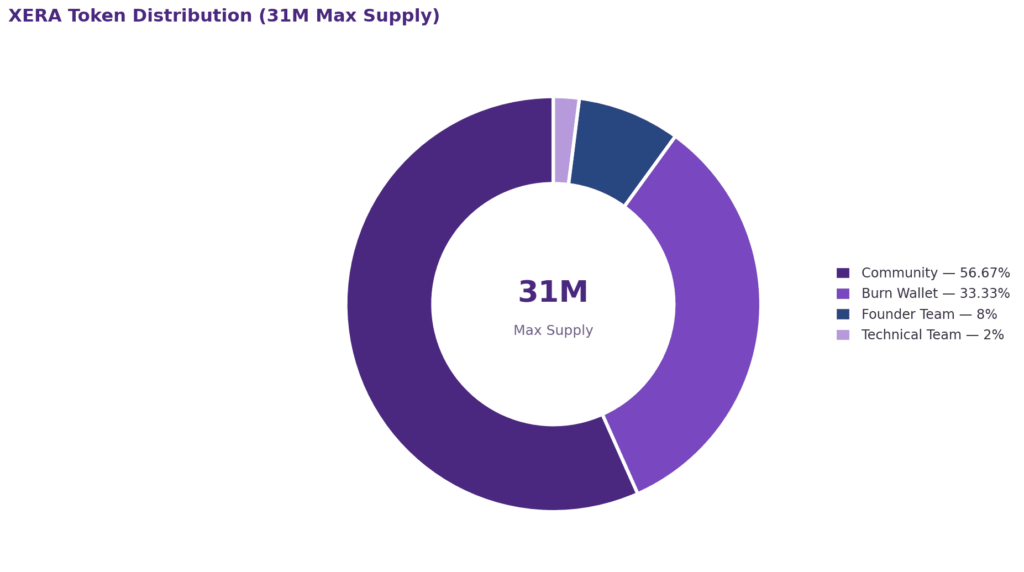
Total supply is capped at 31 million tokens, with 56.67% allocated to the community and 33.33% permanently burned.
XERA rose roughly 600,000% between late November 2025 and mid-January 2026, and has stayed close to that peak since.
What Is XERA (Luxera)?
XERA is the native token of Luxera, a project describing itself as a DAO built on BNB Smart Chain. As per the whitepaper, XERA is meant to work as a rewards and payments token, letting holders earn cashback-style rebates when spending through partner merchants and platforms, with governance handled by token holders.
That’s the stated pitch. In practice, the project is young, having launched in mid-2025, and much of what it describes, global merchant partnerships and mainstream payment integrations, is aspirational rather than already in place. We’ll walk through what’s verifiable and what isn’t as we go.
How Does XERA Coin Work?
XERA’s whitepaper describes a token that consumers earn and spend within a rewards network, with merchants onboarded to accept it and offer rebates to holders. The token also carries a burn mechanism: roughly a third of the entire max supply was allocated straight to a burn wallet, permanently removing it from circulation from the start.
Definition: Burn Wallet A wallet address where tokens are sent to that no one holds the private keys for, permanently removing those tokens from circulating supply.
Beyond the burn allocation, the whitepaper’s description of “how it works” leans heavily on future plans, integrations with payment platforms and e-commerce sites that are listed as roadmap goals for 2026 through 2029, not features live today.
What Is the Utility of the XERA Token?
Based on XERA coin’s own materials, the token is positioned around a few uses:
Rewards and rebates Holders are meant to earn cashback-style rewards when spending through partner merchants, once those partnerships exist.
Governance As a DAO token, XERA coin is meant to give holders a say in project decisions.
Payments The whitepaper describes XERA coin eventually functioning as a payment method accepted by onboarded merchants.
Nearly all of this utility is forward-looking. As of today, we found no independent confirmation that the payment integrations or merchant partnerships described in XERA’s roadmap are actually live.
Which Blockchain Does XERA Coin Use?
XERA coin is a BEP-20 token on BNB Smart Chain. This part is consistently confirmed across CoinMarketCap, BscScan, and the project’s own site.
Where it gets more complicated is contract verification. The official Luxera website lists one contract address in its page content, but its own “Trade XERA” link points to a different contract address entirely, on a token-tracking site called AVE.AI. A separate BSC token tracker also shows this second address tied to a token with the same 31 million total supply.
What Are the Main Use Cases of XERA Coin?
According to XERA’s roadmap, planned use cases include:
E-commerce rebates through platforms like Shopee, Taobao, Lazada, and Temu.
Travel bookings with rebates via Agoda, Trip.com, and Airbnb.
Everyday payments through integrations with Mastercard, PayPal, and regional wallets like GCash and Alipay.
DeFi savings and lending, listed as a 2027 goal.
These are stated goals in XERA’s own roadmap. However, there has been no official announcement regarding the integration from Mastercard, PayPal, Airbnb, or any of the other brands listed. Treat this section of the roadmap as aspirational until you find independent confirmation otherwise.
What Is the Total and Circulating Supply of XERA Coin?
Metric
Value
Max supply
31,000,000 XERA
Total supply
Approx. 27.9 million XERA
Self-reported circulating supply
Approx. 21 million XERA
Market cap
Varies significantly depending on which supply figure is used
Worth flagging: XERA coin’s own whitepaper states its max supply as 31 million in one section, then separately describes “a limited total supply of 21 million XERA tokens” elsewhere in the same document. These figures don’t match, and there is no correction or clarification anywhere in XERA’s public materials. You can check the live XERA price in INR anytime, though we’d treat any specific market cap figure with caution given this inconsistency.
What Is the XERA Coin Tokenomics Breakdown?
According to the whitepaper, XERA’s 31 million max supply is allocated as follows:
What Is XERA Coin? Utility, Tokenomics, and Luxera Ecosystem
Allocation
Share
Purpose
Community
56.67%
Distributed to the broader token holder base
Burn Wallet
33.33%
Permanently removed from supply at launch
Founder Team
8%
Founding team allocation
Technical Team
2%
Technical contributor allocation
A one-third burn allocation at launch is unusually large and does reduce available supply meaningfully. That said, a large burn doesn’t tell you anything about demand, adoption, or whether the roadmap gets delivered; it’s a supply-side mechanic, not a utility guarantee.
What Is the XERA Coin Roadmap and Ecosystem?
XERA’s published roadmap runs from a 2025 launch through 2029 and beyond, with stated goals including onboarding major e-commerce and travel platforms, integrating with global payment processors, applying for tier-1 exchange listings (Binance, Gate.io, KuCoin, OKX) by 2028, and reaching a full Binance listing by 2029.
A multi-year roadmap that front-loads globally recognized brand names as future integration targets, without any of those brands confirming involvement, is a pattern worth real skepticism, not just here but for any project that does it. We also noticed the roadmap document itself repeats identical paragraphs across different year sections, which suggests parts of it may not have been carefully reviewed before publishing.
Right now, XERA’s price reflects market sentiment and speculation far more than confirmed utility or adoption. The token’s rapid rise from under a cent to over $30 in about six weeks is the kind of move typically driven by hype and speculative trading rather than fundamentals catching up to a fair value. None of the roadmap’s headline partnerships are confirmed yet, so there’s no verified adoption story underpinning the price today.
This doesn’t mean the project is necessarily fraudulent, but it does mean the current price shouldn’t be read as the market’s verdict on whether the roadmap will happen.
Conclusion
XERA (Luxera) is a young BNB Smart Chain token positioned around DAO governance and merchant rewards, with a tokenomics structure that includes a large upfront burn. Its roadmap names major global brands as future partners, none of which are independently confirmed, and its own public materials contain real inconsistencies, including two different contract addresses linked from its own website and conflicting supply figures in its own whitepaper. None of this proves bad intent, but all of it warrants careful, independent verification before you act on anything XERA claims about itself.
For a quick look at XERA’s current price, head to the Mudrex converter. If you’ve done that research and still want to proceed, you can buy XERA on Mudrex
Also, subscribe to the official Mudrex YouTube channel for regular market updates so you can keep up with all things crypto.
FAQs
What is XERA (Luxera)?
XERA is the native token of Luxera, a project describing itself as a DAO on BNB Smart Chain focused on merchant rewards, payments, and governance.
How does XERA work?
XERA is designed to reward holders for spending through partner merchants and to give holders governance input, alongside a large one-time burn mechanism built into its initial token allocation.
What is the utility of the XERA token?
Planned uses include merchant rebates, governance participation, and payments, though most of this depends on partnerships and integrations that aren’t independently confirmed yet.
Which blockchain does XERA use?
XERA is a BEP-20 token on BNB Smart Chain. Be careful with contract verification here, since two different addresses appear across XERA’s own official materials.
What are the main use cases of XERA?
E-commerce and travel rebates, everyday payments, and DeFi savings are all listed as roadmap goals.
What is the total supply of XERA?
XERA’s max supply is stated as 31 million tokens, though the project’s own whitepaper separately references a conflicting 21 million figure elsewhere in the same document.
Where can I check the official XERA contract address?
Most major trackers, including CoinMarketCap and BscScan, list 0xca7df3c62aee95e44d2b6ee51d1fd95a0b2d6688 as the primary tracked contract. A second address appears via XERA’s own site and other trackers; verify independently on BscScan before transacting with either.
What are the main risks associated with XERA?
An unconfirmed roadmap built around major unnamed-partner brands, inconsistent supply figures in official materials, a second contract address of unclear status, and a price that rose roughly 600,000% in six weeks with no confirmed fundamental driver.
Disclaimer: XERA is an extremely volatile, newly launched cryptocurrency with several unresolved inconsistencies in its own public materials. This article is for educational purposes only and is not financial advice. Crypto investments carry risk of loss. Do your own research before investing.
Siri is a writer venturing into the exciting realms of blockchain technology, cryptocurrency, and decentralized finance (DeFi), eager to explore the transformative potential of these innovations. She brings a unique perspective that bridges traditional industries and cutting-edge technology, often infused with a touch of humor through memes. She has a rich background in real estate and interior design, having previously contributed to NoBroker, where she crafted blogs and assets on these topics.