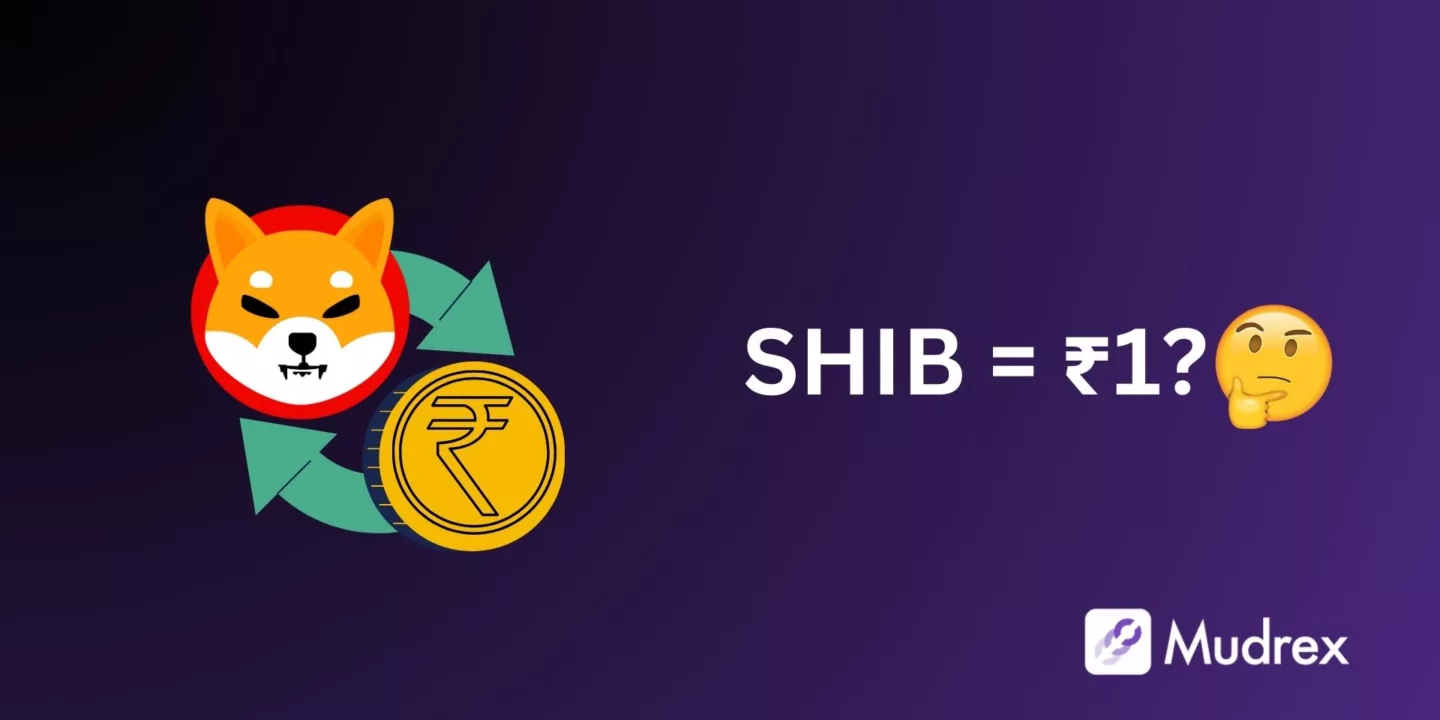

Meme coins like Shiba Inu and Dogecoin have captured attention with their viral popularity and community-driven growth. But the central question remains: can Shiba Inu, with its vast supply, ever reach ₹1? For Indian investors, ₹1 is a significant psychological and financial milestone. Given Shiba Inu’s roughly 590-trillion-token circulating supply as of August 2026, the honest answer is that this is achievable in theory but requires market-cap growth or supply burns on a scale that hasn’t happened yet, anywhere in crypto.
Note on prices: Figures in this guide use SHIB’s price, supply, and market cap as of August 25, 2026 (~$0.0000055, ~590 trillion circulating tokens, ~$3.2 billion market cap), and an approximate USD/INR rate of ₹94.5. All of these shift daily, check live SHIB prices on Mudrex before making any decision.
As of August 25, 2026, Shiba Inu trades at roughly $0.0000055 (about ₹0.00052), with a market capitalization near $3.2 billion and a circulating supply of approximately 590 trillion tokens out of a 1 quadrillion total supply. This places SHIB among the more established meme coins by market value, but its enormous token count remains the central obstacle to any high-value price target, ₹1 or otherwise.

Price is simply market cap divided by circulating supply, so the fastest way to test any target is to work out the market cap it implies at SHIB’s current 590-trillion-token supply. The table below does that for the targets Indian investors ask about most.
| Target Price | Required Market Cap | Compared To | Feasibility |
|---|---|---|---|
| $0.0001 (~1 paisa) | ~$59 billion | Close to Dogecoin’s 2021 all-time-high market cap (~$88B) | Difficult but has a real-world precedent in meme-coin history |
| $0.001 (~9.5 paisa) | ~$590 billion | About 0.4x Bitcoin’s current market cap | Mathematically large but not physically impossible over a long horizon |
| ₹1 (~$0.0106) | ~$6.24 trillion | Almost 4x Bitcoin’s entire current market cap; ~19% of gold’s total market cap | Would require SHIB alone to become one of the largest financial assets on Earth |
| $1 | ~$590 quadrillion | About 371x Bitcoin’s market cap; over 4x global GDP | Not achievable under any realistic economic scenario |
The pattern is clear: every extra digit added to SHIB’s target price multiplies the required market cap by 10x on the current supply, while the supply itself doesn’t shrink automatically. This is why ₹1 sits in fundamentally different territory from a target like $0.0001, even though both sound like “small” numbers in isolation.
Based on the market cap required (~$6.24 trillion, which no single asset except gold has ever reached), there’s no credible timeframe to attach to this target under current supply and demand conditions. A “when” answer implies the “if” is settled, and the market-cap math above shows it isn’t.
Mathematically, yes, price has no hard ceiling. Economically, it would require a market cap larger than Bitcoin’s entire current value, which would mean SHIB overtaking every other cryptocurrency and most global assets combined, a scenario with no historical precedent in any asset class.
No, not under any realistic scenario. A $1 SHIB would require a market cap exceeding total global GDP several times over, which isn’t a matter of adoption or sentiment, it’s larger than all the money the world produces in a year.
Token burns permanently remove coins from circulating supply, which lowers the market cap needed to hit any given price. The table below models how aggressive a burn campaign would need to be, on top of real market cap growth, to make ₹1 achievable.
| Supply Burned | Remaining Supply | Market Cap Needed for ₹1 |
|---|---|---|
| 50% | 295 trillion | ~$3.1 trillion |
| 90% | 59 trillion | ~$624 billion |
| 99% | 5.9 trillion | ~$62 billion (Dogecoin ATH territory) |
| 99.9% | 590 billion | ~$6.2 billion (close to SHIB’s current market cap) |
Even a 99% burn, dramatically more than anything achieved by any major token to date, still requires SHIB to reach a Dogecoin-ATH-sized market cap to hit ₹1. Only at a 99.9% burn, removing all but one in a thousand tokens currently in circulation, does the required market cap fall close to where SHIB sits today. Burns move the goalposts, but they don’t replace the need for real demand growth; both would need to happen together, and at a scale well beyond anything the project has executed so far.
Shiba Inu (SHIB) was launched in August 2020 by an anonymous developer known as Ryoshi. Inspired by Dogecoin, it positioned itself as the “Dogecoin killer.” Initially, it gained traction as a joke, but soon its popularity skyrocketed due to a dedicated community, widespread social media mentions, and its inclusion in decentralized exchanges. Shiba Inu has evolved beyond just being a meme coin with the introduction of its decentralized exchange, ShibaSwap, and its own Layer-2 network, Shibarium.
Shiba Inu’s community, known as the Shib Army, plays a crucial role in driving its market activity. The community has led numerous social media campaigns and continues to hold influence over price trends, particularly through coordinated buying efforts, memes, and celebrity endorsements. Community-driven initiatives like ShibaSwap have enhanced its utility, further bolstering its value in the eyes of investors.
Shiba Inu’s price is heavily influenced by community-driven hype and social media trends. Platforms like Twitter, Reddit, and Telegram have seen the Shib Army mobilize around the coin, driving surges in its value. Memes, celebrity endorsements, and viral campaigns play a significant role in generating speculative demand, but this volatility means price spikes are often short-lived unless backed by stronger fundamentals.
ALSO READ: What is the Shiba Inu Coin?
Shiba Inu is no longer just a speculative asset. With ShibaSwap and Shibarium, its Layer-2 scaling network, it now offers staking, liquidity provision, token swaps, and low-cost DeFi and NFT activity, adding utility beyond just trading. Increased use cases could create sustained demand, though its long-term growth still depends on how deeply integrated it becomes in mainstream finance and applications.
Shiba Inu’s token supply remains enormous, with roughly 590 trillion tokens still in circulation out of a 1 quadrillion original supply. Cumulative burns over the project’s history have removed a meaningful share of tokens from the total 1-quadrillion supply, but as the market-cap tables above show, the pace and scale of burns to date remain far short of what would be needed to meaningfully move price targets like ₹1. For burns to matter at that scale, they’d need to accelerate by orders of magnitude and sustain that pace for years.
Global crypto trends, including regulation and market cycles, have a direct effect on Shiba Inu’s price. In India, where crypto adoption continues to grow, regulatory clarity remains a key swing factor; crypto gains in India are currently taxed under the existing virtual digital asset framework, and any further regulatory shift, positive or negative, would affect meme coins like Shiba Inu more than most, given how sentiment-driven their price action is.
ALSO READ: Is Shiba Inu a Good Investment?
Shiba Inu’s massive circulating supply, still around 590 trillion tokens, is the biggest obstacle to its price reaching ₹1. As the market-cap table above shows, hitting ₹1 at the current supply would require a market capitalization larger than Bitcoin’s entire current value, a genuinely unrealistic goal given the size of the broader crypto market. Even with burn mechanisms, the scale of reduction needed is enormous, and significant, sustained supply reduction would be required for any notable structural shift in price potential.
Unlike other cryptocurrencies with established use cases or technology backing, Shiba Inu remains largely speculative. Its price has been driven by social media hype, influencer endorsements, and retail investor speculation rather than any intrinsic technological advancement. This reliance on speculation makes Shiba Inu highly volatile, with its price more prone to sharp rises and equally steep declines, limiting its long-term stability and growth prospects.
The meme coin space is saturated with competitors, including Dogecoin, Floki Inu, and others, each vying for investor attention. In addition to meme coins, Shiba Inu must also compete with established cryptocurrencies like Bitcoin and Ethereum, which offer real-world utility and greater security. The growing number of meme coins further dilutes investor interest, making it harder for Shiba Inu to stand out and sustain significant price increases.
In India, the future of cryptocurrencies remains closely tied to government regulation. Regulatory uncertainty presents an ongoing challenge, as restrictive laws could hamper growth and limit accessibility for Indian investors, who form a substantial part of Shiba Inu’s global community.
Analysts remain divided on Shiba Inu’s outlook, but most published 2026 forecasts cluster in fractions of a cent rather than anywhere near ₹1, reflecting the same supply constraint outlined above. Given the current circulating supply of roughly 590 trillion tokens, reaching ₹1 would require unprecedented market conditions, sustained large-scale demand growth combined with burns far beyond historical pace.
Comparing Shiba Inu’s price trajectory to other meme coins like Dogecoin, which has seen rapid surges and drops, shows that while short-term gains are possible, dramatic multi-year price growth isn’t typical without new demand catalysts. Shiba Inu’s 2021 rise was largely fueled by market sentiment and speculative interest, much like Dogecoin’s. Sustaining that level of interest over time has proven difficult without clearer utility or mainstream adoption.
Shiba Inu reaching ₹1 is mathematically possible but economically extreme, it would require a market cap larger than Bitcoin’s entire current value, well beyond anything meme coins, or most assets, have ever achieved. Smaller targets like $0.0001 or $0.001 sit in more plausible, though still difficult, territory. Investors should treat any of these as scenarios to understand, not predictions to bank on, and do their own research before acting.
Use Mudrex to track SHIB’s price and get tools and insights to help you make informed crypto decisions. Download the Mudrex app to buy or sell SHIB with as little as ₹500.
Mathematically possible, but it would require a market cap (~₹6.24 trillion/$6.24T) nearly four times Bitcoin’s entire current market cap. No meme coin, or almost any asset, has come close to that scale.
There’s no credible timeframe to give, since the underlying “if” isn’t settled. At current supply, the required market cap has no historical precedent to base a timeline on.
Yes, in theory, price has no hard mathematical ceiling. In practice, it would need market cap growth or supply burns on a scale that has never happened before in crypto.
Same math applies regardless of phrasing, hitting ₹1 (about $0.0106) at today’s ~590 trillion circulating supply needs a market cap around $6.24 trillion. That’s roughly 19% of gold’s entire global market cap.
SHIB’s price can rise with broader crypto market cycles, burns, or Shibarium/ecosystem growth, the same way it has in past bull runs. Whether any rise gets meaningfully closer to ₹1 depends on the scale discussed in the market-cap tables above, not on sentiment alone.
“Soon” isn’t supported by the math: the market cap needed for ₹1 is multiples of Bitcoin’s entire current value. Nothing in SHIB’s current trajectory points to that scale of change in the near term.
Shiba Inu’s future in India depends on regulatory developments and market adoption, both of which remain uncertain. Its taxation currently falls under India’s existing virtual digital asset framework.
That depends on individual risk tolerance and research, since it’s a high-risk, speculative asset without the utility backing of larger cryptocurrencies. This isn’t financial advice, consult your own judgment and, if needed, a qualified advisor.
Shiba Inu is a highly speculative, volatile asset, and none of the figures in this article, including the market-cap and burn scenarios, are predictions or guarantees. They’re illustrative calculations based on data as of August 25, 2026, meant to explain what would have to be true for each price target, not forecasts of what will happen. Please do your own research and consult a qualified financial advisor before investing, and only invest capital you can afford to lose.