
Ethereum trades near $2,600–$2,700 as of September 2026, and how to trade Ethereum futures comes down to one core idea: you’re speculating on that price, not buying the asset itself.
ETH futures let you go long or short with leverage, trade 24/7, and skip the wallet-security question entirely — but leverage cuts both ways, and this guide covers the mechanics, the risks, and a full worked example before you place a trade.

Ethereum futures are derivative contracts that let you speculate on ETH’s price without owning the underlying asset. A long position profits if ETH’s price rises; a short position profits if it falls. No wallet, no private keys, no custody decisions — just a contract tracking the price.
Most crypto exchanges, including Mudrex, offer perpetual futures rather than traditional dated contracts. Perpetuals have no expiry date, so you can hold a position indefinitely as long as your margin covers it.
Traditional futures, by contrast, settle on a fixed date and force you to roll the position forward if you want to keep it open. The CFTC’s own explainer on futures market basics covers the mechanics of dated contracts in traditional markets, if you want the fuller picture.
| Factor | Spot ETH | ETH Futures |
|---|---|---|
| Ownership | You own the ETH | No ownership, a contract |
| Leverage | None | Up to 100x |
| Profit if price falls | No, long only | Yes, via short positions |
| Liquidation risk | None | Yes, with leverage |
| Ongoing costs | One-time trading fee | Funding rate + fees |
| Best suited for | Long-term holding | Hedging, active trading |
If you already hold spot ETH and want downside protection without selling, a short futures position can hedge that exposure — a use case distinct from pure speculation.
Trading Ethereum futures on Mudrex is built for beginners, with INR margin so there’s no separate USDT conversion step. Here’s the process:
Mudrex’s own walkthrough of trading crypto futures covers the same flow with screenshots if you want a visual reference before your first trade.
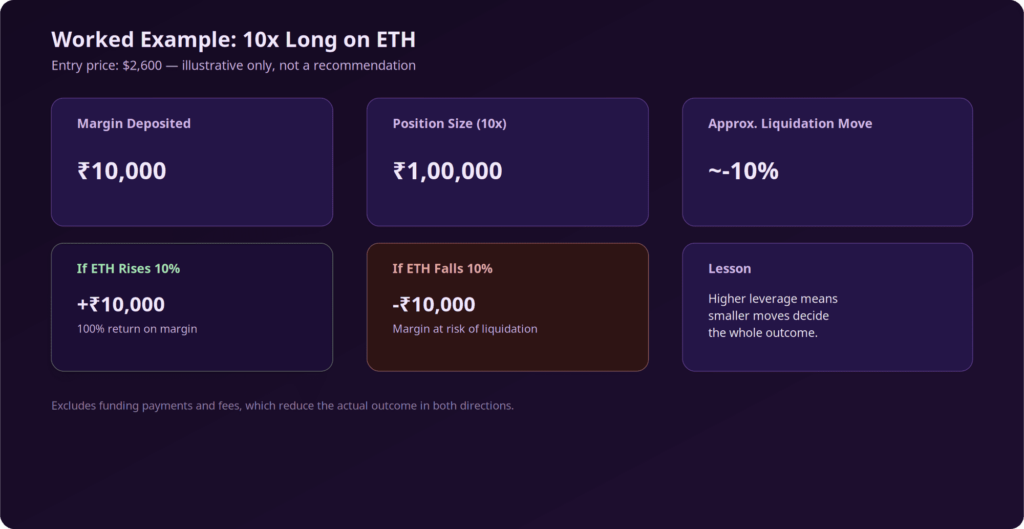
Leverage lets you control a larger position with less capital, with the exchange effectively lending you the difference. There are two margin concepts to know: initial margin, the amount needed to open a position, and maintenance margin, the minimum needed to keep it open.
If your account balance falls below the maintenance margin due to adverse price moves, the position is liquidated — closed automatically, often at a worse price than you’d have chosen yourself.
Mudrex’s guide on crypto leverage trading and its crypto liquidation strategies guide both go deeper into reading liquidation risk before it becomes a problem rather than after.
Perpetual futures have no expiry, so exchanges use a funding rate (a periodic payment exchanged between long and short position holders every few hours) to keep the contract price anchored to ETH’s actual spot price. If perpetual prices trade above spot, longs typically pay shorts; if below, shorts pay longs.
Holding a leveraged position for an extended period means funding payments accumulate, which can meaningfully erode returns even on a directionally correct trade.
Mudrex’s base futures fee sits at 0.05% for standard retail volume, falling further at higher volume tiers, with 18% GST applied on top of the trading fee itself. Funding payments themselves aren’t subject to GST or TDS.
Because Mudrex supports INR-margined futures, you avoid the forex-style spread that comes from converting rupees to USDT and back on exchanges that require stablecoin margin. Profits on futures trading are still taxed under India’s VDA rules regardless of margin currency.
Mudrex’s guide to filing crypto taxes in India covers the filing mechanics in full.
How do I trade Ethereum futures? Complete KYC on a regulated platform like Mudrex, fund your Futures wallet, select ETH/USDT futures, choose a direction and leverage level, set stop-loss and take-profit, and confirm the order.
What are Ethereum futures? Derivative contracts that let you speculate on ETH’s price without owning the asset, using leverage, with perpetual contracts using funding rates to track the spot price since they never expire.
How do I trade Ethereum as a beginner? Start with low leverage (2-5x), risk no more than 1-2% of your capital per trade, always set a stop-loss, and practice on small positions before scaling up.
What is the minimum capital needed to start? There’s no fixed minimum beyond what covers your intended margin; Mudrex supports fractional position sizing, so you can start with a small amount while you learn the mechanics.
How does leverage affect liquidation risk? Higher leverage shrinks the price move needed to wipe out your margin. At 10x, roughly a 10% adverse move can trigger liquidation; at 50x, it takes only about 2%.
What is a funding rate? A periodic payment exchanged between long and short holders on a perpetual contract, keeping its price aligned with the spot price since there’s no expiry date to force convergence.
How can I avoid liquidation in ETH futures? Use lower leverage, maintain margin well above the minimum requirement, set stop-losses before the position needs manual attention, and avoid adding to a losing position hoping for a reversal.
Ready to trade ETH futures? Trade ETH/USDT on Mudrex, an FIU-IND registered platform with INR-margined futures.
Futures trading involves substantial risk of loss due to leverage and is not suitable for all investors. This article is for educational purposes only and is not financial advice. Please assess your own risk tolerance and consult a qualified financial advisor before trading with leverage.