Best Way to Trade Bitcoin Futures: Complete 2025 Guide
Trading Bitcoin futures has evolved from a niche strategy to a mainstream financial activity. In 2025, both institutional investors and retail traders are exploring futures to hedge, speculate, and arbitrage opportunities in crypto markets.
But with leverage, funding rates, and margin mechanics, trading BTC futures can get complicated fast. This guide breaks down strategies, risks, and step-by-step processes to help you approach Bitcoin futures with confidence.
What Are Bitcoin Futures?
Bitcoin futures are contracts that let you bet on the future price of BTC. Unlike buying spot Bitcoin, you don’t own the coin itself. Instead, you trade a contract that tracks Bitcoin’s price.
The most popular type of Bitcoin futures is the perpetual futures contract (or “perp”). Unlike traditional futures (which expire monthly or quarterly), perps never expire. You can hold them as long as you want, provided you maintain a margin.
The catch? To keep the perp price close to the spot price, exchanges use something called a funding rate. Traders on one side (long or short) pay the other side a small fee every 8 hours.
Key differences vs dated futures:
No expiry: You don’t have to roll contracts.
Funding mechanism: Keeps price in line with spot.
24/7 markets: Unlike traditional commodity futures, crypto perps run nonstop.
Note that in the crypto world, “futures” almost always refers to perpetual futures contracts, i.e., they do not have an expiry date.
Directional traders: Speculating with leverage on upward or downward trends.
Hedgers: Long-term holders protecting spot BTC with short futures.
Arbitrage players: Capturing spreads between futures and spot prices.
Pros
Cons
High liquidity on major venues.
Liquidation risks from leverage misuse.
Access to leverage for capital efficiency.
Complexity of funding, margin, and slippage.
Strategies beyond simple spot trading.
Requires strict emotional discipline.
If you’re disciplined, well-capitalized, and structured, BTC futures can be a useful tool. If you struggle with FOMO, revenge trading, or over-leveraging, you may want to avoid them.
Trading perps means putting up margin (collateral) to open a leveraged position. Exchanges let you amplify exposure with leverage, but it comes with liquidation risk.
Isolated margin: Risk is limited to one position.
Cross margin: Risk is shared across your whole account.
Example:
Account balance: $1,000 USDT
Leverage: 10x
Position size: $10,000 BTC long at $60,000
If BTC rises 5% → Position value = $10,500 → Profit = $500 (50% gain on account)
If BTC falls 5% → Loss = $500 (50% of account gone)
If BTC falls further → Liquidation (account wiped).
Funding Example:
Funding rate: +0.01% per 8h
On $10,000 position, that’s $1.
Over 30 days, you’d pay ~$90 if you hold long and funding stays positive.
Fees, Funding & Hidden Costs
Trading perps isn’t free. Key costs:
Trading fees: Maker/taker, typically 0.02%-0.06% per trade.
Funding fees: Paid every 8h between longs and shorts.
Slippage: Price impact when entering or exiting with large orders.
Setup: Use the 200 EMA (Exponential Moving Average) to define trend direction. Combine with Supertrend to confirm entry.
If EMA is sloping up, look for pullbacks to buy.
If EMA is sloping down, look for rallies to sell.
Timeframe: 1h–4h is ideal, because it filters noise but still gives multiple trade setups in a week.
Example: Suppose BTC trades at $60,000 with the 200 EMA trending upward. Price dips to $59,500, aligning with Supertrend support. You enter long here, place a stop-loss at $58,800 (below the last swing low). Risk = $700. Target $61,900 → a clean 2R reward (twice your risk).
Common mistake: Many beginners enter when the price is moving sideways. Trend-following only works when a clear slope exists.
Breakout-Retest
Setup: Watch for price breaking key daily highs or lows. Confirm the breakout with a spike in open interest and volume, which shows traders are genuinely backing the move.
Entry is not at the breakout itself but on the retest of the broken level.
Example: BTC breaks above $62,000 on strong volume and open interest increase. Instead of chasing, you wait for the price to retest $61,900. That’s where you go long, keeping a tight stop just below $61,700.
Risk: False breakouts are common, especially during low-volume Asian hours. Always demand OI and volume confirmation.
Setup: Price often reverts back to its average after short-term spikes. Tools like VWAP (Volume-Weighted Average Price) with ±1-2 standard deviation bands help identify extremes.
Example: BTC jumps 3% above VWAP and reaches the +2SD band. You open a short position near that level, expecting the price to mean-revert back to VWAP. Profit is taken at VWAP, stop-loss set above +2.5SD.
Avoid: Do not attempt this strategy during strong trending days or when funding rates are extremely skewed, as price can stay overextended much longer than expected.
Basis Trade
Setup: Futures prices sometimes trade higher than spot (known as contango). Traders can capture this difference risk-free by going long spot and short futures.
Short 1 BTC in futures market. At expiry, the futures price converges with the spot at $60,000. The short position earns $2,000 while the spot BTC offsets any price move.
Net = locked-in profit of $2,000.
Note: Requires larger capital and access to both spot and futures markets. Best suited for advanced or institutional traders.
What’s the Best Timeframe to Trade Bitcoin Futures?
Scalpers (1-5m): Thrive on micro-volatility and small bursts in price. Require low fees, lightning-fast execution, and strict stop-losses.
Day traders (5-15m): Focus on capturing session highs and lows. Aim for multiple small wins within the same day without holding overnight risk.
Swing traders (1-4h): Ride bigger directional moves with fewer trades. This suits those who want a balance of patience and opportunity.
Position traders (4h-D): Hold positions for days or weeks. Futures are often used here as hedges against spot BTC holdings.
Volatility Windows (UTC):
12:00 – 16:00 UTC (London-US overlap): The busiest and most liquid time, with the strongest price swings.
01:00 – 04:00 UTC (Asia session): Liquidity is thinner, so prices can spike sharply on smaller trades.
Limit: Place orders in advance at your chosen price. Saves on fees but requires patience to get filled.
Market: Executes instantly at the best available price. Great for urgency, but costs more due to spreads and slippage.
Stop-market: Triggers an order when the price hits a level. Guarantees exist, but slippage risk is higher in fast markets.
Stop-limit: More precise, only fills within your price limits. It can fail during volatile spikes if the price skips over.
Bracket orders: Combine entry, stop-loss, and take-profit in one. Helps enforce discipline automatically.
Iceberg orders: Break a large order into smaller pieces to hide the size and avoid moving the market.
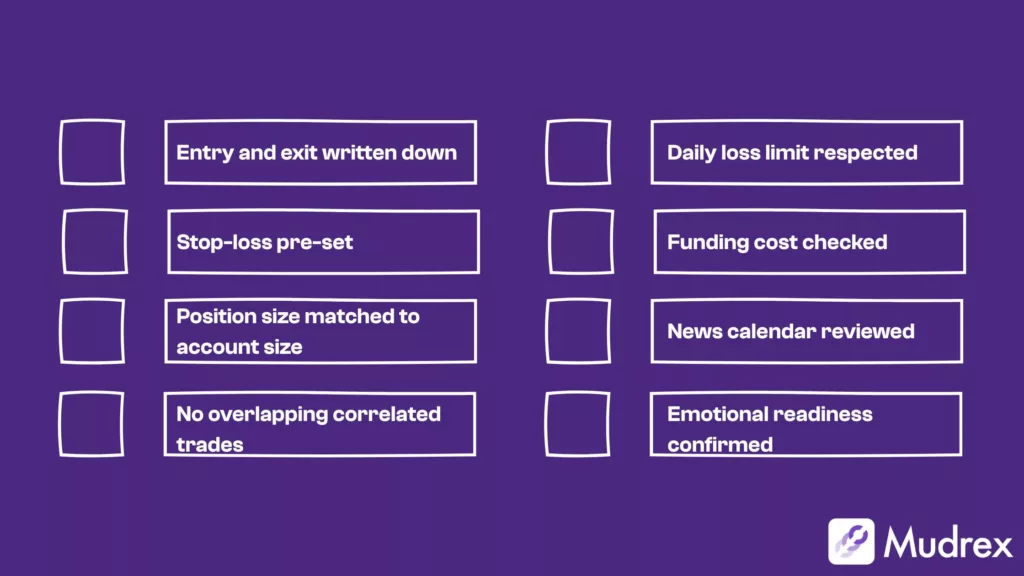
Risk Management You Cannot Skip
Every successful futures trader focuses on capital survival before profits. The goal is staying in the game long enough to compound skills and capital.
Fixed fraction rule: Only risk 0.5-1% of account equity per trade. Prevents big losses from wiping you out.
ATR-based stops: Adjust stop-loss distance based on volatility. Keeps stops from being too tight or too wide.
Max daily loss cap: Limit yourself to losing no more than -3R (3 risk units) in a day. Walk away after hitting it.
Weekend rules: Perp markets run 24/7, but liquidity thins on weekends. Reduce leverage or close risky trades to avoid surprises.
𝐑𝐈𝐒𝐊 𝐌𝐀𝐍𝐀𝐆𝐄𝐌𝐄𝐍𝐓 𝐆𝐔𝐈𝐃𝐄 𝐅𝐎𝐑 𝐁𝐄𝐆𝐈𝐍𝐍𝐄𝐑𝐒
PART 1:
I. WHAT IS RISK MANAGEMENT? II. WHY IS IT IMPORTANT? III. RISK PERCENTAGE (%) IV. Formula: Capital x Risk %
In India, crypto perpetual futures are usually treated as crypto trades rather than traditional derivatives. That means flat tax rules may apply on profits, and funding costs might also need to be declared.
Maintain records: Log every trade, funding fee, and closing PnL.
Use exchange reports: Most platforms provide downloadable histories to help at filing time.
Consult a CA: Tax rules are evolving, so always get professional guidance.
Step-by-Step: How to Place Your First BTC Futures Trade
Trading Bitcoin perpetual futures can be broken down into five clear steps:
1. Choose your platform
Pick a trusted platform like Binance, Bybit, or Mudrex.
2. Fund your margin
Deposit USDT, USDC, or BTC as collateral. Always keep more margin than the minimum required.
3. Set an order
Enter with a predefined stop-loss and take-profit to automate discipline.
4. Monitor funding
Check if you’re paying or receiving the funding rate every 8 hours, since it impacts profits.
5. Close or roll your position
Exit when your trade plan completes, or adjust if funding/skew makes holding costly.
Common Pitfalls
Real-world trading stories show how easy it is to slip. Here are common mistakes you should avoid:
Over-leveraging: Using extreme leverage (20x–50x) often results in liquidation on tiny moves.
Revenge trading: Jumping back in after a loss usually leads to bigger drawdowns.
Trading during thin liquidity: Late-night or early-morning sessions often have wider spreads and unpredictable spikes.
Ignoring funding costs: Holding a position with heavy positive funding can slowly drain your account.
No drawdown rule: Without a limit like “stop at -20% account equity,” one bad streak can wipe you out.
Comparing Platforms for Bitcoin Futures Trading
Different exchanges offer Bitcoin perpetual futures with varying levels of liquidity, costs, and user experience. Here’s a comparison relevant for Indian traders:
Exchange
Contract Size
Trading Hours
Custody Risk
KYC Required
Key Notes
Binance
0.001 BTC
24/7
Medium (custodial)
Yes
Deep liquidity, global reach, higher learning curve for beginners
Bybit
0.001 BTC
24/7
Medium (custodial)
Yes
Popular for active traders, offers advanced order types
CoinDCX
0.001 BTC
24/7
Lower (local, INR on-ramps)
Yes
Easy INR deposits and withdrawals, lighter global liquidity
Simple interface for beginners, but limited futures liquidity
Mudrex
0.001 BTC
24/7
Low (regulated structure, secure custody)
Yes
Combines easy INR access with global-grade liquidity and risk controls
Conclusion
Trading Bitcoin futures in 2025 offers unmatched flexibility for hedging, speculation, and arbitrage. But the leverage that creates opportunity also creates risk. The best way to trade isn’t a single strategy; it’s a disciplined process: choose the right product, apply risk rules, control costs, and build consistency. If you can survive the learning curve, Bitcoin futures can be a powerful part of your trading toolkit.
Want to sharpen your futures trading knowledge further? Explore Mudrex Learn for detailed guides and tutorials, and subscribe to the Mudrex YouTube channel for visual strategy breakdowns.
FAQs
1. What is the best way to trade Bitcoin futures for beginners?
The best way is to start with perpetual futures on a reputable exchange like Mudrex using low leverage (2-3x). Focus on simple strategies like trend-following or breakout setups, always set a stop-loss, and risk less than 1% of your account per trade. Beginners should avoid scalping or complex arbitrage until they have experience.
2. Is Bitcoin futures trading profitable in 2025?
It can be profitable, but only for traders with a clear plan and strict risk management. Futures amplify both gains and losses through leverage, so many beginners lose money by overtrading or chasing funding-driven trends. Profitability comes from discipline, position sizing, and trading during liquid hours, not from high-leverage bets.
3. What’s the safest timeframe to trade Bitcoin futures?
There’s no single “safest” timeframe; it depends on your goals. Scalpers use 1–5m charts but face high stress and fees. Day traders focus on 5–15 minutes for intraday swings. Swing traders prefer 1-4h charts to catch trends with fewer trades.
4. What are the biggest risks of Bitcoin futures trading?
The main risks are liquidation from high leverage, funding fees eating profits, emotional trading, and thin liquidity during off-hours. Unlike spot trading, you can lose your entire margin quickly. The best defense is conservative leverage, small position sizes, a daily loss cap, and awareness of funding skew.
Siri is a writer venturing into the exciting realms of blockchain technology, cryptocurrency, and decentralized finance (DeFi), eager to explore the transformative potential of these innovations. She brings a unique perspective that bridges traditional industries and cutting-edge technology, often infused with a touch of humor through memes. She has a rich background in real estate and interior design, having previously contributed to NoBroker, where she crafted blogs and assets on these topics.