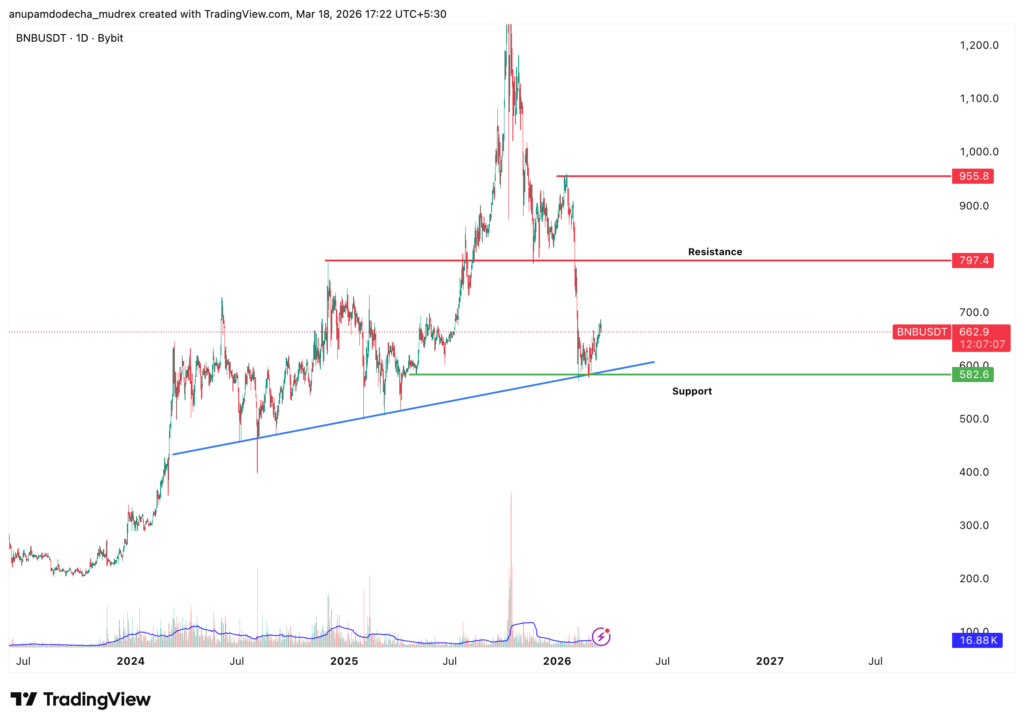
BNB is the native cryptocurrency of the BNB Chain ecosystem and plays a central role in powering one of the most prominent decentralized infrastructures in the Web3 space. On Mar 18, 2025, BNB is trading at $663.65, approximately ₹61,000.
Key levels
Total Supply: 136.35M BNB
Circulating Supply: 136.35M BNB
Max Supply: 136.35M BNB
Introduction
Launched in 2017 by Binance, BNB initially served as a utility token within the Binance exchange, offering users trading fee discounts. Over time, BNB evolved beyond just exchange use cases. It became the core asset of the BNB Chain, an ecosystem encompassing:
BNB Smart Chain (BSC) — for smart contracts and DApps
opBNB — a Layer 2 scaling solution
BNB Greenfield — for decentralized storage
BNB now supports governance rights, ecosystem growth campaigns, and serves as a strategic reserve asset within the broader Binance network.
Why is BNB Gaining Bullish Momentum?
BNB’s price action is reflecting strong fundamentals, with recent momentum attributed to:
Strong Ecosystem Activity: BNB Smart Chain remains one of the most active smart contract platforms in daily transactions and active users, rivaling Ethereum in network usage.
Adoption of opBNB and Greenfield: BNB’s role in Layer 2 scaling and decentralized storage is strengthening its long-term value, attracting developers and enterprises seeking cheaper and scalable infrastructure.
Buybacks and Burns: Binance continues quarterly BNB token burns, systematically reducing supply and potentially creating upward price pressure over time.
Cross-Chain Growth: Increased interoperability with other chains and Web3 protocols is bringing new liquidity and users into the BNB ecosystem.
Regulatory Adaptation: Despite pressure on centralized exchanges, Binance has managed to adapt by focusing on regional licenses, which indirectly supports BNB adoption.
Risks to Watch
Despite BNB’s growth, certain risks must be monitored:
Regulatory Crackdowns: Binance’s legal battles in major jurisdictions may indirectly affect investor confidence in BNB.
Centralization Concerns: BNB Chain governance is often criticized for being more centralized compared to Ethereum, raising concerns about long-term decentralization.
Competition from Other Layer 1s: Competing ecosystems like Solana, Avalanche, and newer modular blockchains may pose threats to BNB’s dominance if innovation slows.
Global enterprise integration, enhanced tokenomics
Year-by-Year Price Outlook
2026
If enterprise adoption picks up via BNB Greenfield and governance becomes more decentralized, BNB could test $950 level. Lower-end scenarios may result from continued exchange scrutiny.
2027
BNB’s integration into gaming, AI, and real-world assets (RWAs) could push prices toward $1,700, assuming Layer 2s dominate over Ethereum scaling competitors.
2028
If BNB Greenfield becomes a mainstream decentralized storage option, and BSC sees major stablecoin activity, BNB could push toward $2,000.
2029
BNB may consolidate its position as a core Web3 infrastructure asset. A price between $1,400 to $2,500 is possible depending on DeFi volume and validator decentralization.
2030
In a fully matured cycle with widespread global Web3 adoption and BNB acting as collateral or settlement layer across chains, it could hit $3,200 in a bullish scenario.
Core Growth Drivers
Token burns and deflationary pressure
Expansion of Greenfield and opBNB
Cross-chain interoperability and adoption
Massive dApp ecosystem
Global partnerships and real-world use cases
Risks to Monitor
Regulatory uncertainty
Binance-specific legal and operational issues
Dependence on Binance ecosystem activity
Competition from newer blockchain networks
Conclusion
BNB continues to be a top-tier Layer 1 asset with a strong use case beyond speculation. Its value lies in ecosystem participation, not just exchange utility.
By 2030, BNB could trade between $1,600–$3,200, assuming Binance maintains innovation pace, decentralization improves, and global adoption of decentralized infrastructure continues.
Anupam has over 3 years of experience in the crypto industry, having worked with top indian crypto exchanges. He writes about Bitcoin, altcoins, AI, and emerging tech, helping readers understand what’s driving markets and where the digital asset ecosystem is headed.