Day trading crypto means buying and selling a cryptocurrency within the same day to profit from short-term price moves, closing every position before the day ends.
It sounds simple. It isn’t. Crypto markets run 24/7 and swing harder than stocks or forex, so the same features that create opportunity also create fast, painful losses for anyone who doesn’t understand how this actually works.
This guide covers what day trading crypto really means, how it works day to day, how it’s different from day trading stocks, and the strategies, tools, and risks you need to know before you place a trade.
Key Takeaways
Day trading crypto means opening and closing every trade the same day, using short-term price moves rather than holding for months or years.
Crypto day trading differs from stock day trading mainly through 24/7 market access, no minimum-equity rule, and generally higher volatility.
Profitability varies widely: Evidence from other retail day-trading markets shows high loss rates, while reliable crypto-specific success-rate data remains limited.
A handful of strategies cover most day traders: scalping, range trading, momentum trading, breakout trading, trend following, and mean reversion.
Risk management, more than the strategy itself, is usually what separates traders who last from traders who don’t.
What Is Day Trading Crypto?
Day trading crypto is a short-term trading style where you buy and sell a cryptocurrency within the same day, aiming to profit from small price swings rather than a coin’s long-term growth.
This is different from investing, where you hold an asset for months or years hoping it appreciates over time. A day trader instead opens a position, watches it closely, and closes it before the day is out, whether it made money or not.
Day Trading Crypto: How It Works & 5 Risks
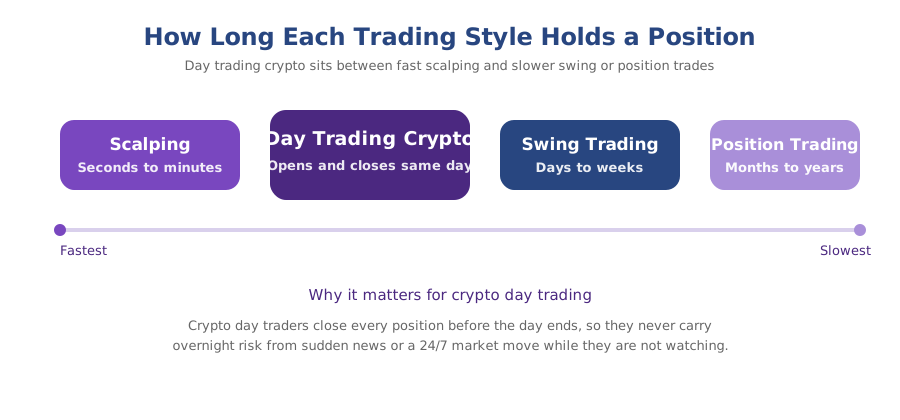
The diagram above shows where day trading sits among trading styles. Scalpers hold for seconds or minutes. Day traders hold for hours, but never overnight. Swing and position traders hold for weeks, months, or years. Because crypto has no official closing bell, traders normally define a fixed trading session—for example, 8 a.m. to 4 p.m. IST—and close positions before that session ends. The defining feature is opening and closing the position during the same planned session rather than holding it across rest periods or multiple sessions.
Definition: Volatility Volatility is how much and how fast a coin’s price moves up or down over a set period.
Crypto is generally more volatile than stocks or forex. That’s exactly why day traders are drawn to it: bigger price swings create bigger opportunities, but also bigger, faster losses if a trade goes the wrong way.
How to day trade crypto? How Does a Typical Session Work?
Crypto day trading works by watching price charts and indicators for a short-term setup, entering a trade with a planned entry, stop-loss, and take-profit level, then closing the position the same day.
Crypto intraday trading is another term for opening and closing positions within the same planned trading session.
A typical session looks like this. A trader scans a few liquid coins for a setup that matches their strategy, sets their entry price and exit levels before placing the trade, then monitors it and exits at the planned level, win or lose, rather than holding and hoping it recovers.
Definition: Liquidity Liquidity is how easily you can buy or sell a coin without moving its price much.
Liquidity matters because thin order books cause slippage, where an order fills at a worse price than expected. This is one reason most day traders stick to major coins like Bitcoin and Ethereum rather than obscure altcoins with low trading volume.
How Is Day Trading Crypto Different From Day Trading Stocks?
Day trading crypto differs from day trading stocks mainly in market hours, regulation, leverage, and volatility, even though the core idea of opening and closing trades the same day is identical.
Factor
Crypto trading
US stock trading
Market hours
Usually available 24/7, including weekends
Regular session is generally 9:30 a.m.–4:00 p.m. ET, with some extended-hours trading
Minimum-equity rule
No universal crypto-specific minimum; platform and product rules apply
The $25,000 pattern-day-trader requirement is being replaced by risk-based intraday margin standards
Settlement
Execution may be immediate, but withdrawal and final settlement vary by venue and blockchain
Most covered securities settle on T+1
Leverage
Varies by platform, jurisdiction, product and user eligibility
Depends on the broker, account and applicable margin requirements
Regulation
Varies substantially by jurisdiction and venue
Established SEC and FINRA framework
Volatility
Frequently high, particularly for smaller assets
Usually lower for large-cap equities, although individual stocks can still move sharply
FINRA’s new intraday margin standards took effect on June 4, 2026, but firms may phase them in through October 20, 2027. A broker may therefore continue using the previous requirements during its transition. Check your broker’s current policy before trading.
Two of these differences matter most when it comes to crypto day trading for beginners. Market hours mean a crypto position can move while you’re asleep, so day traders still close out before they stop watching, even though nothing forces them to. Leverage is far higher on many crypto platforms, which means a wrong move can wipe out an account much faster than the same mistake would in a stock account.
Regulation is worth a specific note if you’re trading from India. In India, crypto assets are treated as Virtual Digital Assets for tax purposes. Income from VDA transfers is generally taxed at 30% plus applicable surcharge and cess. Apart from the cost of acquisition, deductions and loss set-offs are generally not permitted, and qualifying transfers may attract 1% TDS. These rules can materially affect frequent spot trading, so check the latest official guidance and consult a qualified tax professional.
Is Day Trading Crypto Profitable and Worth It?
Day trading crypto can be profitable, but most beginners lose money before they build the skills to trade consistently. It comes down to strategy, discipline, and risk management, not luck.
Reliable crypto-specific profitability data is limited. One frequently cited study followed people trading Brazilian equity futures rather than cryptocurrency.
Among those who persisted for at least 300 trading days, 97% lost money and only 1.1% earned more than the Brazilian minimum wage. These results illustrate the difficulty of sustained short-term trading, but they should not be presented as a universal success rate for every market or crypto trader.
Trade with a written plan, not a gut feeling, for every entry and exit.
Risk a small, fixed percentage of their account on any single trade, often 1-2%.
Track every trade in a journal to spot what’s actually working.
Treat losses as a cost of doing business, not a reason to chase the market back.
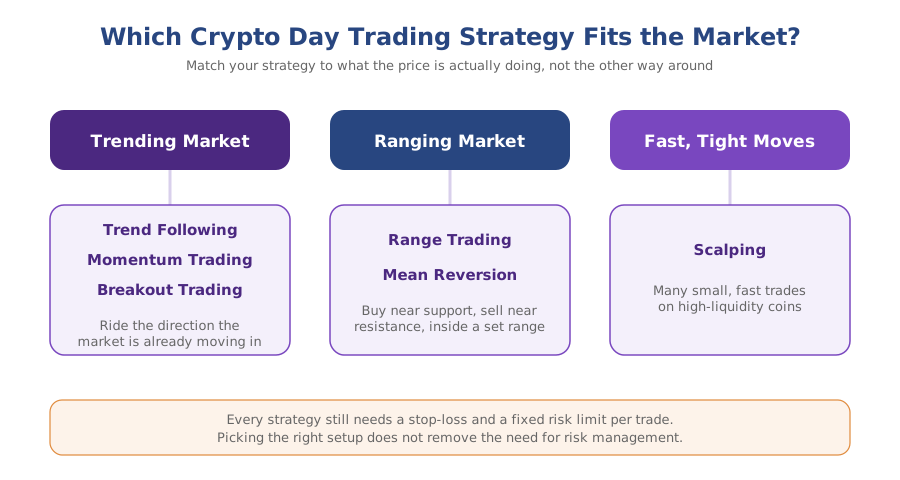
There is no single best strategy for day trading crypto. The right one depends on whether the market is trending, ranging, or moving in short, fast bursts.
Day Trading Crypto: How It Works & 5 Risks
Strategy
Best market condition
Typical hold time
Scalping
Fast, liquid, tight spreads
Seconds to minutes
Range trading
Sideways, bound by support/resistance
Minutes to hours
Momentum trading
Strong directional move, high volume
Minutes to hours
Breakout trading
Price clearing a key level with volume
Minutes to hours
Trend following
Established up or down trend
Hours
Mean reversion
Overbought/oversold inside a range
Minutes to hours
What Is Crypto Scalping?
Scalping means taking many small, fast trades to capture tiny price moves, usually holding for seconds to a few minutes. It needs tight spreads and high liquidity, since fees can quickly eat a scalp’s thin profit margin. See Mudrex’s crypto futures scalping strategies guide for beginner-friendly setups.
What Is Crypto Range Trading?
Range trading means buying near support and selling near resistance, betting that price keeps bouncing inside a set range. It works best in a sideways market, and traders often confirm the bounce with RSI or Bollinger Bands before entering.
What Is Crypto Momentum Trading?
Momentum trading means entering a coin that’s already moving strongly in one direction, often on high volume, and riding the move until it starts to fade. The goal is to capture the middle of the move, not the very start or end.
What Is Crypto Breakout Trading?
Breakout trading means entering when price pushes through a key support or resistance level on strong volume, expecting the move to continue. Volume is the key filter, since a breakout on weak volume often reverses. Take a look at our crypto breakout trading strategy guide for five specific setups.
What Is Crypto Trend Following?
Trend following means trading in the direction the market is already moving, buying in uptrends and selling in downtrends, rather than predicting a reversal. Traders typically use a moving average to define the trend and a trailing stop to let winners run. See our trend following strategy guide for the full playbook.
What Is Crypto Mean Reversion?
Mean reversion bets that an overextended price will snap back toward its average, using RSI or Bollinger Bands to spot overbought or oversold conditions. It works best inside a range and can fail badly during a strong, one-directional trend.
Which Indicators Are Commonly Used for Crypto Day Trading?
RSI, MACD, Bollinger Bands and volume are commonly used to assess momentum, trend direction, volatility and participation. None can reliably predict the next price move.
Indicator
What it measures
Common interpretation
RSI
Momentum on a 0–100 scale
Readings above 70 or below 30 can indicate stretched conditions, not an automatic reversal
MACD
Trend and momentum changes
Crossovers may support a setup but can lag price
Bollinger Bands
Volatility around a moving average
Outer-band touches show price extension, not an automatic entry
Volume
Participation behind a move
Increasing volume may strengthen breakout confirmation
No single indicator works well alone. Most traders combine two or three, using one to spot a setup and another to confirm it. For a full breakdown with examples, read our guide to technical indicators for crypto day trading.
Which Crypto Is Best for Day Trading?
The best cryptocurrencies for day trading are the ones with the highest liquidity and trading volume, since that combination keeps spreads tight and price movement predictable.
Bitcoin and Ethereum are the most common starting points for this reason. Once a trader is comfortable, some move into liquid altcoins with consistent volatility and volume. Chasing low-volume coins for “bigger moves” usually backfires, since thin order books make it harder to exit at a fair price. Take a look at our list of the best crypto for day trading for what to check before picking a coin.
What Are the Key Risks of Crypto Day Trading?
The key risks in crypto day trading are volatility, leverage, thin liquidity, emotional decision-making, and unclear regulation, and each one can turn a small mistake into a large loss.
Volatility risk. Prices can swing hard within minutes, moving a trade against you faster than in most stock markets.
Leverage risk. Borrowed funds on futures platforms magnify losses as fast as gains, and can trigger a forced liquidation that wipes out your position.
Liquidity risk. Thin order books on smaller coins cause slippage, so your order can fill at a worse price than you planned, especially in fast markets.
Emotional risk. A 24/7 market with no closing bell makes it easy to overtrade, chase losses, or abandon a plan under stress.
Regulatory risk. Rules and tax treatment for crypto are still evolving in many countries, including India, which can affect costs and what’s allowed.
How Do You Manage Risk in Crypto Day Trading?
Managing risk in crypto day trading means setting a stop-loss on every trade, risking only a small percentage of your capital per trade, and having a rule for when to stop trading for the day.
Worked example: risking 1% per trade
Account size
Risk per trade (1%)
Stop-loss distance
Position size
₹50,000
₹500
2% below entry
₹25,000
₹1,00,000
₹1,000
2% below entry
₹50,000
A stop-loss order and a stop-limit order fail differently, and mixing them up can cost you money. A stop-market order always triggers once your price is hit, but it can fill at a worse price during a fast move, a problem called slippage. A stop-limit order protects your fill price, but it can fail to execute at all if the market gaps straight past your limit.
Beyond order types, a few habits keep risk in check:
Set your exit before you enter, both the stop-loss and the take-profit.
Never risk more than 1-2% of your account on a single trade.
Avoid high leverage until you have a consistent track record without it.
Stop trading for the day after hitting a set loss limit to avoid revenge trading.
What Mistakes Should Beginners Avoid in Crypto Day Trading?
The biggest mistakes beginners make are overtrading, skipping stop-losses, and letting emotion drive decisions instead of a plan.
Overtrading because the market never closes, leading to fatigue and poor setups.
Trading without a stop-loss, which turns a small loss into a large one.
Chasing losses by increasing size to “win it back” quickly.
Ignoring fees and spread, which quietly erode profits on frequent trades.
Using high leverage early, before understanding how fast it can wipe out an account.
Conclusion
Day trading crypto is buying and selling within the same day to chase short-term price moves, and it works very differently from stock day trading once you account for 24/7 markets, higher leverage, and thinner regulation. It can be profitable, but it rewards a plan more than it rewards speed or confidence.
Yes, some traders do, but most lose money early on. Consistent profit usually comes from a tested strategy, strict risk management, and time in the market, not luck.
Can you make a living day trading crypto?
It’s possible but rare. Full-time income from day trading crypto usually takes years of experience, a proven strategy, and enough capital to make small percentage gains meaningful.
How much do crypto day traders make per day?
This varies enormously by capital, skill, and strategy. Many beginners earn just a few dollars a day if profitable at all, while experienced traders with larger accounts can earn far more, and just as easily lose it.
How much money do you need to start day trading crypto?
There’s no fixed minimum, since many exchanges allow fractional trades and crypto has no equivalent of the old $25,000 pattern day trader rule. What matters more is having enough capital that your risk per trade, often 1-2% of your account, is still a meaningful position size.
Is day trading Bitcoin profitable?
It can be, since Bitcoin’s high liquidity and steady volume make it a common choice for day traders. Profitability still depends on strategy and risk management, not the coin itself.
Should beginners try crypto day trading?
Beginners can learn it, but it’s demanding and carries a real chance of losing money early on. Starting with a demo account or small capital while learning the basics is a safer way in.
Disclaimer: Crypto day trading carries a high risk of loss. Prices can move fast and against your position within minutes. Leverage and margin can magnify both gains and losses, and you can lose more than your initial deposit when using them. The examples in this article are illustrative only and are not financial advice.
Siri is a writer venturing into the exciting realms of blockchain technology, cryptocurrency, and decentralized finance (DeFi), eager to explore the transformative potential of these innovations. She brings a unique perspective that bridges traditional industries and cutting-edge technology, often infused with a touch of humor through memes. She has a rich background in real estate and interior design, having previously contributed to NoBroker, where she crafted blogs and assets on these topics.