How to Trade a Sideways Crypto Market: The 2026 Playbook
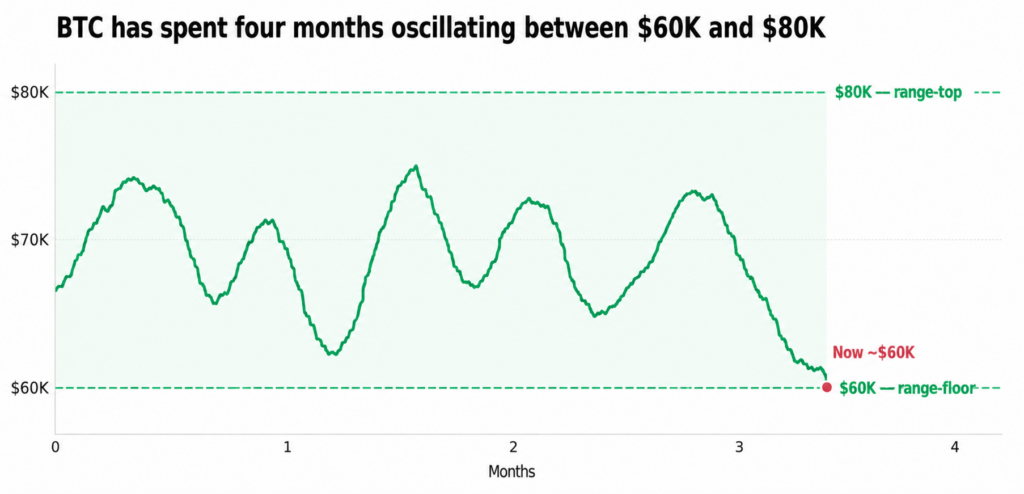
Bitcoin has been range-bound between $60K and $80K for four months, and a sideways crypto market has left most traders bored or quietly losing money. Here’s how to trade a sideways crypto market — the traps that drain accounts, and the four ways to position before the breakout.
How to Trade a Sideways Crypto Market in 2026
It’s the most frustrating phase in crypto: the sideways market. After Bitcoin’s run to its October 2025 high, price has spent the last four months oscillating between $60K and $80K, daily trading volume is down about 40% from the spring highs, and the headlines have gone quiet. The Altcoin Season Index sits at 46 of 100 — squarely in Bitcoin-season territory — and crypto’s correlation with the S&P 500 has climbed to 71%, meaning the market isn’t even moving on its own catalysts right now. Most retail traders are bored, frustrated, or slowly bleeding fees. Here’s the part nobody says out loud: a sideways crypto market is the exact regime in which the largest fortunes get quietly built.
How Do You Trade a Sideways Crypto Market?
To trade a sideways crypto market, the winning move is accumulation, not action. The strategies that work in a trend — momentum chasing, narrative rotation, breakout trading — actively lose money in a boring, choppy market. Instead, accumulate systematically (dollar-cost average), hold a cash buffer for the eventual breakout, and trade only into specific, near-term catalysts. Patience is the position.
That’s the short answer. The rest of this guide explains why the regime behaves this way, the five traps that quietly drain retail accounts during chop, what every prior cycle did next, and the four ways to position — with the detailed execution reserved for the full Mudrex Alpha report.
What a Sideways Crypto Market Actually Is
A sideways market isn’t just “nothing happening.” It has a specific signature, and recognising it matters because it changes which strategies make money. Five things show up together: range-bound price on the major assets, compressed realised volatility, neutral funding rates, high Bitcoin dominance (capital consolidating into BTC rather than rotating out into risk), and high macro correlation (the market reacting to CPI and Fed talk rather than crypto-specific news). Today’s tape checks all five boxes — the textbook definition of a sideways crypto market.
KEY INSIGHT: The market isn’t rewarding action right now — it’s rewarding patience, structure, and selective conviction. The first move is to stop trying to trade the regime you wish you were in.
Why the Market Is Stuck
Three forces are holding crypto in this range. First, post-peak digestion: after the October 2025 high, the supply bought near the top is slowly redistributing, which is exactly what produces extended consolidation. Second, institutional derisking — US spot Bitcoin ETFs posted their biggest monthly outflow of the year in May 2026, and the outflow was far larger than the modest price dip alone would suggest, meaning institutions are stepping back faster than the chart shows. Third, a catalyst vacuum: the narratives that drove the bull run are fully priced, and the next real catalysts (ETH staking decisions, more altcoin ETFs, stablecoin framework milestones) are still one to three months out. Until one fires, the macro tape dominates.
How to Trade a Sideways Crypto Market in 2026
The Traps: What Actually Hurts You in Chop
The counterintuitive thing about a sideways crypto market is that the losses are mostly self-inflicted. The chop itself doesn’t move enough to do real damage — but the behaviour it triggers does. Four of the five traps the report covers:
1. Boredom-trading — position sizes creep up to make something happen; a 2% move becomes a 5x leveraged trade. The market doesn’t move enough to reward the size, but enough to liquidate it.
2. FOMO rotation — chasing whatever pumped 20% today. In a low-volume tape, most of those are dead-cat bounces. Weeks of small losses chasing micro-pumps add up to a real drawdown.
3. Premature longs — “it can’t go lower” is the most expensive sentence in crypto. Catching a knife in a sideways-to-down regime usually means catching three more.
4. Capitulation before the break — the worst one. Regime breaks historically come right after maximum pessimism — so the trader who finally gives up tends to sell the exact bottom.
The fifth trap — the most expensive of all — is abandoning the framework entirely. We cover it, and how to inoculate against it, in the report.
What History Says About Sideways Markets
Every prior cycle had a multi-month consolidation that felt exactly like this one — 2015, 2019, 2023, and the summer of 2024 — and each preceded the strongest move of its cycle. The current sideways crypto market sits right inside that historical window.
How to Trade a Sideways Crypto Market in 2026
Two things are true at once. The pattern of multi-month sideways action preceding major moves is real and remarkably consistent — every cycle since 2015 has had a five-to-nine-month consolidation. But the magnitude of the move that follows has shrunk each cycle (roughly 50x to 7x to 4x to 2x), which is what you’d expect from a maturing asset. The lesson isn’t that a 50x is coming. It’s that waiting through this kind of regime has historically paid — and the people who waited best were the ones who kept accumulating.
Get the Full Sideways Crypto Market 2026 Analysis
This post covers the headline framework — what a sideways crypto market is & the traps. The full Mudrex Alpha report goes deeper: breaking down all five retail traps with the behaviour that triggers each, mapping the regime signals in detail, and explaining how to combine the four plays into one disciplined stance for the breakout.
What every major Bitcoin consolidation since 2015 tells us about today’s market.
How to automate a Coin Set on Mudrex and keep accumulating without timing the market.
Already an Alpha member? The full report is live on the Mudrex app now.
Disclaimer: This is for informational purposes only and is not investment advice. Cryptocurrency markets are highly volatile and futures trading involves substantial risk of loss, including loss of principal. The use of leverage can amplify both gains and losses. Historical cycle patterns and consolidation parallels are observational, not predictive, and past performance does not guarantee future results. Crypto products are unregulated in India and may be highly risky, with no regulatory recourse for any loss. Price levels, dominance figures, ETF flows, and sentiment indicators are sourced from public trackers including CoinGecko, CoinMarketCap, and ETF flow data as of June 2026 and are subject to change. Always do your own research and never invest more than you can afford to lose.
Anupam has over 3 years of experience in the crypto industry, having worked with top indian crypto exchanges. He writes about Bitcoin, altcoins, AI, and emerging tech, helping readers understand what’s driving markets and where the digital asset ecosystem is headed.