
Is crypto futures trading riskier than spot trading? In most standard comparisons, yes. Both markets expose you to volatile cryptocurrency prices, but futures add leverage, margin requirements, funding costs and forced-liquidation risk. Standard, unleveraged spot trading does not include those contract mechanics.
That does not make every futures trade worse than every spot purchase. Futures can support short positions and portfolio hedges, while spot trading provides direct asset ownership. The suitable choice depends on your objective, experience and ability to absorb loss.
This guide compares crypto futures vs spot trading risk, explains where the extra risk comes from and provides a practical checklist for choosing between them.
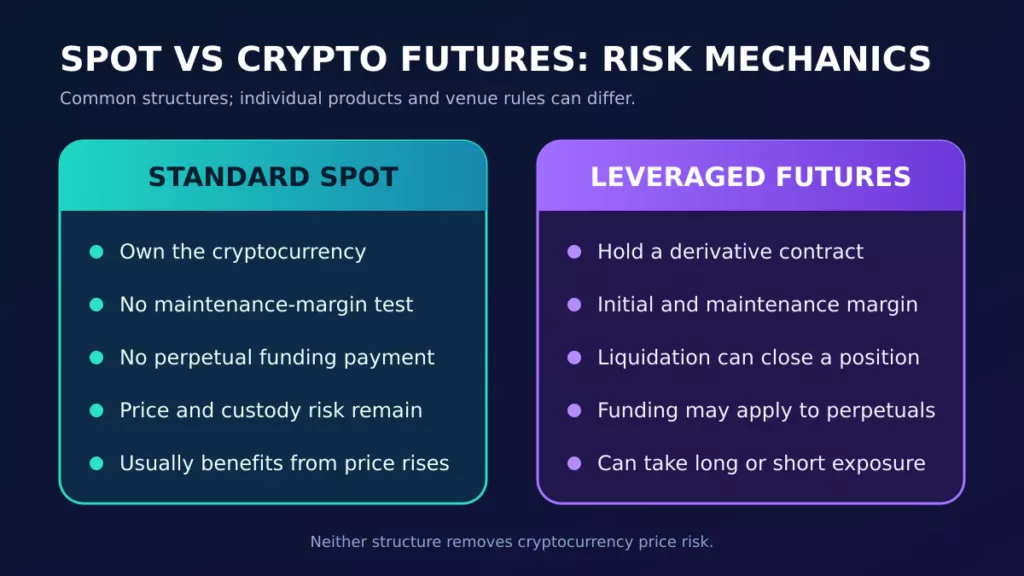
Spot and futures markets may reference the same cryptocurrency, but the legal and operational exposures differ.
In a standard spot trade, you exchange money or another asset for cryptocurrency at the current market price. The purchased asset appears in your exchange account or wallet, subject to its custody and withdrawal arrangements.
Suppose you buy ₹10,000 of Bitcoin. If Bitcoin rises by 10%, the holding becomes worth about ₹11,000 before fees and taxes. If Bitcoin falls by 10%, it becomes worth about ₹9,000. You decide when to sell; an ordinary unleveraged spot position is not automatically closed because of a maintenance-margin test.
However, “no liquidation” does not mean “no risk”. The cryptocurrency can fall sharply, liquidity can deteriorate, and custody, cybersecurity, platform and regulatory risks may affect access or value. The CFTC’s virtual-currency risk advisory discusses risks in both cash and derivatives markets.
Crypto futures trading involves a contract linked to an underlying cryptocurrency or price index. You do not ordinarily own the referenced coin merely because you hold the futures position.
Traders can go long when they expect the contract price to rise or short when they expect it to fall. They post margin as collateral and may use leverage to control a position larger than that margin. Read the Mudrex beginner checklist for crypto futures before comparing live contracts.
Perpetual futures do not have a fixed expiry. A funding mechanism helps keep their price aligned with the spot index. Dated futures expire and settle under the contract specification. Fees, settlement rules, leverage limits and margin calculations vary by product and venue.
Crypto futures generally carry a more complex risk profile because several contract mechanics act at the same time. Price direction still matters, but it is no longer the only factor that can reduce account equity.
Leverage changes exposure, not the probability that a market forecast is correct. A 5× position makes the profit or loss on the margin roughly five times the percentage move in the underlying contract, before fees and funding.
Higher leverage also leaves less room for error because the trader has posted only a fraction of the position’s notional value. The CFTC notes that leverage amplifies the underlying risk in margined virtual-currency futures.
There is no universally safe leverage ratio. Risk depends on position size, volatility, stop distance, maintenance margin, fees, funding and available collateral. A lower ratio can reduce sensitivity, but it cannot make a futures position risk-free.
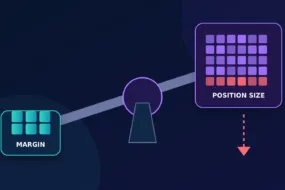
Initial margin is the collateral required to open a position. Maintenance margin is the minimum equity that must remain to keep it open. If losses and costs push equity below the required level, the venue may reduce or close the position.
Margin mode also matters. Isolated margin generally limits the collateral assigned to one position. Cross margin may use more of the eligible account balance to support positions. Exact behaviour is venue-specific, so traders should read the contract and margin rules rather than rely on a generic formula.
A spot holder can usually continue holding through a decline unless they sell or a platform event intervenes. A leveraged futures trader may lose that choice when the applicable margin threshold is breached.
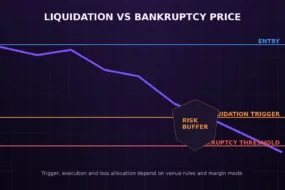
Liquidation is not the same as a planned stop-loss. A stop is an order instruction and may fill with slippage or fail in an extreme market. Liquidation is a risk-control process initiated under the venue’s rules. The Mudrex guide to crypto futures liquidation explains the relationship between margin, leverage and forced closure.
Perpetual contracts use periodic funding payments between long and short holders. When the rate is positive, longs generally pay shorts; when it is negative, shorts generally pay longs. The interval and calculation differ by venue.
Funding can be a cost or a credit, and the sign can change. It applies to notional value, so a small-looking rate can become material for a large or long-held position.
Futures make it possible to take a short position without first owning the cryptocurrency. That flexibility can support a bearish trade or a hedge, but losses increase when the contract price rises.
A crowded short can face a short squeeze, rapid mark-to-market losses and liquidation. A hedge can also be imperfect if its size, contract, expiry or reference index does not match the spot exposure. Shorting is a tool, not automatic protection.
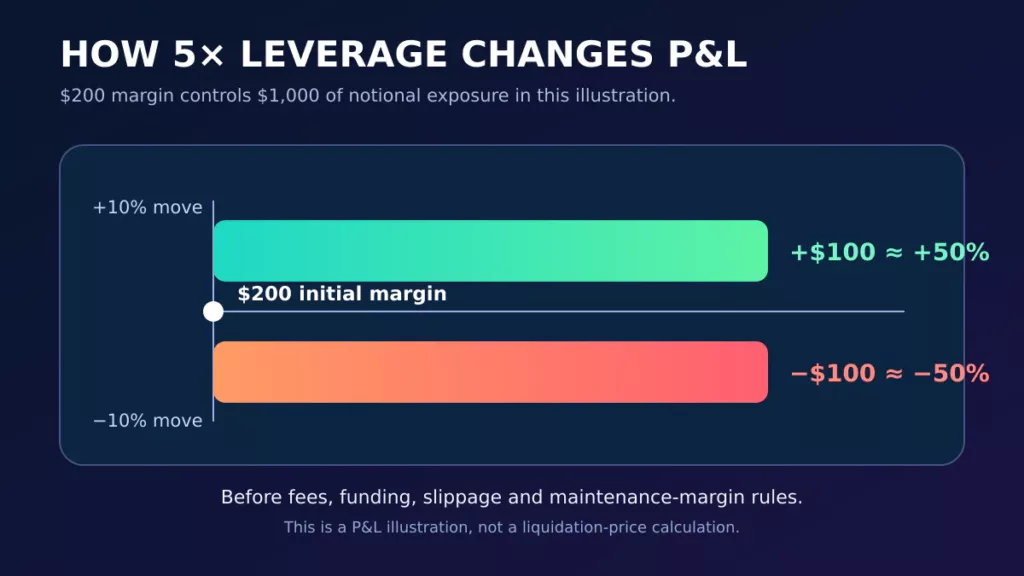
Assume Bitcoin is priced at $100,000 and a trader posts $200 of margin for a $1,000 long futures position. The notional exposure is five times the margin.
| Contract-price move | Approximate P&L | Return on $200 margin* |
|---|---|---|
| +10% | +$100 | +50% |
| -5% | -$50 | -25% |
| -10% | -$100 | -50% |
*Before trading fees, funding, slippage and other adjustments.
The same $200 used to buy unleveraged spot Bitcoin would gain or lose about $20 after a 10% move. The futures position changes by about $100 because it controls $1,000 of exposure.
This example is not a liquidation calculation. Actual liquidation can occur before the simple margin is completely exhausted because the venue also applies maintenance margin, fees and its own risk rules. Cross margin and added collateral can change the result.
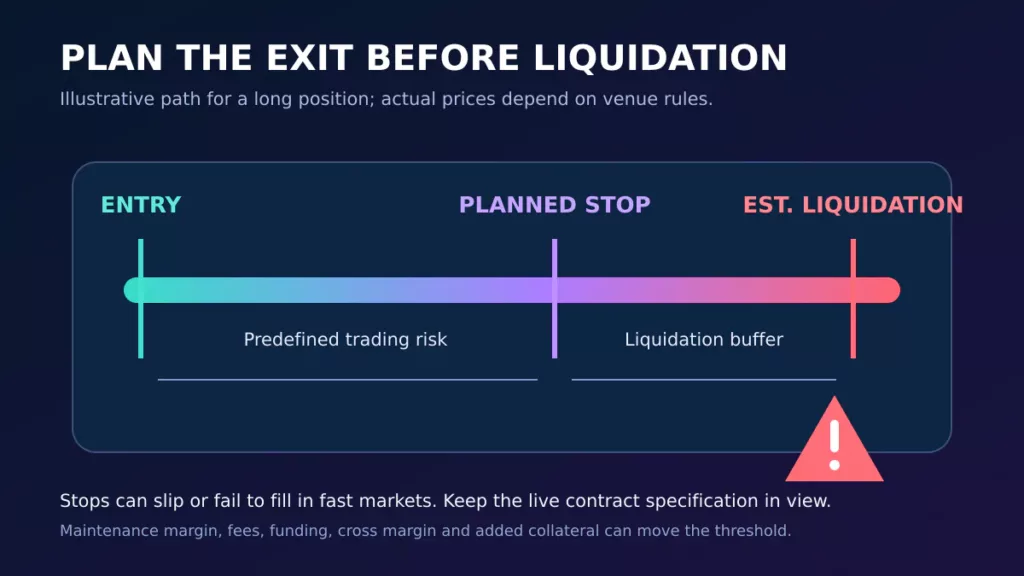
Many crypto-derivatives venues use a mark price rather than the last traded price to calculate unrealised profit and loss and test liquidation thresholds. The mark price is a reference intended to track fair value using an index and, depending on the venue, a premium or funding component.
The last price records the most recent trade and can briefly diverge from the broader market. A mark price reduces reliance on one print, but it does not prevent liquidation during a sharp market move.
Before entering a futures position, identify:
The Mudrex guide to mark price provides more context. Always use the live values and rules shown for the specific contract.
Spot trading is generally simpler than leveraged futures, but it is not automatically safe.
A cryptocurrency can lose a large share of its value, and there is no guaranteed recovery. Holding one asset or one sector creates concentration risk. Long holding periods do not eliminate weak fundamentals, token dilution or market-structure changes.
Assets held on an exchange depend on the platform’s security, operations and withdrawal processes. Self-custody transfers responsibility for keys, backups and transaction accuracy to the holder. Each method has a different failure mode.
Wide bid-ask spreads, shallow order books and sudden volatility can produce slippage. A market order can execute at several prices, while a limit order may not fill. These risks also apply to futures and can intensify during market stress.
| Feature | Standard unleveraged spot | Leveraged crypto futures |
|---|---|---|
| Exposure | Ownership of the cryptocurrency | Contract linked to a crypto price or index |
| Direction | Usually benefits from price appreciation | Can take long or short exposure |
| Leverage | None in a standard spot purchase | Often available; magnifies gains and losses |
| Margin test | None for unleveraged ownership | Initial and maintenance margin apply |
| Forced liquidation | No margin-based liquidation | Possible under the venue’s rules |
| Recurring funding | No perpetual-funding payment | May apply to perpetual futures |
| Time limit | No contract expiry | Perpetual or fixed-expiry contract |
| Main risks | Price, custody, liquidity and platform risk | All relevant market risks plus leverage, margin, liquidation and contract risk |
| Typical use | Ownership and longer-term exposure | Active directional trading or hedging |
The table describes common structures, not every product. Leveraged spot, tokenised products and venue-specific futures can behave differently.
Standard spot trading may be the clearer starting point when the goal is to own cryptocurrency, avoid leverage and learn how market orders, wallets and volatility work. It still requires a loss limit and a custody plan.
Crypto futures may fit an informed trader who needs a short position, a time-specific hedge or actively managed directional exposure. The trader must be able to monitor margin, liquidation distance, funding and execution. Read the Mudrex comparison of spot, futures and options for a broader product view.
Beginners do not become safer merely by selecting a low leverage number. They should understand the entire loss path: position size, stop distance, likely slippage, fees, funding and liquidation buffer. Paper trading can test the process, although simulated fills differ from live markets.
Risk controls can reduce avoidable loss, but none can guarantee an exit price or prevent every loss.
The Mudrex position-sizing guide offers practical sizing methods.
So, is crypto futures trading riskier than spot trading? For a standard comparison between leveraged futures and unleveraged spot, the answer is generally yes. Futures add leverage, margin, funding and forced-liquidation risk. Spot avoids those mechanics but still carries substantial price, custody, liquidity and platform risk.
Choose the instrument whose mechanics match your objective and knowledge. Before opening a futures position, review the contract specification, calculate the loss at the planned exit and check the distance between the stop and liquidation price.
Explore Mudrex Learn, watch the Mudrex YouTube channel, or download the Mudrex app to learn more and, if appropriate for your risk tolerance, trade crypto futures.
Disclaimer: Crypto futures trading involves substantial risk, including the potential loss of your entire margin. Leverage magnifies both gains and losses, and no strategy in this guide guarantees a profit or eliminates risk. All figures, percentages, and worked examples above are simplified and illustrative, meant to explain mechanics rather than reflect real market data. This article is not financial advice. Please assess your own risk tolerance and consult a qualified financial advisor before trading crypto futures with leverage.
Usually, yes. Leveraged futures add margin, liquidation, funding and contract risk to the underlying cryptocurrency’s price risk. Standard, unleveraged spot trading does not have margin-based liquidation.
Standard spot trading generally has a simpler risk profile, but “safer” does not mean safe. The asset can lose most or all of its value, and custody, liquidity and platform risks remain.
Not in a standard unleveraged spot purchase because there is no maintenance-margin requirement. Leveraged spot or margin products are different and may face forced closure.
It depends on the contract, margin mode, account structure and venue rules. Liquidation is intended to control losses, but gaps, slippage, cross-margin exposure and other mechanisms can affect additional collateral. Check the venue’s terms before trading.
No leverage ratio is universally safe. Lower leverage generally leaves more room for adverse price movement, but position size, stop distance, volatility, margin rules and available collateral determine the actual risk.
Futures can provide short exposure, capital-efficient directional trading and portfolio hedging. These uses may be valuable to an experienced trader, but they introduce costs and operational risks that need active management.
They can help a trader exit before liquidation, but they do not guarantee the fill price. A fast move, price gap, thin order book or trigger-setting mismatch can create slippage or leave the order unfilled.