
Open a leveraged crypto futures trade and you will notice something almost every exchange shows before you place your order: a liquidation price. Most beginners barely pay attention to it. That usually changes after their first liquidation. A trade starts moving against them, unrealised losses begin to grow, and suddenly the position disappears from their account. It’s frustrating, especially if the market reverses a few minutes later.
That is when the questions begin. Why was my trade closed? What is a bankruptcy price? Did I lose all my money?
These are some of the most searched questions in crypto futures trading. In addition, they are often misunderstood because liquidation price and bankruptcy price are closely related. However, they are not the same thing. Understanding liquidation vs bankruptcy price is more than learning trading terminology. It helps you understand how crypto futures exchanges manage risk, why the exchange closes positions automatically. In addition, how you can avoid seeing your own trades liquidated. If you are planning to trade with leverage, this is one of the most important concepts you will learn.
This guide explains liquidation vs bankruptcy price in crypto futures, including the role of mark price, maintenance margin, leverage, insurance funds and venue-specific risk rules.
Imagine you open a Bitcoin (BTC) futures position using 20x leverage. At first, everything looks fine. Then the market starts moving against you. As Bitcoin’s price falls, your unrealised loss increases while the margin supporting your position gradually decreases. Many traders become completely focused on one thing: hoping the market turns around before it is too late. The exchange is looking at something very different.
Instead of asking whether the price might recover, the exchange’s risk engine continuously checks whether your remaining collateral is still enough to support the position. If your losses continue growing and your available margin falls below the required level, the exchange steps in and closes the trade automatically. Traders call this process forced liquidation. For many beginners, this is where the confusion begins. They assume liquidation means their account has been completely wiped out. In reality, liquidation usually happens before that point.
Beyond your liquidation price sits another level known as the bankruptcy price. Most traders never actually see it because exchange risk engines aim to close positions before they get there.
Crypto futures trading allows traders to control larger positions using a relatively small amount of capital through leverage. While leverage can increase potential returns, it also magnifies losses. If exchanges simply allowed losing positions to remain open, traders could lose more than the collateral backing their trades. In extreme market conditions, those losses could even exceed the funds available in the account. That is why crypto futures exchanges do not wait until every dollar of your margin has disappeared.
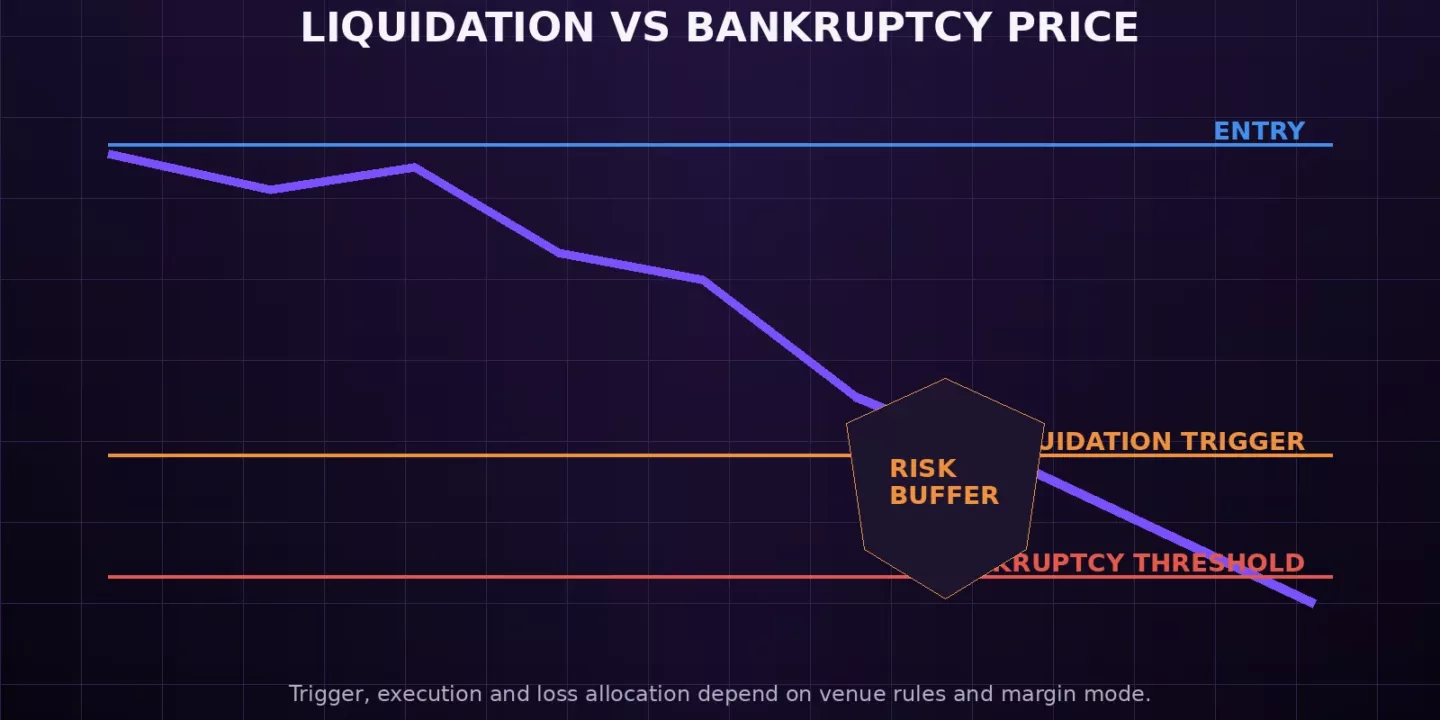
Instead, they liquidate positions earlier to prevent negative account balances and reduce the risk of bad debt entering the market. Liquidation is primarily a venue risk-control mechanism. It limits the chance that losses exceed allocated collateral, but the trader may still lose most or all margin assigned to the position. The bankruptcy price represents the point where the collateral supporting your trade has been completely exhausted. If a position remained open until that level, the exchange could be left covering the remaining loss itself. The liquidation trigger is generally set before the bankruptcy threshold, although final execution and loss allocation depend on the venue’s rules.
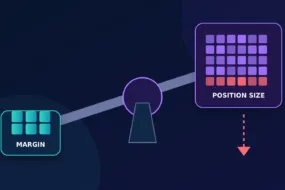
The closer your liquidation price is to your entry price, the less room your position has to survive normal market volatility. That is one reason experienced futures traders do not focus only on finding good entries. They pay equal attention to leverage, position sizing, margin. In addition, risk management, knowing these factors often determine whether a trade survives temporary price swings.
One of the easiest mistakes beginners make is treating the liquidation price as just another number on the trading screen. It is not. Long before a trade goes wrong, that number is already telling you how much room your position has to survive. Margin backs every crypto futures trade, which acts as the collateral keeping the position open. As long as enough margin remains, your trade stays active.
But the market does not always move in your favour. As losses increase, part of your margin is gradually used to cover those unrealised losses. The more the market moves against your position, the less collateral remains supporting the trade. Eventually, your remaining margin reaches the exchange’s maintenance margin requirement. At that point, keeping the position open becomes too risky. That is when the exchange steps in and closes the trade automatically.
Traders know this as forced liquidation, and traders call the triggering level the liquidation price. One detail many beginners overlook is that liquidation usually is not triggered by the last traded price on the chart. Most crypto futures exchanges use the mark price. This aims to reflect the fair market value of an asset and reduce unnecessary liquidations caused by sudden price spikes or short-lived volatility.
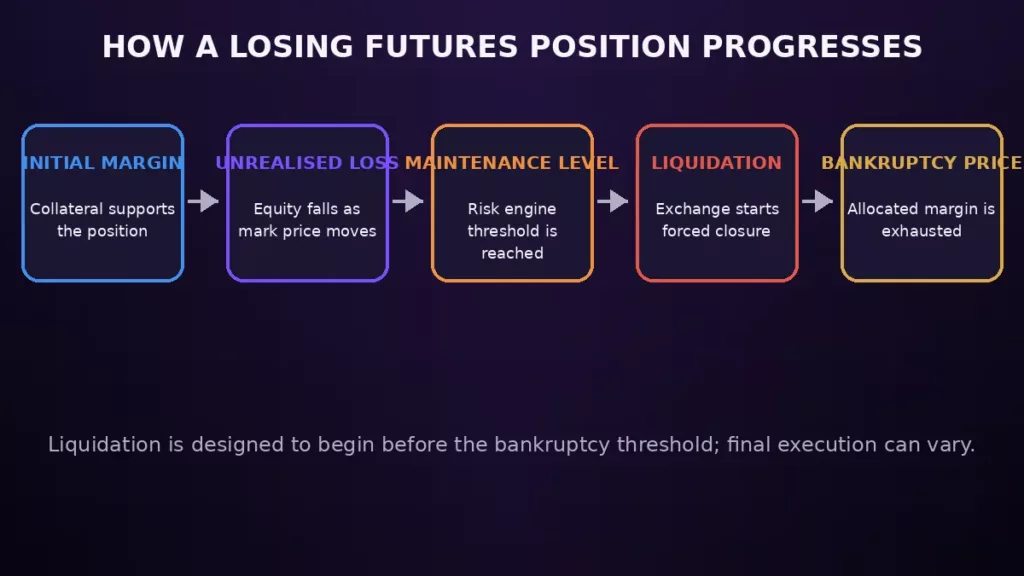
If the liquidation price is the exchange’s safety net, the bankruptcy price is the point where that safety net would no longer be enough. Imagine your losing position remained open as the market continued moving against you. Eventually, every bit of collateral backing the trade unrealised losses would consume. That is the bankruptcy price. It’s the point where your remaining margin has been completely exhausted.
Fortunately, traders almost never reach this level because exchange risk engines aim to intervene much earlier. Instead of allowing losses to consume all of your collateral, they liquidate positions before price reaches the bankruptcy threshold. In other words, the bankruptcy price exists as a risk threshold, while liquidation is the mechanism that helps prevent traders from getting there.
A common question among beginners is why exchanges do not simply wait until the bankruptcy price before closing a position. The answer lies in how markets actually behave. During major news events or periods of extreme volatility, Bitcoin (BTC) and other cryptocurrencies can move hundreds or even thousands of dollars within minutes. If an exchange waited until every losing position reached its bankruptcy price, there might not be enough time to close those trades before losses exceeded the available collateral. Liquidating positions earlier creates a safety buffer.
It helps reduce the risk of negative account balances, protects the exchange from bad debt. In addition, supports a fair and orderly market for everyone trading on the platform. Many crypto futures exchanges also maintain an insurance fund to absorb losses if the venue cannot close positions at their expected liquidation prices. In rare situations where even that is not enough, some platforms may use Auto-Deleveraging (ADL) to manage extreme market conditions.
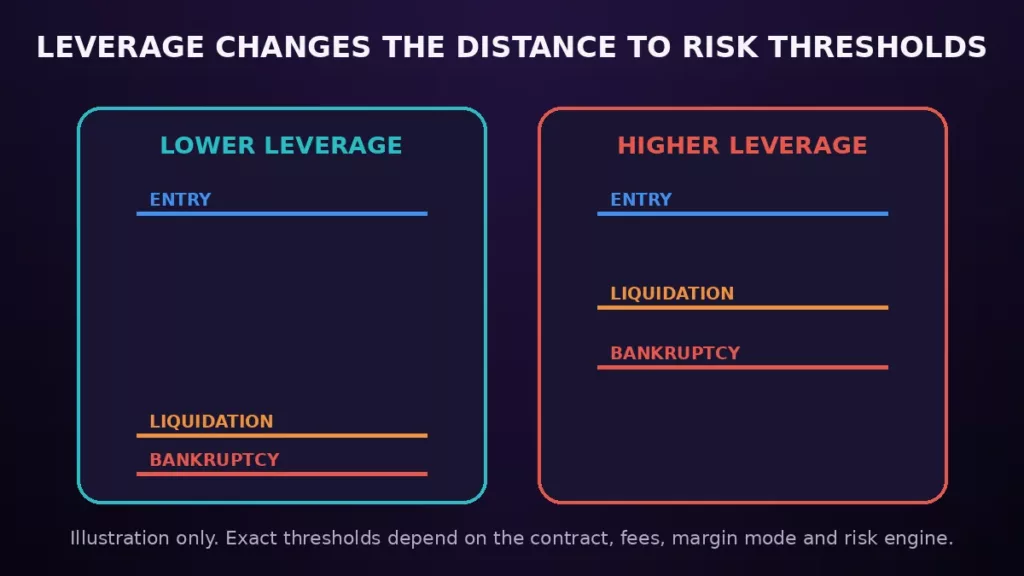
Two traders can open the exact same Bitcoin futures position at the exact same price. The only difference is the leverage they choose. One uses 5x leverage. The other uses 50x leverage.
If the market moves against both positions, the trader using 50x leverage will see a liquidation warning much sooner. The trader using 5x leverage still has room for the trade to breathe. That is the real trade-off with higher leverage. It does not just increase potential returns. It also brings your entry price, liquidation price, and bankruptcy price much closer together, leaving less room to absorb normal market volatility. That is why experienced futures traders do not choose leverage based on how much they hope to make. They choose it based on how much risk they can manage.
By now, liquidation vs bankruptcy price should be much clearer. Liquidation price and bankruptcy price are not competing concepts. They’re two different stages of a leveraged trade. The liquidation price is where the venue’s risk engine determines that maintenance requirements are no longer met. The bankruptcy price is where the margin supporting that position has been completely exhausted.
A quick comparison makes the distinction easier to understand.
| Liquidation price | Bankruptcy price |
| Risk engine begins forced closure | Allocated margin is fully exhausted |
| Generally reached first | Sits beyond the liquidation trigger |
| Linked to maintenance-margin rules | Linked to full depletion of allocated margin |
| Designed to create a risk buffer | Represents the threshold used for loss allocation |
| Commonly visible to traders | Often used internally by the venue’s risk engine |
For most futures traders, the bankruptcy price is something they’ll learn about rather than experience because exchanges are designed to liquidate positions before they ever get that far.
No strategy can eliminate the risk of liquidation completely. Markets are unpredictable, and even disciplined traders take losing positions. The goal is not to avoid losses. It’s to make sure one trade does not cause unnecessary damage to your account. One of the simplest ways to reduce liquidation risk is to use lower leverage. Higher leverage increases your exposure, but it also moves your liquidation price much closer to your entry price. Even a relatively small market move can then trigger a forced liquidation.
Position sizing matters just as much. Instead of committing most of your capital to a single trade, many disciplined traders risk only a small portion of their account on each position. This leaves more room to absorb normal market volatility without putting the entire account at risk. A stop-loss is another important layer of protection. Rather than waiting for the exchange’s risk engine to close your position, a stop-loss lets you exit the trade on your own terms and control how much you are prepared to lose.
Finally, keep an eye on your margin ratio and available collateral, especially during periods of high volatility. Strong price swings can reduce available margin much faster than many beginners expect.
Also Read : How to Avoid Liquidation in Crypto Futures
Understanding liquidation vs bankruptcy price helps leveraged traders see why a venue closes a position before allocated margin is fully exhausted.
Instead of focusing only on finding the perfect entry, you begin paying equal attention to leverage, margin, position size, and capital preservation. Those decisions often have a greater impact on long-term performance than predicting the market’s next move. The crypto market will always present another opportunity. Protecting your capital is what allows you to take it.
Continue learning on Mudrex Learn, watch the Mudrex YouTube channel, or trade crypto futures on Mudrex. Crypto derivatives carry substantial risk; use only capital you can afford to lose.
Liquidation is the automatic closure of a leveraged position when your remaining margin falls below the exchange’s maintenance margin requirement. It helps prevent losses from exceeding the collateral backing your trade and reduces risk for both traders and the exchange.
The liquidation price is the level at which an exchange is likely to close your leveraged position automatically. It depends on factors such as your entry price, leverage, margin, position size, and the exchange’s maintenance margin requirements
The bankruptcy price is the point where the collateral supporting a leveraged position has been completely exhausted. Crypto futures exchanges generally liquidate positions before they reach this level.
The liquidation price is where the exchange closes your position to limit further losses. The bankruptcy price is where all of the margin backing the position is gone. The liquidation trigger is generally reached first; execution details can vary during fast markets.
Generally, yes. Risk engines generally begin liquidation before the bankruptcy threshold to reduce the risk of negative account balances and protect the stability of the trading platform.
It depends on the exchange and market conditions. In many cases, traders lose most or all of the margin assigned to the liquidated position, but the exact outcome varies depending on how the venue executes the liquidation.
Most major crypto futures exchanges use risk engines and insurance funds to minimise the risk of traders ending up with negative balances. However, policies differ between exchanges, so it is always worth checking how your chosen platform handles liquidation.
Higher leverage moves your liquidation price closer to your entry price, meaning even a small move against your position can trigger liquidation. Lower leverage provides more room for normal market fluctuations.
Adding margin can move risk thresholds, but the effect depends on isolated or cross margin, fees, funding and the venue’s formula. This gives your trade more room to withstand adverse price movements
When all of the collateral backing a position is gone, the trade reaches its bankruptcy price. Exchanges aim to liquidate positions before this happens to prevent additional losses.
Using lower leverage, trading smaller position sizes, setting stop-loss orders, monitoring margin levels, and avoiding overleveraging can significantly reduce the risk of liquidation.
No. The liquidation price is where the exchange closes your position automatically. However, the bankruptcy price is the point where the remaining collateral has been completely exhausted.
A stop-loss may close a losing trade before forced liquidation, but trigger and fill prices are not guaranteed in a fast or thin market. This gives you greater control over your losses, helps preserve trading capital. In addition, can reduce the chances of a forced liquidation during volatile market conditions.