Why Crypto Futures Positions Can Be Liquidated Even With Stop Losses
You set a stop-loss. You did everything right. And your position still got liquidated anyway.
This isn’t a glitch. It’s how crypto futures actually work. A stop-loss is a request to sell; liquidation is the exchange’s guarantee that it will close your position no matter what, even if your stop-loss request never gets filled. When markets move fast, that gap between “asked” and “guaranteed” is exactly where traders lose their margin. Here’s why crypto futures positions can be liquidated even with stop losses in place, and what to change so it doesn’t happen to you again.
Key Takeaways
Liquidation and stop-loss are two separate systems: your stop-loss can fail while the liquidation engine still fires.
Price gaps and slippage during high volatility can skip your stop-loss trigger price entirely.
Mark Price, not Last Price, controls liquidation. A mismatch between the two is one of the most common causes of “surprise” liquidations.
High leverage shrinks your margin buffer so much that liquidation can happen before your stop-loss ever executes.
Stop-limit orders can fail to fill in fast-moving markets, leaving your position open and exposed.
What Is the Difference Between Stop Loss and Liquidation?
A stop-loss is an order you set voluntarily to exit a position; liquidation is the exchange forcibly closing it because your margin fell below the maintenance requirement. Liquidation happens automatically and overrides any pending order you have open.
Stop-Loss
Liquidation
Who triggers it
You (voluntary)
The exchange (automatic)
Price basis
Last Price or Mark Price (your choice)
Mark Price (always)
Purpose
Limit your own losses
Protect the exchange’s lent capital
Can it fail to execute?
Yes, slippage, gaps, thin liquidity
No, it forces a close regardless
A stop-loss is a request that has to find a match in the order book. Liquidation doesn’t ask; it seizes your remaining collateral the moment your margin ratio breaches the maintenance level. If you want to understand exactly how your margin ratio and liquidation price are calculated, our guide on how Mark Price works in crypto futures breaks down the mechanics, which is worth reading before you assume a stop-loss alone has you covered.
The 4 Reasons Liquidation Can Happen Despite a Stop-Loss
1. Price Gapping Triggers Your Stop-Loss Too Late
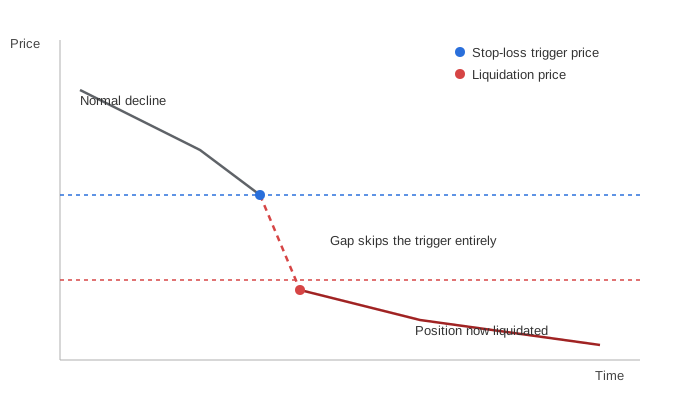
Price gapping happens when the market jumps from one price level straight to another without a single trade occurring in between, so your stop-loss still activates, just far past the price you intended it to fire at.
Definition: Price Gapping is a sudden jump in price from one level to another with no trades occurring in between, usually caused by a sharp drop in order book liquidity during high volatility.
During a flash crash, major news event, or sudden regulatory update, liquidity providers pull their orders from the book in a panic. That leaves a near-empty order book, and instead of price ticking down smoothly, it jumps. Your stop-loss (if set as a stop-market order) still activates once the price update crosses your trigger level, but by then price has already gapped well below where you meant it to fire, and it converts into a market order that has to chase whatever liquidity is left.
Worked example: You hold a long position with a stop-loss trigger at ₹95 and a liquidation price at ₹90. A flash crash hits, and price jumps straight from ₹97 to ₹91. No trades happen at ₹95 at all, so your stop-loss doesn’t activate until price is already at ₹91, just above your liquidation price, and it’s now racing to fill before liquidation does.
2. Slippage Turns a Triggered Order Into a Worse Fill
Slippage happens when your stop-loss does trigger, but the price you actually get filled at is far worse than your intended trigger price, because the order book is too thin to absorb your position size.
Definition: Slippage is the difference between the price you expected an order to fill at and the price it actually fills at, caused by insufficient buy or sell orders at your intended price.
Once a stop-market order triggers, it becomes a regular market order demanding immediate execution, at whatever price is available, not the price you set.
Worked example: Continuing from the ₹91 gap above, your market order is thrown into a chaotic, mostly empty order book. If there are no buyers at ₹91, your order walks down the book (₹90.80, then ₹90.40) hunting for a match. If it reaches ₹90 (your liquidation price) before finding a buyer, the liquidation engine fires first and seizes your remaining collateral.
3. Mark Price and Last Price Don’t Match
Liquidation always runs on Mark Price, a smoothed, cross-exchange average, while your stop-loss may be set against Last Price, the price ticking on that one exchange alone. When the two diverge, your stop-loss can miss the trigger it needs.
Definition: Mark Price is a smoothed reference price calculated from multiple exchanges, used specifically to prevent one exchange’s temporary price spike from triggering an unfair liquidation.
Mark Price exists specifically to stop one exchange’s flash crash from unfairly liquidating you. But that same design means your Last-Price-based stop-loss can simply never activate if the global Mark Price never reaches your trigger, even while your liquidation price, based on Mark Price, keeps closing in.
Worked example: A whale dump crashes the Last Price on your exchange from ₹100 to ₹88 for three seconds before snapping back, while the global Mark Price only dips to ₹98. If your stop-loss trigger was ₹93 based on Mark Price, it never activates. Mark Price never got there. But if your liquidation price was ₹90 and a later, sustained move pushes Mark Price down for real, you can get liquidated with your stop-loss still sitting unfilled.
4. Leverage and Stop-Limit Orders Leave No Room to React
High leverage shrinks the price move needed to wipe out your margin, and stop-limit orders can fail to fill entirely in a fast market. Both leave your stop-loss no time or ability to execute before liquidation does.
Definition: Stop-Limit Order is an order that only fills at your exact specified price or better. Unlike a stop-market order, it can fail to fill at all if price moves through that level too fast.
The higher your leverage, the closer your liquidation price sits to your entry. There’s simply less room for your stop-loss to act before liquidation catches up.
Separately, if you’re using a stop-limit order instead of a stop-market order, your order only fills at your exact limit price or better. In a freefall, price can blast straight through that limit, leaving your order sitting unfilled while your position drops all the way to liquidation with zero protection.
How Can You Avoid Liquidation in Crypto Futures?
You can avoid liquidation by lowering leverage, aligning your stop-loss with Mark Price, keeping distance from your liquidation price, and watching your margin ratio directly rather than relying on a stop-loss alone.
Lower your leverage. More margin buffer means more time for your stop-loss to fill before liquidation becomes a risk.
Match your stop-loss trigger to Mark Price, not Last Price, so it’s aligned with what actually drives liquidation.
Keep a safety distance. Placing your trigger too close to your liquidation price leaves almost no room for slippage.
Prefer stop-market over stop-limit orders in genuinely fast-moving markets. A worse fill still beats an unfilled order.
Watch your margin ratio directly, not just your stop-loss placement, since that’s the number liquidation actually reacts to. Our leverage guide walks through how to size a position so this stays manageable.
Conclusion
Liquidation despite a stop-loss usually comes down to one of four mechanics: a price gap, slippage, a Mark Price mismatch, or leverage/order type that left no room to react. None of these are random. They’re all things you can see coming if you’re watching the right numbers instead of just trusting the stop-loss to do its job alone.
Download the Mudrex app on Android or Apple to check your live margin ratio and liquidation price before you open your next leveraged position, or head to the Mudrex YouTube channel for walkthroughs on setting up safer leverage and stop-loss combinations.
FAQs
Why was my position liquidated despite a stop-loss?
Your position was likely liquidated because the market moved too fast for your stop-loss to fill, or because your stop-loss was set against the wrong price index relative to the Mark Price that liquidation actually uses.
Can liquidation happen before a stop loss?
Yes. Liquidation runs on Mark Price with override priority, so if your stop-loss trigger is set too close to your liquidation price or based on a different price index, liquidation can fire first.
Does a stop loss prevent liquidation?
Not always. A stop-loss reduces the risk of liquidation but doesn’t guarantee prevention. Extreme volatility, thin liquidity, or misconfigured trigger prices can still lead to liquidation.
What is the difference between stop loss and liquidation?
A stop-loss is a voluntary order you set to limit losses; liquidation is an automatic, forced closure by the exchange when your margin falls below the maintenance requirement.
How do liquidation prices work?
Your liquidation price is calculated from your leverage, position size, and maintenance margin requirement. The more leverage you use, the closer your liquidation price sits to your entry price.
Why didn’t my stop loss trigger?
Common reasons include using the wrong price index (Last Price instead of Mark Price), setting the trigger beyond your liquidation price, or the exchange rejecting the order due to insufficient margin.
Can slippage cause liquidation?
Yes. If your stop-market order fills at a worse price than expected due to thin liquidity or a volatile market, that slippage can push your position past the liquidation threshold before it fully closes.
Disclaimer: Crypto futures trading involves substantial risk, including the potential loss of your entire margin. Leverage magnifies both gains and losses. The scenarios, numbers, and price levels used in this article are simplified, illustrative examples meant to explain liquidation mechanics, not real market data, financial advice, or a guarantee of outcomes. Always assess your own risk tolerance and consult a qualified financial advisor before trading crypto futures.
Siri is a writer venturing into the exciting realms of blockchain technology, cryptocurrency, and decentralized finance (DeFi), eager to explore the transformative potential of these innovations. She brings a unique perspective that bridges traditional industries and cutting-edge technology, often infused with a touch of humor through memes. She has a rich background in real estate and interior design, having previously contributed to NoBroker, where she crafted blogs and assets on these topics.